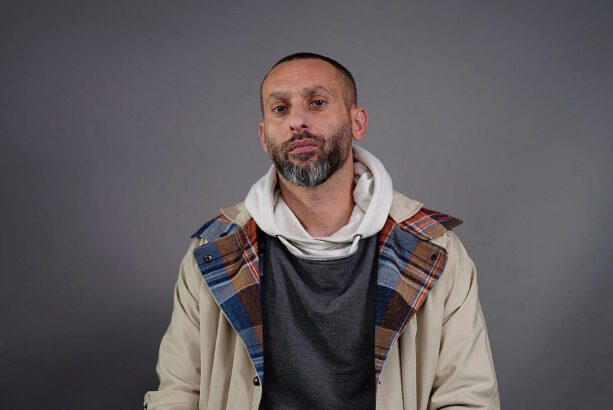
Three Palestinian creatives grapple with their responsibility to make art that meets the moment while Israeli authorities stifle free expression.
By Tamer Nafar, reposted from +972 Magazine, July 21, 2026
Sometime in the 1980s, when I was just a kid, my aunt took me to Dizengoff Center in Tel Aviv. Coming from the run-down “mixed city” of Lyd (known in Hebrew as Lod), it was the first shopping mall I had ever seen. At the entrance, before we reached the lights, the stores, the escalators, and everything else that seemed to be from another planet, my aunt bent down and told me in a loud whisper: “Don’t speak Arabic.”
She said this in Hebrew — as though the warning itself had already passed a security check.
I went inside. I did not speak. I bought a transparent pencil case filled with water and colorful paper fish that appeared to swim inside it, along with pencils and erasers that somehow looked like they had come from Tel Aviv, which at the time also seemed like another planet compared with my hometown.
We returned to Lyd. I finished school. The fish died. I survived.
I grew up. I was no longer a small child being dragged into a mall under the shadow of the sentence, “Don’t speak Arabic.” Over time, I looked that monstrous sentence in the eye, shrank it down to the size of a worm, and buried it. I did not know that one day I would take out the shovel and dig it back up — not as a corpse, but as a living creature that had only grown bigger in that dark pit.
“If Jewish kids make comments, or try to start a conversation about the situation, say: ‘I don’t know.’” That’s what I told my children the first time they left the house after October 7.
I placed that sentence before their small bodies just as my aunt had placed it before mine. Except this time, I saw it not through the eyes of a child, but through the eyes of a father. It no longer looked like a monster to me; it looked like a friend. A friend who would help us survive not only Dizengoff Center but Tel Aviv, Lyd, this whole place, and the “lords of the land” who had set their sights on Palestinians everywhere, including the 2 million of us who are citizens of Israel.

It is more complicated for my children than it was for me. I simply silenced my Arabic for an hour, returned to Lyd, and the world went back to “normal.” For them, the gap is between heaven and earth, between reality and TikTok. While I was silencing them, TikTok was shouting. Every other video they came across was Palestine: an ocean of protesters raising a flag, raising their voices, expressing solidarity. And my children — two fish in an aquarium, outside that free ocean.
As support for the Palestinian cause expanded around the world, the only thing we felt here was a tightening noose around our necks. While Western capitals were unrecognizably transformed in defense of Palestinian rights, more and more armed Israelis became afraid of the unarmed Palestinians living beside them.
As a Palestinian artist in Israel, I live inside this gap.
Since October 7, I have played almost no shows in this country. On TikTok and Instagram, I watch Palestinian artists who live abroad taking off: festivals, interviews, audiences, freedom. And I am happy for them. Truly. Perhaps that is their mission: to travel the world and shout the words that need to be heard, without anyone trying to silence them.
It seems that our mission here is different. With prominent Palestinian cultural figures being deliberately targeted by the authorities to send a message to the wider community, our mission is simply to survive this place. To survive the darkness. Not to break through, not to take off — simply not to die. To learn from that buried worm how to grow in the dark. And if I cannot make it into the light, then at least I can find friends in the darkness. Because being alone is even darker.
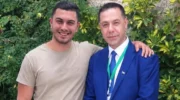
It was out of this feeling that I approached two Palestinian artists who live and create here: the musician Jowan Safadi and the actor and playwright Amer Hlehel. Each in his own way, they have begun creating quieter, barer, more intimate art over the past three years. Not because the pain is smaller, but because making noise is too dangerous right now.
‘I censor myself while I’m still thinking’
As a solo artist, Jowan Safadi has been writing and performing songs in Arabic (and occasionally in Hebrew) that challenge the oppressive status quo here for almost two decades. He launched his latest show, “Naked Songs,” earlier this year — for an audience that is not looking for regular entertainment.
“People miss this kind of gathering,” Safadi tells me, “a cultural encounter that is not exactly a performance. It has songs and it has conversation. People sit beside one another and hear something political that is not a political speech.

“We listen to songs and do not feel guilty, because these songs are with us inside the story,” he continues. “They understand us. They come from the same place we are in.”
According to Safadi, today’s audience is “sensitive, attentive, thirsty for clarity, and at the same time afraid. Afraid to come. Afraid the police will show up. Everyone is shaken, but everyone needs this. Sometimes my team and I feel that we have released them from something. People need this now more than ever, something that is more than pure entertainment.”
After October 7, Safadi began asking himself: What is the role of artists from al-dakhil, (“the interior”) — meaning Palestinians with Israeli citizenship.
“At first, even before the scale of the genocide became clear, I asked myself whether I should release songs in Hebrew. I even wrote in Hebrew. I thought my role was to tell them: ‘Wait, guys, you’re heading in the wrong direction.’ But then I understood there was no one to talk to. The demon was out of the bottle. So I told myself: I will speak to us.”
But that answer did not satisfy him either. “Who is ‘us’? People being torn to pieces? People dying? Maybe I should speak to foreigners instead?”
Eventually, in February 2024, he released the song “I Am The Semite” in English, which includes the lines “Take a look at me / You will see the Semite / You will see the refugee / Living in your ghetto / Dying to be free.”
“I barely slept because I was so afraid,” he says. “I was genuinely waiting for someone to knock on my door.”
Other political songs also remained in the drawer. “I did not have the courage to release some of them. I consulted a lawyer; he told me, ‘Before October 7, there would not have been a problem. Now, it is impossible to know.’”
Out of all these questions, he says, an answer also emerged. “I had many thoughts about our role as Palestinians living here. In the end, I realized that the role is simply to remain. To remain here and hold on in this land, because people really are emigrating. If you look at my latest album, the whole thing is essentially saying: ‘Let’s stay here. Not only physically, but mentally too.’”

I know Safadi’s songs well, along with his talent for wordplay, so I was somewhat surprised by the bluntness of the album’s title: Dam’at Al-Qahr. Dam’at means “A tear of,” but I struggle to find an exact translation for the Arabic word qahr. It is not exactly pain, but suffering that arises from oppression, injustice, and helplessness in the face of a power greater than yourself.
Like so many others, Safadi says he considered leaving. “For the first three months after October 7, I thought about emigrating. The suitcases were packed. Every time, I told my wife: ‘Yalla, maybe tomorrow. Maybe the day after tomorrow.’ But the moment we decided that we were staying, the songs began to flow as well.
“From that moment on, not only the songs, but also my conversations with people, and the posts and videos I published, all came from that state of mind: I am the Palestinian artist who received every possible sign that he should emigrate, and nevertheless chose to stay,” he continues.
According to him, the audience feels this too. “It will not change people’s decisions, and it will not change reality. But it helps people accept and live with the decision they made. That is the place from which I began performing again, on a small scale. Sharing my feelings with the audience, which are really also their feelings, because we all live through this.”
When I ask him what the role of the Palestinian artist is today, he answers in English: “To balance or to regulate.” Then he switches back to Arabic: “To regulate the feelings of our society here.” Then he adds another word: “To document.”
“I hate that word,” I tell him. “I deleted it from my vocabulary.”
I began my path as an artist in order to tell the world what was happening in my neighborhood, fueled by a certain sense of missed opportunity that there were no cameras or iPhones during the Nakba. I used to think that if only my grandfather had taken a selfie when he was expelled from Jaffa to Al-Majdal [known today as Ashkelon], and then from Al-Majdal to Lyd, the world would have witnessed the crime and justice would have been done.

Yet now, faced with the ocean of information coming out of Gaza, with hundreds of thousands of images and videos documenting the most horrific atrocities in the highest possible resolution, nothing happens.
Safadi insists. “You can see before your own eyes how history is being falsified. Right now. So you tell yourself that within this flood, the truth of your song must also enter. It has to be there.”
I press him again: “But what importance does a song have when hundreds of thousands of Gazans are documenting the crimes before our eyes, and even that disappears into the stream?”
“There is no comparison,” he answers. “There are people whose role is to document the genocide. You, as an artist, document what we feel in relation to what is happening. It is emotional documentation.”
Safadi nonetheless notes a significant change in his writing process. “In the past, I would write and then censor myself. Today, I censor myself while I am still thinking. The very act of releasing a song contains within it the awareness that I am exposing myself to arrest.”
The change is also apparent on the stage where he performs his new show. “I understood that, musically, all the excess of instruments and noise was unsuited to this period and to mourning. I wanted to synchronize with the pain and silence in which we are living.”
As I listen to him, I understand that something similar has changed in me too. I also find myself sitting more onstage, speaking more quietly, listening more closely to the audience. It has become an atmosphere much like being at home.
‘We believed in something that turned out to be a lie’
A few days later, when I arrived to see a new play by Amer Hlehel, I discovered that for him, too, the stage has become a kind of home: minimalist, almost bare.
In his new one-man show, “I Am From There,” Hlehel does not enter the stage to dramatic music or emerge from theatrical darkness. He simply opens the door. The audience waits outside, and Hlehel invites them in as though into his home. Only after everyone is seated does he begin.

Hlehel even encouraged someone whose phone rang to answer it. “It’s all right, make yourself at home.”
“It is completely connected to the genocide,” he says. “They shut our mouths, and we understood that the game we had been playing before was not real. We believed in something that turned out to be a lie. The tables have been turned — on top of our heads.”
For him, the return home is a return to the only place that remains real. “In the street and in public space, you are always pretending a little. You wear a mask to protect yourself. At home, you undress and return to being yourself.
“During COVID, we rediscovered the home, and then the genocide came and sent us back there,” he continues. “Because suddenly we understood that everything we thought we could say outside could no longer be said.”
Hlehel describes a deep crisis of trust — not only in relation to reality, but also in relation to art itself.
“We thought we could shout whatever we wanted in plays, in art, in the media. Suddenly, we discovered that our voice changes nothing. It is useless at the moment of truth. I felt that my entire life’s work had been shaken. Why am I doing this? For applause?”
That feeling also changed the way he approached the new play. “I did not want another production, another set. I did not want to be part of that game and pretend that everything was continuing as usual. I did not care whether I performed the play once and that was it. I did not ask myself how many people would come. It was a play that came from me, for me.
It was only later that he discovered that it was also for the wider Palestinian community in Israel. “We are all emotionally disordered, we have all lost our sense of belonging, and we are trying to find it again, or at least to find its starting point,” he says. “In the past, we would go to demonstrations, shout, and feel that we were part of something. When they silenced us, we felt guilty. Not only as though we had betrayed Gaza — we had betrayed ourselves.
“We stopped being who we were,” he continues. “People came to ‘I Am From There’ in order to search for themselves again.”
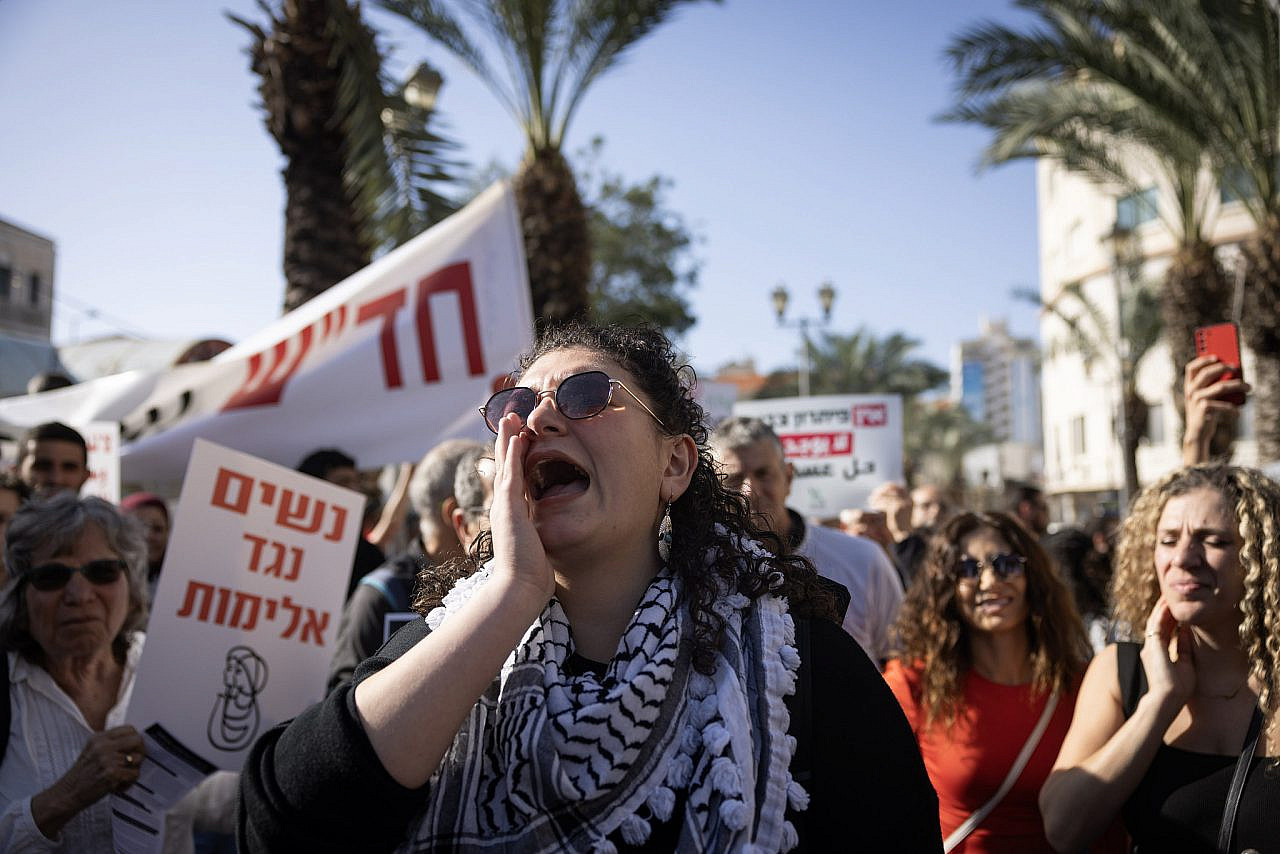
But the play was not originally created in its current form. Before the war, it was called “The Poet Says.”
“Originally, the play was built mainly around poetry,” Hlehel explains. “It included Shakespeare, sonnets, poetry in Arabic and English. The stories were there only to lead into the next poem, as a kind of connective tissue. My personal story was almost nonexistent. After the genocide, everything felt irrelevant.”
What changed, he says, was not only the text, but the point of departure.
“I felt that if I wanted to return to the stage, I had to begin with my own truth. First of all, I had to admit the minimum: I failed the test. All my life, I said that my art was connected to my people, and then there came a moment when I was unable to say what I wanted to say. If I wanted to return, I had to begin there.
“I brought the private self onto the stage because I no longer wanted to act,” he continues. “What use is a character I perform when I myself no longer believe in that character’s ability to have an impact? I wanted Amer to speak, not the actor. It was a basic need of mine.”
According to Hlehel, his personal story also acquired a different meaning. “Many times, we thought we had to show the Arab world that Israel had not penetrated us, that we were still 100 percent Palestinian. That, too, became a game I was tired of playing. I am who I am — I am from there. Just as there are Palestinians in the diaspora and in exile, in the West Bank, in Gaza, and in refugee camps, there are also 2 million Palestinians who are still here, and I am from here.
“Something about the genocide separated us from Gaza, as though these were two different stories, and I kept asking myself how to connect them again,” he says. “How to say that we are the same story, even though the horrors there are beyond anything imaginable. If I told only the story of Gaza, it would be as though I were merely expressing solidarity. Gaza is the story, but so is what my grandfather went through, what my father went through, and what I go through. It is all part of the road that brought me to where I am today.”
The moment that determined the direction of the play came when Hlehel read a poem by Refaat Alareer, the Gazan poet and lecturer who was killed in an Israeli airstrike in December 2023. The poem, “If I must die, you must live to tell my story,” became one of the most widely quoted Palestinian texts of the war after his death.

“Here is someone who is literally telling you what to do,” Hlehel explains. “He says: ‘Tell my story.’ I cannot stop a genocide, but I have spent my entire life telling stories. So why run away from that? Someone is asking you to do what you are skilled at. That is your place in the world.”
I ask Hlehel whether he censored his plays or censored his thoughts — like an internal police officer that had stripped away so much of his freedom that, by the time he sat down to write, he was already censoring himself.
“These three years were a prison,” he answers. “Suddenly, protest is no longer for the sake of a life of freedom, but against imprisonment. The standards have changed. A protest for freedom asks how to live. A protest against imprisonment asks more basic questions: When will they open the cell so that we can see a little sunlight?”
The struggle for freedom of expression and protest, Hlehel says, does not have to mean artistic suicide. “If they tell me, ‘Remove the entire section about Gaza,’ then no. I will cancel the play and cancel myself. But if there are things I can still find without endangering myself or the essence of the play, then it is my duty to find them. I am not approaching this suicidally. The idea is for the play to continue.”
Perhaps this is where the difference between entertainment and art lies. Entertainment is a privilege. Art is a need. Even in Gaza, despite everything, people continued and still continue to create art. Not because it was comfortable, but because sometimes creating is the only way to remember that we are human beings.
When I ask Hlehel how it is possible to continue making art after a genocide, he turns the question back on me. “People in Gaza continued creating art precisely under those conditions. So how am I going to say that I am not in a condition to do the same?
“We are privileged in comparison to Gaza; we are not under physical extermination as they are. We are privileged in comparison to the West Bank because some of us can still fly abroad. And Palestinian artists with foreign passports are privileged in comparison to us because they can travel the world and say aloud what we choke back in our throats. And still, we are here to tell our story and the stories of those who cannot tell theirs.”
Peeling away the layers of darkness
This article — my first attempt of its kind — grew out of the feeling that I had been left alone inside loneliness itself. After the conversations with Safadi and Hlehel, I was left even more confused. Darkness always takes the form of a black emptiness, but I felt that the present darkness was chaotic: many things, many feelings, much of the past, much of the present, and perhaps not much of a future.
The fact that I had waited three years to have a real conversation about fear and courage troubled me. A conversation with people who had been inside their own darkness, which was also mine.
After two days of blaming myself, I calmed down, because I understood that the feelings of guilt and the disconnection from others were yet another layer of this darkness. In other words, by setting out on this therapeutic journey, I had already peeled away one layer of darkness. Every period has its role, and we have a role within this period.
Perhaps this is the essence of Palestinian art here and now: not a microphone that promises to change the world, but a door that opens from the inside. Not a large stage, but a home. Not an answer, but a place where people can sit together in the darkness without pretending that they are not afraid.
And if we are destined to be fish in an aquarium while the ocean rages outside, perhaps we can at least learn to recognize one another through the glass.
Tamer Nafar is a Palestinian rapper, actor, and screenwriter from Lyd.
RELATED:
- Gaza is not an aberration – Israel planned this genocide decades ago
- We Were Ordered to Kill’: The 1967 Nakba That Israelis Don’t Know About
- ‘Help Me, the Settlers Are Coming’: Armed With Clubs, They Beat a Palestinian Father and His Boy
- Honoring Gaza’s women who refused to let the world look away
- ‘War Is a Divine Mission’: The Influential Group Seeking to Bring the Israeli Army Under Torah Law