By Hilo Glazer, reposted from Haaretz, May 8, 2026
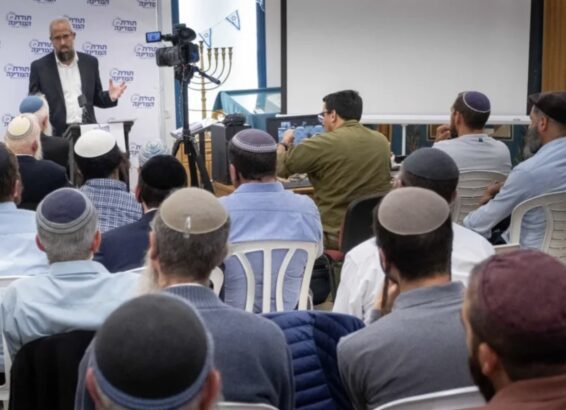
The study hall of the Torat Hamedina organization is located in the Beit Orot neighborhood on the northern ridge of the Mount of Olives in East Jerusalem. Last Monday evening, a few dozen men, most of them dressed in the Haredi-nationalist style, some of them armed, were taking their seats in the hall where a book launch was about to begin for “Mashiv Haruah” (“Restorer of the Spirit”), whose aim is to posit “a Jewish alternative to the ‘Spirit of the IDF’ document,”also known as the army’s Code of Ethics.
The stack of books for purchase and the table of refreshments (pastries, sliced vegetables, even a pot of steaming soup) created the atmosphere of a conventional literary event. However, when MK Simcha Rothman (Religious Zionism) entered and hugged the heads of the nonprofit group – its real purpose became clear: This was the kickoff of a campaign to change the Israel Defense Forces’ Code of Ethics by subordinating it to halakha, Jewish religious law.
This will apparently be achieved, above all, by doing away with the approach that perceives war as a necessary evil. “For years we have been habituated to think in terms of war being a dark task – an approach that leads directly to the ongoing attempt to restrain the fighter and to stop him, for fear of moral corruption,” the authors, Rabbi Yair Kartman and Rabbi Yaakov Yakir, wrote in an article published on the eve of the book launch. “However, the sources of the Torah teach us a different, refreshing approach. War is a commandment, it is a divine mission, it is our way to tikkun olam [repairing the world].”
Moreover, they added, “Instead of a document whose goal is to restrict the fighter, we need a motivational document, one that will remind every soldier that he is perpetuating the path of King David and of the Maccabees, and that he is fighting in the name of God and in the name of all of the People of Israel.”
Rothman, chairman of the Knesset’s Constitution, Law and Justice Committee, opened the evening. “This book frightens a lot of people, and you are to be congratulated for that,” he said, addressing his friends at the Torat Hamedina organization, with whom he has extensive connections (more on which below).
From Rothman’s point of view, by the way, the era of the Code of Ethics – a seminal document that is identified with its primary author, philosopher Prof. Asa Kasher – is over. He referred to it as “the document that was once the ‘Spirit of the IDF,'” adding that “it could be the ethical code for every army, for every country in the world.”
For them, too, he continued, “it would screw things up, for all kinds of reasons, but certainly it is not appropriate for the only Jewish state on Earth. For the only state that combines nation, land, Torah and combat that derive from a bold spirit, holiness and heroism.”
Another key figure involved in the launch, even though he wasn’t present at the event, is Meir Ben-Shabbat, a former head of the National Security Council. Rabbi Kartman, who heads Torat Hamedina along with Rabbi Yakir, told the audience that “Ben-Shabbat has been with us from the start” and was also involved in drafting the new manifesto. “He told us: ‘You can say that I am an ardent supporter of this project of changing the ‘Spirit of the IDF.'”
But with all due respect to Rothman, Ben-Shabbat and even the wife of the ultranationalist Rabbi Dov Lior – who sat in the audience as his representative, while he himself was among the project’s promoters – the real star of the evening was Rabbi Avraham Zarbiv, head of the pre-military academy in the settlement of Beit El.
Zarbiv gained fame during the war in the Gaza Strip as the reservist who operated a Caterpillar D9 machine and developed a method for razing buildings quickly and efficiently. He boasted at the time: “Tens of thousands of families don’t have paper, don’t have childhood pictures, don’t have ID cards. No home – they have nothing.”

Zarviv interspersed clips of the demolition of buildings in the Strip with religious sayings and blasts on a shofar. The man whose name became synonymous with the devastation there and was even turned into a verb – “Zarbiving Gaza” – is today revered by the right wing and received the ultimate seal of approval last month, when he was chosen to light a torch in the Independence Day eve ceremony on Mount Herzl in Jerusalem.
Introducing Zarbiv at the book event, Rothman said he was astonished that there had been a public backlash to the rabbi’s participation in that ceremony. Zarbiv, he said, “fuses Torah spirit with combat, and as such should be part of the absolute consensus,” and embodies “the greatest ideal there is: One hand holds a D9, the other holds the book [the Hebrew Bible], and together they are building the Kingdom of Israel.” He paused for a moment and then added, with a grin, “actually, destroying, in this case.” Laughter from the audience.
Zarbiv opened his speech, timed to be the high point of the evening, by citing a statistic he said he had heard from the head of the IDF’s Manpower Directorate, according to which “70 percent of reserve soldiers are from the religious Zionism movement, and another 20 percent are formerly religious.” Yet despite its overwhelming presence among the command ranks, the national-religious public had not yet actually dared to shape the IDF in its image, he said.
“We occupied ourselves with questions of kashrut, modesty and proper integration [of the genders], but we have never occupied ourselves with the morality of war,” Zarbiv said. “We left morality in the army to all kinds of wanton men. To wanton women. We let ‘them’ decide the fate of our children – and I emphasize ‘them’ because that’s how they perceive us: as the blood of the periphery, as ‘death eaters.’ We did not demand that we be the ones to control morality in the army.”
That is now over and done with, Zarbiv declared, going on to describe his role in shaping a new era: “I intend to lead it, publicly. Not long ago I told the commander of the Givati Brigade that my selfless devotion is not seen in the fact that I survived dozens of explosive devices, but that I went on to be interviewed and we succeeded in breaching the consciousness of the people of Israel, in creating a mass movement that demands victory. All the talk about ‘Zarbiving,’ and so on … To sweep up a mass movement and fire up a nation, you need edgy words.”
The jargon he brought to center stage is already being translated at the operational level, he added. “In contrast to the Gaza Strip, where there was no government decision to destroy it, in Lebanon, thank God, there is a consciousness of victory and of the burning need for victory. The enemy understands that there is a cost for provoking the Jewish people, and it’s a high cost. In Gaza, too, in the tens of years ahead, a million children in the Strip won’t have where to sleep. They will be hot and then cold, and they all want to get out of there.”
Zarbiv emphasized that in the “Spirit of the IDF” document – which he and his cohorts hope to shred – the word “victory’ is missing. “If we do not go into [battle] with a consciousness of victory, the home front will collapse. And if the home front collapses, the [war] front collapses. Without spirit it won’t work.”
Quite a few high-ranking officers share his approach, he said, criticizing them for being “chickens” because of their refusal to declare public support for his ideas. In conclusion, he called on his listeners “to embark on a confrontation” with the media. “There is a minority here with a great many microphones,” he said, referring to journalists who criticize him. “How do I know they are a minority? Because I walk around on the street. The people of Israel is with us; there’s no reason to be afraid. I pity them. Their leprosy may not be manifested in a bodily way, but it is a spiritual disease.”

Religious remake
Despite the urgency exuded by “statesmanlike” individuals (Rothman, Ben-Shabbat, Zarbiv), last week’s gathering in the small kollel (yeshiva for married men), jammed between two residential buildings and accessed via a private parking lot, might have seemed like another off-the-wall initiative from the fringes of the nationalist-ultra-Orthodox, or Hardali, stream. But that would be a mistaken impression. Torat Hamedina – whose name means both “Torah of the state,” and “doctrine of the state” – enjoys free access to government power centers and is working through the government to recast the State of Israel in the spirit of halakha.
In recent months the nonprofit group has scored a series of achievements. One was the passage of legislation, sponsored by MKs from the Haredi United Torah Judaism party, to expand the authority of rabbinical courts to adjudicate in civil matters. Aimed at creating in practice a parallel religious judiciary, the new law is stirring real concern that women will be adversely affected; some see it as a harbinger of moves to subordinate a host of civil spheres to religious law. That is indeed the case as far as Kartman is concerned.
“If the State of Israel wants to be conducted according to Torah, it should ask us, we who are sitting here, how to runt the state’s affairs. We are meant to answer them as to how to do that,” the rabbi said recently in a talk in a pre-military academy, summing up his vision. “We want the system of laws of Israel to be based on Torah,” he explained in a podcast interview several years ago. “Now, what is our role? Our role is to lure the Jewish people into understanding that this is the most proper thing for them, the truest one for them and the most appropriate for them, and that is already work of a different kind.”
Such “work of a different kind” is entrusted to the Yachin Research Center for strategic and national studies, in which Kartman, Yakir and other right-wing figures are also active. The law to expand the authority of rabbinical courts, which was approved by the Knesset in March, is based on policy papers authored by the center, which focuses “on advancing policies rooted in Jewish values and Jewish identity,” according to its English-language website.
The center is also the driving force behind a series of religiously based laws (aimed at “realization of Jewish identity in the public domain”), which are being sponsored by MK Galit Distel Atbaryan (Likud). These initiatives seek to anchor gender-segregated prayer in public places and to impose criminal sanctions on anyone who tries to prevent it; to obligate public institutions to install mezuzahs; and to obligate judges to pass tests in halakha as a condition for promotion.
Yachin has aligned itself with the “Roots” reform launched by Education Minister Yoav Kisch (Likud). Its goal is to reinforce Jewish and Zionist identity among primary and high-school students by augmenting Judaism studies, classifying Bible as a core subject and demanding that teachers to take courses on Jewish heritage-related subjects. The staff has also drafted legislation that would revise the composition of the assembly for electing rabbis, in order to block the participation of women with a Torah education in it and thereby to entrench the control of men in the Chief Rabbinate.
The bill, sponsored by Rothman, is aimed at thwarting the implementation of a High Court of Justice ruling in response to a petition by the Rackman Center for the Advancement of Women’s Status at Bar-Ilan University, according to which the chief rabbis would have to consider integrating women into their electoral body. The press reported at the time that the “Yachin Research Center has enlisted in the struggle and has drawn up position papers based on historical and cultural research. Rabbis Kartman and Yakir have showed how integration of women into this body is contrary to halakhic tradition, and they have suggested a new formulation of the law.”
Another legislative initiative by Yachin, which is being promoted in cooperation with MKs Limor Son Har-Melech (Otzma Yehudit) and Ohad Tal (Religious Zionism), aims to expand the powers of the State-Religious Education Council to enable it “to decide how to behave when a contradiction arises between different values, and to determine what the religious way of life should be in state-religious educational institutions.”
In practice, this legislation is aimed at bypassing the Pupils’ Rights Law – by determining that certain values clash with the principles of the Torah and, for example, legitimizing discrimination based on sexual orientation or gender identity. The explanatory remarks appended to the bill mention the removal of a transgender student from a school in Givat Shmuel under pressure of parents and right-wing organizations. The presence of trans students in the religious education system is liable to harm “the rights of students enrolled in it to be educated according to their worldview,” according to sponsors of the proposal.
Rabbi Dani Isaac, former head of the Beit Orot Yeshiva, also located in East Jerusalem, appeared to be astonished at Torat Hamedina’s broad range of influence. “When we established the organization, we didn’t know how far the dream would go,” he said at the event last week, adding that he would never have imagined, for instance, that “Rabbi Kobi [Yakir]” would be a regular guest at Knesset committee meetings. “But something wonderful happened here, which goes beyond the plan.”
Isaac also addressed the organization’s current incarnation. “The initial thought when we established it was to educate pupils, but it became a research institute known for its achievements and activities worldwide.” But the developments he described didn’t occur in a vacuum, rather they are subsumed within a broader strategy that has spread among the right in recent years: creation of “research institutes” as a professional cover for promoting an extreme agenda that garners very little public legitimization.
After years of activity within the framework of right-wing, religious organizations whose actual influence on the ground was limited, the Yachin center and similar facilities simply rebranded themselves as research institutes. As such, they “skip over” the public and operate directly vis-à-vis policy makers. To achieve this, they brandish professional and ostensibly neutral tools (“expert opinions,” “policy papers”). And with the aid of Yakir and Kartman’s close connections in the corridors of power, they promote issues for which, again, public support is negligible.

‘Third-class citizens’
According to Tal Hochman, executive director of the Israel Women’s Network, “the Yachin Research Center, under the guise of ‘Jewish identity,’ is working behind the scenes of the Knesset and the government to dismantle the foundations of democracy and equality. What concerns them is not the state’s identity but preserving gender roles in society. Their attempts to exclude women from centers of influence, the public domain and the IDF are part of a systematic plan to transform Israel into a halakhic state in which women are third-class citizens.”
Indeed, Torat Hamedina and Yachin are in it for the long haul. “To get to the point at which we can implement the laws of Shabbat, we need to be in a situation where it is clear to everyone that desecration of Shabbat is bad and one must be severely punished for it,” Kartman explained in a 2023 interview.
“We will get there, but it will take time,” he continued. “In the end, every regime must resort to the application of force. I want this to also be the case with respect to the method of Torah that is imbued with mercy and kindness.”
On another occasion, when asked if he advocates coercion in order to inculcate his worldview, the rabbi replied, “I will tell you what kind of coercion: moral coercion, principled coercion – coercion so that the deepest understanding of the Jewish people in the Land of Israel will be that this is the most correct and truest thing.”
The thrust to revise the IDF’s Code of Ethics dovetails with a relatively new trend, in which both groups mentioned here are extending their purview to encompass security-related issues. During the war in the Gaza Strip, Yakir and Kartman published a pamphlet titled “Release of Hostages in Wartime,” underlying their rationale, based on Jewish sources, for their opposition in principle to hostage deals.
“If someone says that ‘[return of] the hostages take precedence over victory’ – he is simply mistaken,” Yakir explained. “That is not the position of Torah. We are at war, and in war the principle is that one must triumph.”
In June 2025, the two issued a document, translated roughly as, “In the name of the brandished sword of the High Court of Justice: On the covert judicial supervision and its influence over the IDF’s security policy.” Last February it was reported that the two, who head the judicial affairs unit in the Yachin center, asked Prime Minister Benjamin Netanyahu to investigate the High Court’s conduct in connection with its role in the debacle of October 7, based on the findings of their “research” – i.e., as described in that June 2025 document.
An earlier version of it, which is no longer available on the web, has a foreword by Justice Minister Yariv Levin (Likud), which explains that the study in question “invites sincere and responsible discussion on the question of the place of the High Court of Justice vis-à-vis security issues.” Levin adds that, “the research shows how the Supreme Court, in an ostensibly covert way, abuses its role and harms the security of Israel’s citizens.”
The Yachin center is run by a public-benefit corporation called the Institute for Religious and State Identity Studies, Ltd., which was incorporated in 2022. Its annual budget of approximately 1.3 million shekels (currently about $441,000) is based entirely on donations from the Central Fund of Israel, which channels funds from American philanthropists into right-wing organizations in Israel. The facility is led by ideological right-wingers who operate within a dense network of older organizations whose aim is to bolster the status of halakha in the public and judicial spheres, and to promote a distinctly conservative line that rejects feminism and LGBTQ rights. A 2025 investigative report by Channel 13 News found that the total financial turnover of the organizations associated with Yachin stood at about 30 million shekels in the past three years.
The center’s CEO is Oren Henig, who also served as head of the Hardali organization Liba Yehudit that was founded in 2013 in order “to strengthen the Jewish identity of the State of Israel.” Liba operated as a PR arm for Rabbi Zvi Tau, the spiritual leader of the homophobic Noam party and among its other activities, is spearheading a campaign against the drafting of religious girls and amplified messages to the effect that such efforts were “part of the culture war and of the attempt to ruin [the ideal of] the family.”
Liba spokespeople also came out in defense of a rabbi who claimed that children of LGBTQ families are doomed to be miserable. One of the organization’s manifestos added that “the aggressive terrorism, accompanied by media brainwashing day and night – aimed at preparing the hearts for thinking that this is some sort of concept of ‘family’ and to turn the perverts into heroes – will not succeed.”
One member of the Liba board is Itamar Segal, who edits a Shabbat pamphlet called “Olam Katan” (Small World). In 2025 he published an op-ed calling for a boycott of the Independence Day ceremony because of the decision to have Dana International, a trans singer and 1998 Eurovision Song Contest winner, light a torch. Segal dubbed her “the symbol of trolling,” referred to her as “a male singer who decided that he is a woman,” slamming the decision as “idolatrous.”
He also asserted in his pamphlet that “all talk of weakness and bitterness, cynicism, malaise – or, worse, contempt for and lack of trust in the government and in its leader – is no less than a national crime.” He also called for persevering in the war against the Iranian regime (“The enemy is on the ropes, this is the time to break its neck”), stressing that “it is really impossible to stop until we destroy, kill and get rid of all the enemies, until their actual perdition.” Included among his targets was “the Arab enemy [that] is still in the heart of the land – in Judea and Samaria, in the Gaza Strip of course, in East Jerusalem and also in the Negev and the Galilee.”
Segal also recently offered support for the new campaign to revise the “Spirit of the IDF,” asserting: “The morality of Torah should be adopted as the official morality of the IDF.”

Not just about democracy
Among the salaried employees at the Yachin center are Rabbis Kartman and Yakir. The two worked on legislation to broaden the powers of rabbinical courts even before the center was established, in their capacity as leading figures in Torat Hamedina. Even before that, they were among the founders of the far-right Komemiyut nonprofit, which was Religious Zionism Party leader and Finance Minister Bezalel Smotrich’s stomping ground, and initiated the “march of the beasts” protest against a Gay Pride Parade in Jerusalem.
Kartman has remained consistent in his anti-LGBTQ views. In 2019 he published an article backing the decision by the Netanya Municipality not to support the city’s Pride parade. “The significance of life without norms is ruinous to human society,” he wrote. “Placing the anomalous and the different at the center of society voids society of its aspiration to progress.”
In another article that same year he defended a religious nonprofit that sought to prevent women from singing at a fundraising event, and railed against the “modern totalitarian movements” that protested against the exclusion of women.
Similar views have been put forward by his associate, Kobi Yakir. “Legitimizing LGBTQ demands is crossing a red line,” he wrote in an article. “Human agreements relating to partnership between single-sex members of a couple, which are prohibited by Torah, are not family.”
A 2023 report put out by the Yachin center mentions the name of Naama Zarbiv, as the director of a unit; in a 2025 publication she is described as “director of gender and equality” there. A founder of the anti-feminist organization Shovrot Shivyon (Breaking Equality), Zarbiv terms herself “a fighter against radical feminism” and fiercely opposes the rights of trans people.
Prominent at Yachin these days are a few women of a secular bent. One is Noga Arbel, a researcher of political strategy who serves as the center’s policy director. A former senior researcher at the conservative Kohelet Policy Forum, she is a regular guest at Knesset sessions led by Distel Atbaryan, and plays a key role in framing legislation that the MK sponsors to deepen religious influence in the public sphere in the public domain.
Arbel, also presented as a former top official in the Foreign Ministry, recently called for incarcerating Supreme Court President Isaac Amit and praised Social Equality Minister May Golan (“an amazing minister”) for her attempt to deny budgets to Arab communities, claiming that the money is actually being channeled to crime organizations.
Educational imperatives
Another prominent woman at Yachin is Tal Greenfeld, director of education. She has written articles declaring that “postmodernism and universalism” have emptied state education of its content, and frequently praises Minister Kisch’s reform program, which “is restoring Jewish identity to schools in Israel.” In an interview with the Bibi-ist Channel 14 recently, she declared that “the days when Jews need to be afraid of displaying Jewish symbols or of praying, are over.”
Greenfeld, who lives in Givatayim, also launched her public activity in the heart of the conservative right, albeit not necessarily the religious right. Among other activities, she spoke at the annual conference of the Argaman Institute, which operates under the auspices of Herut – Israel Liberty Center, and she also served as a judge in a Kohelet literary competition.
Foregrounding women of this stripe is a well-known tactic from previous incarnations of Hardali nonprofits. The same was done, for example, at the Forum of Organizations for the Family, which united right-wing groups with a fanatic religious orientation, placing a secular lawyer, Naama Sela, from Haifa, at its head. The reason: to cast a liberal light over the group and to attract support for its ideas from new publics.
Kartman himself shed light on the trend to generally downplay the religious profile: “We have another hat, called the Yachin Research Center, which translates concepts from the Torah into spoken Israeli,” he said in a recent talk.
For his part, Meir Ben-Shabbat, who heads the Misgav Institute for National Security and Zionist Strategy, affiliated with the Kohelet Policy Forum, is a member of the advisory board of Yachin and has signed off on the center’s foreword on the subject of the IDF’s Code of Ethics. In fact, in many respects the center is a Hardali version of Kohelet: Their modi operandi are similar, and so are the sources of inspiration and revenue.

However, where Kohelet has drawn on libertarian-conservative approaches imported from the United States, Yachin seeks to shape a public policy rooted in a decidedly halakhic approach. The resemblance to Kohelet has been noted by Kartman himself. “We are like a Torah-based Kohelet,” he told a publication put out by the Beit El settlement, adding that the center’s aims are “smaller than those of Kohelet, of course, but our uniqueness is that we shape policy from Torah.”
His associate, Yakir, explained their religious and regime-oriented doctrine in a speech reported last year by Channel 13 News. “There are Torah values, we must abide by them, not everything is democracy,” Yakir said, predicting that this “dream is going to be realized far more quickly than it seems to us, when we resume our spiritual independence and the law will be conducted according to Torah.”
In January 2023, immediately after the regime coup was launched, Yakir told a Knesset committee that Rothman had requested an opinion supporting the judicial reforms from Torat Hamedina. Yakir said at the time, “Torah law confers regime legitimacy only on decisions of the public. That authority cannot be subject to a normative critique from a body that is not of a religious nature.”
These rhetorical acrobatics, which derive from an internal logic that is useless to try to refute, conceal a distilled truth. The leaders of the coup, including Rothman, have claimed all along that it is aimed only to give maximum effect to the will of the people. They flatly rejected arguments that their true goal is to loosen the brakes of the judicial system in order to foment a deep change in Israeli society.
“I am not into content at all, I am into procedure,” Rothman said, feigning innocence in an Haaretz interview (February 23, 2023), in which he asserted, “I don’t see myself as an architect of social change. I am a technician, a plumber, I unclog blockages. After they are unclogged, you can take society wherever you please … I don’t have any idée fixe and I don’t think there should be one.”
These days Rothman is singing a slightly different tune. Indeed, as early in March 2025, he said at the first public conference organized by the Yachin center, in the presence of cabinet ministers and coalition MKs, that he aspires to introduce the principles of Jewish law into the Israeli judicial system: “I think that Torah has a very great deal to say about how to manage a state.”
The close connection between Rothman and the staff at Yachin merits special mention. Yakir recently termed Rothman “a good friend of mine” and incidentally noted that “he is a democrat, I am not.” For his part, Kartman thanked Rothman at last week’s gathering, calling him “a loyal partner on the path.”

Years-long ties underlie these partnerships. Together Yakir, Kartman and Rothman founded the right-wing Movement for Governability and Democracy nonprofit in 2013, which already then sought to add the weakening of the judiciary to the public agenda.
In 2019, Rothman took part in a Torat Hamedina conference titled “Restore our judges – Torah law in the State of Israel.” Then serving as legal adviser to the Movement for Governability, he delivered a speech in which he explained how discourse on liberal rights could be exploited to advance gender segregation and to neutralize legal and public opposition to it among the secular public.
In 2022, Kartman and Yakir led a campaign against Israel’s joining the Istanbul Convention, an international pact calling for the prevention of violence against women and violence in the family. The Torat Hamedina duo warned that the accord “will act to abolish classic Jewish customs and tradition that are based on gendered features and roles.”
Rothman, by then an MK on the margins of the opposition, backed his associates’ campaign. “The struggle I waged against Israel’s joining the Istanbul Convention was crowned with success,” he declared at the time. Nor did he omit putting in a good word for Torat Hamedina – “a central partner in the moves to put a halt to [Israel’s] joining the Istanbul Convention.”
Four years ago, Rothman also took part in a fundraising video on behalf of the nonprofit. Today, people affiliated with Torat Hamedina and the like-minded Yachin center have a much more extensive foothold in the government, thanks in no small measure to the lawmaker, who acts as their unofficial representative in the Knesset.
Human rights cult
The “Spirit of the IDF” was formulated in the 1990s. The chief of staff at the time, Ehud Barak, assigned the drafting of the document to a committee headed by Maj. Gen. Yoram Yair, on which the dominant member was Prof. Asa Kasher, an expert on ethics. The resulting Code of Ethics sought to enshrine moral principles that would guide the army’s activity and define its operations within a values-based framework. The idea was that the IDF would strive for operational efficiency, but at the same time would be committed to basic principles such as human dignity and loyalty to the state, and to upholding the law. From these principles emerged 10 core values, including “perseverance in the mission and the pursuit of victory,” “the critical importance of human life” and “purity of arms,” meaning use of weapons only to fulfill a mission and only when necessary.
The document is not legally binding; it serves principally as an educational-moral compass for the military, and has become a reference point for discourse relating to norms in the IDF and deviation from them. Just last month the IDF chief of staff, Eyal Zamir, decried a video showing a soldier smashing a statue of Jesus in Lebanon, and asked, “Where does this overlap with the ‘Spirit of the IDF’?”
Over the years, right-wingers have complained that the concept of “victory” has been marginalized in the document and that it lacks a call to “vanquish the enemy.” These voices have maintained that the values-based language of the “Spirit of the IDF” is too “restrictive” and weakens soldiers on the battleground.
In the year 2000, the army’s chief education officer, Elazar Stern, sought to amend the Code of Ethics and appointed a new committee, with the participation of commanders, jurists and intellectuals. The new version added the basic value of “love of the homeland” under the rubric of “patriotism and loyalty to Israel” – an addition that was ridiculed at the recent book launch. Some of the participants expressed disappointment that even Prof. Avi Sagi, a central figure on the new committee who comes from the heart of religious Zionism, made do with a bland and vague text, detached from its national contexts. “What homeland? A homeland can be of all peoples,” one of the speakers remarked, referring to the word used in Hebrew.
They also succeeded in seeing the half-empty glass in the line, in the original version, asserting that defense of the state should reflect the basic goals of a military organization in Israel as a democratic and Jewish state. “This is the only official document in which ‘democratic’ appears before ‘Jewish,'” another speaker pointed out.
They date the start of their campaign to revise the code to an interview that an Armored Corps officer gave after October 7. He related that his force had refrained from opening fire at Palestinian civilians who tried to cross the border into Israel, because they weren’t armed. For Kartman and his ilk, that testimony sums up in a nutshell the “distorted conception of morality” that they believe has taken root in the IDF.
Kartman also cited another interview, with former IDF Chief of Staff Aviv Kochavi, in which he reconstructed the 2002 battle in Jenin, in the West Bank, during Operation Defensive Shield. Kochavi noted that the unit under his command had cleared the area of militants in a house-to-house ground operation, on the day that 13 reserve soldiers were killed in an ambush. That contradicted the alternative proposed by Rabbi Kartman, who has said that it’s necessary “to flatten the whole area, to bomb it in advance.”
In general, Kartman and his associates draw a connection between the concept of morality that underlies the Code of Ethics, and military failures and even disasters. In their view, tragic events are a result of the restrictions imposed by that moral straitjacket, such as the fundamentally mistaken distinction, in their view, between combatants and noncombatants. Hence their allegation that the code prioritizes the life of the enemy over the life of IDF soldiers.
The people behind Torat Hamedina believe that the “Spirit of the IDF” is estranged from Jewish identity, as seen in the very fact that it makes no reference to basic concepts such as the People of Israel, the Land of Israel and the Torah of Israel. In their view, the IDF’s moral ID card has fallen prey to individualistic conceptions that are tainted by an alien, not to say Christian, conception of morality – one that draws its essence from the cult of human rights. They also reject the document’s prevalent use of legal language (such as the need “to incriminate” targets), which in their view is inappropriate for a war situation. Moreover, they reject the perception that war is just a matter of necessity.
“Wars are the onset of redemption,” the chief rabbi of the settlement of Psagot, Shlomo Weitzen, stated at the book event. “Wars are part of our dream. Accordingly, when a war comes to us, we do not detest it. War comes because we need to grow, to progress, to rise. It’s not that we have no choice. It’s part of the code of our redemption.”
Hence also the importance the Torat Hamedina organization accrues to the IDF fallen. According to Weitzen, “These special souls are the diamond of the war, and the Holy One, blessed be He, chooses them to surrender their soul.” It follows, he avers, that their death “should cause the uplifting of life. Our war in Israel is not a defensive war, but a war of transcendence.”
That view was echoed by Yakir, who seeks to turn “the values-based gaze into practical instructions.” He explained that “the notion of pikuah nefesh [the principle that saving a life overrides virtually all other precepts] does not exist in war, because in war we are all welded to our public identity.” Accordingly, there is no real difference between a soldier who fell in battle and a civilian who was murdered in a terrorist attack. Both are “the individuals who rise up, transcend and give their life in actuality, and we see them as organs. Each of us is an organ of the Israeli nation, across the generations. And it is a well-known rule that one can endanger an organ in order to save the soul.”

Purity and modesty
Yagil Levy, who heads the Open University’s Institute for the Study of Civil-Military Relations, explains that since the disengagement from Gaza in 2005, the Hardali community has sought to wield influence over the IDF by increasing its presence in the combat units and at the command level, and by promoting a conception that emphasizes victory over abiding by moral and legal restrictions.
Parallel long-term processes, he said, have also strengthened another group he calls “blue-collar fighters” – those filling frontline roles in the ground forces, with a prominent presence of “Mizrahi soldiers from the middle class and below.” During the war members of this cohort have also boasted about their use of unrestrained violence. “The two groups are promoting an agenda of changing the identity of the army, so that it will be very difference from what was shaped by the secular elites,” Prof. Levy says. “The organized Hardali group also relies on the unorganized blue-collar group in order to coerce change.”
Under these circumstances, Levy continues, “one of the bastions that hasn’t yet crumbled is the ‘Spirit of the IDF’ document. It is a remnant of the power of the liberal, secular elites in an era in which the Education Corps had not yet fallen. Torat Hamedina is the external instrument of expression of the field rabbis in the reserves – a radical group that sometimes poses a challenge to the military rabbinate establishment.
“Now the time has come for revising the ‘Spirit of the IDF’ text. Its value is not only symbolic, but also quasi-legal. It is the document that is often quoted in the army, to call out deviations like looting or damaging symbols of Islam.”
Another argument put forward by Torat Hamedina, which can be examined substantively without adopting all of the fundamentalist positions of its framers, is that there is a lack of congruence between the official document and the actual “spirit of the fighters,” especially as manifested in the Gaza war.
Levy: “The original document suited the culture of the army during the Oslo era, which placed universal values at the center, including the obligation to protect innocent individuals. Today, the echelon in the field, including the middle-rank command if not the senior level, wants to divest itself of this ethical restriction. Thus, the demand for a reformulation blurs the distinction between enemy civilians and fighters, and places at the center the mission of realizing sovereignty in the Land of Israel and especially of developing an affinity with the Jewish religion.
“The thrust is to complete the adaptation of the formal ethos to the military culture as it now exists. From this point of view, the position of Torat Hamedina represents reality. The ‘spirit of the IDF’ has changed in practice.”
According to Kartman, the “Jewish alternative” document that his Hardali organization is promoting derives “its source of authority from the heroism of the fighters and from the Torah of Hashem [God].” It is based on four basic principles, complemented by additional values.
The principle of “the enemy as a collective” is intended to legitimize attacks on civilians. “Enemy civilians who do not support combat are not a target in and of themselves, but their presence in the area of combat will not prevent the vanquishing of the enemy,” the text states. Restrictions on the use of force rest on “Jewish law and not on unfounded international law.”
The section on “love of the Land of Israel” asserts: “The soldier will fight out of love of the Land and recognition that it is the eternal home of the Jewish people.” The principle of “rightness of the way and eradicating evil” calls on soldiers “to exercise force that derives from a sense of meaning, determination and spiritual might.”
The “victory” clause rests on a verse from Psalms (“I have pursued mine enemies, and overtaken them; neither did I turn back till they were consumed”). And the entry titled “holiness of the camp” explains that “the soldier shall strictly observe purity and modesty.”
A video screened at the event last week by Torat Hamedina showed prominent politicians expressing support for the text of the “Mashiv Haruah” book, including Finance Minister Smotrich, Heritage Minister Amichay Eliyahu and, of course, MK Rothman. Amid the battery of rabbis who spoke at the launch, the presence stood out of Tal Kopel, a right-wing activist and columnist who comes from a secular background.
“Despite its dry wording, this ethical code is a ‘spiritual-sovereign’ document,” he said, adding that it constitutes “another phase in the spiritual exodus from Egypt of our people … that will usher in, for the first time since the days of the Hasmoneans, a phenomenon that seems to have become extinct: a Jewish army in its character, in its essence, in its values.”
Hilo Glazer wrties for Haaretz from inside Israel.
RELATED:
- Far Right Israeli Settler Movement Enters Syria in a Push for “Greater Israel”
- Israeli Military Accused of Palestinian Organ Theft Again
- Palestinian children disappear amid Israeli military detentions in Gaza
- Israeli Settlers Killed a Palestinian Farmer on His Own Land, in Front of His Father. Yes, Again
- Meet the Top “Content” Producers Linked to Canary Mission