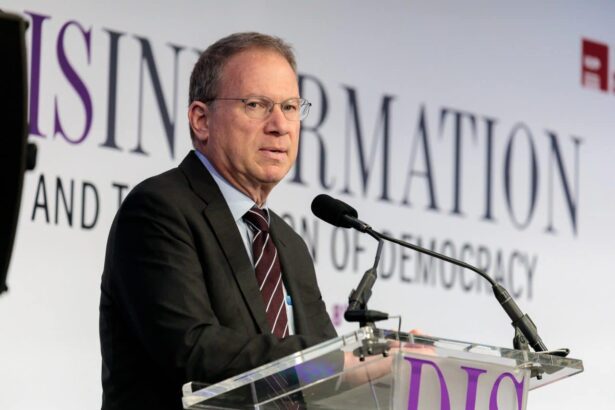
Over the past two decades, no one has done more to shape U.S. discourse on Israel than Jeffrey Goldberg. By relying on tropes of eternal Jewish victimhood, Goldberg declared Iran an existential threat to Jews and helped pave the way for war.
By Yakov Hirsch, reposted from Mondoweiss, May 21, 2026
America’s decision to go to war with Iran is best understood not as a response to uranium enrichment levels, regional power balances, or any coherent strategic objective, but as the product of a narrative shaped by historical trauma and moral absolutism. In that narrative, Iran is not a state with interests; it is the latest embodiment of an ancient threat to the Jews.
This deliberate replacement of empirical reality with the mythology of eternal Jewish victimhood is what I call “Hasbara Culture.” It relies on erasing historical context and replacing it with a single, sacred narrative. In the book Victimhood Discourse in Contemporary Israel, the scholar Ilan Peleg captures the psychological mechanics of this alternative reality:
Other than Benjamin Netanyahu, no one is more responsible for the ultimate success of the Hasbara Culture worldview than Jeffrey Goldberg, the Editor-in-Chief of The Atlantic, and a former Israel Defense Forces soldier who later chronicled his service in his memoir, Prisoners: A Muslim and a Jew Across the Middle East Divide.
Since taking the helm of the magazine in 2016, he has kept a lower profile on the Hasbara Culture front, perhaps to maintain some semblance of journalistic objectivity as an institutional gatekeeper. But today’s media environment no longer requires his daily byline, because he has already laid its ideological foundation. The boundaries of today’s political discourse are a direct, downstream result of the cultural rules Goldberg ruthlessly cultivated for decades.
During the Obama administration, Eric Alterman called Goldberg “the most important Jewish journalist in the United States,” describing him as a “referee” and an “enforcer of its boundaries,” noting: “So, when he moves, the 50-yard line moves.” Leon Wieseltier famously called Goldberg the “mashgiach,” noting that “Goldberg is a little bit in the business of deciding who is kosher and who is not.” And in 2018, Jewish Currents editor David Klion recognized the sheer ideological weight of this gatekeeping. In an essay appropriately titled “Jeffrey Goldberg Doesn’t Speak for the Jews,” Klion noted:
The most accurate description of Goldberg’s journalism was given by Paul Starobin in a 2013 Washingtonian profile, calling Goldberg a “Never Again” journalist: “As a Goldblog headline once asked: IS IT POSSIBLE TO THINK TOO MUCH ABOUT THE HOLOCAUST? His reply: “No, the answer is no—it is not possible to think about the Holocaust too much.”
And this is the mindset that has defined and determined much of the mainstream U.S. discourse on Israel and the broader Middle East for the last two decades.
Goldberg’s ‘Never Again’ doctrine
First it is important to note that Goldberg’s influence stemmed not from traditional foreign policy credentials, but from his recognized role within top-tier journalism as the definitive interpreter of Jewish historical memory. He established himself as the journalist who could dictate exactly what “Never Again” required of American foreign policy. Armed with this self-appointed monopoly on good and evil, he was able to dismiss geopolitical complexities under the unassailable banner of “moral clarity.”
This unique authority is precisely what made his earlier advocacy for the Iraq War so consequential. Years before he applied this framework to Iran, Goldberg used the memory of the Holocaust to provide a moral rationale for American military intervention in the Middle East. In a 2002 Slate article, he wrote:
“Saddam Hussein is uniquely evil, the only ruler in power today—and the first one since Hitler—to commit chemical genocide. Is that enough of a reason to remove him from power? I would say yes, if ‘never again’ is in fact actually to mean ‘never again.’
In this framework, the invasion of Iraq was not presented as a debatable geopolitical strategy but as a moral obligation derived directly from the Holocaust.
Goldberg wasn’t just remembering history; he was actively enforcing a psychological framework. As scholar Ilan Peleg writes: “The Holocaust is used as the ‘final proof’ for the eternal victimhood of the Jewish people. Thus, collective victimhood has emerged not merely as politically instrumental but even as a culturally cultivated and psychologically internalized condition.”
By insisting that the Holocaust must constantly dominate the discourse, Goldberg was actively cultivating this exact internalized condition. He used the Holocaust to serve as the ‘final proof’ that Iran, the Palestinians, and anyone else who opposes Israel don’t actually have their own legitimate political perspective like everyone else but rather are simply the newest iterations of an eternal, eliminationist enemy.
Jeffrey Goldberg was the Grand Inquisitor of Hasbara Culture, using his Jewish authority to systematically excommunicate anyone—from Jewish reporters to the President of the United States—who dared to analyze the Middle East using material facts instead of Holocaust theology.
When Netanyahu invoked Haman and the Holocaust to kill the Iran deal, Goldberg didn’t report it as a cynical political stunt. While traditional policy analysts watched a politician manipulating Congress, Goldberg saw a fellow defender of the Jews. On March 2, 2015, during Netanyahu’s speech, Goldberg tweeted: ‘This is a good thing that Bibi just said: The Jews shouldn’t be passive in the face of threats to annihilate us.’
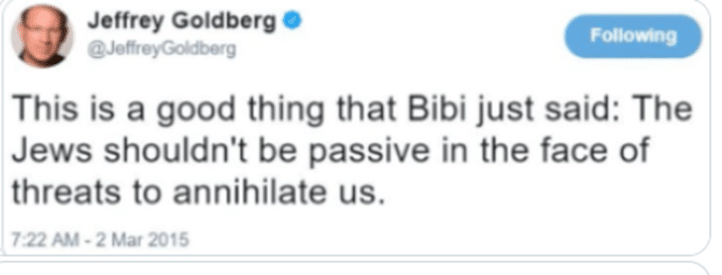
This reaction was not merely a passing comment; it was a pedagogical instruction. Goldberg’s true historical significance lies in his ability to export this trauma-driven worldview out of right-wing echo chambers and into the center of American political life. By relentlessly promoting the Hasbara Culture framework, he normalized this state of perpetual emergency—ensuring it was adopted not just by Jewish institutions, but by The Atlantic’s liberal readership and the Washington establishment as the only legitimate way to view the region.
One need only look at the ideological zeal of billionaire advocates like Bill Ackman today—influential figures who wield immense financial power to police political discourse and crush dissent—to see the downstream effects of this socialization. An entire generation of donors, institutional leaders, Jewish journalists, and politically engaged Jews was taught by Goldberg’s and other “never again” journalists to view 21st-century geopolitical complexities through the paralyzing lens of Jewish victimhood.
Hasbara Culture socialization has spawned an entire cottage industry of “anti-antisemitism literature“—a publishing phenomenon built entirely on the Hasbara Culture ideology epitomized by Dara Horn’s manifesto, People Love Dead Jews. Tellingly, this is the exact paranoia Goldberg has chosen to institutionalize, elevating Horn as The Atlantic’s premier authority on modern antisemitism.
Policing the discourse
To see how political culture is formed, you have to look at Goldberg’s specific interventions. In May 2009, he published a defining Op-Ed in The New York Times titled “Israel’s Fears, Amalek’s Arsenal“:
“I recently asked one of his advisers to gauge for me the depth of Mr. Netanyahu’s anxiety about Iran. His answer: ‘Think Amalek.’… The rabbis teach that successive generations of Jews have been forced to confront the Amalekites: Nebuchadnezzar, the Crusaders, Torquemada, Hitler and Stalin are all manifestations of Amalek’s malevolent spirit.
If Iran’s nuclear program is, metaphorically, Amalek’s arsenal, then an Israeli prime minister is bound by Jewish history to seek its destruction, regardless of what his allies think.”
By officially branding Iran’s nuclear ambitions as “Amalek’s arsenal,” Goldberg endorsed the exact logic Netanyahu uses to justify war today. On March 2, 2026, Netanyahu addressed reporters and explicitly connected the ongoing military campaign against Iran to the biblical commandment to eradicate Amalek: “We read in this week’s Torah portion, ‘Remember what Amalek did to you.’ We remember—and we act,” Netanyahu said.
Goldberg helped grant Netanyahu his ideological immunity. By endorsing this rhetoric, Goldberg transformed a cynical, right-wing politician into the ultimate arbiter of Jewish and Israel survival—validating him as the rightful spokesman and defender of the Jewish people.
This process of sanctification perfectly explains American Jewish unconditional deference to Netanyahu that Israeli journalist Anshel Pfeffer shows in his 2018 Forward article, “How American Jews Enable Bibi’s Never-Ending Cycle of Abuse.”
In calling for a “reckoning” for Netanyahu’s “American enablers,” Pfeffer blamed these enablers for empowering Netanyahu to speak not just as Israel’s prime minister, but as the representative of the entire Jewish people. It was this exact manufactured authority that Netanyahu used to justify his unprecedented 2015 address to Congress.
Looking back at that moment, Pfeffer asked: “Why did next to none of them [American Jewish leaders] stand up for their own president? Why did none of them stand up for the American Jews who voted for him by huge margins?” Their silence, he concluded, “was deafening—and it served as the ultimate enabling of the Israeli Prime Minister.”
The proof that Goldberg mainstreamed this political culture is found in the very vocabulary the establishment used to fight the president. When legacy Jewish organizations and politicians like Chuck Schumer mobilized against the Iran nuclear agreement, they ignored the assessments of Israeli and American security experts.
Instead, they adopted the exact existential framing that Goldberg had spent years legitimizing in the pages of The Atlantic. Goldberg had successfully conditioned them to view Iran’s nuclear program not as a geopolitical challenge, but as a matter of literal life or death. Once that theological premise is internalized, political loyalty to an American president simply dissolves in the face of an imagined existential emergency.
Goldberg cultivated the Nazi/Iran connection at every opportunity. In a 2012 article discussing the possibility of Israel attacking Iran, Goldberg introduced the concept of “Holocaust calculus“:
“Bibi is in a box… It’s not impossible that he would make the Holocaust calculus, which is to say, he believes that stopping a second Holocaust is worth the risk of alienating the U.S., but I think he also knows that we’re far from the moment when a second Holocaust might be possible to contemplate.”
If Goldberg admits that Netanyahu realizes “we’re far from the moment when a second Holocaust might be possible to contemplate,” what exactly is “Holocaust calculus” doing in this article?
For this apocalyptic framework to thrive, mainstream political culture had to make taboo any voice that threatened the Hasbara Culture narrative.
The defining battle took place in 2009 between Goldberg and New York Times columnist Roger Cohen. After traveling to Iran, Cohen wrote a series of columns prioritizing empirical reporting over Washington’s ideological assumptions. “Let’s be unequivocal: Iran’s Islamic Republic does not resemble a Third Reich revival… I’m convinced the “Mad Mullah” caricature of Iran and likening of any compromise with it to Munich 1938 — a position popular in some American Jewish circles — is misleading and dangerous.”
Cohen directly targeted the Hasbara Culture narrative in an article called “Israel Cries Wolf”:
Now here comes Netanyahu, in an interview with his faithful stenographer Jeffrey Goldberg of The Atlantic, spinning the latest iteration of Israel’s attempt to frame Iran as some Nazi-like incarnation of evil:
“You don’t want a messianic apocalyptic cult controlling atomic bombs. When the wide-eyed believer gets hold of the reins of power and the weapons of mass death, then the entire world should start worrying, and that is what is happening in Iran.”
…This “messianic apocalyptic cult” in Tehran is, of course, the very same one with which Israel did business during the 1980’s… I don’t buy the view that, as Netanyahu told Goldberg, Iran is “a fanatic regime that might put its zealotry above its self-interest.” Every scrap of evidence suggests that, on the contrary, self-interest and survival drive the mullahs.
Cohen soundly defeated Goldberg in the actual war of ideas. But just as experts didn’t matter to Netanyahu, “every scrap of evidence” was irrelevant to Goldberg. He unleashed a ferocious campaign to smear Cohen, declaring: “He [Cohen] is a Jewish apologist for an anti-Semitic regime, and he should be reminded often that he has debased himself,” and wished Cohen were as sympathetic to his own people as he is to the Poles.
Why is this 2009 fight so crucial to understanding the current war with Iran? Because this was the moment the trap snapped shut. When Goldberg attacked Cohen, he was engaging in what the scholar W.M.L. Finlay calls the “pathologizing of dissent“:
“A simple dichotomy is set up between those who agree with the writer, presented as on the side of the Jews in general, and the ‘enemy,’ the close associate of the self-hater. In these accounts, there are no legitimate differences of opinion among the Jews, there is simply a hawkish version of Zionism on the one side, representing the authentic Jewish voice, and the enemy on the other.
Critics of military actions, advocates of a negotiated settlement, and those who state that the Palestinians have suffered injustice are presented as committing an act of aggression against the Jews by allying themselves with those who would kill the Jews, either the terrorists or the anti-Semites in general.”
By diagnosing Cohen’s empirical reporting as a psychological defect—Jewish self-hatred—Goldberg was able to bypass the facts entirely. In doing so, he cemented a devastating cultural rule: Jews who supported diplomacy, or who refused to view the Middle East through the lens of Jewish trauma, were not just wrong. They were traitors.
For decades, Jeffrey Goldberg ruthlessly policed the American discourse to ensure this deceptive political strategy was treated as sacred truth. While Israeli experts warned that the “existential threat” was spin designed to win elections, Goldberg was hounding anyone who dared question Netanyahu’s apocalyptic focus on Iran.
Goldberg frames the Iran deal debate
By 2015, Goldberg’s hubris had reached its peak. Securing interviews with President Barack Obama and Secretary of State John Kerry, he did not interrogate them on centrifuge capacities. Instead, he browbeat the leaders of the free world over the metaphysical nature of Iranian antisemitism.
In an article called “Why Iran’s Anti-Semitism Matters,” he described scolding Kerry for failing to adopt the Amalek framework, writing: “I was troubled by what I took to be his unwillingness, or inability, to grapple squarely with Iran’s eliminationist desires.”
He took the same condescending tone with President Obama. Obama calmly pointed out that history is full of deeply antisemitic leaders who still operated rationally regarding their own survival.
Obama:
“I take what the supreme leader says seriously. I think his ideology is steeped with antisemitism, and if he could, without catastrophic costs, inflict great harm on Israel, I’m confident that he would. But as I said… it is possible for leaders or regimes to be cruel, bigoted, twisted in their world views and still make rational calculations with respect to their limits and their self-preservation.
It doesn’t preclude you from being rational about the need to keep your economy afloat; it doesn’t preclude you from making strategic decisions about how you stay in power; and so the fact that the supreme leader is anti-Semitic doesn’t mean that this overrides all of his other considerations.”
This is the non-Hasbara Culture way to view Iran.
Reflecting on the interview, Goldberg wrote that he regretted not dropping the “H-bomb” to Obama’s face:
“In retrospect, though, I should have raised it, because Hitler is the perfect, but not singular, example of a world leader who made decisions that seemed, to his adversaries, deeply irrational except if you understood his desire to wipe out the Jews of Europe as an actual overriding policy goal, a raison d’etre of his rule.
antisemitism was not simply an ‘organizing tool’ for him. And if you’re paying attention, you will see that bringing about the end of the sovereign Jewish state in the Middle East is a paramount political and theological mission of the Iranian regime.”
In Goldberg’s mind, if the President of the United States did not see Hitler when looking at Tehran, he was fundamentally unqualified to evaluate the Middle East.
Goldberg never missed a chance to cultivate the Iran-Nazi analogy, even exploiting the physical location of diplomacy to do so. When negotiations overlapped with the Munich Security Conference in February 2015, Goldberg publicly warned the Obama Administration to avoid making announcements there “for obvious reasons.” The tweet cultivated the idea that any diplomatic progress on a non-proliferation treaty should be read as reminiscent of Munich.

This relentless insistence on framing a geopolitical debate as a referendum on antisemitism completely stifled the administration. As Phil Weiss meticulously documented in his analysis of Ben Rhodes’s memoir, The World As It Is, the pushback against the Obama administration was deeply intertwined with the weaponization of Hasbara Culture. Listen to how Rhodes, Obama’s deputy national security adviser, describes the resistance to the Iran deal coming from the Jewish community:
“Even to acknowledge the fact that AIPAC was spending tens of millions to defeat the Iran deal was anti-Semitic… It was an offensive way for people to avoid accountability for their own positions.”
Obama had a similar reaction to being trapped by this exact framing:
“Come on… This is aggravating… This isn’t about anti-Semitism… They’re trying to take away our best argument, that it’s this or war.”
Obama and Ben Rhodes live in the real world. They knew that Iran was no existential threat to Israel and that the JCPOA was good for America and good for Israel. Just listen to former Israeli PM Ehud Olmert: ” Not one of Israel’s official strategic nuclear experts that I spoke with thought that the [Barack] Obama [administration’s] agreement was a bad deal. Some thought that it might have been possible to reach an even better agreement, but they all thought that this agreement was better than what was happening before it.”
Behind closed doors, Rhodes and Obama were expressing a profound frustration: they were winning the geopolitical debate, but they were not allowed to use their best arguments. As Obama presciently warned, the reality was a binary choice between the JCPOA and war. But because the debate had been hijacked by Hasbara Culture, framing the policy purely in terms of American interests or non-proliferation was suddenly deemed “antisemitic.”
Just look at Goldberg’s treatment of Obama’s arguments for the Iran deal. This is precisely what Rhodes and Obama were complaining about:
“Why does it seem to a growing number of people (I count Chuck Schumer in this group) that an administration professing—honestly, from what I can tell—to understand Jewish anxieties about the consequences of anti-Semitism in the Middle East does not appear to understand that the way some of its advocates outside government are framing the Iran-deal fight—as one between Jewish special interests, on the one hand, and the entire rest of the world, on the other—may empower actual anti-Semites not only in the Middle East, but at home as well?…
I suspect that opponents of the deal in the American Jewish community are wrong in their views, but this does not make them warmongers, in the way Charles Lindbergh once understood Jews to be warmongers.”
What Goldberg was doing in that article was enforcing a Jewish tribalist perspective on mainstream politics.
In fact, Goldberg’s own agitation about “Jewish anxieties” created a self-fulfilling prophecy. Goldberg exacerbated Jewish anxiety by exaggerating it. He imposed a kind of blackmail when he claimed Obama and Rhodes were not playing fair in the “war of ideas” about the Iran deal. This same agitation was deployed to shield Israel from any other form of international political pressure.
The Obama administration technically won that immediate political battle by signing the JCPOA. But Goldberg’s framing and Hasbara Culture won the long-term cultural war.
The political leverage of this alternative reality became undeniable during the Trump administration. When Donald Trump unilaterally withdrew the United States from the Iran nuclear deal in 2018, he was not acting on the advice of military experts or intelligence agencies—who confirmed Iran was complying with the agreement.
Rather, he had been entirely captured by Benjamin Netanyahu’s narrative that the JCPOA was a “terrible” deal and that Iran is dead set on acquiring a bomb no matter the consequences. Trump was influenced by Hasbara Culture from all sides.
Netanyahu’s lobbying was backed by the financial muscle and demands of right-wing Jewish mega-donors, like Sheldon Adelson and Bernard Marcus, who had entirely internalized the Hasbara Culture worldview. To these actors, Iran was not a geopolitical puzzle to be managed through statecraft; it was “Amalek’s arsenal” and the JCPOA was a modern-day Munich agreement that had to be destroyed at all costs.
The proof of Hasbara Culture’s ultimate victory is the Biden administration. When Joe Biden took office, he did not dare re-enter the agreement, despite it being a stated national security objective. Why? Because the boundaries of acceptable discourse had been permanently redrawn. Biden knew that treating Iran as a rational state actor would trigger a Hasbara Culture tsunami. To advocate for diplomacy now was to guarantee being labeled as the number one enemy of the Jews.
The moment his administration signaled a desire to return to the JCPOA, right-wing politicians accused him of pursuing an “anti-Israel foreign policy to appease antisemites,” while publications like Tablet declared that his diplomatic “appeasement” put Israel in “mortal danger” and constituted an “ugly betrayal.”
The closer Biden would get to a deal, the more relentlessly he knew he would face a weaponized victimhood discourse.
Goldberg sees Nazis everywhere
And it wasn’t just in Iran where Goldberg sensed a revival of the Third Reich.
When the BDS movement began to gain traction, Goldberg did not analyze it as a political tactic aimed at changing Israeli state behavior. Instead, he instantly transformed it into 1930s Germany. In a 2010 Atlantic blog post, he explicitly framed the boycott as a Nazi parallel:
“Because I’m running a campaign on this blog against the cheap deployment of Nazi imagery in argument-making, I am going to resist the urge to point out that the European-centered campaign to launch an economic boycott of the world’s only majority-Jewish country smacks of something historically unpleasant, except now I didn’t resist the urge.
But I do actually think it’s a fair analogy, and the BDS movement, like no other anti-Israel propaganda campaign, has sent chills down the collective Jewish spine precisely because economic boycotts have been, throughout history, used to hurt Jews.”
By projecting that BDS “has sent chills down the collective Jewish spine,” Goldberg was doing much more than just reporting on his community; he was appointing himself to speak for all Jews. Just as he frequently agitated about “Jewish anxieties” to box in American politicians, he deployed the same tactic here. It functioned as a self-fulfilling prophecy: by constantly broadcasting and magnifying this existential terror, Goldberg actively created the very Jewish anxiety he claimed to be merely observing.
In doing so, he successfully cultivated the “fair analogy” between BDS and Nazi imagery within American political culture. Naturally, Goldberg soon took to Twitter to explicitly associate the BDS movement with “far right anti-Semitic racial supremacists.”
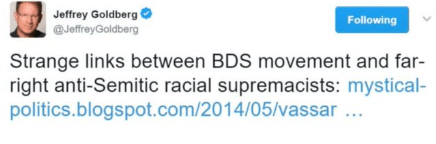
And what was Goldberg’s read of this Facebook photograph of a Norwegian ska/punk band called Razika holding up BDS signs in 2016?
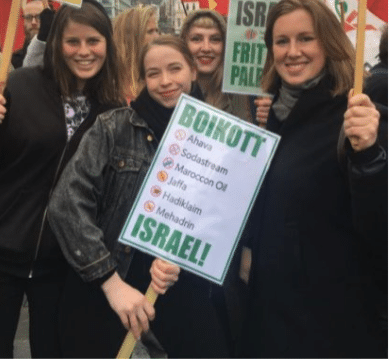
This is a textbook example of Hasbara Culture in action. The ideological insistence that any criticism of Israel or opposition to its policies is merely a modern mask for historical hatred of “the Jews” is a narrative that Goldberg and his contemporaries have aggressively hammered into the Jewish community from every direction.
He went so far as to use this Holocaust framing not just against the boycott of Israel itself, but against the boycott of illegal Israeli settlements in the West Bank. In 2012, Peter Beinart published his book The Crisis of Zionism alongside a New York Times Op-Ed explicitly titled “To Save Israel, Boycott the Settlements.” As The Atlantic’s Robert Wright correctly observed at the time, Beinart’s proposal was a pragmatic, “last-ditch effort to revive” the two-state solution and pressure Israel to end the occupation.
Beinart was trying to save the possibility of a democratic future. But for Goldberg, the dogmas of Hasbara Culture were more important than engaging with geopolitical reality. Where Beinart saw a political tactic to end the occupation, Goldberg and Netanyahu saw 1930s Germany.
As journalist Ali Gharib pointed out at the time, Goldberg’s reaction to a proposed settlement boycott was functionally indistinguishable from Benjamin Netanyahu’s rhetoric, which claimed that European boycotts were “eerie” echoes of the Holocaust.
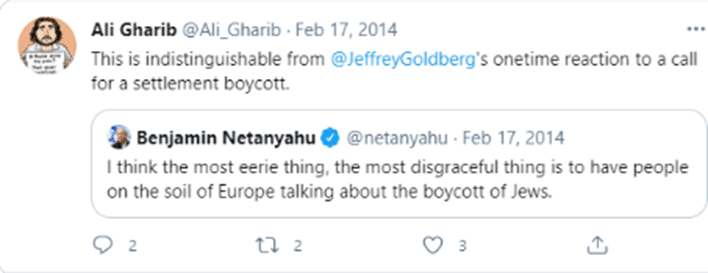
Goldberg did not need Israeli state propaganda to reach this conclusion. Driven by his own internalized Hasbara Culture, he independently collapsed the difference between a political protest of a military occupation and the historical persecution of Jews, perfectly mirroring the Israeli right wing.
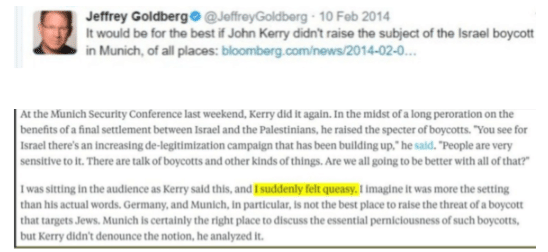
This absolute refusal to engage with geopolitical reality reached absurd heights in 2014. When Secretary of State John Kerry, speaking at the Munich Security Conference, accurately warned that Israel’s behavior was creating a global “delegitimization campaign,” Goldberg was not interested in Kerry’s warning.
Kerry was trying to save Israel from its own disastrous policies, but Goldberg was too preoccupied with the physical location of the speech to listen to the substance. In an article titled “Kerry’s Israel boycott talk will backfire,” Goldberg complained that hearing the word “boycott” uttered in Munich made him “queasy.”
To see exactly how this ideological intimidation operated in real time, consider Goldberg’s immediate smear of former National Security Advisor Zbigniew Brzezinski.
In November 2013, Brzezinski tweeted: “Obama/Kerry = best policy team since Bush I/Jim Baker. Congress is finally becoming embarrassed by Netanyahu’s efforts to dictate US policy.”
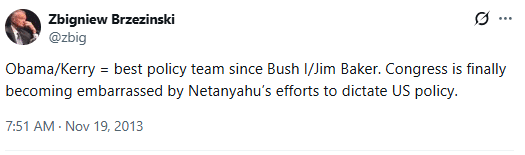
Goldberg immediately responded with an accusation of antisemitism. “Jews run America, suggests ex-national security adviser,” he tweeted.
“Jews run America, suggests ex-national security adviser: https://t.co/1ZH2R7jyuC” — Jeffrey Goldberg (@JeffreyGoldberg) November 24, 2013
By treating a standard geopolitical observation as an antisemitic conspiracy theory, Goldberg modeled exactly how the boundaries of acceptable debate would be enforced. He educated an entire generation of American journalists and Jewish advocates to scour every critique of Israeli influence for hidden “tropes.”
Today, this hyper-vigilant, bad-faith discourse—where pointing out Netanyahu’s political leverage is instantly pathologized as the “Jews run America” trope—is exactly how mainstream Jewish writers and the establishment operate.
Victimhood without context
This tactic of ritual defamation—collapsing legitimate dissent into an alliance with antisemites or violence—was Goldberg’s primary method of policing discourse. He applied this same pathological framing to Jewish critics who tried to ground the conflict in geopolitical reality. When Jewish author Ayelet Waldman observed that a 2016 bus bombing was the tragic but inevitable result of the military occupation, Goldberg cynically inverted her empirical point, accusing her of believing “The Jews had it coming.”
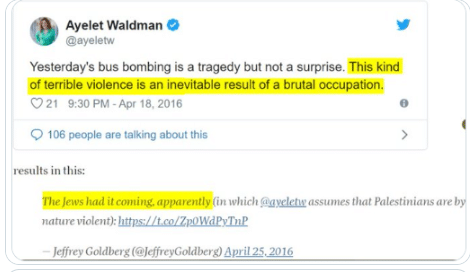
Ayelet Waldman’s tweet is deeply threatening to Jeffrey Goldberg because it links Palestinian violence directly to Israeli state behavior, challenging the core premise of eternal Jewish victimhood. By attacking her, Goldberg enforces the ideological boundary that violence against Israelis must only be understood as a product of irrational, historical antisemitism rather than a geopolitical reaction.
According to Hasbara Culture, the “most historically informed” view on the “roots” of Palestinian violence is “something deeper.” And that “something deeper” is that Jews are being targeted in Israel for being Jews and only for being Jews.
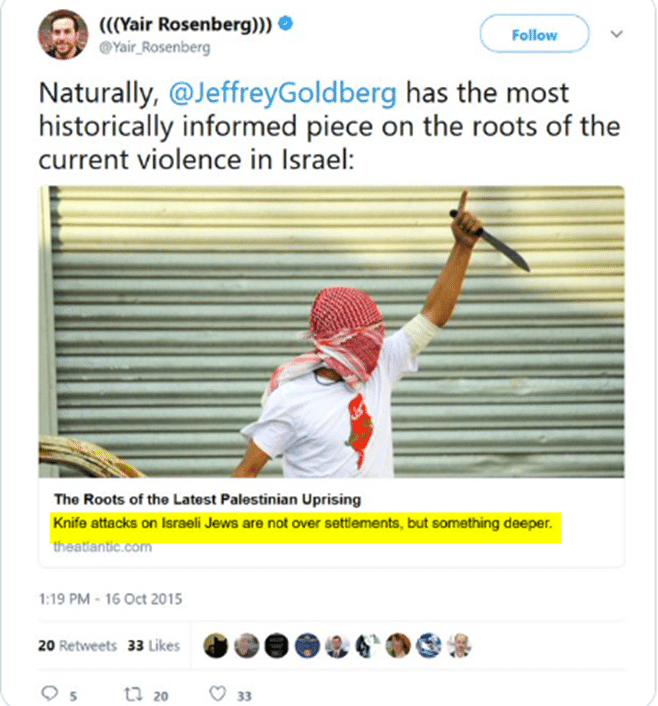
This dynamic perfectly illustrates how the Israeli victimhood discourse completely divorces state actions from international or Palestinian pushback. In Victimhood Discourse in Contemporary Israel, scholar Ilan Peleg captures this psychological mechanism by describing the refusal to accept any responsibility for conflict.
Peleg defines this condition as “the belief that the persecution is completely unrelated to the targeted ingroup and that it is exclusively the product of actions taken by the outgroup (it is therefore assumed that the persecuted ingroup cannot impact the victimization).”
Goldberg’s campaign against Ha’aretz
The Israeli newspaper Ha’aretz serves as the number one enemy of Hasbara Culture. It treats Israel like a normal country whose actions have real-world geopolitical consequences, rather than viewing the state through the paralyzing lens of permanent Jewish victimhood. By acknowledging the material reality of the occupation and the legitimate political grievances of Palestinians, the publication acts as a bastion of sanity that shatters the myth of blameless national innocence.
Because Ha’aretz applies traditional journalistic scrutiny and evaluates Israel as a normal state, its editorial pages have sounded the alarm almost every day over the last decade regarding the growing fascism, racism, and political conditions making atrocities possible within Israeli society. By washing Israel’s “dirty laundry” in public and holding the government accountable, Ha’aretz is deeply hated by the enforcers of Hasbara Culture, who argue that this reporting is a communal betrayal that actively gives ammunition to Israel’s enemies.
That’s why in 2016, Goldberg proclaimed that he was “leaving Haaretz behind.”
“I think I’m getting ready to leave Ha’aretz behind, actually.” — Jeffrey Goldberg (@JeffreyGoldberg) August 1, 2016
He explained by saying he was “tired of reading about the evil Jews” on their opinion pages:
“@BarakRavid @haaretzcom I love you, I’m just tired of reading about the evil Jews all the time on the opinion pages.” — Jeffrey Goldberg (@JeffreyGoldberg) August 2, 2016
When challenged by Ha’aretz journalists on his attempt to delegitimize the paper, Goldberg resorted to associating Ha’aretz with Jew-haters: “Look, when neo-Nazis are emailing me links to Haaretz op-eds declaring Israel to be evil, I’m going to take a break, sorry,” he tweeted.
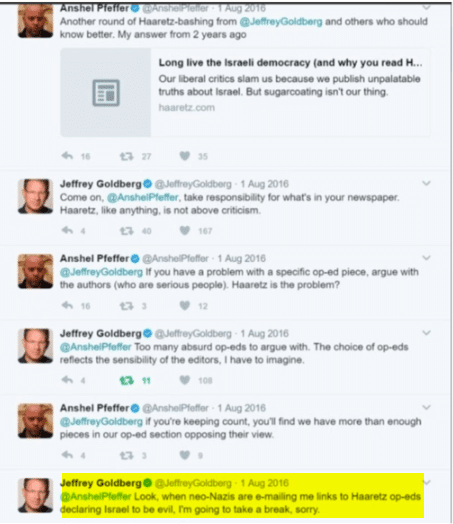
The sheer scope of Goldberg’s influence was immediately apparent in how the Jewish media ecosystem amplified his verdict. Israel National News eagerly covered the spat, highlighting his accusation of “cartoonish anti-Israelism,” while Israel Hayom praised the “prominent American journalist” for decrying “anti-semitism at Ha’aretz.”
The Algemeiner breathlessly reported on the “Twitter frenzy,” and the Jewish Press celebrated him for finally walking away from the “Ha’aretz cult.” Even Gideon Levy felt compelled to address the fallout in a piece titled “The Dangerous Fantasies of Jeffrey Goldberg.”
The message was clear: if the ultimate “liberal Zionist” arbiter considers Ha’aretz to be aligned with the enemies of the Jews, then the publication is fundamentally illegitimate. This is exactly how Hasbara Culture is cultivated—not through factual debate, but through excommunication. Just as he used the ghost of Charles Lindbergh to demonize real-world defenders of a non-proliferation treaty, he used supposed anonymous neo-Nazi emails to render Israeli journalism non-kosher.
Policing American Jews
But it was deeply important for Goldberg to police his own community most of all. It was easy for him to dismiss more radical Jewish critics of Israel by pathologizing their political positions as deep-seated psychological defects. He could effortlessly dismiss Jewish Voice for Peace as “a group that displays a homicidal impulse toward Israel.”
Similarly, he could marginalize other Israel critics as “part of a tiny minority of Jews who believe that the destruction of Israel will bring them the approval of non-Jews, which they crave”.
In the battle over reality, the ‘pro-Israel, pro-peace’ lobby J Street emerged as the most dangerous internal threat to the Hasbara Culture consensus. Unlike Netanyahu’s allies at AIPAC, who eagerly subordinated American foreign policy to the demands of the Israeli Prime Minister, J Street insisted on living in the real world as an American civic organization. Grounding their advocacy in the empirical assessments of security officials, they actively supported the 2015 Iran nuclear deal because they had American interests at heart.
They also explicitly rejected the apocalyptic framing used to sabotage diplomacy. When the Israeli Defense Minister compared the Iran deal to the 1938 Munich agreement, J Street publicly condemned the analogy as “littered with falsehoods” and “fear-mongering of the worst kind,” as highlighted by Haaretz journalist Chemi Shalev.
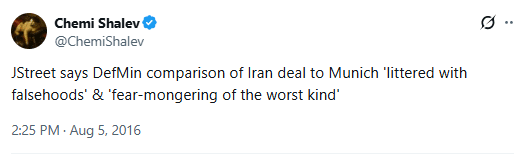
When Netanyahu came to Washington to force American Jews to choose between the diplomatic objectives of the United States and his own mythological narrative, J Street chose the United States. They consistently prioritized rational American statecraft over the demands of the Israeli right.
By standing by their own president and proving that you could be a fiercely committed Jewish organization without succumbing to the theology of perpetual victimhood, J Street committed the ultimate heresy. This challenge to the Hasbara Culture monopoly was intolerable to Goldberg. He could not debate them on the merits of their arguments, so he moved to cast them out of the Jewish mainstream through psychological pathologization.
Leveraging his platform at The Atlantic, he sought to frame their pragmatic independence as a form of communal betrayal, famously declaring: “I think many J Street supporters are cringing Diaspora Jews who are embarrassed by displays of Jewish muscularity.”
By diagnosing their support for diplomacy as the psychological defect of a “cringing” diaspora Jew, Goldberg signaled to the establishment that J Street was a fundamentally anti-Israel organization. To prioritize American interests or seek peaceful resolutions was no longer a political choice; in Goldberg’s eyes, it was a shameful rejection of Jewish strength.
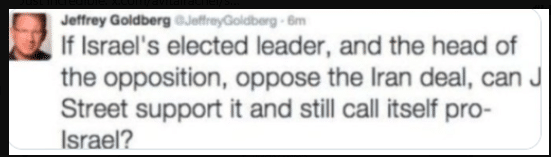
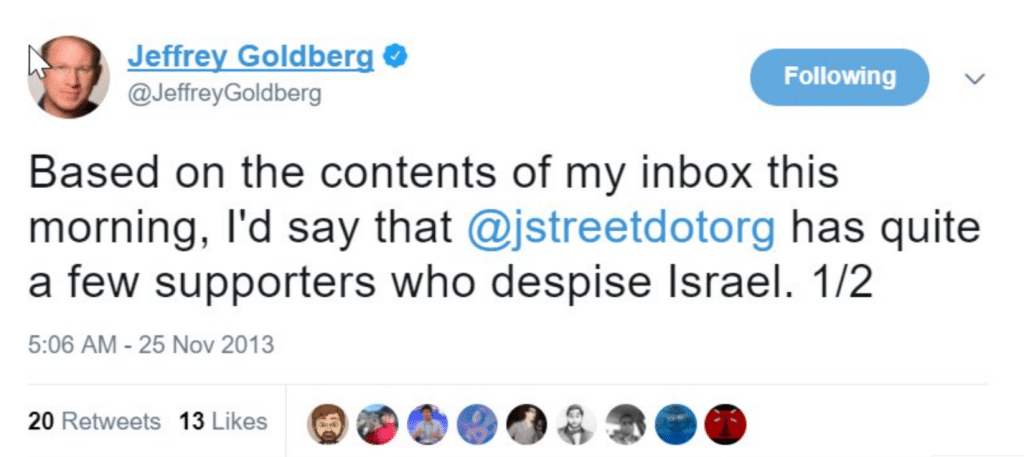
He suggested J Street was stabbing Israel in the back:
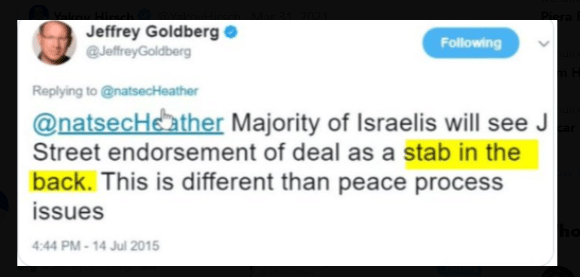
By labeling a diplomatic endorsement a “stab in the back,” Goldberg was doing what he does best: excommunicating Jews who refused to adopt his apocalyptic worldview.
J Street had confronted Hasbara Culture’s delusions, and Goldberg was making sure they paid the price. These clashes are between two entirely different Jewish approaches to the world. In 2013, he took to Twitter to openly debate whether J Street still deserved a place “in the Jewish tent.” Goldberg’s gatekeeping had become so absolute that he genuinely believed it was his personal prerogative to determine who was allowed inside the ‘Jewish tent.”
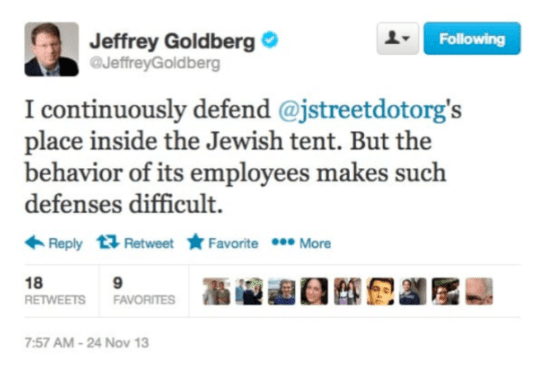
It was this arrogant gatekeeping that prompted the Jewish political theorist Corey Robin to reject Goldberg’s Jewish authority in a blog post titled “Rabbi Goldberg, Can I Come Back into the Tent?”
What I am describing is not merely a media critique; it is the defining battle between Hasbara Culture and reality. Ultimately, the question of who belonged inside Jeffrey Goldberg’s “Jewish tent” was never just an internal communal squabble. It was a systematic effort to dictate the boundaries of acceptable American political debate.
By successfully pathologizing dissent and excommunicating actors like J Street who advocated for rational statecraft, the enforcers of Hasbara Culture ensured that the United States would evaluate the Middle East through the paralyzing lens of Jewish victimhood rather than material state interests.
This ecosystem is sustained by right-wing firebrands like Ben Shapiro and Mark Levin, “never again” journalists like Bret Stephens and Bari Weiss who act as self-appointed spokespeople for the Jews, and “pro-Israel” think tanks backed by mega-donors. At the institutional level, it is aggressively promoted by organizations like AIPAC and the ADL.
But while these actors function as the movement’s partisan political muscle, one figure stands above the rest in giving this alternative reality its mainstream, centrist credibility.
Goldberg’s record at The Atlantic
While this article has primarily focused on Jeffrey Goldberg’s vocal gatekeeping before he became Editor-in-Chief of The Atlantic, his current role is where Hasbara Culture exerts its most profound influence. Though he now writes less frequently, the ultimate power of an editor is deciding what is newsworthy and what should be ignored.
When it comes to Israel, Iran, and Jewish issues in general, Goldberg’s editorial decisions are consistently filtered through the paralyzing lens of Hasbara Culture rather than the objective demands of journalism. Just as he once policed the boundaries of debate as a “spokesman for the Jews,” Goldberg now uses his position to aggressively resist the opening of the Overton window on American foreign policy.
This dynamic was glaringly obvious during the Trump administration. Donald Trump and Benjamin Netanyahu met countless times, forging an alliance that fundamentally destabilized the region. Yet The Atlantic ignored each meeting and offered virtually no serious scrutiny of their relationship, let alone Netanyahu’s outsized influence over the American president. Likely paralyzed by the fear of invoking “tropes” of Jewish control, Goldberg simply ignored one of the most consequential geopolitical stories of the era.
Even more damning is Goldberg’s ongoing blackout of Israel’s descent into fascism. Netanyahu has been running amok for a decade, and the political climate has grown darker every year, yet the Editor-in-Chief has effectively shielded his readers from this reality.
The warning signs were impossible to miss as early as 2016, when Israel was consumed by the Elor Azaria saga—a case involving an IDF medic who executed an incapacitated Palestinian in Hebron. For eighteen months, it was the most important story in the country. History will show that the Azaria affair and its reverberations were a watershed moment in Israel’s descent into populist madness.
Seeing exactly where this nationalistic frenzy was leading, Major General Yair Golan, the IDF’s Deputy Chief of Staff, sounded an early alarm. During a Holocaust memorial speech, he publicly warned of “nauseating trends” in Israel reminiscent of 1930s Germany. Any objective editor would recognize the importance of a senior military official making such a statement and treat it accordingly. Yet Goldberg completely suppressed this reality.
As Israel’s fascistic drift worsened every single year—eventually bringing the most racist politicians since the end of World War II into the government—Golan’s stark warning was nowhere to be found in The Atlantic. While Goldberg thought it best that “Elor Azaria’s Trial Should Never Have Become a Public Affair” Bret Stephens took the side of Jewish fascism.
In the framework of Hasbara Culture, Israeli outlets like Ha’aretz that actually reported these trends were treated as the enemy for simply spilling the beans. It took until November 2023 for Yair Rosenberg, the magazine’s designated Israel correspondent, to finally break this silence. There is only so long that even Hasbara Culture journalists can defy reality. Acknowledging what happened in 2016, Rosenberg finally wrote:
“Rather than the usual platitudes about safeguarding the state, Golan warned of the rise of Jewish extremism in Israeli society. ‘If there is something that frightens me in the memory of the Holocaust, it is identifying the horrifying processes that occurred in Europe … and finding evidence of their existence here in our midst, today,’ he said. ‘It is worthwhile to ponder our capacity to uproot the first signs of intolerance, violence, and self-destruction that arise on the path to moral degradation.’”
How can it be explained that Rosenberg and his Editor-in-Chief failed to report this story to their readers as it was actually happening? There was literally nothing more important occurring in Israel and the Jewish world. Yet for seven years, Goldberg and Rosenberg decided that the fascistic radicalization of the state was simply not news. The fact that Netanyahu was turning Israel into an authoritarian, Hasbara Culture-driven autocracy was entirely ignored by The Atlantic.
This omission is especially staggering given the magazine’s broader editorial focus. Since the rise of Donald Trump in 2016, authoritarianism has been The Atlantic’s big idea. The magazine built an entire editorial brand warning the American liberal center about democratic backsliding, a crusade led by writers like Anne Applebaum and David Frum. In a stroke of profound irony, Frum—who has spent much of his career as one of Netanyahu’s most reliable American enablers—literally wrote the magazine’s famous 2017 cover story, “How to Build an Autocracy.” Yet for seven years, Israel was granted a miraculous exemption from this exact diagnostic lens.
While Netanyahu systematically dismantled Israeli institutions and empowered Jewish supremacists, the magazine that had made fighting autocracy its defining beat looked the other way. It wasn’t until October 2023—after Netanyahu’s judicial coup had already torn the country apart and the state collapsed on October 7—that Applebaum finally wrote that the crisis was created by “an autocratic populist party, in alignment with extremists.” She noted that Israelis had rightly feared the emergence of “a de facto autocracy”—a reality that The Atlantic should have been relentlessly covering since 2016.
This editorial blackout is exactly what got Israel to where it is today. By hiding the terrifying reality of Israel’s internal collapse from the American liberal center, Goldberg and his writers ensured there would be no meaningful pushback, no reckoning, and no accountability. When faced with a choice between protecting Hasbara Culture from the profound embarrassment of Israeli fascism, or actually trying to help Israel by reporting the truth, it was no choice at all.
The good news is that the Overton window on Israel is opening wider every day, and Goldberg has largely lost his influence to unilaterally enforce the boundaries of acceptable debate. A decade ago, any politician who dared to criticize AIPAC risked a rebuke from gatekeepers like him. Those days are over. Polls show Israel’s popularity taking a nosedive, with a recent survey revealing that 80% of Democrats now hold an unfavorable view of the country.
Empowered by this shift, politicians are openly crossing rhetorical lines that were once strictly forbidden. In April 2026, 40 out of 47 Democratic senators voted to block arms sales to Israel, and lawmakers like Chris Van Hollen and Jeff Merkley have publicly accused Israel of ethnic cleansing. For years, politicians were kept in check not by the threat of losing campaign money, but by the terror of being smeared as anti-Israel or antisemitic by the establishment.
Moving forward, future administrations will no longer be controlled or influenced by the ideological intimidation of Hasbara Culture. Goldberg has spent his career trying to make Israel sacred in the American and Jewish conversation, but there is no question that U.S. leaders will eventually evaluate Israel like a normal foreign state. J Street will become the establishment and Goldberg will be in no position to lead a new ideological charge.
He will keep his head down and tell his readers as little and as late as possible about Israel and Jewish issues that undermine Hasbara Culture. But reality can only be suppressed for so long. As the catastrophic consequences of this worldview become impossible to ignore, the illusion has finally shattered. The next era of American popular opinion will be defined not by the paralyzing mythology of Hasbara Culture, but by the undeniable truth.
Yakov Hirsch is the author of the Mondoweiss series “Hasbara Culture” and produces the podcast, “The Jewish War of Ideas.” (Follow on Apple Podcasts and Spotify.) You can follow him on Twitter/X at @Yakovhirsch.
RELATED:
- Israel to Bari Weiss: ‘Thank You’ for whitewashing our war crimes
- Politico’s powerful parent company tells Politico they must support Israeli narrative
- We Analyzed Thousands of News Articles: Here’s the Proof of Pro-Israel Bias in Mainstream Media
- Hidden Deep in an NPR Story About a Man Who Threatened to Kill Jews at Cornell… He Admits He Did It to Make People Love Israel
- Bari Weiss ‘Meddles’ With ‘CBS Sunday Morning’ Story on Palestine