In the southern Hebron Hills, a Palestinian farmer and his 10-year-old son were attacked by settlers while tending their fields. Days later, the child still wakes screaming at night
By Gideon Levy and Alex Levac, reposted from Haaretz, May 23, 2026
We met at the entrance to the village. Inside a battered Skoda Kodiaq SUV with every window shattered and its body dented sat a father and son, both with white bandages wrapped around their heads.
They are survivors of a pogrom. Yet another pogrom. It is frightening how routine this has become. A farmer goes out with his child to work his land and ends up bleeding and rushed for treatment. Across the West Bank, this is now almost an everyday occurrence.
But this time it was a child beaten in front of his father, and a father beaten in front of his child.
The 10-year-old has still not recovered. Signs of trauma are everywhere. His father says he wakes in terror every night, screaming: “Help me, the settlers are coming.”
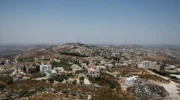
Shweika is a desert village in the southern Hebron Hills, east of Dhahiriya, sharing its name with a larger village in the Tulkarm district. Around 2,000 people live there, their homes scattered among sheep pens and fields of wheat and vegetables. On the surrounding hills stand several luxurious villas built by Bedouin from the Negev who bought land there and married women from Shweika.
The dirt road that now serves as the main route to Dhahiriya passes through the village. Like many other improvised roads across the West Bank, this one was carved out after the army blocked the main road with iron gates following October 7. Along the route, unemployed Palestinian youths collect passage fees from drivers. Children sell drinks and bags of pink cotton candy for pennies by the roadside, in the desert heat.
The road is lined with ruins, remnants of herding communities expelled by settlers over the past two years. At least seven communities have been driven out. In contrast, illegal outposts, now referred to as farms, keep appearing on nearly every hilltop. From week to week, the landscape changes beyond recognition. There is hardly a week without an attack on Palestinians.

Murad al-Batat is a 49-year-old sheep merchant and farmer, and the father of nine children. Sitting in his shattered Skoda, he directs us to his farmstead, a one-room structure used for hosting guests and resting during work in the fields on the edge of the village.
Beside him sits his son Tamer, a fifth grader at the village school.
Since the attack two weeks ago, Tamer has not returned to school. His condition does not allow it.
From the yard of the farmstead, one can see the settler outpost established there about two months ago. Down in the valley, a tent, a trailer and several vehicles sit hidden, the source of all evil in this quiet village. The assailants came from there, and not for the first time.
About a month ago, settlers vandalized around 30 olive trees nearby and attacked the grove’s owner. When he called the army, he was arrested for three days on suspicion of assault and released only after posting 5,000 shekels bail. Such is justice in this remote and abandoned region.
“Since October 7, it’s been very difficult,” sighs Murad’s 61-year-old neighbor, Hijazi Samamri. “But the last year has been even harder.”
Residents describe sheep thefts, arson, trees being cut down, and assaults – the familiar repertoire of armed Jewish militias. For the past month, villagers have been taking turns standing guard at night.
Settlers also steal vehicles. The gang that attacked Murad and Tamer arrived in a stolen Palestinian car, adding insult to injury.

Friday, May 8, began like any other day. Murad went to his slaughterhouse in Dhahiriya in the morning and later drove to his fields in Shweika, where he grows wheat on 35 acres and summer vegetables, including cucumbers and zucchini, on less than an acre.
Two days earlier, he says, the family had gathered there for a celebration. They barbecued and enjoyed themselves.
That Friday, around 5 P.M., Murad drove to the fields, about a mile from the village. He and Tamer were weeding when a settler suddenly arrived with a flock of several dozen sheep.
Murad says he knows who the man is.
The shepherd drove his flock directly into Murad’s cultivated fields, land he had worked for months to nurture. The sheep began grazing on the wheat and zucchini. Afterward, the settler approached Murad’s Skoda and photographed it from every angle with his phone for reasons Murad could not understand.
Moments later, Murad saw the unmasked settler talking on the phone. Within a minute, what Murad describes as a stolen Palestinian Mitsubishi arrived. Five masked men climbed out carrying clubs.
Without saying a word, Murad says, they began beating them brutally. Murad tried to speak to them, to ask what they wanted, but they said nothing. Only their eyes were visible through the masks.
They hit him on the head and across his body again and again. Four settlers surrounded him, raining blows with clubs.

At the same time, he says, another settler attacked his son.
“Dad, help me, save me,” the terrified child screamed while his father stood beaten about 65 feet away. Murad tried to fight back to protect his son. According to his account, he managed to grab one of the clubs from a settler. He threw himself over Tamer’s body, shielding him as the boy lay bleeding on the ground.
Then he heard one of the settlers tell the others: “Let’s wreck his car.” The settlers smashed the Skoda as well.
Neighbors from the nearby village of Khirbet Deir Shams, who witnessed the attack from a distance, called residents of Shweika to rescue the father and son. The settlers fled soon afterward.
Photographs taken afterward show father and son stunned and bloodied, sitting on the ground after the attackers had fled.
“We were almost done for,” Murad says.
Murad says the attack lasted about 20 minutes. He managed to get Tamer into the car and drive a few hundred meters before stopping as he felt himself losing consciousness.
The two were first taken to a clinic in Dhahiriya and then transferred to Alia Hospital in Hebron. According to Murad, the child was hospitalized for one night and the father for two. Murad received ten stitches above his eye. Tamer received eight. Murad’s body is still covered in black and reddish bruises.

A pleasant desert breeze blows outside. Around Murad sit several men from the village listening to his account, their faces grim. Someone says: “If the army doesn’t protect us and the police don’t protect us, then we will have to protect ourselves.”
It is difficult to know how long these men, their faces burned by the sun and their expressions hardened, will remain silent and refrain from defending themselves, their children, their property and their honor.
A relative, 59-year-old Ibrahim al-Batat, speaks in Hebrew learned during 40 years of work in Be’er Sheva.
“These are not Jews who came here,” he says. “Jews don’t kill children or attack them. Now they have a name for everything: October 7. You talk to the army and the government, and they tell you: October 7. Everything is October 7. People in Gaza made a mistake, so our whole people made a mistake?”
Manal al-Ja’bri, a B’Tselem field researcher in the Hebron area, adds: “In recent months we have been documenting settler violence every day. It has become routine. This week in Zurif they tried to burn down a house. In Susiya they burned a tent and tried to enter a home but were met with iron bars. There were also attacks in Halhul.”
“Whether we attack or are attacked, we always pay the price,” Murad says.
The police and army arrived only after the injured father and son had been evacuated and the settlers had fled.
The Monday after the attack, Murad went to the Kiryat Arba police station to file a complaint. According to him, he waited five hours outside in the sun before being allowed inside. The following Saturday he was summoned again to provide another statement. This time, he says, he waited from 9 A.M. until 4:30 P.M. before being allowed to enter the station.
Complaint number 206224/2026 was eventually filed for assault, bodily harm, and criminal trespass. It is safe to assume it will be buried forever, like so many before it.

We asked the police this week whether settlers, too, are made to wait five or seven hours in the sun before being allowed to file a complaint. The police responded:
“This concerns a complainant who arrived to file a complaint regarding a violent incident that had occurred several days earlier. Last Saturday, he returned to complete the investigation and provide testimony, and received professional and thorough service at the police station.
“We note that the waiting times [mentioned in the inquiry] are inconsistent with the facts of the investigative file. We further emphasize that waiting times for filing complaints depend on workload and professional prioritization, regardless of the identity of the complainant.
Any claim otherwise should be rejected outright.”
We ask Murad: “Will you return to the land?”
“Of course, I will.”
With your son?
“Not so much.”
Gideon Levy is a Haaretz columnist and a member of the newspaper’s editorial board. Levy joined Haaretz in 1982, and spent four years as the newspaper’s deputy editor. He is the author of the weekly Twilight Zone feature, which covers the Israeli occupation in the West Bank and Gaza over the last 25 years, as well as the writer of political editorials for the newspaper.
Alex Levac is an Israeli photojournalist and street photographer. He was awarded the Israel Prize for photography in 2005
RELATED:
- The Numbers Behind the ‘Sacred Work’ of Cleansing West Bank Palestinians for Future Jewish Villas
- Israeli Soldiers Abduct Many Palestinians in Occupied West Bank
- Armed Israeli Colonizers Destroy Agricultural Property, Seize Land in West Bank
- Israel’s Smotrich orders the uprooting of 3,000 Palestinian trees in West Bank
- Israel’s war on the West Bank comes for Palestinian greenhouses