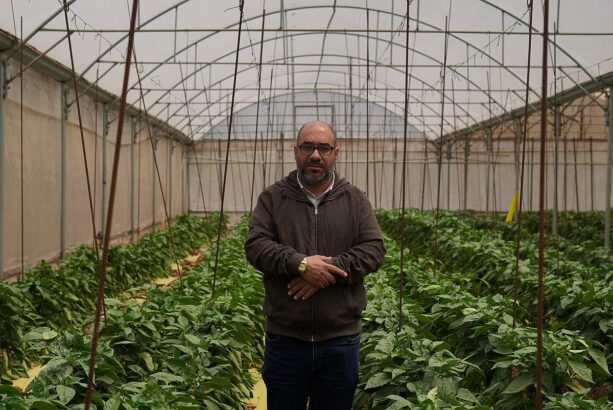
In Jayyous and neighboring villages, Palestinian farmers have been served dozens of new demolition orders intended to push them off their land.
Hakam Salim stood in his pepper greenhouse on the lands of Jayyous, a village east of Qalqilya whose farmland lies partly in the so-called “seam zone” — the strip of West Bank territory caught between the Green Line and Israel’s separation barrier. Building the nursery cost him more than NIS 30,000 ($10,190), with tens of thousands more invested in preparing the land.
A typical greenhouse in Jayyous generates NIS 50,000 to 60,000 annually before expenses. For Salim and his brother, that income supports their families and helps pay for their four children’s university tuition.
Now, however, a recent stop-work order issued by Israel’s Civil Administration threatens to wipe out everything Salim has built, along with his family’s livelihood.
The Civil Administration, an arm of the military, says the greenhouses were built without permits, even though they have stood for many years, some for over two decades. “When the greenhouses were built, there was no problem with the army; nobody came and said ‘don’t build here,’” Salim told +972. “The municipality even connected them to electricity.”
Salim is far from alone. In recent weeks, Israeli authorities have issued stop-work orders — the first step before demolition — for 52 greenhouses in Jayyous, located east of the separation barrier. At least two of those have already been demolished. This week, dozens more greenhouses located on the other side of the wall also received demolition orders.

The fact that the orders apply to structures within 300 meters on either side of the barrier and cite no specific security rationale suggests that their goal is to clear the area of Palestinian agricultural presence altogether. “They harass us, the villagers, so that we’ll move to the cities, and from the cities abroad,” Salim told +972. “They want to make life harder for Palestinian farmers. Their goal is political.”
Cutting off the West Bank’s ‘food basket.’
Jayyous sits on a hill overlooking Israel’s coastal plain, with the city of Netanya visible in the distance. Its greenhouses sit so close to the separation barrier that during the recent war with Iran, farmers working there could hear both the rocket sirens inside Israel and the explosions of interceptions that often occurred above the West Bank.
The village’s farmland stretches out in one of the most water-rich areas of the West Bank outside the Jordan Valley. Extending from south of Qalqilya to north of Tulkarem, the region is often described as the West Bank’s “food basket.”
In the early 2000s, Israel built what Palestinians here refer to as the “apartheid wall” across these fertile lands. In many places, the barrier runs close to the westernmost homes of Palestinian villages, leaving large swaths of farmland on the western side, between the Green Line and the barrier.
Farmers can access their land only through gates that open briefly each day, and only a handful of family members are granted permits. One longtime Palestinian activist against the separation barrier, who chose to remain anonymous for fear of retaliation by Israeli authorities, told +972 that Israel chose the route “deliberately to prevent Palestinians from accessing this aquifer.”
But while the barrier severely restricts Jayyous farmers’ access to their own land, it does not prevent the army from entering the village regularly. The day before I arrived in Jayyous, 68-year-old Sabriya Amin Shamasneh died of a heart attack while soldiers raided her home in the middle of the night.

The restrictions have also led to absurd situations. One Jayyous farmer, who asked to remain anonymous, recounted how Israeli police arrested Israeli volunteers for “stealing” olives from his trees beyond the fence — even though they were harvesting them at his request.
For Salim, proof that the Israeli army and Civil Administration saw no problem with the construction of the greenhouses lies in the fact that, until 2014, they were in an area on the western side of the separation barrier. “We used to reach our greenhouses through the gate with a permit,” Salim recalled. “We brought in equipment, iron arches, plastic sheeting, and vegetables. There was no problem at all.”
Following a Supreme Court ruling that year, however, the barrier was moved westward, placing the land back on the West Bank side. That is why the stop-work orders came as a shock. “Sometimes they say it’s because there’s no permit, sometimes they say it’s a security reason — but there has been no security incident in this area,” he said.
‘An attack on all agriculture.’
While agriculture accounts for just 6 percent of Palestinian GDP, its significance goes beyond economics. “Historically, Palestinian culture is an agricultural culture, and we preserved our agricultural identity,” economist Raja Khalidi, director of the Palestine Economic Policy Research Institute, told +972. “If you have money, you buy land — it’s part of the culture. It’s the way people eat, the way they sit.”
Israeli policies, he said, accelerated the proletarianization of Palestinian society — partly because competition with Israeli goods meant Palestinian families could no longer make a living from agriculture. At the same time, a counter-process is also taking place: Palestinians who lost their jobs in Israel have turned to small-scale farming, growing food for personal use and informal markets.
Veteran farmers in Jayyous still remember the lands that belonged to the village before 1948 — now part of the Israeli town of Kochav Yair-Tzur Yigal. “This land belongs to our grandparents,” Salim said. “We used to grow wheat, watermelon, and cucumbers here, but over the years, greenhouse agriculture developed.”

“In the 1970s and ’80s, citrus was exported from there to Jordan, the Gulf states, even Iran,” Khalidi said. But after the first Gulf War, the Oslo process, and economic liberalization, that industry fell into crisis. Farmers adapted by turning to crops such as avocados, guavas, loquats, and lychees, while building greenhouses for peppers, tomatoes, and cucumbers. “This shows the high entrepreneurial capacity of Palestinian farmers,” Khalidi added.
Now, that entire agricultural system is under threat. As in Jayyous, stop-work orders have been issued in the neighboring village of Falamya and farther north in villages like Deir Al-Ghusun, Shweika, and Attil.
In the village of Irtah, just south of Tulkarem, farmer Faiz Taneeb received stop-work orders for nine dunams of greenhouses he has cultivated for 35 years. “After October 7, soldiers cut the plastic sheeting in greenhouses near the fence,” he recounted. For a while afterward, workers stayed away. But as soon as they returned to repair the damage, Taneeb received a stop-work order on the grounds that the greenhouse had been built without a permit.
“This is the first time we’ve ever heard that you need a permit to build greenhouses,” he said. “The army wants to harass us, wants us to go to the cities. The problem isn’t just the greenhouses — there is an attack on all agriculture in the West Bank.”
‘If you destroy the greenhouses, you destroy their livelihood’
With the exception of two or three that have already been demolished, most of the greenhouses in Jayyous remain standing pending legal proceedings. Elsewhere in the West Bank, however, the damage is already being felt.
In the east — particularly in the water-rich Jordan Valley and the herding communities on its margins — settler militias have spearheaded the campaign of expulsion against Palestinian farmers and shepherds, using outposts and herding farms to seize land, while the army plays a supporting role.
Where land is not actively cultivated, Israel can claim it as state land. Khalidi and other researchers have identified such a “soft spot” in the Auja area of the Jordan Valley. “Israel wants these lands to be empty,” he said.
In the northern Jordan Valley, farmers have reported severe disruptions, including to livestock production and the meat industry. Eighty percent of goat meat comes from Bedouin communities in the southern West Bank, as do yogurt and cheese. All of this has been jeopardized by settler attacks.

At the same time, agricultural roads across the West Bank have been systematically destroyed, while access to them has been restricted by settlers and the army. “There was barely an olive harvest this year,” Hagit Ofran of the anti-occupation NGO Peace Now told +972.
But while settler attacks on Palestinian communities in other parts of the West Bank have received considerable public attention, the assault on agriculture in the western West Bank has largely flown under the radar.
In Jayyous, Irtah, and other villages in the area, there are no settler militias. Instead, they are surrounded by “bourgeois,” quality-of-life settlements such as Tzofin and Sal’it, whose residents were promised they could live “15 minutes from Tel Aviv.” Here, the task of pushing Palestinians off their land is carried out mostly by the Civil Administration and the army.
Beyond the demolition orders, Salim said that Palestinian farmers are being squeezed by changing market dynamics. In the past, he said, he and many other farmers sold produce to Israel; today, Israeli goods dominate West Bank markets. Only during shortages in Israel — such as the tomato shortage after October 7 — are Palestinian products temporarily allowed in, often driving up prices in West Bank markets.
With work in Israel cut off since October 7 and the Palestinian Authority barely able to pay salaries, village residents say they see few ways to make a living. “There’s already no work in the village; half the men used to work in Israel. Now people don’t have 20 shekels to top up the electricity in their homes,” Yaqoub Asfour, the Palestinian Authority’s official for Jayyous, told +972. “Hundreds of families make their living from these greenhouses. If you destroy the greenhouses, you destroy their livelihood.”
Asfour said young people in Jayyous are increasingly looking to emigrate, though leaving — let alone settling in places like Europe or the United States — is far from simple. “I think this is part of an Israeli plan to expel us from here,” he said.
A Palestinian lawyer familiar with these cases, who asked to remain anonymous, noted that under Jordanian law — which Israel continues to apply in Area C — all construction requires permits, including agricultural structures. In practice, he said, this gives the authorities grounds to target almost any greenhouse. Israeli military courts in the West Bank rarely take into account how long a structure has been standing, making demolition possible even decades after it was built.
Farmers in Jayyous have petitioned the court in the settlement of Beit El and are trying to obtain permits, though their chances are “not great,” the lawyer said. In another case he handled in the Tulkarem area, the army objected “on security grounds,” even though the greenhouses were not close to the fence and the landowners had offered to install cameras inside them.
Over the past three years, he added, there has been a sharp rise in stop-work and demolition orders against agricultural structures. Right-wing settler groups such as Regavim, he said, have been pressing the Civil Administration to increase enforcement.
Despite the odds, Salim is still seeking legal recourse. “If the court is independent, if it isn’t political, if it doesn’t see its role as implementing government policy, then there’s no problem,” he said. “If it sees me as equal to you, everything is fine. But if it thinks you are better than me, then it isn’t clean.”
In response to +972’s inquiry, the Civil Administration said it issued demolition orders because the structures in question are “illegal.” It added that any enforcement would be carried out “in accordance with operational assessments and subject to approval by the political echelon.”
Meron Rapoport is an editor at Local Call.
RELATED:
- Israel’s Attacks on Seed Banks Destroy Millennia of Palestinian Cultural Heritage
- Israel’s Obliteration Ecocide from Gaza to Lebanon and Beyond
- Israel’s ecocide in Gaza sends this message: even if we stopped dropping bombs, you couldn’t live here
- 98% of Gaza’s Tree Cropland Destroyed by Israel
- ‘Almost wiped out’: Israeli restrictions stifle recovery of Gaza’s farmlands