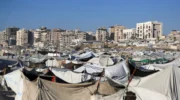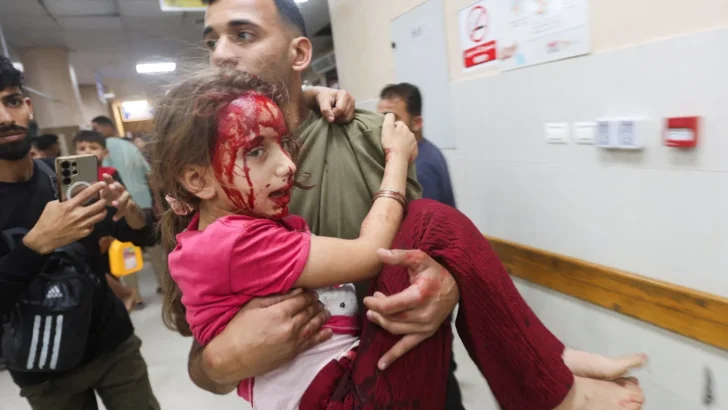
In October 2023, Israel found an excuse to breathe new life into an old story of slaughter and expulsion. The chief differences this time have been of scale and duration
By Jonathan Cook, reposted from Middle East Eye, June 11, 2026
The truth slowly comes to light: Israel‘s genocide in Gaza was planned decades ago.
Listen to the testimonies of four Israeli soldiers who served in Gaza.
Soldier 1: “Human lives didn’t matter. You could kill, there was no law. No one would say a word to you. But it’s not a good feeling. It mainly kills your humanity.”
Soldier 2: “At first I wasn’t willing to execute Arabs who weren’t resisting [that is, civilians]. Then we came to the conclusion that we had to kill. We went through the process of ceasing to see them as human beings.”
Soldier 3: “We caught guys, lined them up and eliminated them. In retrospect, it looks like murder.”
Soldier 4: “We would roam through refugee camps in Gaza and carry out purges… Every soldier who was there created a ‘concentration camp’, and they didn’t hesitate to kill people who caused a slight disturbance.”
No, these testimonies are not new. The whistleblowers did not serve in Gaza during the current, ongoing genocide there. These accounts are nearly 60 years old, published last week by the Israeli newspaper Haaretz under the headline “We were ordered to kill”.
Israeli soldiers interviewed shortly after the 1967 war – often referred to as the Six-Day War – not only confessed that they and others routinely committed war crimes but they pointed out that they did so under orders from their commanders.
The accounts were compiled into a book, The Seventh Day: Soldiers Talk About the Six-Day War, by Avraham Shapira, though many testimonies were not included because they were too shocking.
None of this should be simply of historical interest. These accounts are a vivid reminder that what Israel has been doing during its current, near three-year destruction of Gaza – leveling all homes, hospitals, schools, universities, bakeries and government offices; murdering tens of thousands, more likely hundreds of thousands, of Palestinian civilians; and blocking aid and starving the population – is part of a decades-old pattern of Israeli military conduct.
Nothing “started” on 7 October 2023, when Hamas broke out for a single day of the Gaza “concentration camp” – the plight of Gaza’s Palestinians noted 59 years ago by Soldier 4.
Rather, Israel found an excuse that day to breathe new life into an old story, one in which it has been slaughtering and expelling Palestinians for decades. The chief difference this time is simply one of scale and duration.
Washington and other western capitals have given Israel the time and space to finish in Gaza what, earlier, it had only been able to achieve in part. Israel’s much greater firepower today, provided by modern munitions supplied by the United States, has allowed Israel to realise what before it could only dream of doing: wiping Gaza off the map.
Policy of starvation
The whistleblowing soldiers of 1967 admitted their job was not to “fight the enemy” – or “eradicate the terrorists”, as Israeli leaders now term it. It was to kill and terrorize Palestinian civilians under cover of war.
Few soldiers were shy of saying why they were committing atrocities. Their task was to create a reign of terror, integral to Israel’s efforts to expel as many Palestinians as possible from the last remaining parts of the Palestinian homeland, the territories captured by the Israeli military in 1967 and then illegally occupied.
This was seen as a new opportunity to complete the ethnic cleansing campaign begun by Zionist militias in earnest in 1947 and 1948 as the British Mandate authorities withdrew from Palestine. By the end of that campaign, some 80 percent of Palestinians had been expelled from their homes inside the borders of the newly declared Jewish state.
Many ended up in refugee camps in neighboring states such as Lebanon and Syria. But some fled into the surviving pockets of historic Palestine in the West Bank, East Jerusalem and Gaza – the 22 per cent of their homeland that had been shielded from further Israeli advances in 1948 by Jordan and Egypt.
The 1967 war was seen by the Israeli leadership as a second bite of the cherry: a chance both to seize and colonise all of historic Palestine through military occupation and the establishment of Jewish militia settlements, and to expand the ethnic cleansing operation to rid historic Palestine of its native inhabitants.
Weeks after Israel seized the Palestinian territories, the prime minister of the time, Levi Eshkol, told his cabinet where the expulsions must begin. “We are interested in emptying out Gaza first,” he said.
Given international pressures, he was clear that the ethnic cleansing of Gaza would need to proceed by stealth, so as to attract less attention. Foreshadowing Israel’s 16-year siege of Gaza that started in 2007, he proposed that Palestinians could be forced out of Gaza “precisely because of the suffocation and imprisonment” Israel was imposing there.
The ethnic cleansing programme could be hastened, he suggested, by depriving the population of essentials like water. “Perhaps if we don’t give them enough water, they won’t have a choice, because the orchards will yellow and wither.”
In this spirit, 40 years later, Israel would go on to calculate the minimum number of calories to allow into Gaza so that the people there would grow steadily more malnourished. Or as senior government adviser Dov Weisglass explained in 2006: “The idea is to put the Palestinians on a diet, but not to make them die of hunger.”
Seventeen years after Gaza was forced on to its “diet”, when Hamas briefly broke out of the enclave, Israeli Prime Minister Benjamin Netanyahu and his generals seized their moment.
They destroyed those “orchards” and transformed the “diet” into a full-blown starvation blockade – a crime against humanity for which Netanyahu and his former defence minister, Yoav Gallant, are wanted by the International Criminal Court.
Targeting innocents
The crimes of 1967 were understood long ago by Palestinian historians, who were, of course, not listened to. Israeli historians took much longer to start piecing together the story as they gained access to parts of Israel’s military archives.
Haaretz’s new investigation, based on research by the Akevot Institute, provides details of the ruthlessness of the mass expulsions of Palestinians beginning in 1967.
As the paper reports: “The historical inquiry shows that Israel expelled and drove out some 300,000 Arabs from the West Bank, Gaza and the [Syrian] Golan Heights. And as in 1948, the expulsion included killing civilians, sowing terror in Arab communities, looting and ultimately, destruction.”
Having managed in 1967 to again expel large numbers of Palestinians, the next task – as in 1948 – was to prevent their return.
Uri Avnery, a journalist and member of the Israeli parliament, recorded testimonies from soldiers stationed at the borders with Jordan and Egypt, into which Palestinians had been expelled. The soldiers’ job was to murder any Palestinian families trying to get back to their homes.
Here is one soldier’s testimony, reported by Haaretz, that Avnery noted in his autobiography: “We blocked these crossings and received orders to shoot to kill, without prior warning. Indeed, such shots were fired every night at men, women and children, even on moonlit nights when it was possible to identify those crossing. That is, to distinguish between men and women and children.
“In the morning, we would go out to scan the area, and we would kill, by explicit order of the officer present, those who were alive, including those hiding and the wounded. After the killing was over, we would cover the bodies with dirt until a tractor arrived.”
Today’s Israeli whistleblowers warn that this military doctrine is unchanged. Over the past three years, investigations have repeatedly shown Israel trying to conceal its crimes by secretly bulldozing its civilian victims into mass graves in violation of international law.
It did so, for example, when troops massacred Palestinians seeking aid a year ago, and again when soldiers executed 15 Palestinian emergency workers in an ambush on ambulances in March 2025.
Another soldier troubled by the 1967 shoot-to-kill policy recalled a conversation with his commander: “I asked the officer: And if I hear babies crying, should I shoot them too? The answer I received was: Don’t be a girl.”
There is nothing exceptional about this. Israel is known to have killed more than 1,000 babies in Gaza under the age of one since 7 October 2023, not all of them anonymously in strikes from the air.
The Israeli military allowed a group of five premature babies in al-Nasser hospital to die and decompose in their incubators after its soldiers took over the building in late 2023.
Israeli commanders also knew that the first to die from a blockade of aid would be the most vulnerable. Babies froze or starved to death as the population was deprived of shelter, baby formula and food, with their mothers lacking sufficient nutrition to produce milk.
As Soldier 2 noted, Israeli military doctrine encourages soldiers to stop seeing Palestinians, even Palestinian babies, as “human”. Their lives are considered worthless.
Past familiar
Israeli soldiers murdered another Palestinian baby last week in the West Bank, after they ambushed a car driven by a lecturer from Bethlehem university, Fahd Abu Haikal, in the Palestinian city of Hebron, which is under particularly brutal occupation.
One of the soldiers fired into the car, as it was slowing to a halt, from only a few metres away, from where he must have been able to see the passengers inside. The bullet killed Abu Haikal’s seventh-month-old baby, Sam, and wounded his wife, who was holding the infant. Abu Haikal’s 11-year-old son, also in the car, watched his baby brother bleed to death.
Israeli soldiers have been murdering Palestinian babies for decades. Yet none of it has roused an ounce of the outrage uniformly expressed by western media and politicians at Israel’s entirely fabricated claim that Hamas killed 40 babies on 7 October 2023.
In fact, only one Israeli baby was killed that day: nine-month-old Mila Cohen, who, like Sam Abu Haikal, was shot in her mother’s arms.
Israel’s 1967 campaign of expulsions in Gaza and the West Bank was not improvised, nor was it done on the spur of the moment. According to Haaretz, the policy had been carefully planned many years in advance.
Since 1948, Israel had been waiting for a moment to carry out additional expulsions and seize the last parts of the Palestinian homeland, the territories it had been denied for the completion of its violent settler colonial project.
The 1967 war – against Egypt, Syria and Jordan – provided the pretext.
Ishai Amrami, a senior battalion commander in that war, later admitted: “This thing, which I experienced first hand, was an attempt at massive population transfer.”
As Haaretz observes: “The Palestinians were mere bystanders in this story. Defence Minister Moshe Dayan wrote in his memoirs that the Palestinians residing in the West Bank did not take part in the war, and that it was not their war. Nevertheless, they were the ones who paid its price.”
Israel began the mass destruction of Palestinian communities, as it had done after 1948, so there would be no homes for Palestinians to return to. But as Haaretz notes, Israel became a victim of its own rapid military success.
“This was one of the rare instances in the history of the conflict where Israel was forced to back down due to heavy international pressure.”
It hardly needs pointing out that, unlike 1967, such international pressure has been sorely missing over the past three years. The new cast of western leaders, like Britain’s Sir Keir Starmer, once a noted human rights lawyer, have justified Israel’s explicitly exterminationist agenda against the Palestinians of Gaza, terming it “self-defence”.
Unlike their predecessors in the 1960s, today’s western leaders and their media chose to buy Israel the diplomatic time and space it needed – as well as providing the weapons and intelligence – to destroy Gaza. The genocide would have been impossible without their assistance.
Buoyed by this impunity, Israel has tried to spread the destruction further afield, with limited success in Iran and much greater success in south Lebanon.
As western politicians and media happily forget Gaza, Israel keeps up the relentless pressure and misery there. A so-called “Yellow Line”, demarcating Israeli military control over the destroyed enclave, an area off-limits to Palestinians, has gradually expanded from half the land to 70 percent.
The people of Gaza are quite literally being squeezed out of the ruins of their homeland, as Israel scrambles to find a third country – Egypt, or perhaps Somaliland – willing to take them in.
Excising context
As the US cosmologist Carl Sagan famously observed: “You have to know the past to understand the present.”
Which is precisely why western politicians and media have been so careful to strip out the past, excising the context and background, such as Israel’s violent ethnic cleansing campaigns of 1948 and 1967, that explain Israel’s behaviour in the present – in Gaza, the West Bank and south Lebanon.
Western audiences, deprived of the region’s history, have been more easily manipulated into believing that Israeli atrocities are a response – and a supposedly “proportionate” one, at that – to Hamas’ one-day attack on Israel in late 2023.
An obvious truth has been obscured: that for at least eight decades, Israel has been exploiting any opportunity it could find to expel the Palestinians from their homeland.
The October 2023 Hamas attack was not a turning-point or a rupture, as it is so often presented in the West.
In 1967 – that is, 56 years before the Hamas attack – Eshkol advised that unforeseen events might accelerate Israel’s stealthy programme of ethnic cleansing. A moment might arrive in the future – what he called an “unexpected luxury solution” – when Israel could rapidly realise its dream of a Palestinian-free Palestine.
“Perhaps we can expect another war, and then this problem will be solved. But that’s a type of ‘luxury,’ an unexpected solution,” he explained to the cabinet.
With the missing context added, as Israel’s Haaretz has done with its new article, the story is transformed.
The events of 7 October 2023 look less like simple savagery and more like a desperate, last-roll-of-the-dice response to decades of Israeli atrocities designed to make conditions for Palestinians so miserable – through pauperisation, confinement, starvation, and murder – that they either flee their homeland or die in situ.
With the missing context added, Israel’s supposed “retaliation” in Gaza – its genocidal rampage – looks like what it actually is: a continuation of its eight-decade ethnic cleansing campaign. In fact, its final instalment. Its denouement.
David Ben Gurion, Israel’s founding father, wrote to his son in 1937, 11 years before Israel’s creation: “We must expel the Arabs and take their places.”
In a diary entry during the mass expulsions of 1948, Ben Gurion summarised the mood among his generals: “If we accuse a family – we need to harm them without mercy. Women and children without mercy. Otherwise this is not an effective reaction. During the operation, there is no need to distinguish between guilty and not guilty.”
The goal was the weaponisation of fear, making Palestinians too terrified to remain in their homeland.
Mordechai Maklef, a senior commander in the fledgling Israeli army, noted two years later, in 1950, the logic behind Israel’s policy: “It is impossible to expel 114,000 people who lived in the Galilee without terror.”
Even if we ignore Palestinian accounts from those times, the small sections of the Israeli archives that have so far been opened to Israeli historians document massacres and systematic rapes of Palestinians in 1948.
In recent Israeli films such as Tantura – the village where a terrible massacre of Palestinians was carried out – old men who served as Israeli soldiers at the time confirm the archival documents, recounting how they personally witnessed Palestinian girls being raped.
Let us note that weaponised rape continues to this day – in what the Israeli human rights group B’Tselem calls Israel’s “network of torture camps”.
These rapes – now often using dogs specially trained for the purpose – are so widespread that they have become impossible to conceal. They have even come, very belatedly, to the attention of mainstream media like the New York Times, provoking a cacophony of protest and threats from Netanyahu to sue.
So routine is the sexual abuse of those Israel detains that international peace activists suffered systematic rapes when hundreds of them were seized last month in international waters off Cyprus, as they began their journey to Gaza to break Israel’s genocidal blockade.
Israel wants the fear to spread, from Palestine itself to anyone who wishes to show solidarity with its people.
Western politicians and the media have barely referred to these horrific crimes against their own citizens. Why? Because to acknowledge those crimes would be to concede that even worse atrocities are being meted out to Palestinians under Israeli rule.
Prisons of complicity
Gaza is not an aberration. It is fully in accord with an eight-decade-long Israeli military strategy. Westerners aren’t aware of that only because their political and media class have worked strenuously to stop them from learning about it.
If western publics knew what has really been happening to Palestinians for 80-plus years – first, from the Zionist movement and then from the Israeli state – they might swell further the ranks of the protest marches, making these demonstrations politically impossible to ignore.
If westerners knew what has really been happening to Palestinians, they might join activists who have been trying to incapacitate Israeli weapons factories, like Elbit Systems, operating quite openly in western countries such as Britain. They might, as a result, manage to smash the supply of drones and other weapons being used to massacre the people of Palestine and Lebanon.
Instead of thousands, there might be tens or hundreds of thousands of people willing to hold up a placard in the UK opposing genocide, and be arrested as a “terrorism supporter”, overwhelming the prison system and making a mockery of Britain’s supposed “justice” system.
Armed with knowledge rather dulled by ignorance, more westerners might board boats, amassing an armada that it would be impossible for the western media to disregard. But most critically of all, were the real context understood – were Israel’s decades-long pattern of murdering, raping, and expelling Palestinians known – western publics might wake up to the fact that their political and media class are not moral actors. They are not upholding the values of a superior civilisation. They are not the guardians of international law and a democratic liberal order.
They are imposters. Or more accurately, they are working within political and financial structures that make it impossible to tell truths that would rock a system of power in the West that enriches a tiny elite through a lucrative war machine used to protect the gargantuan profits of the fossil fuel industries.
That system of power drives some Palestinians into an early grave, and others into concentration camps, or exile, or penury.
Meanwhile, it drives us in the West into prisons without physical walls – prisons either of ignorance and complicity, or of knowledge and impotence.
Either way, like Soldier 1, we find our humanity deadened. Our hearts are hardened or broken. The challenge we face is the same as the Palestinians: to find a path out of our confinement.
*Additionally*