The Palestinians dying for work.
By Charlotte Ritz-Jack, reposted from +972 Magazine, June 12, 2026
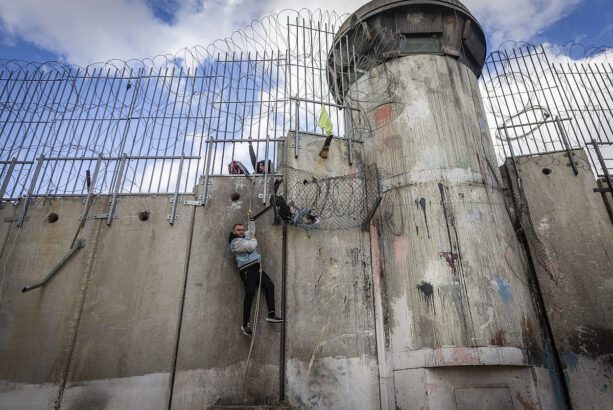
The morning of May 12 started like many others had for Zakaria Qatousa, a 44-year-old father of four from Deir Qadis in the occupied West Bank. Every few months, Qatousa got up early, caught a ride to Al-Ram — a town bordering East Jerusalem but cut off by Israel’s separation wall — and scaled the concrete. Once across, he would make his way to central Israel, where he spent the next month or two working various construction jobs. After earning a few thousand shekels, he would make the journey back to his family.
This time, however, Qatousa never came home. “The [Israeli police] shot and killed him,” Zakaria’s brother, who prefers not to be named, told +972 Magazine. “A bullet hit him in the head while he was climbing the wall, and he was martyred.”
The Qatousas are among dozens of Palestinian families in the West Bank that have recently buried loved ones killed while attempting to enter Israel in search of work. “There are so many people who do this because they’ve lost their income,” Zakaria’s brother explained. “He couldn’t provide for his family, for his home, for the things he needs.”
Ever since the separation wall was built in the early 2000s, Palestinians have scaled it — bypassing the checkpoints that maintain Israel’s strict permit regime to search for work or pray at Al-Aqsa Mosque in Jerusalem. But while the Israeli army often arrested or injured them in the past, killing them remained fairly rare. Since October 7, however, the death toll has skyrocketed.
The General Federation of Palestinian Trade Unions (GFPTU) reports that Israel has killed more than 50 Palestinians attempting to cross the separation barrier without permits over the past two and a half years. Hundreds more — at least 290 according to the UN — have been wounded while trying to get over the 25-foot wall.

Assaf Adiv, executive director of Ma’an Workers’ Association which unionizes workers across Israel and the West Bank, said the number of people killed or wounded trying to cross the barrier is likely much higher than the UN and GFPTU’s figures. He noted that many deaths go unreported to Israeli police (whose data form the basis of the aforementioned tallies), and workers who are targeted at the wall often try to get to hospitals without being discovered.
“It’s very hard to estimate,” Adiv said, but suggested that “somewhere between 100 and 200 workers have been killed trying to cross since October 7.”
This surge in killings is primarily a reflection of a surge in attempted crossings driven by economic desperation. Nearly one-third of Palestinians in the West Bank are currently unemployed, largely due to Israel barring 150,000 people with work permits from entering the country after October 7. Hundreds of thousands more in the public sector have gone months without receiving salaries, as Israel continues to withhold over $4.5 billion in tax revenues from the Palestinian Authority.
In recent months, however, the numbers have ticked up further after Israeli National Security Minister Itamar Ben Gvir ordered police to use live fire as a default against Palestinians crossing the barrier without permits. “[Border Police] started a nice pilot shooting illegal entrants,” Ben Gvir said in December. “It’s starting to bring the numbers down.”
The number of dead, meanwhile, is only growing. At least four Palestinians were killed trying to cross the barrier in May alone.
“Every other day, someone dies trying to cross the separation wall,” said Marwan (a pseudonym), who used to commute from his home in the West Bank town of Anata to his job in Tel Aviv’s produce sector before Israel canceled his permit after October 7.
Since then, he has been tracking deaths and injuries of job seekers at the section of the wall in Al-Ram, where he has witnessed a spike in fatal shootings in recent weeks. He has hundreds of graphic videos that show workers shot while scaling the wall and falling to their death, and paramedics from the Palestinian Red Crescent Society treating those severely injured.

Israeli soldiers and police officers have also caught scores of Palestinians hidden in the trunk of cars or packed into a garbage truck. Those discovered are among the 38,000 Palestinian workers arrested by Israeli authorities since October 7, according to the GFPTU. Many of them were later released but thousands remain languishing in Israeli prisons, where torture and abuse is systematic and around 100 Palestinians are known to have died since the war on Gaza began.
In light of these lethal threats, many Palestinian are choosing to live in acute poverty rather than take the risk of scaling the wall. Zakaria’s brother crossed into Israel twice after October 7, but since Zakaria was killed a few weeks ago, he has decided not to make another attempt. “I don’t want to risk my life and leave my kids to fend for themselves just so I can work in Israel,” he said.
A ‘martyr for workers’
Before October 7, Imad Haroun Ishtayeh ran a successful butchery in his hometown of Salem, just east of Nablus. But since the start of the Gaza war, amid a deepening economic crisis in the West Bank, his business ground to a halt. “He could barely make ends meet and support his family,” his cousin, Nasser, told +972 Magazine. “There was no demand for Palestinian chicken.” A little over two months ago, Ishtayeh was forced to close the store.
He searched for other work, but couldn’t find a viable source of income. Imad was in the process of building a house, hoped to get married soon, and needed to support his father who was suffering from cancer. By the end of May, he was desperate, and decided to do what many around him were doing: sneak into Israel.
On the morning of May 31, Ishtayeh and a few others set up a ladder alongside a part of the wall in Al-Ram, and he was the first to attempt to climb over the barbed wire-topped concrete slabs. Almost immediately, he was shot in the thigh by a Border Police officer, bursting a major artery. As can be seen in a video that captures the aftermath, the other men rushed to get his limp body back down the ladder and to a hospital in Ramallah, where doctors pronounced him dead.

“He wasn’t armed — it’s clear from the video,” Nasser lamented. “It’s obvious he’s a civilian, and he has 10 other civilian workers with him.” Ishtayeh’s family held a funeral for him the same night, which Nasser said drew more than 10,000 people. “They’re calling him a ‘martyr for workers,’” he added.
While the West Bank economy is on life support, Israel’s economy is soaring despite the war with Iran. Particularly as the shekel pushes its upper limits, demand for the low-wage work that Palestinians often provide — construction, carpentry, agriculture — tends to go up with it. Several laborers interviewed for this article testified that they often work upward of 60 hours a week.
Inside Israel, full-time workers from the West Bank are paid on average NIS 6,000-7,000 (around $2,100-2,500) a month, in cash and under the table. Such sums are more than double the average pre-October 7 West Bank salary; in the current economic crisis, they represent close to four times what available local jobs pay (10,000 of which are in Israeli settlements). “If there weren’t employers on the other side, workers wouldn’t risk their lives,” Adiv, of Ma’an, explained.
Authorities have caught Israeli employers bribing Border Police to turn a blind eye as they smuggle workers out of the West Bank, or paying Jewish Israelis to drive workers through checkpoints in their inconspicuous cars — as Zakaria’s brother was in the two instances he snuck into the country. “The irony is that there are Israelis that we work with, and they are not hostile people,” he said.
Adiv was briefed on the latest internal Israeli military security reports, and relayed that the army suspects between 60,000 and 70,000 Palestinians from the West Bank are now working inside Israel without permits. Yet most spend the few weeks they stay inside Israel in hiding. “People are not safe once they cross the barrier — it’s 24/7 worry,” he explained. Most work in Arab towns, where it’s easier to blend in with local workers than in Israel’s bigger, more homogeneously Jewish cities.

Mohammed and Yousef, two 20-year-olds from the southern West Bank region of Masafer Yatta who requested pseudonyms, told +972 that they were planning on making their third journey into Israel without a permit in a few days’ time. As on previous trips, a relative will drop them off near the Green Line in an area where the separation wall has not been completed. They will walk six hours through the Naqab (or Negev) desert to the southern Israeli city of Arad, and then catch a taxi to the Bedouin town where they will stay for a month or two while working.
But Mohammed admitted that there are still serious risks. “If the police catch us on the way, we’ll go to jail for two or three months,” he said. “If we get caught again after that, we will be put in administrative detention,” referring to a form of imprisonment without charge or trial that can be indefinitely extended.
‘Each one of us has a death sentence’
There is little to indicate that Israel is planning to bring Palestinian workers back into its labor force any time soon. Instead, the government has imported tens of thousands of migrant workers in efforts to replace those Israel barred after October 7 — which has only deepened the West Bank employment crisis, and driven more men to risk their lives for work.
The crisis is intensified by the debt-heavy structure of the West Bank economy. “Everyone in the West Bank has loans,” Adiv explained, and families continue to fail to make their monthly payments. “The banks have started legal proceedings, and people are being detained, arrested, and evicted.”
Since October 7, Palestinian households’ risk of defaulting on loans has skyrocketed. While the Palestinian Monetary Authority intervened by requiring banks to adjust monthly payment deductions to partial salaries and authorizing the postponement of deadlines, breadwinners face the prospect of losing their home, car, or freedom. And the dire financial pressure is destabilizing Palestinian families: Marwan and his wife are among thousands filing for divorce as marriages collapse under such unstable and repressive conditions.

The depth of the crisis has also pushed some Palestinians to take their own lives, although suicide rates are generally low in the West Bank. Marwan knows of at least two people who tried to commit suicide, citing their inability to pay off debt or the lack of any income prospects. Two years ago, he filmed a Palestinian man setting himself on fire in a crowded Hebron marketplace while declaring that he had no work.
“The situation is absolutely tragic,” Marwan said. “No one cares about us workers — we’re dying every day.”
And despite the rising death toll, there is little evidence to suggest attempts to seek work in Israel will slow down. “It’s hard to expect that Palestinians will stop trying to cross the barrier, even though it puts their lives at serious risk,” Elza Bugnet, a lawyer at the Association for Civil Rights in Israel (ACRI), told +972.
Bugnet is part of a team challenging the legality of Israeli police officers’ use of live fire against workers crossing the barrier. “Police open-fire regulations do not authorize officers to use live fire in such cases, especially when the person is unarmed and does not pose a threat,” she explained. “Israel is well aware those crossing are actually work seekers, [and this] use of force poses an extreme and disproportionate risk.”
“Each one of us has a death sentence,” Zakaria’s brother said. “Maybe the way we’re killed changes — maybe I’ll die at a checkpoint, maybe I’ll die on my own land from the settlers, maybe I’ll die just walking around — but every kind of killing is happening here.”
To Israel, he continued, “the land is expensive, the wall is expensive, the barbed wire is expensive, but the cheapest thing in all of this is the human being, who is supposed to be the most precious thing in the world. The wall was deemed more valuable than my brother’s life.”
Israel Police did not respond to a request for comment.
*Additionally*
After the ‘ethnic cleansing’ of camps in the West Bank, families say Israeli forces are now taking over buildings in surrounding neighborhoods
By Fayha Shalash and Muhammad Ateeq, reposted from Middle East Eye, June 12, 2026
Mohammed Rahal spent a year and a half displaced after the Israeli army forced him from his home in the Jenin refugee camp in the occupied West Bank.
Eventually, the Palestinian father bought a new house on the edge of the camp. After months of painstaking work preparing it for his large family, Israeli soldiers came knocking once again.
This time, they told him he had to leave so the house could be used as a military outpost for the next two months.
“Sometimes I worked 20 hours a day preparing the house,” Rahal told Middle East Eye. “I was hoping for stability and peace after the hardship of displacement.”
The Israeli military’s use of civilian homes as military positions has become increasingly common in the occupied West Bank.
The practice has intensified since October 2023 alongside Israel’s escalating crackdown across the territory.
In early 2025, the Israeli army launched a large-scale offensive in Jenin, Tulkarm and Tubas. The operation devastated refugee camps across the northern West Bank, with homes demolished, burned or requisitioned by soldiers.
Nearly 40,000 Palestinians were displaced, most of them from Jenin refugee camp.
Human rights groups and experts have accused Israel of war crimes, crimes against humanity, and ethnic cleansing in the West Bank assault.
Ordered to leave
Rahal and his family were among those forced out when the assault began in January 2025.
“My family, my five brothers and their families all lived in the same building inside the camp,” he said. “When the military operation started, we had to flee because the building was damaged and partially destroyed.”
For the next 14 months, the family lived in student accommodation at the Arab American University, which Rahal described as difficult and overcrowded.
Determined to rebuild their lives, he and his sons pooled their resources to buy a house in the nearby Jabriyat neighborhood, overlooking the camp.
The property sits on the edge of a seven-dunum plot of land that Israel seized in May, despite it being located in Area A under the Oslo Accords, an area officially administered by the Palestinian Authority.
Just two months after moving in, Israeli soldiers arrived at the house on Tuesday and ordered Rahal to leave within 10 minutes.
Following discussions with the family, the soldiers extended the deadline until Thursday morning.
Rahal spent the next two days hurriedly removing furniture and belongings he had spent weeks buying and arranging.
Now, he can only wait for the military order to expire on 23 August and hope he will be allowed to return.
But after everything his family has endured, he has little confidence that the house will be handed back as promised.
“Even though the order is for two months, the occupation is unpredictable,” he said.
“They could extend the takeover for another period, and then another, until the house is seized permanently.”
Nowhere to go
Next door, Fidaa Abu al-Haija received a similar order to vacate her home.
Residents believe the Israeli army is preparing to establish a military camp on the land it recently confiscated between the houses. Many fear the takeover will spread beyond a handful of properties and eventually encompass the entire neighborhood.
Abu al-Haija’s home overlooks the seized land, reinforcing fears that the military presence is intended to be long-term.
She lives there with her three children while her husband has been imprisoned by Israel for nearly four years.
A similar expulsion order was issued for the nearby home of her brother-in-law, Abdel Salam, who has also been imprisoned for more than four years. His family of four must leave as well.
Even before the latest order, Abu al-Haija said, soldiers frequently raided the house during the assault on Jenin, frightening her children and leaving rooms damaged. Much of the furniture is now unusable.
“At times I had to turn back halfway home from work because soldiers were everywhere,” she recalled. “I knew they wouldn’t leave me alone.”
The formal expulsion order, however, marks a new escalation and has fueled fears that the takeover could become permanent.
With her husband’s family home inside Jenin camp already destroyed, Abu al-Haija said she has nowhere else to go.
Speaking to MEE as workers hurriedly removed furniture from her house, she said she was now searching for a rental property while trying to salvage what remained of her family’s life.
“The furniture is piled up outside because I want to save it before it’s destroyed,” she said.
“We’ve been living through this tragic situation for more than a year.”
‘Ghost town’
The Jabriyat neighborhood overlooks Jenin refugee camp, making it strategically valuable to Israeli forces and increasingly vulnerable to home seizures.
Mu’tasim Istaiti lives nearby and fears his home could be next.
His family spent more than a year displaced after soldiers occupied their house during the assault on the camp. He later returned in an attempt to protect it.
“Since we came back, it feels like we’re living in a ghost town,” he said. “All we hear are military vehicles. This used to be a vibrant neighborhood. Now it’s almost deserted.”
Concerned for their safety, Istaiti rarely allows his children to leave the house alone.
The army has also blocked the main access road with barbed wire, forcing residents onto a rough alternative route.
“We know staying here is dangerous, but we want to protect our homes until the very last moment,” he said.
“We don’t know what the future holds for our children and us after the decision to confiscate the land near us.”
Mohammad Jarrar, mayor of Jenin, said Jabriyat is one of the city’s largest neighborhoods, home to around 10,000 Palestinians.
Because parts of the area overlook the refugee camp, a growing number of homes have been seized. At least 15 families in Jabriyat have been forced from their homes there since the assault began.
Jarar said Israeli restrictions have also prevented municipal crews from reaching some neighborhoods near the camp to provide basic services to many families still living there.
In one area, he said, a damaged sewage pipe has flooded streets and created a health hazard, but municipal workers have been unable to access the site.
“We fear the displacement of these families will become permanent,” Jarar told MEE. “The occupation appears intent on displacing as many residents as possible out of the neighborhoods surrounding the camp.”
According to the municipality, around 800 families have now been displaced from neighborhoods across Jenin city, excluding the refugee camp itself.
“Even those who remain are being pressured through the withholding of services,” Jarar added.
“The aim is to make life so difficult that people leave on their own.”
Charlotte Ritz-Jack is the Editorial Fellow at +972 Magazine based in Jerusalem. She graduated from Harvard College in the spring of 2025.
Fayha Shalash is a Palestinian journalist based in Ramallah in the occupied West Bank. Shalash holds a BA in Media from Birzeit University.
Muhammad Ateeq is a Palestinian journalist and photographer based in Jenin.
RELATED:
- Welcome to the 60th Year of Israel’s Occupation of the West Bank
- The Gaza family torn apart by IDF snipers from Chicago and Munich
- Israel has no mercy on Christian communities in West Bank, Lebanon: 2 Articles
- ‘Not a normal war’: doctors say children have been targeted by Israeli snipers in Gaza
- Israel’s ethnic cleansing of West Bank Bedouin and herding communities