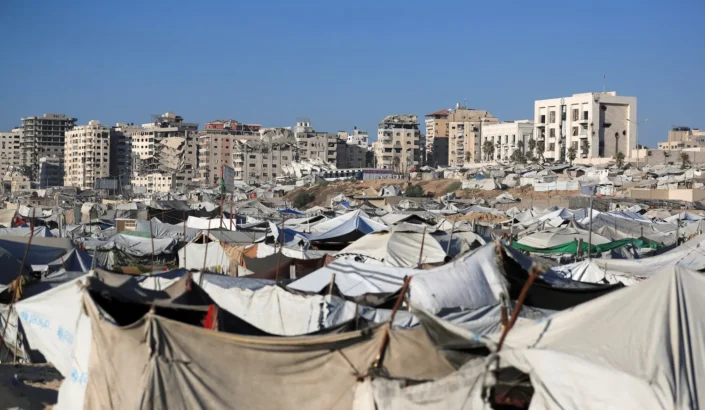
Roughly 1 million Palestinians are living in stifling tents across Gaza. Most of the rest are still waiting for sheltering supplies. And the hottest part of the summer is still ahead.
By Nagham Zbeedat, reposted from Haaretz, July 22, 2026
*Editor’s note: While this article acknowledges the devastation and suffering in Gaza, it leaves out a few critical facts: As a de facto occupier of Gaza, Israel is obligated under the law of armed conflict to ensure that the occupied civilian population is provided with supplies essential to their survival, including basic food and medical supplies as well as clothing, bedding and means of shelter. Instead, 90% of the homes have been destroyed or damaged, and Israel blocks the entrance of sheltering materials. Meanwhile, the Israeli military takes over more and more of Gaza, relegating Palestinians to a smaller and smaller space. In short, this humanitarian catastrophe is part of Israel’s own strategy.*
Osama Nofal spent last night – one of the hottest nights of the year so far – without electricity inside the tent where he lives with his wife and two children.
“It was one of the hardest nights I have been through,” says Nofal, a 32-year-old nurse who has lived in the tent for more than two years.
For Nofal and other families displaced into Gaza’s makeshift camps, such nights are neither exceptional nor temporary. As of March 2026, around 170,000 households – roughly 1 million people – are living in tents across Gaza, according to a report by the Shelter Cluster, a coalition of humanitarian organizations led by the Norwegian Refugee Council.
Another 5,000 households are sleeping outdoors, 52,000 are living in overcrowded shelters, and 850,000 people still lack emergency shelter supplies, such as plastic sheeting, plywood and rope, according to the report. For the estimated 1.9 million Palestinians that have been displaced multiple times since October 2023, this summer marks the third without adequate shelter from heat.
The crisis is expected to become more dangerous as summer temperatures break previous records. Average daytime temperatures in Gaza reach 34.5 degrees Celsius (94.1 Fahrenheit) during August, the warmest month, while the number of days that exceed 35 degrees Celsius (95 Fahrenheit) is expected to increase compared to recent years, according to the Red Cross Red Crescent Climate Center.
The plastic sheets used to construct many tents trap heat and leave little ventilation during the day, nor is there relief after sunset. Families endure the humidity without electricity, fans or a dependable water supply.

“You cannot sleep because of the heat inside the tent, the insects, the reptiles and the rodents, because of the life you were forced into,” Nofal says. “These tents are unsuitable for summer heat or winter cold. In summer, the plastic makes it even hotter inside, and there is no air.”
The conditions are especially punishing for larger families crowded into a single tent, he adds. “We are a small family, but some families have seven or eight people in one tent, through the heat of the day and the night, as well as the illnesses.”
Even water offers little relief. Obtaining enough to drink or cool themselves requires waiting in long lines at water trucks provided by humanitarian groups, Nofal says. There is no tap inside the tent, and no reliable supply nearby. Summer heat has made each daily task much harder to complete.

Nofal describes sweat pouring from their bodies “as if we were in a sauna or a wood-fired oven.”
“What did these children, aged 5 and 6, do to deserve living through all of this?” he says. “All their childhood memories are of war, displacement and killing.”
Palestinians in Gaza have also described the summer conditions in online posts, portraying the heat as another layer of a displacement crisis that has stripped families of ordinary ways to protect themselves.
Muneer al-Bursh, director general of the Gaza Health Ministry, wrote that torn tents become “plastic ovens” under the summer sun, without electricity or fans and with barely enough water for families to drink or wash their faces. At night, he wrote, a “second shift” begins, with mosquitoes in the air, rats on the ground and fear that never subsides.

Al-Bursh linked each of those conditions to the war: homes destroyed and replaced by tents, scarce water, devastated infrastructure and families forced into a few square meters enclosed by fabric and plastic.
Ibrahim Muslim, a journalist and writer from Gaza, asked users on X to imagine enduring unbearable heat “while the thing you crave is a glass of cold water, but water is either scarce or unavailable.”
“Homes where fans or air conditioners once offered relief are now memories, while families suffocate beneath tent roofs in a summer made harder by shortages of basic necessities,” he added.
Ahmad Hamdan, an independent journalist from northern Gaza, wrote language could convey only a fraction of the suffering.
“There is pain that words are unable to carry,” he wrote on X. “The tent can only be described as an inferno that burns souls before bodies.”
Nagham Zbeedat covers Palestinian affairs and the Arab world.
RELATED:
- ‘We hate winter’: Palestinians face the rain without shelters as Israel blocks tents
- This baby joins thousands of Gazans in need of medical evacuation
- Israel drops incendiary and explosive bombs on Gaza City homes and tents
- Israel turns Gaza into death camp denser than Srebrenica, forces displacement under guise of voluntary emigration
- Family Wiped Out, Police Targeted: Israel’s Genocide Claims 16 More Lives