By Dahlia Scheindlin, reposted from Haaretz, May 5, 2026
A few days ago, Mohammed Zaanoun, a well-respected Gazan photographer wrote on Instagram “So that we do not forget: More than 20,000 children have been killed in Gaza during the war, and many children are still missing. The war continues, but the world no longer seems to care.”
The video was full of white body bags, including a small one, wrapped in a blue baby blanket, on top of the adults. Another recent photo on his feed showed a family holding their dead child, the mother’s hands stretched out to touch his face during the funeral. The child was killed the previous day by an Israeli air strike. Three days earlier, a “graphic content” warning: the bloodied feet of dead children on sheet metal tables smeared with blood turning brown.
Is it true that Gaza is being forgotten? It’s both sad and obvious that newer and more tectonic wars in the Middle East have drowned out Gaza – where there is supposed to be a cease-fire. But that’s the easy explanation.

Horror saturation
Compassion fatigue is surely at play. People get exhausted and desensitized to more death, anguished families, misery – the main story coming out of Gaza.
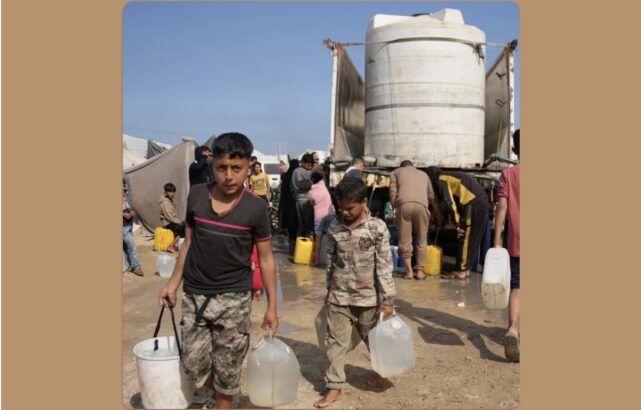
And dead children are just one example of this unbearable reality. Life itself seems to yield fresh horrors daily. The latest one is rats; they are everywhere. Elderly people and babies have been bitten. The World Health Organization found that “rodents and pests” can be seen at 80 percent of displacement sites in Gaza, along with the accompanying skin diseases, like scabies – hard to treat without sufficient electricity for washing machines or abundant water, not to mention medicine. The war wrecked Gaza’s healthcare system, and Israel bombed hospitals, putting about half out of operation during the worst fighting. Nearly all hospitals have suffered damage or destruction, according to WHO.
People’s mental health is suffering. Women’s health is suffering; there have been cases of sexual exploitation by Hamas or religious authorities in exchange for basic supplies. Teen marriages have risen sharply during the war after years of decline, due to “hunger, fear and displacement,” while adolescent pregnancies have surged; the rate of teenagers giving birth has more than doubled since before the war, according to the UN Population Fund.

One doctor wrote on X: “This is what people in Gaza talk about now: Food. How to get aid. How to get rid of the rats living inside their tents. How to survive the unbearable heat of summer under fabric roofs. How to educate their children when there are no schools … How to cover bathrooms whose thin cloth no longer provides even basic privacy.”
Take this terrible review, and quadruple it for the fields of education, housing and infrastructure, and the economy, to understand life in Gaza.
It is admittedly hard to keep reading all this, when human instincts want to stop it, or at least find out how this can end.

Political chaos
But such a quest offers few answers. Under what passes for a cease-fire, the Israeli military has killed over 800 people. Israel’s restrictions on Gaza’s crossings, for people and for cargo, are spastic (Rafah, the main crossing to Egypt, was closed when Israel destroyed the Gazan side in May 2024, then opened almost a year later, but has been repeatedly closed by Israel again since the war with Iran, according to the Israeli human rights organization Gisha, which focuses on freedom of movement in Gaza).
Who is actually in charge? Let’s count the different actors.
The Israeli army is physically installed in over half the territory, while Israel’s policies affect everything about life in Gaza – from the movement of people and goods, near total obstruction of electricity supply, as well as restrictions on fuel needed for electricity generation, and on parts needed for maintenance and repair of generators, as well as water and sewage infrastructure.

More humanitarian aid may be entering Gaza since the cease-fire, but Israel still restricts “dual-use” items – possible security threats, as it has since 2007. The list has always included construction materials and chemicals, but also at times medical equipment like insulin pens, and bizarre items like cilantro.
A few months ago, the UN found that Israel had restricted “frozen meat, tropical fruit, biscuits, vehicles, power equipment, specialized machinery, multipurpose tents and learning and recreational materials for children.” Since October 7, Gisha found that Israel’s restricted “dual-use” category has included at points “flashlights, non-electric wheelchairs, tarps, sleeping bags and portable toilets.”
Next, Hamas is famously still around – apparently entrenched in the western part of Gaza. Nickolay Mladenov, the seasoned UN diplomat now serving as High Representative to Gaza and director general of the Board of Peace (a creation of the cease-fire plan), is working to negotiate disarmament but seems to be facing a standoff.

Hamas is demanding that Israel first commit to its obligations under the deal – withdraw its forces from Gaza, for example. Unnamed Israeli security officials responded in Israeli media by threatening to re-start the war there. It should be no surprise that lengthy, phased, conditional deal has stagnated.
There’s the Board of Peace: U.S. President Donald Trump’s idea. It was supposed to represent a sort of council of elders for Gaza and the whole world. The body has raised funds and now boasts of the excellent improvements to humanitarian aid – certainly a good thing in itself, but no substitute for political progress. It’s also busy mocking pro-Palestinian activists instead of sticking to its lane, which seems unlikely to build trust among Gazans.
There is the National Committee for the Administration of Gaza, also established by the cease-fire deal. This technocratic group is probably well-meaning, but unable to do much from its hotel in Cairo, since Israel hasn’t yet let its members into Gaza. Maybe if they get in, the group could advance some symbolic developments, such as winning more openings at Rafah, or help with disarmament, said one informed international observer. But even symbolic progress seems hypothetical.
The much-promised International Stabilization Force has not yet materialized. Mladenov told the UN Security Council in late March that five countries had committed to sending troops (Indonesia, Morocco, Kosovo, Albania and Kazakhstan) and five principles have been discussed. He also reported that he had a good meeting with Israeli Prime Minister Benjamin Netanyahu on Tuesday. It all sounds good, any day now.
In another wan twist regarding governance, Palestinians held local elections in late April. Experts noted to Haaretz that this has happened every number of years, though erratically – it’s not the major breakthrough that national elections would be. Most candidates ran on independent lists, many leaned towards Fatah – in some places, Fatah lists ran unchallenged.

Still, for the first time, election law was changed to allow voting for candidates within a list, rather than choosing a whole list. In Gaza, the elections were held in Deir al-Balah, a municipality that was relatively less damaged than other parts of the Strip. Turnout was only around one-quarter. Nevertheless, it was a Palestinian Authority-led process within Gaza, deemed orderly and fair; Hamas neither participated nor interfered, and a local council will now represent at least those voters in that district, for the first time in 22 years. It’s not much – PA loathing runs deep, too – but at least it comes from Palestinians.
Helping themselves
Between the IDF, Hamas, the BoP, the NCAG, the ISF and the PA – Gazans seem to hold out hope for very little from this alphabet soup. Shortly after the cease-fire was reached in October, PSR polling found that just nine percent of Gazans were satisfied with U.S. performance during the war. Considering their own political parties, nearly 60 percent of Gazans in the latest Arab Barometer survey from October 2025 would not vote for either Fatah or Hamas (of these, about one-third said they wouldn’t vote at all).
In this dismal environment, perhaps it’s only natural that the inspirational stories have come from Gazan people themselves. Haaretz’s Nagham Zbeedat reported on a spectacular initiative of individuals to re-establish libraries – including swanky bookshelves and hip-looking opening events.

Zaanoun, the photographer, posted a video of a mass wedding ceremony in Gaza City a few days ago, with brides dressed in eye-popping colors where we usually see gray. I think about “The Book of Gaza” – a terrific collection of short stories by Gazan authors, translated into English. It was published nearly a decade before the current war, but provides a window for outsiders onto the inner lives of human beings in that unnatural world.
These nice stories are no match for a brutal reality. But if nothing else, they could remind an indifferent world that Gaza isn’t just a humanitarian crisis or a security problem to be addressed when things get tough. It’s a place full of human beings who need a normal life, all the time.
Dr. Dahlia Scheindlin is a public opinion researcher and a political advisor who has worked on nine national campaigns in Israel and in 15 other countries. She is currently a policy fellow at The Century Foundation, and she has co-hosted the Election Overdose podcast at Haaretz.
RELATED:
- Rep. Randy Fine Tells Palestinians To ‘Starve Away’ as Babies Die of Malnutrition Under Israeli Blockade in Gaza
- The Madeleine ship: A message of solidarity with Gaza and resolve to break the blockade
- After 15 years of blockade, 4 of 5 children in Gaza struggle with depression, grief & fear
- “Emperor” Trump’s So-Called Board of Peace Erases Palestinians from Gaza Governance
- Gaza’s ‘Board of Peace’ – A New Phase of Palestinian Dispossession and Genocide