By Yagil Levy, Reposted from Haaretz, May 7, 2026
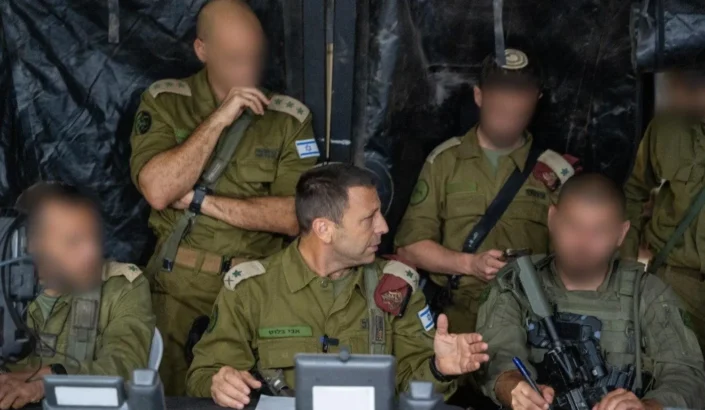
A general is only a reflection of his community. Maj. Gen Avi Bluth, appointed in 2024 to lead Central Command, and with it the army forces in the West Bank, grew up in a settlement and his family still lives there, and attended pre-army academy in the settlement of Eli.
His appointment – he is the first of his background to be appointed to the position – has shaped the change in Israel’s policy in the West Bank. His appointment signaled an erasure of the artificial distinction between Gaza and the West Bank. And indeed, he has not disappointed.
In a closed discussion published by Haaretz journalist Josh Breiner (Haaretz, May 4), Bluth eloquently described his mission: to create a perpetual war in the West Bank, but also to prevent its escalation. How to do that? You create constant friction, “engage” the Palestinians and “turn the villages into conflict zones.” That’s how you ignite a conflict. In response, Israel is “killing like we haven’t killed since 1967.”
But the killing is presumably legitimate, because it’s only against those involved in terror (96 percent of the killed), surgical shooting or “precise aggression” as Bluth puts it.
It isn’t hard to find those involved, because after all, every Palestinian is a “potential terrorist,” he says. Those who aren’t involved are killed less often, but deterrence is created against them. How? The economic distress, which is reflected in unemployment, functions as a mechanism that leads to a situation in which trespassers who are desperately seeking work in Israel are willing to risk being shot in the knee in order to enter. Israel is exploiting the economic motive and creating “awareness of an obstacle” by easing the regulations for detaining a suspect.
The shooting is not designed to prevent danger, as Bluth is implying, but to leave Palestinians in the area whose limping attests to the circumstances of their injury, whom he dubs “limping monuments.” But if there was no unemployment, then that wouldn’t happen, and it’s doubtful whether they would find presumably legitimate excuses for firing at the knees, which gives rise to so many “monuments.”
That’s how a sophisticated and quasi-legitimate engine of control works. But this legitimacy is being threatened by settlers who don’t internalize the rules of the game, to the effect that violence is reserved for the army only, and in order for the army to impose it effectively, it’s necessary to refrain from independent initiatives. After all, the army is creating territorial contiguity with dozens of private farms in Area C (where Israel has security and civil control) – a method favored by Bluth even before his appointment as head of Central Command.
Silencing the world and the Palestinians requires sophisticated use of force, which Jewish hoodlums don’t use. And in particular, the Palestinians must be prevented from responding (Bluth is concerned that they’ve begun to form popular guard committees), whereas the art of the commander lies in sophisticated deterrence that will guarantee obedient Palestinians.
But here the general is careful not to provoke the settlers, whose obedience he must also ensure. That’s why the army refrains from shooting at Jewish stone throwers, also in order to prevent immediate danger, because “that has very serious consequences from a sociological perspective.”

The general, in his role as a sort of sociologist and not only a military governor, refrains from doing his job out of fear of upsetting the Jewish order. But in order to avoid disobedience among the Palestinians, Bluth must call the settler public to order again. That’s why he recently condemned Jewish terror in harsh terms. In doing so, he helps to draw a line between violent but legal activity conducted by the organized military machine, centered around taking over control of the land by means of the farms, and the activity of civilian rioters, which endangers this legitimacy.
Yagil Levy is an Israeli military sociologist and political scientist who studies the theoretical and empirical aspects of relations between society and the military.
RELATED:
- With World Distracted by War, Extremist Settlers Intensify Attacks in West Bank
- Far Right Israeli Settler Movement Enters Syria in a Push for “Greater Israel”
- Israeli Settlers Killed a Palestinian Farmer on His Own Land, in Front of His Father. Yes, Again
- Israeli soldiers echo settler ideology, talk of revenge after targeting Palestinians and detaining CNN crew in the West Bank
- Israeli media reports grotesque settler attack in West Bank