Hundreds, if not thousands, of Palestinian students who have been awarded scholarships abroad are trapped in Gaza, unable to claim their places at universities in Italy, Turkey, and other countries.
By Sara Awad, Reposted from The Electronic Intifada, June 22, 2026
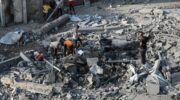
In May 2024, Israeli troops seized control of the Rafah crossing between Gaza and Egypt. It marked the beginning of an all-out Israeli offensive on Gaza’s southernmost city that has left Rafah in ruins.
Since then, the crossing has been mostly closed, until February of this year, when, nearly four months into a ceasefire-that-is-not-a-ceasefire, Israel allowed some exceptions for humanitarian cases.
But Israel continues to close the crossing on a whim, and for those seeking to study abroad, there has been little hope of traveling.
For the youths in Gaza, the closure not only sees them trapped in a genocide, but it also leaves them unable to rebuild their future or bring expertise back to Gaza if they had secured scholarships abroad.
On 22 April, dozens of students gathered under the heat of the sun across Gaza to protest their situation. The protest was publicized on WhatsApp student groups with the admonition, “Your attendance is crucial.”
“All we need is for the doors to open,” Naghma Abu Ghali said in comments during the protest, later published on social media, calling for a solution for her and her fellow students.
No choice
There is no official figure for how many students are trapped in Gaza, unable to take up scholarships abroad. Estimates vary between 1,000 and 2,700.
The lack of “steady statistics,” according to Ahmed Abu Nada of the Ministry of Education in Gaza, is that there are “variations in the types of scholarships” and “different approaches” during the application process.
What is not in doubt is that, however many the students, they have so far survived Israel’s genocide, the wholesale destruction of their homes and lands, and the killing of tens of thousands of their neighbors and relatives. Yet they still continue to fight for their dreams.
They have no choice.
They are calling for help from the governments and universities around the world that awarded scholarships – the United Kingdom, Turkey, Canada, Italy, France and others – to help secure safe passage.
Some students did make it out of Gaza after October 2023.
Luck was on my side. I was fortunate enough to be evacuated from Gaza to Italy via a program called IUPALS, or Italian Universities for Palestinian Students. I left Gaza in December 2025, in one of the last evacuations before they stopped.
My evacuation process was complicated. I passed through historic Palestine and the occupied territory to Jordan, then on to Rome. It took me one full day in a bus that had to stop at three Israeli military checkpoints, where we were all checked and checked again, before we could arrive in Jordan. It was exhausting. And, it being my first face-to-face encounter with the people who have been killing us en masse and stealing our land, it was doubly emotional.
I felt so much anger. Israel was created through the ethnic cleansing of the Palestinian people, my people. It has occupied, detained, evicted, slandered, and killed us ever since. It has destroyed our future and controls our present.
I left Gaza with nothing but my phone and my identity card. I left behind my parents and five siblings. I feel guilty every day for leaving them.
My scholarship in Italy means more than simply a right to education, however. It is a right to live. It gave me a chance to experience a sense of normalcy and to continue my academic path safely, without fear of death and destruction.
It’s been six months since I arrived in Italy. I am an undergraduate student in languages and linguistics at Università per Stranieri di Siena. I study in a new place, with new faces, a new language, and a new life – a life I had almost given up on in Gaza under genocide.
I secured the scholarship after two years of chasing opportunities, in tents, in offices, on any street where I could find an internet signal. Whenever I found an opportunity, I reached for it.
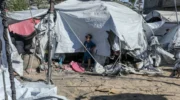
I applied for more than ten scholarships. Most declined, but I didn’t know what giving up meant. I remained fixated on my phone screen at night in our tent in Al-Zawayda camp.
I was awarded the scholarship in October 2025. I left two months later. All the tiredness, the fear, and the tension I had put aside in Gaza without noticing have now come to the surface, and I receive counseling for my mental health.
All my worries and thoughts spill over into my days in Italy.
Losing hope
My heart aches for those who remain trapped in Gaza.
Israel’s genocidal war has changed the relationship between Gaza’s students and foreign universities.
Students no longer view a foreign scholarship as merely nice to have. It has become an existential necessity, a matter of survival, to leave the miserable conditions in Gaza.
Sham Jouda, 25, is an engineering graduate from Gaza’s Al-Azhar University. She was awarded a scholarship in Italy a year ago, but she is still stuck in Gaza and has no clear idea when she might be able to travel.
“I am tired of the false hope,” Sham told The Electronic Intifada. “I wake up and go to bed hoping for better news, but nothing changes.”
Sham had long dreamt of studying in Italy, even before October 2023, having her heart set on civil engineering at the University of Padova. Now she only wishes to get out of Gaza.
Of the 340 students who secured scholarships to Italy, just 180 were able to reach the country last year.
Sham is one of the 160 students who remain stuck in Gaza.
“Italy managed five evacuations, but I was not included in any,” Sham said over a video call, her face visibly exhausted and lined with worry. “I would love to reunite with my fiancé and start our paused life in Italy as we dreamed.”
Sham’s fiancé, Mustafa, had left Gaza in the early months of the genocide and, from Egypt, secured a scholarship to Italy.
She feels unjustly treated when she sees or hears from the students who did make it out, she said.
“My life has stopped in Gaza. Everything is moving except my own timeline.”
Mental health struggles
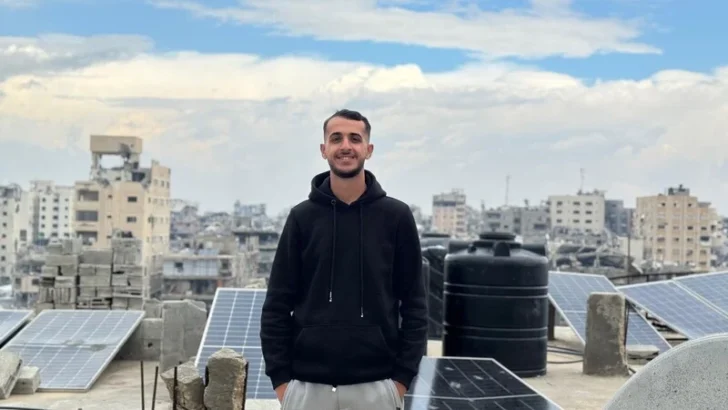
Bilal Salama, 23, an e-commerce graduate of Al-Azhar, had been awarded a master’s degree scholarship to Goldsmiths, University of London. Unlike Sham, he is not on any evacuation list, and his wait is likely to be longer than hers.
“If the Rafah border did not close, I would be out,” Bilal told The Electronic Intifada via video chat, his eyes often seeking the floor rather than the camera. He said he had lost a job opportunity in Egypt in the first months of the war due to the Israeli siege, and now he fears he may never leave Gaza.
“I am continuing my part-time job in Gaza,” he said. “I am not waiting.”
Students are struggling with depression because of the fading hope that they might still be able to leave, borders might reopen, or someone might break this barrier that stands between them and their scholarships.
Bilal is one of those students. The endless wait has taken a toll on his mental health, he said.
“Students who are suffering from this endless waiting need mental health assistance. I need a therapist. But how can I recover [while] living in the same conditions?”
Bilal tries to continue his life in Gaza. He has an Instagram page, he said, that gives him some relief.
“If I can’t go out, I will do other useful things,” he said. He has chosen to use his platform to share the reality of what is happening in Gaza.
Of course, leaving Gaza is not the end of the story, as I’ve come to understand.
Fares al-Faraa, 20, was evacuated to Italy in November 2025 after receiving a scholarship under the IUPALS program to study political science at the University of Bari Aldo Moro.
In 2024, his right hand was fractured during an Israeli bombardment on homes in his Khan Younis neighborhood that killed four of his relatives. Ever since, his movement and ability to use his hand have been constricted, and daily life is more complicated.
“I not only receive the right to education, but I also get treatment for my injury,” Fares told The Electronic Intifada.
Fares does not want to be defined solely as a survivor of war and genocide, however. He has chosen instead to tell the world what it means to be young in Gaza, in his book, I Didn’t Die, which was published by Italian publishers, Another Coffee Stories.
“I wrote this book because I want everyone to understand that we are not numbers, we have stories,” Fares said.
Despite the opportunities now available to him in Italy, the separation from his loved ones remains a heavy burden. He was evacuated with his brother Tarek, who is pursuing a master’s degree in economics at the University of Turin, yet the rest of their family is still in Gaza as the two brothers build a life from scratch in Italy.
“Life feels meaningless sometimes when I am away from my family,” Fares told The Electronic Intifada. “I wish there were no distance between us.”
Editor’s Note: In 2008, the U.S. State Department canceled the Fulbright scholarships of eight students in the Gaza Strip because they would not be able to get exit visas from Israel. Israel has long blocked Gaza’s students from studying abroad.
Sara Awad is a Palestinian writer from Gaza now studying in Italy.
RELATED:
- Gaza’s students face a near impossible test to study abroad
- 15K Gaza Students Have Been Killed. Survivors Are Denied Their Education.
- Israel’s assault on Palestinian universities is a threat to human rights and a tragedy for this generation of students
- After crushing dissent, U.S. universities are deepening ties with Israeli academia
- This school is sheltering 14,000 people in classrooms…