Almost 1,000 days after October 7, there is still no new evidence backing up Israel’s claims of mass rapes and systematic sexual violence by Palestinians.
In fact, the report appears to further undermine those claims.
By Ali Abunimah, Reposted from The Electronic Intifada, June 03, 2026
UN investigators have verified multiple rapes of Palestinian detainees by Israeli forces, but have still not verified a single claim of sexual violence against Israelis on or after 7 October 2023.
In his latest annual report to the Security Council on sexual violence in armed conflict, United Nations Secretary-General António Guterres warns that the verified crimes against Palestinians should be seen as “indicative of incidents and patterns” more broadly.
For the first time, Guterres added Israel’s military and security forces to the UN list of entities credibly suspected of responsibility for patterns of rape or other forms of sexual violence.
The full extent of those crimes is difficult to document because Israel continues to deny UN investigators access to detention sites and to Gaza, while reporting is further obstructed by “explicit threats” from Israeli forces “coercing detainees not to report abuse,” according to the report.
Rapes and gang rapes
The UN verified sexual violence, including rape and sexual violence used as torture, by Israeli forces against 31 Palestinians from Gaza and the West Bank: 14 men, seven women, nine boys and one girl.
Thirteen of these cases occurred in 2025, and 18 in 2023 and 2024. The violations included rape, rape with objects, gang rape, attempted rape, forced nudity, threats of rape, unwanted touching of breasts and genitals, genital violence, targeted shooting of the genitals, and strip and cavity searches “without apparent security justification.”
Rape and gang rape, sometimes repeated, were verified against nine victims, most of them from Gaza.
The UN identified the perpetrators as Israeli military and security forces, including the Israeli army, the Israel Prison Service, its Keter special forces, and Yamam, the police “counterterrorism” unit.
The abuses took place mainly during detention and interrogation, including in prisons and detention camps at Sde Teiman, Etzion, Majnunah, Megiddo, Ofer, Ramla, Hasharon, Shatta, Nafha, Damon and Gush Etzion police station. Others occurred at checkpoints and during Israeli military operations.
The victims included journalists and human rights defenders. Some violations were filmed or photographed, including one of the rapes.
Women detainees were subjected mainly to threats of rape, forced nudity, unwanted touching and “humiliating or degrading strip searches without justification.”
Men and boys were subjected to rape, attempted rape and genital violence, leaving five male victims with severe rectal bleeding or swelling for days or weeks, in some cases without medical treatment.
The report adds that released detainees returned to catastrophic conditions in Gaza.
The UN report says Israel’s longstanding failure to hold its forces accountable has created a climate of impunity for violations against Palestinians.
It cites the case of five Israeli reserve soldiers indicted in February 2025 for severely assaulting a Palestinian detainee at Sde Teiman in July 2024.
Despite video and medical evidence – and allegations that the assault included inserting an object into the victim’s anus, causing severe rectal injuries – the indictment did not include charges of rape or sexual violence.
In March 2026, all charges were dropped, and the alleged perpetrators have been widely celebrated in Israel as heroes.
These findings are consistent with other independent investigations into systematic Israeli sexual violence against Palestinians.
No verified Israeli victims
Meanwhile, the new UN report contains no new evidence backing up Israel’s claims of mass rapes and systematic sexual violence by Palestinians on 7 October 2023. In fact, it appears to further undermine those claims.
In his report to the Security Council last year, Guterres listed Hamas – though not Israel – as a party responsible for patterns of sexual violence and rape.
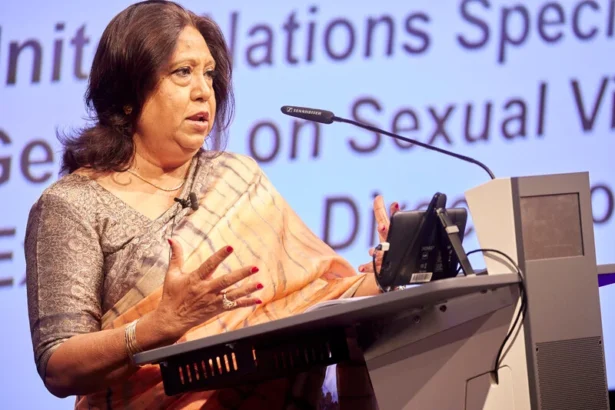
In last year’s report, Guterres stated that a mission to Israel in early 2024 led by Pramila Patten, the secretary-general’s special representative on sexual violence, “found clear and convincing information that some hostages taken to Gaza were subjected to various forms of conflict-related sexual violence during their time in captivity.”
Guterres also wrote that Patten’s mission “found reasonable grounds to believe that sexual violence occurred during the attacks of 7 October 2023 in multiple locations, including rape and gang rape.”
Patten’s claims, contained in a separate special report published in March 2024, were widely reported at the time as corroborating Israel’s narrative.
However, last year’s report by Guterres specifically states that evidence Patten cited was “circumstantial” and Guterres did not state that any case of sexual violence, including rape, had been verified.
Guterres’ 2026 report still makes no reference to verified Israeli victims of alleged sexual violence by Palestinians, including rapes.
It states that after two ceasefire deals in 2025 led to the release of more than 50 captives held by Hamas and other Palestinian armed groups in Gaza, six Israeli former captives publicly alleged sexual violence.
They included one female captive released in January 2025, two women released in 2023 who spoke publicly in March 2025, and three male captives released in October 2025.
Guterres states that “the United Nations was not able to verify any of these reports, given the continued denial of access by the Government of Israel to competent United Nations bodies to carry out investigations.”
The secretary-general’s report is totally silent about any new evidence, let alone victims, that could corroborate Patten’s sweeping 2024 claims regarding sexual violence on 7 October.
Guterres also notes that the UN “has not as yet received information on indictments by the authorities in Israel for charges of sexual violence against detained Palestinians accused of involvement in the attacks.”
Despite the sensational headlines generated by Patten’s March 2024 report, its detailed findings actually undermined more than they supported Israel’s propaganda narrative: For instance, Patten’s team was unable to find a single photo or video documenting any rapes on 7 October or containing “tangible indications of rape.”
What is clear from this year’s annual report is that the UN has not obtained any new evidence since then.
That is consistent with earlier findings.
In June 2024, the UN Human Rights Council’s independent commission of inquiry into the events and aftermath of 7 October 2023 stated that it had reviewed reports of Israelis being raped “but has not been able to independently verify such allegations.”
The commission also said it was “unable to verify reports of sexualized torture and genital mutilation” of Israeli victims.
In January 2025, an Israeli prosecutor admitted that authorities had zero complainants in alleged cases of 7 October rapes.
And last month, a 300-page Israeli report attempted to revive the mass rape narrative, but also failed to document a single credible case of rape more than two and a half years later.
Rush to judgment
In a press conference last week launching the secretary-general’s new report, Patten confirmed that she “did not meet with any survivor” of supposed 7 October sexual attacks during her 2024 visit.
She said that early last year, she received an invitation from the Israeli government to return to the country, but protracted negotiations over the terms of the visit broke down over Israel’s refusal to provide any evidence that it was implementing measures to stop sexual crimes against detained Palestinians and to provide UN access to detention facilities.
At the press conference, Patten faced a direct challenge over her 2024 visit.
France 24 correspondent Jessica Le Masurier noted the concrete evidence of Israeli sexual crimes against Palestinians cited in this year’s report from the secretary-general, including videos and photos of abuses.
She contrasted that with the absence of evidence backing Israel’s claims about 7 October.
“I remember when you had your visit to Israel, you told me that you were not able to seek any evidence,” Le Masurier said to Patten. She then asked Patten whether “with hindsight, you regret that trip, seeing as it caused so many issues regarding actually being able to draw clear conclusions based on evidence.”
Patten replied that her 2024 visit to Israel “was of an exceptional nature, because of lack of access to relevant UN human rights monitors.” She argued that if she had not gone, “that would have meant that there would have been nothing in the secretary-general’s report on the 7 October attacks.”
One way of interpreting Patten’s response is that in the absence of credible evidence of sexual violence on 7 October, she and her boss António Guterres preferred to recycle and amplify unverified Israeli claims and atrocity propaganda rather than to wait for credible evidence – evidence that nearly three years later is still nowhere to be found.
In doing so, Guterres and Patten – deliberately or not – aided and abetted Israeli atrocity propaganda used to mobilize support for an ongoing genocide that the UN secretary-general still refuses to name.
Ali Abunimah is executive director of The Electronic Intifada.
RELATED:
- UN Adds Israel to Blacklist of Perpetrators of Sexual Violence in Conflict Zones, Ambassador Says
- Israel Can Sue New York Times Over Sexual Abuse Allegations, But Can’t Erase the Truth
- ‘I wished for death’: Sexual violence in Israel’s prisons is an ‘organized state policy’
- ‘Your Mother Was Raped’: Israel Uses Sexualized Torture against Child Prisoners
- PCHR Documents Testimonies of Systematic Rape and Sexual Torture in Israeli Detention against Released Palestinian Detainees