For many Gazans, both the displaced and those remaining in their homes, Netanyahu’s intent to expand territorial control over Gaza is not merely a military issue, but a question about their ability to continue living in the Strip
By Jack Khoury, reposted from Haaretz, June 4, 2026
Residents of the Gaza Strip have long stopped measuring the war in terms of the number of dead and the scale of destruction. They are focused on the day-to-day struggle to obtain food and medicine, while also cautiously anticipating the implementation of reconstruction and humanitarian aid plans.
However, in the past week, they have once again become concerned with political issues: specifically, Prime Minister Benjamin Netanyahu’s statement of intent to expand Israel’s territorial control over Gaza from 60 percent to 70 percent of the enclave.
For many Gazans, both the displaced and those remaining in their homes, this is not merely a military issue, but a question about their ability to continue living in the Strip.

Nearly two million Palestinians currently live in Gaza, and the takeover of an additional 10 percent of the territory is not just a technical matter for them.
Tens of thousands of Gazans are expected to leave their homes, as Israel will not allow them to live in areas under its control, where members of militias opposing Hamas and their families are currently located.
These are tens of square kilometers from which a population already suffering from severe shortages in infrastructure, water, food, and living space will be pushed out.
According to a senior official in Gaza’s Ministry of Social Development, which is under Hamas control, even a reduction to 30 percent of the livable area could result in tens of thousands of residents being unable to live there.
“To take control of another 10 percent of the territory requires moving a massive demographic mass,” said the official, adding that this would create unbearable pressure and worsen social problems.
The killing of Hamas police has created a “security vacuum,” the official said. According to him, there is no one to deal with theft, violence, and other criminal offenses, and therefore “the citizen struggles to protect himself, his family, and his property.”
Against the backdrop of infrastructure destruction and intense heat, pushing tens of thousands of people out of areas to be evacuated, along with the residents already displaced, in his view, amounts to death or forced displacement. “[Israel] is talking about voluntary migration – so that is the plan.”
Dr. Omar Shaaban, a Palestinian economist who left the Strip at the beginning of the war, also believes that the expansion of control is far more than a territorial issue.
The 70 percent that would be under Israeli control, in such a scenario, includes border areas, agricultural land, water reservoirs, desalination facilities, industrial zones, and future development land reserves.
“About two million Palestinians would be pushed into 30 percent of the Strip,” Shaaban said, “and this would cause a dramatic surge in population density and deepen the crisis in health, education, housing, and sanitation.”

Many in Gaza believe that Israel already effectively controls 70 percent of Gaza. According to Sami Zaqout, a veteran Gazan human rights activist, large areas in Rafah, Khan Yunis, northern and eastern Gaza have become buffer zones or areas with very limited access.
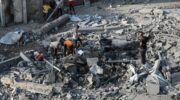
Zaqout said that alongside the army’s advance on the ground, there is ongoing, gradual destruction in these areas. “There is not a day without explosions and demolitions for months.”
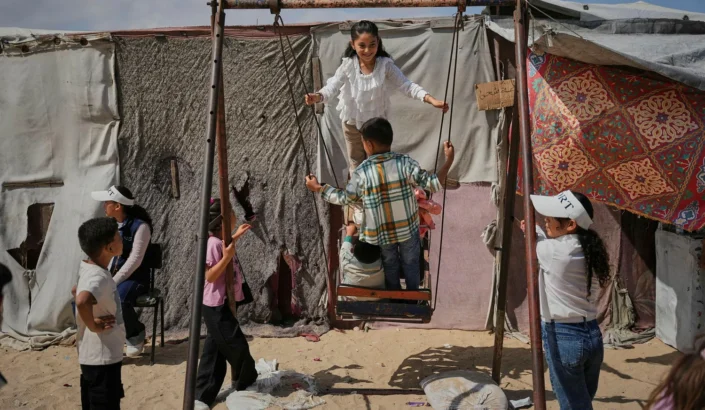
As a result, the population’s ability to survive is eroding. Zaqout said that three years of war, displacement, and life in tents have damaged almost every aspect of daily life: from access to water to the maintenance of generators, vehicles, and basic supply systems. Even community kitchens, which have become the main food source for a large part of the population, are reducing their activity.

Residents who remained near the Yellow Line, which separates the part of Gaza controlled by Hamas from the IDF-controlled “buffer zone,” fear the implications for areas that have not yet been evacuated.
Mohammed, who lives in the Al-Maghazi refugee camp in central Gaza, describes the immediate meaning of the Israeli territorial expansion.
If the area under Israeli control is indeed expanded, he estimates that residents of the Bureij and Al-Maghazi refugee camps and parts of eastern Deir al-Balah will be displaced. “It means a new wave of displaced people; more tents and more suffering,” Mohammed said.

Even in areas defined as yellow zones or areas under Israeli control, people speak of growing difficulties. Shaaban notes that in some of these areas, tens of thousands of people live in almost completely closed spaces.
They cannot move freely, and people from outside have no access to them. “Almost no one knows how many people are living there,” he said.
According to Shaaban, they are not expected to be evacuated to the remaining 30 percent of the Strip if Israeli control is expanded, but this would not alleviate the worsening overcrowding.
The tension over the possible seizure of 70 percent of the enclave is not only about borders. For Gaza’s residents, it is a question of the space in which they will be able to live, with access to water and food, rebuilding homes, schools, and hospitals.
Therefore, many of them believe that the number 70 percent represents a deeper fear: the fear that the war is not only changing the map, but also the ability to imagine a future after the war.
Jack Khoury (Radio A Shams, Haaretz) is an investigative reporter, specializing in Palestinian society and Palestinian-Israeli relations
RELATED:
- Israel Has Physically Divided Gaza With Over 25 Kilometers of Earthen Barriers
- Israel’s “Yellow Line” Is a Death Trap for Palestinians. We Drove Into It.
- UN experts alarmed by escalating settler terror and displacement in West Bank
- ‘We Saved the Child From Drowning’: In Gaza, Winter Storm Makes Displacement Even Deadlier
- 58 years since the Naksa, Israel’s destructive West Bank military operation fuels mass forced displacement of Palestinians