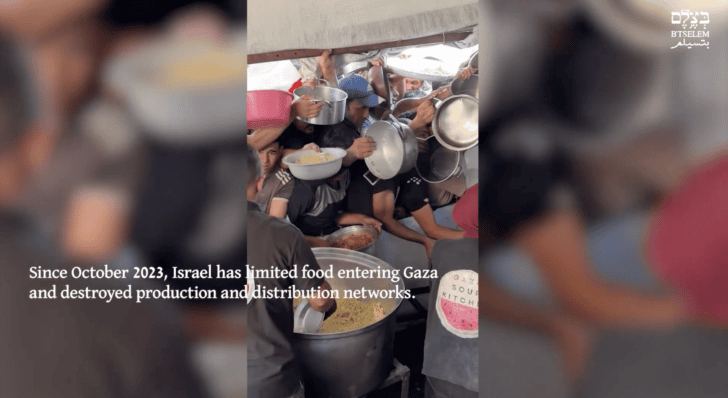
The near total aid blockade Israel has imposed on Palestine is leading to mass deaths and starvation across the population. Gaza residents remain almost entirely dependent on dwindling aid kitchen meals, which continue to provide vital, yet insufficient, emergency relief.
Reposted from B’Tselem, July 15, 2026
Immediately after the Hamas-led attack on 7 October 2023, Israel imposed a total blockade on Gaza. In the months that followed, it intermittently barred the entry of food and water through land crossings under its control. It also destroyed most of the civilian infrastructure for food production and distribution.
The aid Israel has allowed in, following international pressure, has been severely inadequate for the population’s needs. The severe shortages have led to sharp price hikes across the Strip, further limiting access to food for most of the impoverished population. In addition, the displacement of more than 90% of the population and denial of access to infrastructure and cooking necessities, such as cooking gas and clean water, keep Gaza residents unable to feed themselves. Israel has pushed hundreds of thousands of people into almost total dependence on humanitarian aid.
Beginning in July 2025, deaths connected to hunger and malnutrition in Gaza were reported almost every day. According to the Palestinian Ministry of Health, by October 2025, 455 people had died in these circumstances, including 151 children. Hundreds of thousands more are living with the long-term physical and psychological effects of starvation.
In late 2025 and early 2026, Israel introduced and implemented a new registration system for international aid organizations. Dozens of organizations, including Oxfam, MSF, CARE and Action Against Hunger, warned that the new requirements could lead them to cease operations in Gaza. The organizations cautioned that these new Israeli measures would undermine the humanitarian effort, including food supply, aid kitchens and other essential services.
After Israel’s genocidal attack on Gaza began, grassroots initiatives and international organizations, such as UNRWA and World Central Kitchen (WCK), among others, established a network of aid kitchens across the Gaza Strip. As the Israeli assault continues, these kitchens have played an increasingly vital role in the survival of Gaza’s residents.
WCK alone has invested more than half a billion dollars in food aid for Gaza since October 2023. When Israel imposed a full blockade in March 2025, exacerbating starvation, WCK expanded its operations in Gaza to about one million meals a day. For most families, aid kitchens provided their only meal of the day. While these meals fall short of providing complete nutrition in terms of both composition and quantity, they do play a critical role in mitigating starvation and remain one of the only civilian aid mechanisms still active in the Gaza Strip.
In May 2026, WCK started scaling back operations in the Gaza Strip, in part due to financial pressures and the additional restrictions Israel imposed on aid organizations, as described above. Until then, WCK ran six kitchens: two in Gaza City, in the al-Karamah area and on a-Shuhadaa Street in a-Rimal neighborhood, two in Khan Yunis, in the Asdaa area and in the al-Qararah area, and two in Deir al-Balah in the al-Musadar area. Each kitchen prepared 250,000-300,000 meals a day, supplying about 300 displaced persons’ camps across the Gaza Strip. WCK employed about 1,800 local residents across its six kitchens.
In late April 2026, the a-Shuhadaa Street kitchen shut down, and its 60 employees were reassigned to the remaining WCK kitchens in Gaza. On 20 May 2026, WCK laid off 480 workers who had been employed in the kitchens since January 2026 and scaled down operations. On 22 June 2026, the organization announced the closure of two more kitchens, one in Khan Yunis and one in Deir al-Balah, and about 350 more workers were laid off.
Today, only three WCK kitchens remain in Gaza: the Zaytuna kitchen in Gaza City, the Salam kitchen in Deir al-Balah, and the Damyan kitchen in Khan Yunis. They have a staff of about 1,000, and together produce only about 200,000 meals a day for more than two million Gaza Strip residents struggling to survive amid ongoing starvation.
Gaza residents remain almost entirely dependent on aid kitchens, which continue to provide vital, yet insufficient, emergency relief. These kitchens cannot guarantee long-term nutritional security, nor can they replace a stable food production and supply system. That requires massive infrastructure reconstruction, the opening of crossings, and continuous access to humanitarian aid from outside. With infrastructure still in ruins, the closure of aid kitchens delivers another blow to food security in Gaza, as residents’ health and survival are put at further risk.
Testimony of A.S., who worked with the World Central Kitchen
Testimony of Israa ‘Aziza from Gaza City
Testimony of Hanin Abu Mandil from central Gaza
B’Tselem is an Israeli NGO that actively pursues its political agenda in the Israeli courts and the Knesset.
RELATED:
- Crimson Thread: The new Israeli separation wall that cuts through the ‘breadbasket of Palestine’
- Gaza officials warn of ‘silent famine’ as aid deliveries fall far below planned levels
- In Gaza, Fathers Can’t Promise Their Children Food, Safety, or Even Survival
- Second Contractor Steps Forward to Blow the Whistle on Israeli Attacks at Gaza Aid Site
- Gaza is not a natural disaster. It is the victim of genocide enabled by global inaction