By Adam Raz, reposted from Haaretz, June 4, 2026
“At first I wasn’t willing to execute Arabs who weren’t resisting,” one soldier said. “Then we came to the conclusion that we had to kill. We went through the process of ceasing to see them as human beings.”
A second soldier explained that in Gaza, “human lives didn’t matter. You could kill, there was no law. No one would say a word to you, but it’s not a good feeling. It mainly kills your humanity.”
A third soldier recounted “punitive expeditions we would carry out in the minority villages in the Strip, not once or twice. We caught guys, lined them up and eliminated them. In retrospect, it looks like murder.”
“We would roam through refugee camps in Gaza and carry out purges,” a fourth soldier testified. “Every man we saw was a combatant, that’s clear. No way to prove it. Maybe prisoners or civilians were the ones killed. Every soldier who was there created a ‘concentration camp,’ and they didn’t hesitate to kill people who caused a slight disturbance.”
“It’s a philosophical debate,” a fifth soldier said about the attempt to distinguish between “the urge to kill and the urge for sport.”
These Israeli troops’ testimonies, which never saw the light of day, emerged in a series of discussions held in kibbutzim after the Six-Day War. A selection of the conversations was compiled into a canonical book, “The Seventh Day: Soldiers’ Talk about the Six-Day,” but many harsh testimonies were left out. Mor Loushy’s 2015 film, “Censored Voices,” indeed exposed some of the crimes committed in 1967, but the vast majority remained on the cutting room floor.
“Out of 200 hours of recordings, a significant number of hours deal with war crimes,” Loushy said upon the film’s release. “The story came up in almost every kibbutz and repeated itself again and again. We included three or four testimonies about the killing of prisoners in the film.”
A review of the full protocols, housed in the Yad Tabenkin Archive in Ramat Gan, reveals a striking gap between Israel’s collective memory and what actually happened. These protocols, along with a series of documents published here for the first time, form the basis of a Haaretz investigation and research by the Akevot Institute into what transpired during and after the Six-Day War. The historical inquiry shows that Israel expelled and drove out some 300,000 Arabs from the West Bank, Gaza and the Golan Heights. And as in 1948, the expulsion included killing civilians, sowing terror in Arab communities, looting and ultimately, destruction.

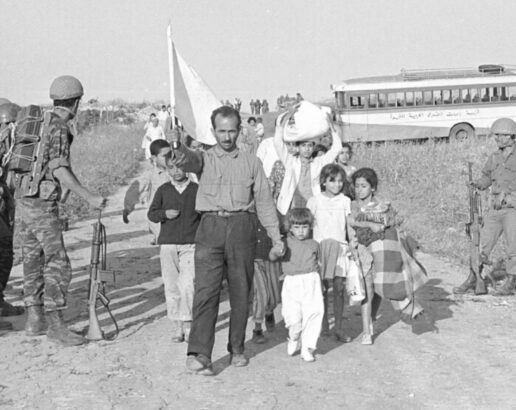
In the weeks following the war, thousands of Palestinian refugees sought to return to the West Bank after finding refuge east of the Jordan River. However, the Israel Defense Forces ambushed those returning and massacred them. The killing of Palestinians attempting to return was not widely publicized but reached the ears of Knesset Member Uri Avnery.
A traumatized soldier who met with Avnery told him that he and his comrades were instructed to open fire even on women and children. After collecting testimony from another soldier, Avnery asked IDF Chief-of-Staff Yitzhak Rabin to open an investigation and order a halt to the killings.
Avnery did not publish the details in his newspaper, HaOlam HaZeh, nor did he speak about them from the Knesset podium. Like others, he too remained silent and waited five decades until he presented the testimony verbatim in his autobiography:
“Every night, Arabs would cross the Jordan from the East Bank to the West Bank. We blocked these crossings and received orders to shoot to kill, without prior warning. Indeed, such shots were fired every night at men, women and children, even on moonlit nights when it was possible to identify those crossing. That is, to distinguish between men and women and children. In the morning, we would go out to scan the area, and we would kill, by explicit order of the officer present, those who were alive, including those hiding and the wounded. After the killing was over, we would cover the bodies with dirt until a tractor arrived.”
“They explained to us that if convoys of refugees returning from Jordan to the West Bank passed by us, we had to shoot them,” another soldier testified. “I asked the officer: And if I hear babies crying, should I shoot then too? The answer I received was: Don’t be a girl.”
Maj. Gen Uzi Narkiss, the head of the army’s Central Command during the war, later admitted that the troops were instructed to shoot to kill those returning if they did not know the password. And how would Palestinian refugees know which password would save them from death?
“Sometimes there are guys who exaggerate in their behavior and instead of asking for a password, they immediately shoot,” Narkiss told the Koteret Rashit newspaper in 1985. “When there’s a war, tragic things happen.”
The IDF itself reported that by early September, nearly 150 Palestinians had been killed in this manner, and Chief-of-Staff Rabin also confirmed to the Ministerial Committee for Security Affairs that these were the orders regarding “infiltrators.” These orders aligned with the government’s decision on June 25 to prevent the return of refugees who had crossed the Jordan River eastward.

Back to the Soldiers’ Talk testimonies. “Suppose we have to treat Arabs this way,” one of the soldiers said, “the question is whether this doesn’t undermine a very large moral ground for all the things we say among ourselves. I’m not a big vegetarian, but this kind of killing, it must have consequences later in our lives.”
He then told of a “Jordanian boy” who stood for a long time by the side of the road in a group, until soldiers “sprayed him with bullets and told me with complete enthusiasm that they had finished them off.” He also reported a large “harvest” that had been carried out elsewhere, but did not elaborate on it.
Another participant in the conversation compared the behavior of regular soldiers to that of reservists. “Regular soldiers kill much more easily. The regulars do terrible things. They carried out actual murders, shot prisoners even when they had their hands up.” He added that he was present at the execution of “some 15 guys” who were unarmed.
Testimonies of this kind appear in the transcripts again and again. One soldier recounted witnessing “cases that severely shocked me, of executions and such things.” A reservist spoke of explicit orders to execute Palestinians taken captive: “It wasn’t a trial, but an officer from the military government, from intelligence, I don’t know exactly from where? He would go through and check IDs and say: ‘This one needs to be executed,’ with no hesitation.”
The murders were not always intended to expedite expulsion or dispose of prisoners. One soldier recounted an incident that occurred in northern Sinai, at Bardawil Lake. The soldier and his comrades encountered seven Arabs, clearly civilians, sitting on a small sailboat. According to him, a nurse who accompanied them “immediately got excited” and suggested sniping them from a distance.
“Quick, they’re Arabs!” she warned the fighters. Part of the force cocked their weapons, and the soldier naively thought “the guys were joking.” When he realized they were serious, he yelled at the officer: “You won’t shoot, do you hear?” But the officer replied that he didn’t take orders from him.
“The first burst of fire went out, and immediately all the others joined in and made it a real shooting range,” he continued in his testimony. The occupants of the boat jumped into the water wounded, “and out of mercy, I told someone, ‘Come on, just shoot them already.'”
“We turned the Sinai Peninsula into a killing field,” another soldier wrote to his girlfriend, recounting that people were executed even if they were unarmed, and that this happened both to captured soldiers and civilians. “I saw too many murders to cry.”
This was not an aberration. In one of the most shocking cases where prisoners were executed, the order was given by Moshe Levy, a staff officer in the Paratroopers. Levy was later appointed chief of staff.
Some of the cases remain hidden from the Israeli public to this day, although most of their details have been published abroad. This was the case with Moshe Levy and the killing of prisoners, and also with testimonies about the killing of four civilians in Rafah after the fighting ended. A document obtained by Haaretz shows that even in 2008, four decades later, State Archivist Yehoshua Freundlich recommended keeping “the file concerning an incident that occurred in Rafah after the Six-Day War” closed, arguing that “its exposure could cause severe damage to Israel’s foreign relations.” The material on the affair remains sealed in the IDF Archive to this day.
The euphoria that followed Israel’s swift victory in the Six-Day War obscured the Nakba of 1967. In the West Bank and the Gaza Strip, some 200,000 Palestinians were driven out, many of them residents of refugee camps who had already been expelled from their homes two decades earlier.
Arab communities along the Green Line were destroyed to blur the border between Israel and Jordan. From the Golan Heights, some 120,000 Syrian citizens were driven out, and their return to their homes was forbidden after the fighting subsided. Their communities were systematically looted by the state. In some cases, private looting initiatives preceded the state-organized looting.
Documents opened for review in archives in recent years and revealed by the Akevot Institute indicate that the IDF engaged in meticulous preparations for the “conquest of areas outside the state’s borders” as early as the beginning of the 1960s. The army hoped that the political situation would play into Israel’s hands and allow it to hold the occupied territory for a prolonged period, estimating that in the West Bank, the Gaza Strip and northern Sinai, “there might be a need for a prolonged military government, in accordance with diplomatic trends.” The occupation of the territories did not catch Israel unprepared, as a mere byproduct of battlefield achievements. On the contrary, the state planned for it.
The Palestinians were mere bystanders in this story. Defense Minister Moshe Dayan wrote in his memoirs that the Palestinians residing in the West Bank did not take part in the war, and that it was not their war. Nevertheless, they were the ones who paid its price.
The Israeli public, for its part, remained silent. Troops who participated in committing crimes kept their mouths shut; a large public that looted and stole property did not want to boast about it; kibbutzim that took part in expelling Palestinians and seizing their property sought to downplay their actions. Amos Kenan, then a reservist who served in Latrun, was among the few who openly protested the expulsion and destruction of the villages, writing a report on the acts of destruction to Prime Minister Levi Eshkol.
However, Israel’s leaders were not merely dragged along by the military echelon. More than once, they signaled to the army with a wink their desire for the expulsion of the Arab population. “We also want to clear out a bit from the Gaza Strip,” Moshe Dayan said at a ministerial meeting in July 1967, according to a document opened for review a few years ago. Labor Minister Yigal Allon expressed a similar sentiment. At a meeting of the Ministerial Committee for Security Affairs, Allon said that “there is no need to be sorry over a few villages that were destroyed.” This was not merely a retrospective reflection. The work of expulsion was then in full swing.
Information Minister Yisrael Galili said at a cabinet meeting that “no amount of public relations would fix” what he saw during a visit to the West Bank. He added that “our main thesis was that we faced a danger of annihilation. This thesis has diminished in value to a minimum.”
The expulsion, as Ishai Amrami, deputy commander of a battalion that fought in the Six-Day War, later put it, was planned. Amrami participated in 1987 in a gathering of Mapam party activists marking 20 years since the publication of the “Soldiers’ Talk” book. The activists and former soldiers, now in their fifties, looked back at the events of the war from a distance.
“This thing, which I experienced firsthand, was an attempt at massive population transfer,” Amrami recalled. “Not a simple expulsion like that, but transportation by buses. This is something that remains etched in my memory to this very day. I don’t know all the details, but it was clear that such a move was being carried out.”
And yet, the question must be asked – who gave the order? Some 200,000 Palestinians sought refuge east of the Jordan River, and we have no documentation of a government decision on the matter, although it is clear that ministers welcomed the flight.
The two key figures are likely Defense Minister Dayan and Central Command chief Narkiss. On June 7, Dayan made it clear to Chief-of-Staff Rabin that he wished to empty the West Bank of its inhabitants. Throughout those days, he repeatedly expressed his satisfaction with reports of the expulsion and departure of Arab residents.
For example, when he learned of the initial flight of residents from the city of Tulkarm, where 25,000 people lived, he ordered a slowdown in the advance of armored forces to the area and demanded that traffic routes remain open to facilitate the residents’ escape.
In government discussions, Dayan avoided speaking in definitive terms, and it appears this helped him mislead some of the ministers. Mordechai Bentov, housing minister on behalf of Mapam, later said that to his knowledge, most of the expulsion initiatives were local, and the large expulsions of 1948 did not repeat themselves because, as far as he knew, there was no order from above. “I don’t think so,” he said with some hesitation in a 1976 interview, “as far as I know. I know they fled.”
The truth was more complex. Maj.-Gen. Narkiss fully understood Dayan’s intentions and acted decisively to expel communities along the Green Line. More than once, in places where Palestinians did not flee on their own initiative, they were ordered to do so. Evidence from the Palestinian side supports evidence from the Israeli side.
For example, it emerges from the testimony of a resident of the village of Yalo in the foothills of the Jerusalem Mountains, preserved in the archive of the Palestinian human rights organization Al-Haq: “The Israelis are in the village, announcing through loudspeakers. All residents of Yalo must leave for Ramallah. Those who do not leave will be in danger.”

Various practices to encourage expulsion were employed in different places: announcements; threatening residents with weapons; lining up buses and trucks and ordering the population to board them. This was the case, among others, in Qalqilyah, the Latrun villages, Tulkarm and the South Hebron Hills. In other places in the West Bank, Air Force bombings carried out as part of the fighting contributed to the intimidation. These bombings helped drive out some 50,000 residents living in three refugee camps in the Jericho area. Many of those who fled carried the memories of the Nakba and did not wait for the arrival of ground forces.
In some cases, there was an apparent attempt to create the impression that the expulsion or flight was the result of local initiatives. An archival document preserved at Yad Tabenkin and now revealed here sheds light on the attempt to expel the residents of Qalqilyah, while covering its tracks.
In the document, Yaakov Mali, head of the Egged bus company’s traffic department during the war, testified that the person who tried to carry out the expulsion was actually Kfar Sava Mayor Ze’ev Geller. “He ordered 40 buses from me to expel the residents of Qalqilyah to the Jordan crossings,” Mali recounted, testifying that he replied he only accepted orders from the IDF.
Geller responded that there was “a historic opportunity to get rid of as many Arabs as possible and that at that very moment, the IDF was blowing up houses in Qalqilyah.” The buses were sent. Geller was indeed the face, but the order to expel came from Dayan and passed to Narkiss.
The expulsion of Qalqilyah was carried out swiftly, and nearly half the homes were destroyed within a few days. However, this was one of the rare instances in the history of the conflict where Israel was forced to back down due to heavy international pressure. On June 25, it was decided to allow the residents of Qalqilyah to return to their city.
The expulsion of the three Palestinian villages in the Latrun area – Imwas, Bayt Nuba, and Yalo – with their 8,000 residents, was one of the most prominent expulsions during the war. So too was the destruction of the villages immediately afterward and the establishment of Canada Park by the Jewish National Fund in 1971.
The villages were captured without resistance on the second day of the war, and hours later, residents were ordered to evacuate to Ramallah. Israel claimed that a significant portion of the structures in the villages were destroyed during the battles that took place there. This was a false claim.
Ze’ev Bloch, a Six-Day War veteran and a former member of Kibbutz Nahshon, located near the three expelled villages, told Akevot Institute researchers that “no one leaves their home willingly. There’s no debate about that. Certainly, certainly they were expelled. War. There are those who expel them, there are those who leave, there are those who survive, and there are those who die.”
In his memoirs, he described “crying children, adults and elderly people slowly trudging along the sides of the road. These sights reminded me and many of the reservists then of other, not-so-distant days, when Jewish families were seen trudging in exactly the same way in occupied Europe. It was difficult to avoid the comparison, and our hearts ached at these sights.”
The emptying of many towns and villages left behind much property. Members of Kibbutz Nahshon held meetings about the fate of the lands and property left abandoned. Transcripts of the conversations were printed in the kibbutz’s newsletter, but it was ultimately decided that they should not see the light of day. According to a note written at the time by the kibbutz archivist, “it was decided that no property or spoils should be taken from the nearby villages.”
However, looting spread throughout the country, and some in the government wondered how to stem it. Justice Minister Yaakov Shimshon Shapira explained at a cabinet meeting at the end of June that “the biggest problem” was that citizens were looting and returning to Israel, “and here it’s impossible to arrest them and put them on trial.”
One of the most prominent looting incidents occurred in Qalqilyah. Cars and trucks made their way from the emptied city to private homes in Kfar Sava and the surrounding area. Some of the property was looted in an organized manner. In the Kfar Sava municipal archive, one can find a long list of equipment taken from schools in Qalqilyah and transferred for the benefit of students in schools in the Israeli city. The person who organized the theft was Mayor Geller, who was also appointed governor of Qalqilyah for a short period.

Expulsion and destruction operations along the Green Line continued even after the war. This was the case, for example, in Zeita near Tulkarm and Beit Awwa south of Hebron. The systematic nature of the evacuation of villages along the Green Line supports the conclusion that these were not local initiatives. Maj.-Gen.
Narkiss himself publicly boasted that he played a central role in the expulsion of the population. Even before the war, he informed his subordinates that if Jordan joined the fighting, “we would sweep all the Arabs out of the West Bank.” He promised and delivered, at least partially. After the war, he admitted that some of the expulsion operations he initiated were acts of revenge.
Although Chief-of-Staff Rabin ordered him to stop the expulsion and even threatened a legal investigation, Narkiss enjoyed the backing of Dayan, who pushed to establish facts on the ground.
In December 1967, six months after the war, the Foreign Ministry’s legal adviser, Theodor Meron, sent a letter to the ministry’s director general concerning “expulsions of Arabs to the East Bank.” This dramatic letter, published here for the first time, serves as evidence that government ministers were involved in the expulsions. Dayan was not a rogue, freewheeling actor in this matter.
“The expulsions constitute a serious violation of the Geneva Convention,” Meron wrote, “and especially in light of the extensive publicity, they are likely to cause complications.” He added that Military Advocate General Meir Shamgar also agreed “that the expulsions violate the Convention.” One sentence he wrote succinctly sums up the history of the conflict: “The Ministerial Committee for Security Affairs nevertheless decided to approve the policy.”
This grim historical chapter did not remain entirely secret. Over the years, the facts gradually came to light through historical research, journalistic investigations and documentary films. In 2005, Tom Segev’s comprehensive book “1967: Israel, the War, and the Year That Transformed the Middle East” revealed a glimpse of the expulsion operations carried out during the war.
In 2012, a richly detail study by historian Avi Raz, “The Bride and the Dowry,” was published, including a fascinating chapter on the authorization, granted through convoluted means, that allowed the forces to expel residents and destroy villages. Last year, historian Omri Shafer Raviv published his illuminating book “The Landlords: The Israeli Government and the Palestinians 1967-1969” (in Hebrew), in which he described Israeli policy to reduce the Palestinian population in the Gaza Strip after the war.
And there were also those who shed light on the great expulsion in the Golan Heights. In 2010, a Haaretz investigation by Shay Fogelman extensively covered the operation to empty the plateau of its Syrian residents. Now, documents obtained by Haaretz and the Akevot Institute allow for unknown aspects of the operation to be illuminated.
First came the occupation. After three days of heavy shelling, the IDF gained full control of the Syrian plateau. A systematic registration of the remaining residents in the Golan Heights was not carried out until mid-August, when it became clear that their number stood at just over 6,000 – out of some 130,000 Syrian citizens who had lived on the plateau until the war.
Immediately after the occupation, a curfew was imposed on some of the remaining residents, and the return of villagers who had hidden in the area during the fighting was forcibly prevented. A document preserved at the Yitzhak Rabin Center presents the testimony of Elad Peled, commander of the IDF’s Ga’ash Formation that led the occupation. According to Peled, a few days after the end of the war, a decision was made to come in “with bulldozers to eliminate the villages, so there would be nowhere to return.” This was indeed done.
In mid-June, the commander of Israeli forces in the occupied city of Quneitra asked the representative of the Military Advocate General’s Office if he was authorized “to forcibly remove residents who had arrived in the city, and if residents could be transported by bus to Syrian territory.”
A Northern Command report stated that from June 11, “the military government began to deal with the population remaining in the occupied territory, with an emphasis on the Druze and Circassian minorities.” The rest of the sentence was censored. Further in the report, it was stated that “the concentration of residents remaining in Quneitra began, and severe measures were taken regarding looting.” Nothing further was written, and generally, the IDF Archive does not open documents on expulsion operations for review.
About a month after the end of the war, the Israeli liaison officer at the UN contacted Northern Command following a long series of detailed accusations Syria had presented against Israel, requesting its response. “Intimidation through threats against village residents reached such proportions that most of the population left their homes and fled,” stated the report submitted to the UN. In some villages, only elderly residents who struggled to endure the flight remained.
According to the report, the intimidation and threats manifested in various forms: shooting intended to cause flight; “general shootings, neglect of the dead, and expulsion of the rest of the population”; and “starving the remaining residents by burning wheat fields.” In one case, residents were divided into two groups – those under 25 were captured and taken to Israel, and the rest were expelled to southern Syria with their hands tied behind their backs.
Amnon Assaf, a member of Kibbutz Ma’ayan Baruch, recounted in Fogelman’s investigation that he witnessed the gathering of hundreds of Syrian citizens, and that Israeli soldiers told him they were about to expel them. “I am not a soft-hearted man, but at that very moment, I felt that something was wrong here,” Assaf said. “I remember to this day that even then, this scene made a bad impression on me. It’s like what happened in Lod, Ramle and other places during the War of Independence.”

Concurrently with the expulsion operations, Israeli forces engaged in seizing property left behind. “Robbery and looting continue incessantly,” stated the Syrian complaint to the UN. “Searches focus on women’s jewelry, gold and television sets. Every shop in Quneitra was looted. Most homes were looted, and even furniture that appealed to the invaders was not left behind and was transported to occupied Palestine by trucks.”
There is no shortage of soldiers’ testimonies supporting the Syrian complaint. “You enter to clear a house, and your eyes are naturally drawn to the other details,” one soldier recounted in a censored testimony from Soldiers’ Talk. “Sometimes the guys would shoot at televisions out of frustration.” Frustration over what? “If I don’t take it, someone else will, and that will be the Military Police, so it’s better to destroy it.”
Additional documents forming the basis of this investigation were found in the Red Cross archive in Geneva. Israel tried to restrict the organization’s activities but did not succeed in completely removing it. An observer who visited the Golan Heights in mid-July described scenes of widespread destruction and looting: bedding had been burned, contents scattered in chaos, roofs destroyed and the charred remains of furniture left behind.
Red Cross personnel also referred in their reports to the burning of crops, which, according to Syria, was intended to starve the remaining residents. Overall, it was clear that the observers understood what they were seeing. One of them wrote that the accompanying IDF representative sought to frame the situation as people going into Syria to search for their relatives and bring them back, but the observers dismissed this as implausible; the sergeant smiled and appeared to agree.
Unlike in 1948, this time the expulsion of Arabs was extensively covered in the international media. Israeli reports also appeared occasionally. Five months after the war, activist and journalist Joseph Algazy published an article that had been partially censored.
According to Algazy, who published the article with the censor’s markings, hundreds of thousands of people were expelled from the beginning of the war from the Golan Heights the West Bank, and Gaza: “Indeed, some were uprooted by ‘choice,’ meaning out of fear of gunfire, shelling and other dangers, but the rest were uprooted, literally, by the terror of the Uzi barrel and explosive devices.”
Col. Shlomo Gazit, appointed by the General Staff to oversee the military government in the occupied territories, argued in March 1968 “that under no circumstances should we call the voluntary migration of Syrians to Syrian territory an expulsion.” In internal correspondence, Israeli officials used the word “expulsion” without difficulty.
Michael Comay, diplomatic adviser to Foreign Minister Abba Eban, wrote in an internal correspondence from mid-1968 that “the expulsion of Quneitra’s Arabs, which has been ongoing for several months, prompts repeated complaints and inquiries from the Red Cross.” He suggested a preferred course of action: “It seems to us that if there is no alternative, it is better to get rid of the problem at once in the most humane way possible.”
Director Netalie Braun, in her film “Shooting,” released last year, presents the testimony of a resident of the abandoned village of Mansura, which was located near where Kibbutz Merom Golan stands today: “Most of the people in the village were scared and fled toward Damascus. Only about a quarter of the village residents remained.
Grandma was already old and had a leg problem, so we stayed. We thought the Jews would leave the Golan Heights soon. Many of the men who left managed to infiltrate back into their homes and gather the scattered animals, but it was dangerous because the Israeli army shot anyone who tried to return.
From those who fled, they took everything; we saw them loading things onto tractors. I’m ashamed to say that we saw and did nothing out of fear. And I remember the thoughts that ran through my head: What will remain of everything I knew? Where will my home be?”
Israel did not allow anyone to return and declared a military government. Within a few months, Jewish settlers began to build their homes in the newly conquered territory.
Adam Raz is a human rights researcher and historian. Raz works at Akevot Institute for Israeli-Palestinian Conflict Research and is the author of Loot: How Israel Stole Palestinian Property and reports for Haaretz.
RELATED:
- Who Started the Six Day War of June 1967?
- The Six Day War and Israeli Lies: What I Saw at the CIA
- Not just the US: How 51 countries armed Israel during Gaza war
- As Israel Heads to Elections, Netanyahu Needs War
- Gaza’s water crisis: Families survive on less than 10 liters a day amid Israel’s ongoing genocide