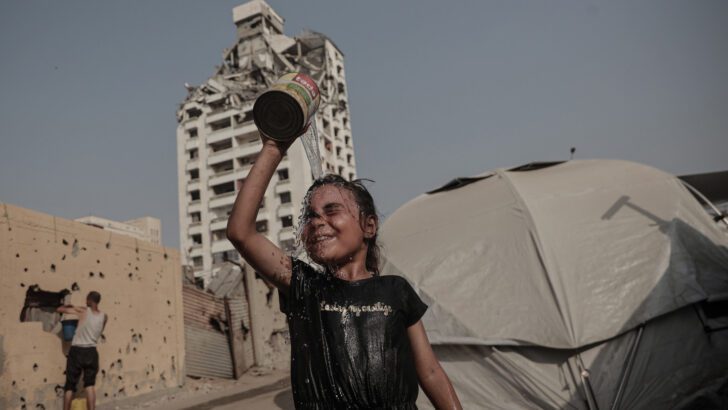
In Gaza’s displacement camps, access to water has become a daily struggle measured in liters, queues, and exhaustion.
Reposted from The New Arab, May 19, 2026
Before Israel’s genocidal war on Gaza, the daily share of water per person in the Gaza Strip was around 80 liters, obtained simply by turning on a tap inside the home.
Now, with cities and towns destroyed and most residents displaced to shelters, securing water is no longer easy, and the daily per-person share has dropped to less than 10 liters.
As a result, water collection has become a daily struggle for displaced families across Gaza. Dozens of Palestinians — men, women and children — queue in front of small water outlets extending from a water truck parked outside a shelter for displaced people in central Gaza City.
Each person tries to fill the small water containers they carry, return them to the tent to empty them into a slightly larger container, and then go back again to refill the smaller ones.
Because water supplies are so limited, all members of displaced families help fetch water while the truck, carrying no more than 10,000 liters, remains at the camp.
The amount is distributed between two camps, each housing more than 800 residents, meaning the daily amount available per person is less than 10 liters, despite internationally recommended rates of 50 to 100 liters per person per day.
For many residents, obtaining even this small share of water requires immense effort. People wait hours for the trucks, stand in long queues, endure overcrowding and walk long distances while carrying water. Suffering worsens in summer, as demand for water increases.
Meanwhile, Gaza’s damaged infrastructure has further deepened the crisis. With most wells in Gaza City destroyed, the municipality has encouraged residents to use submersible pumps, and the number now stands at 1,300. The municipality has also managed to keep 35 water wells operational.
The scale of the collapse becomes clear when assessing water supplies before and during the war.
Comparing the amount of water pumped into the network before the war with the current situation reveals a major decline in the amount available to each person in Gaza City, where around one million displaced people are currently living.
Before the war, the network received around 100,000 cups daily: 70,000 from wells, 20,000 from the Israeli water company Mekorot, and 10,000 from the desalination plant in the Sudaniya area, north of the Strip, which has since been destroyed.
Explaining the severity of the shortages, Maher Salem, director general of planning and investment at Gaza Municipality, told The New Arab: “The amount of water from wells operated by the municipality, together with Mekorot, currently does not exceed 35,000 cups, which is extremely small compared with the quantities residents used to receive.
“Each person used to get around 80 liters of water and now receives less than 10 liters. During periods of the war, the share sometimes dropped to just two liters of water,” he added.
“Entire areas lack services, including the western al-Nasr neighborhood, north of al-Shati refugee camp, and the Tal al-Hawa neighbourhood, south-west of the city. Sometimes areas in the city centre suffer from thirst when Mekorot water is cut off, and the population density of displaced people increases the suffering.”
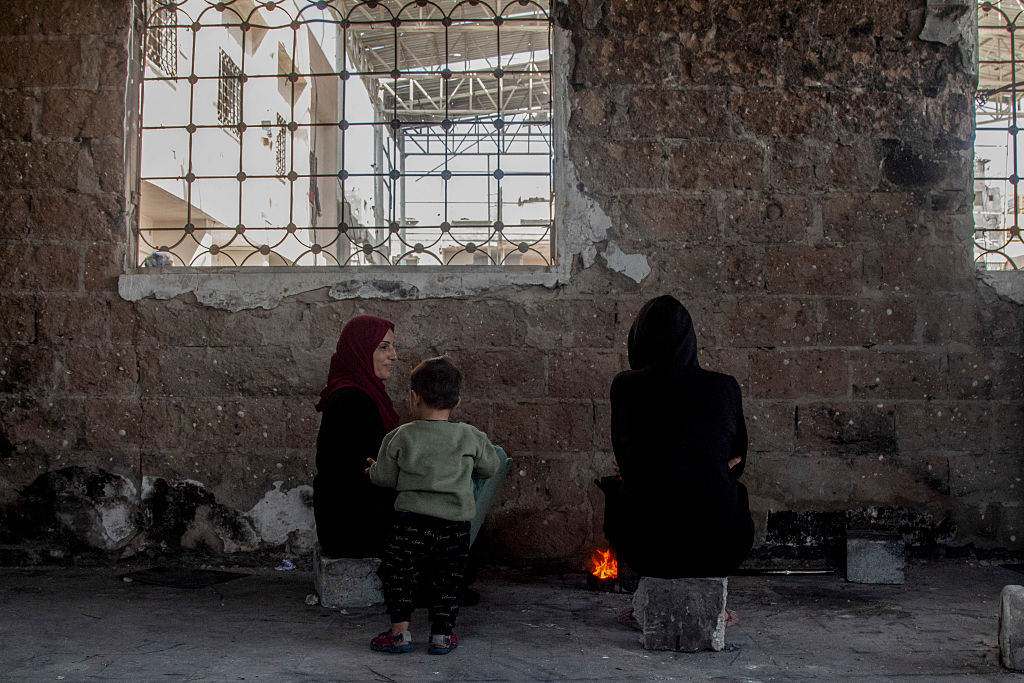
When water runs out by noon
For families living in displacement camps, these shortages have transformed water collection into an exhausting daily routine.
Palestinian resident Ismail Abu Ouda told The New Arab, after filling small water containers: “This is the only truck that comes to the camp daily, and there is another truck, but it does not come regularly.
“No municipal water reaches the camp, and there are no large storage tanks. We depend entirely on the water brought by this truck for drinking, cooking, and washing. I can barely fill five small containers, each holding 20 liters, for my family of seven. The water is never enough for the whole day, and by noon, we are already running low.”
He added, “Water trucks also do not arrive easily.”
The dangers faced by water truck drivers add another layer to the crisis.
Truck driver Ashraf al-Kafarna described some of the daily difficulties and dangers he faces, telling The New Arab: “We go to fill the truck tank from a water station in the al-Tuffah neighborhood, east of Gaza City, which is located near areas where occupation army forces and vehicles are stationed near the Yellow Line.
“At any moment, a tank or quadcopter drone can appear, and then we move away quickly. Very often, they fire shells near us, and shrapnel scatters around us. Bullets and shrapnel can pierce the truck tanks.”
The burden of collecting water often falls heavily on elderly residents and women. Nearby, 63-year-old Palestinian Umm Ziad Abed carries four water containers over several trips with the help of a neighboring woman.
Trying to catch her breath, she said, “I have no breadwinner, and I support my young grandchildren, so I struggle daily to fill four or five water containers. We try to ration consumption and use water only when necessary for drinking and washing, so that it lasts the whole day.”
She added, “I wake up early to secure a place in the queue to fill water from the truck. The water does not meet health standards because it is unfiltered and causes stomach pain or diarrhea among children, but we have no alternatives.”
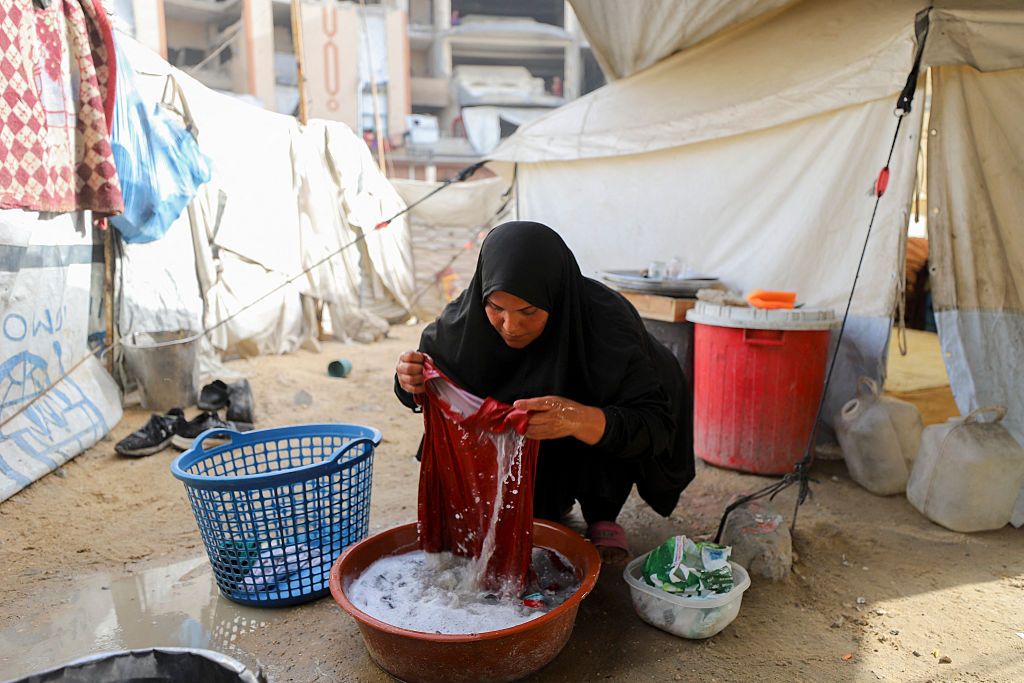
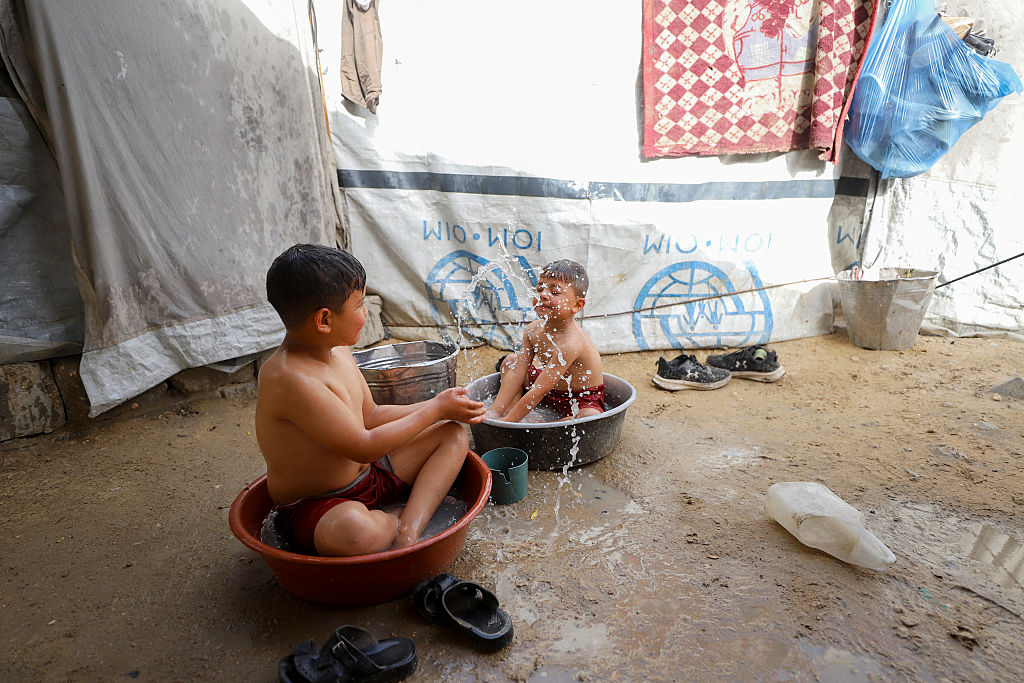
Daily searches
Others are unable to secure any water at all. Her neighbor, Balsam Mousa, was unable to fill any water containers.
She told The New Arab: “There are no nearby water supplies, and we are forced to wake before dawn to fill small amounts and carry them to the camp, even though this water is not suitable for drinking.”
As demand continued to exceed supply, the first truck did not meet the needs of all camp residents, leaving many waiting for the second truck, which arrived about an hour later.
Among those waiting was Palestinian Younis al-Hilu, who prepared small containers as he waited for his turn, saying: “We are seven people, and the issue of water exhausts us daily.”
Younis revealed his leg, showing traces of recent injuries sustained after slipping while filling water, and added, “I do not know how long this daily suffering will continue. If I cannot fill water, thirst will be our fate.”
Nearby, Suhad al-Sharbasi waited beside the second truck for her son to fill water containers so she could carry them back to the tent.
She told The New Arab: “We are eight people, and what we fill does not last us through the day. My husband suffers from a spinal disc problem and cannot fetch water, so my son and I share the task.”
Water access under threat
The risks associated with water collection have also turned deadly.
A week earlier, the water truck did not arrive after being targeted while filling up at the station near the entrance to the Shujaiya neighborhood.
Driver Mahmoud Abu Warda and his brother Eid Abu Warda were killed, and the remaining drivers were prevented from filling water, leaving displaced people facing severe thirst.
Residents in other parts of Gaza City are facing similar hardships. In Tal al-Hawa, south of Gaza City, where large parts of the area have been destroyed, residents also suffer from the absence of municipal water.
Abdul Salam Mousa said, “When municipal water comes, it is weak, and we can barely fill containers. We use it only for washing and cleaning purposes. We do not even use it to wash our faces because it is salty and causes burns.”
Elsewhere in the city, families rely on alternative methods to secure water.
From Street 8, Abdul Karim al-Samouni told The New Arab: “We rely on submersible pumps that operate on fuel, but fuel is scarce. Municipal water comes twice a week, while drinking water is extremely scarce, and my son and I have to fill drinking water containers from a distant location.”
Southern Gaza water crisis
Conditions are equally difficult in southern Gaza. In the Mawasi area of Khan Younis, which lacks water networks and relies on farmers’ pumps, some of which were established during the war to serve shelter camps, water lines extend from the pumps into the camps.
Inside the overcrowded al-Qadisiyah camp, the struggle for water is visible everywhere. In the camp, crowded with tents randomly erected side by side, water pipelines are clearly visible. In front of each tap, displaced people dig a hole to place containers, increasing water flow from the lower level.
Describing the situation, camp representative Mahmoud al-Sharif told The New Arab: “The pump operates for only one hour, so when water flows through the system, those filling containers at the front receive more water than those further down the line.
“We are talking about a three-phase pump serving a camp of 2,500 people, meaning a family can fill around 60 liters a day. Drinking water, however, is delivered by distribution trucks that come only twice a week, which forces people to conserve water carefully to avoid shortages.”
For newly displaced families, the lack of supplies has made survival even harder.
From the same camp, Mohammad al-Amwasi told The New Arab: “We were displaced from the Tel al-Sultan neighborhood in Rafah in March 2025 under bombardment, and we did not bring water containers or large tanks with us.
“I currently have six containers, which I fill from water distribution trucks. We use three containers for washing and three for drinking, and I borrow two additional containers from neighbors so the quantity lasts until the end of the day.”
Article translated from Arabic by Afrah Almatwari. To read the original, click here.
Al-Araby Al-Jadeed is a London-based pan-Arab news outlet owned by Qatari company Fadaat Media. It launched an Arabic-language website in March 2014 and an Arabic language daily newspaper in September 2014.
RELATED:
- No medicine, no beds, no food or water: inside Gaza City’s main hospital
- Gazans face a triple crisis: severe shortages of water and bread, healthcare in tatters
- Israel’s restriction of aid into Gaza leads to critical shortages in bread, baby formula, and water
- The Madeleine ship: A message of solidarity with Gaza and resolve to break the blockade
- Rep. Randy Fine Tells Palestinians To ‘Starve Away’ as Babies Die of Malnutrition Under Israeli Blockade in Gaza