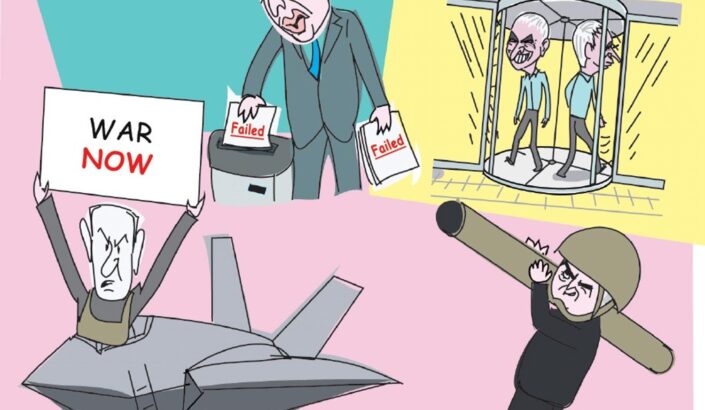
Once, Netanyahu avoided employing force; today, it’s his bread and butter. His goal is to survive another day, another week in power.
By Yossi Verter, reposted from Haaretz, May 21, 2026
Benjamin Netanyahu needs war. Now. Ideally on more than one front and as prolonged as possible, hard and bloody. Like a drug addict desperately in need of his next fix, war sustains him. It is the answer to all life’s troubles. When the cannons roar and the fighter jets are overhead, the proceedings in his criminal trial (which have virtually come to a halt) are canceled.
Dissolution of the Knesset, which was approved Wednesday in a preliminary vote, is off the agenda; his preferred election date, October 27, is also back on the table. This gives him another six weeks to contemplate his future. If the war drags on and gets more complicated, postponing the elections is also an option.
An attack on Iran could be underway any day, U.S. President Donald Trump said on Wednesday that he had been “an hour away” from deciding to order new strikes. At the same time, Netanyahu is pushing for renewed fighting in the Gaza Strip, as if that accursed place hadn’t already swallowed up enough lives, hadn’t destroyed so many Israeli and Palestinian families.
And, of course, there’s Lebanon, where low-level negotiations continue sluggishly in Washington, with Israel represented by a Bibi-ist ambassador. The prime minister has no interest in a diplomatic settlement with Beirut, just as he had none with the Gaza Strip.
Once, Netanyahu shunned the use of force. He was sensitive to the lives of soldiers, to Israel’s international standing and to its economy. Today, war is his bread and butter. The Israeli Defense Forces “is collapsing on itself,” says the chief of staff. He needs a minimum of 17,000 combat soldiers. Tired and worn-out soldiers and commanders make fatal mistakes on the battlefield.
But the ruler is not interested. With his right hand, he is ordering the depleted army to engage in needless fighting without any sense or purpose; with his left hand, he is trying to promote the despicable conscription (evasion) law, or at least make the Haredim think he is going out of his way to perpetuate draft dodging. “We will pass the law on second and third readings,” Cabinet Secretary Yossi Fuchs proclaimed on Wednesday, while another soldier was being buried.

The number of draft evaders will soon reach as high as 90,000, Brig. Gen. Shai Taib told the Knesset Foreign Affairs and Defense Committee on Wednesday. The response of coalition lawmakers was, as usual, indifferent (after all, they soon face a party primary vote), with the nervous murmurs of committee chairman Boaz Bismuth heard in the background.
Thousands of reservists who have served 400, 500 days or more in the past two-and-a-half years received call-up orders this week for another 100 days. There goes summer vacation and the money they put out for flights and hotels. Businesses are collapsing, studies are being delayed and lives are being disrupted. Enlisted troops who have been fighting nonstop since their basic training will be required to serve another four months. Blow after blow, but Netanyahu is serene, unblinking, focused on the goal of surviving another day, another week in power.
Such systematic, sadistic abuse by a ruler of his people only exists in dark dictatorships, where the leader is not required to stand for election. This is another reason for the democratic camp to be concerned about Netanyahu’s intentions: Another three or four months till the election, yet the man dares to continue abusing some 70 percent of Israelis, including most of his voters. Doesn’t he fear their revenge?
It’s hard to see him winning a fair election. Either they won’t be fair, or he’ll refuse to recognize their results.

Netanyahu’s contempt for the majority of Israelis isn’t exclusive to him. Just this week, Likud MK Hanoch Milwidsky, the Knesset Finance Committee chairman, insisted that the north isn’t being bombed by Hezbollah, although “some towns are getting explosive drones,” he admitted. Transportation Minister Miri Regev said she “doesn’t know what they were talking about with total victory,” and Minister David Amsalem opined that “Torah scholars contribute like a soldier serving in Gaza – they are the jewel in the crown.”
For a long time, Amsalem wasn’t heard in public. But when he opened his mouth, he let loose in a big way: “We had four terrible, horrible years” (because of the left, of course); Shin Bet head David Zini was “humiliated” because “he is Sephardi” (and not because he wears a kippah?); and “we will pass the reform with force and with brains” (mainly with brains, this is Amsalem).
Why would any sector of the population, other than the ultra-Orthodox, vote for the coalition parties? Don’t Likudniks serve in the IDF? Don’t they groan under the insane cost of living? Don’t they see how education is deteriorating to the realms of the Third World? Aren’t they ashamed of Itamar Ben-Gvir? Aren’t they outraged when the prime minister boasts that six years ago he was the first to identify the danger of fiber-optic drones (but did nothing about it), just as he knew and detailed Hamas’ plans to take over the settlements adjacent to Gaza almost a decade ago (and since then had showered billions of dollars on the terrorist organization)?

This week, Netanyahu was photographed climbing the three steps in the office of Israel’s first prime minister, David Ben-Gurion, at the Kirya in Tel Aviv. “You know I can’t keep up with you,” Topaz Luk, his court jester, said.
His toadying has become more embarrassing over time. Besides the need to highlight Netanyahu’s physical fitness (three steps!), the purpose of the video was to make the comparison that came at the end: “This is the first cabinet room. In 1949, many important decisions were made here. Back then, we faced a stranglehold by Arab armies, and we broke it, just as we have broken the stranglehold of Iran. Today we are besieging them.” History repeats itself, or so Netanyahu would like us to believe.
Coming in from the cold?
Light years have passed since Netanyahu urged his cabinet in June 2011: “Be like Kahlon!” It was another era. Outstanding ministers who undertook reforms for the public good and were not afraid to confront the tycoons were considered role models back then.
Today, it is the opposite. The more impersonal, failing, corrupt and harmful ministers are (hi, Yoav Kisch), the more they are embraced and nurtured by that same prime minister. Today, he himself is their role model. They look up to him, listen and learn.
Fifteen years later, after serving as an outstanding communications and finance minister and making an unpleasant but not terrible plea deal, Moshe Kahlon is sounding like someone who wants to get back into politics. He will not make a final decision until the court gives effect to the deal next week. He has respect for the system, even when in his (non-objective) eyes, he was treated unfairly.
If he does return in whatever constellation it will be, we will see that he hasn’t moved from his well-known stands. He didn’t “sober up” after October 7 and become a Bibi-ist. He remains on the moderate right, statesmanlike and liberal. He believes in the independence of the judicial system, the institution of the attorney general and a free press. He doesn’t shy away from reforms, but does so from the “reform” stampede of the past three-and- a-half years.

I went back to read a column I wrote about Kahlon in 2016. As chairman of the Kulanu party and a powerful finance minister with a veto right, he blocked “like a goalie,” as he put it, the barrage of reforms that sought to undermine the independence of the legal system and the High Court of Justice by then-Justice Minister Ayelet Shaked (the override clause, changing the composition of the judicial selection committee, etc.).
“I’m not against reforms, but not this kind,” Kahlon told me. “On the contrary, establish a professional committee headed by a former justice minister who will sit for six months and do serious work.” Who would you suggest? I asked. “Dan Meridor,” he replied.
During his stint as finance minister, together with then-Communications Minister Gilad Erdan, he formed the public broadcasting corporation Kan. Later, before it went on the air in May 2017, he blocked with an iron hand an effort by Netanyahu to shut it down, an effort that continues till this day (but doesn’t prevent him from calling our excellent Eurovision team every year to hypocritically thank them for the pride they have brought to Israel).

It’s no wonder that the Kahlon merchandise is still in demand, even seven years after he left politics. In the past few months, he has met with all the “change” party heads. All of them would be happy to see him on the party slates. Since these men never do a thing without checking the polls first, it’s safe to assume that their welcome is based on data.
Who will Kahlon join? At the moment, the pendulum is swinging toward Gadi Eisenkot. They’re good friends, going back to the days when Eisenkot was the chief of staff. Without a doubt, for Eisenkot, Kahlon’s administrative experience would be a major prize.
Another option that has emerged recently is a right-wing party that would both unify the nation and observe proper political norms. Erdan is among the politicians working on this, together with Yuli Edelstein (a new Netanyahu whipping boy) and Chili Tropper, ex-Kahol Lavan (who carries the burden of Yoaz Hendel, of the Reservists, on his shoulders).
Also Brig. Gen. (res.) Dedi Simchi is in the picture. Apparently, his dream of being on the Likud list has been dashed for now, even after he delivered the following statement that was supposed to be a kind of dowry for Netanyahu before the wedding: “The disaster of the massacre on October 7 is 99.7 percent the responsibility of the IDF and the defense establishment.” Apparently, only 0.3 percent lies at the door of the political echelon! Maybe Simchi should be the party’s treasurer. Or its chief statistician.

Talks among this group have stalled for now. Tropper and Erdan are both insisting on being “No. 1.” They aspire to senior positions in the next government. They also disagree about what the party will say about issues that divide the public. What will the party do if neither bloc succeeds in forming a government? “We will force unity on them” one of the group told me. It sounds good in theory, but in real life it doesn’t work so easily.
Somehow, it makes more sense to see them settle in the Netanyahu bloc (that is, after he’s first smeared them with honey), just as he did with Benny Gantz on the eve of the formation of the infamous unity government.
Although Gantz is regarded as a political corpse, Kahol Lavan’s eight funding units are worth about 12 million shekels ($4.1 million) in campaign subsidies, which would be a huge benefit to a new party. All that remains is to decide who will take the money.
Yossi Verter is one of Israel’s leading columnists. He is the chief political writer of “Haaretz Daily” since 1996. He specializes in writing about the internal domestic politics of Israel.
RELATED:
- How Netanyahu Prolonged the War in Gaza to Stay in Power
- Israeli Opposition Leader Accuses Netanyahu of Plotting Assassinations
- Netanyahu’s plan to “end” US aid to Israel is to give even more money under a different name
- The Corporate Media’s Refusal to Accurately Cover Genocidal Terrorist Benjamin Netanyahu
- Hunger Games: As Far as Netanyahu Is Concerned, Gaza’s Humanitarian Crisis Is a PR Problem