Palestinians are turning to Duolingo to get the English certification needed to get scholarships. But “make sure you have a steady internet connection” can be an impossible hurdle to overcome.
By Chris Caurla, Reposted from Zeteo, May 12, 2026
By the time she sat down to take the test, Sara Serriea had been living on lentil soup for days.
It was a hot Wednesday morning in June 2024. Dozens of exhausted people crowded a makeshift cafe in Al-Mawasi, southern Gaza. Dizzy from hunger, she tottered her way to a slightly quieter corner, opened her laptop, and clicked the cheerful button colored in baby blue that launched the Duolingo English Test.
Serriea had been preparing for this moment for about eight months – months marked by hunger, repeated displacement, and heavy bombardment. Her father had borrowed the $65 for the test from a friend. “We do not like asking for help, even when we are starving,” says Serriea. “But he did it for me.”
A video explains the rules. “Make sure you have a steady internet connection,” says a friendly voice. “Sit down in a well-lit room with no distractions,” it continues, while the video shows a happy student behind a desk as a red alarm clock and a gray cat disappear in a magic puff that looks a bit like an explosion. And finally, an encouragement: “Remember, just do your best!” The green owl winks, a certificate appears in its wing with a pop of confetti. The test begins.
A few minutes later, it is already over.
Serriea’s connection dropped. The test is invalid. A message informs her that she needs to purchase a new test. The baby blue button now only says: “Buy now.”
Thousands of Palestinian students like Serriea are trapped in Gaza. The announcement of a so-called “ceasefire” seven months ago has done little to improve their lives, students say. Strikes continue. Once repelled, diseases like scabies and lice spread. Doctors warn of weakened immune systems while humanitarian organizations accuse Israel of blocking essential medicines. Fresh produce and proteins are difficult to get. On March 19, the Rafah crossing with Egypt resumed partial operations, but few Palestinians are permitted to leave, and even when they are, it’s mostly for medical treatment.
“I wish I could get cancer,” says Rami Sultan, a 26-year-old Palestinian in Gaza. “Maybe then they would let me out of this cage.”
But despite being trapped, students like him and Serriea are trying to be ready in case they are allowed to leave, which means obtaining an English proficiency certification. “I made the decision when the genocide started,” Serriea says. “Studying abroad became the only way to pursue my dreams and build a better life.”
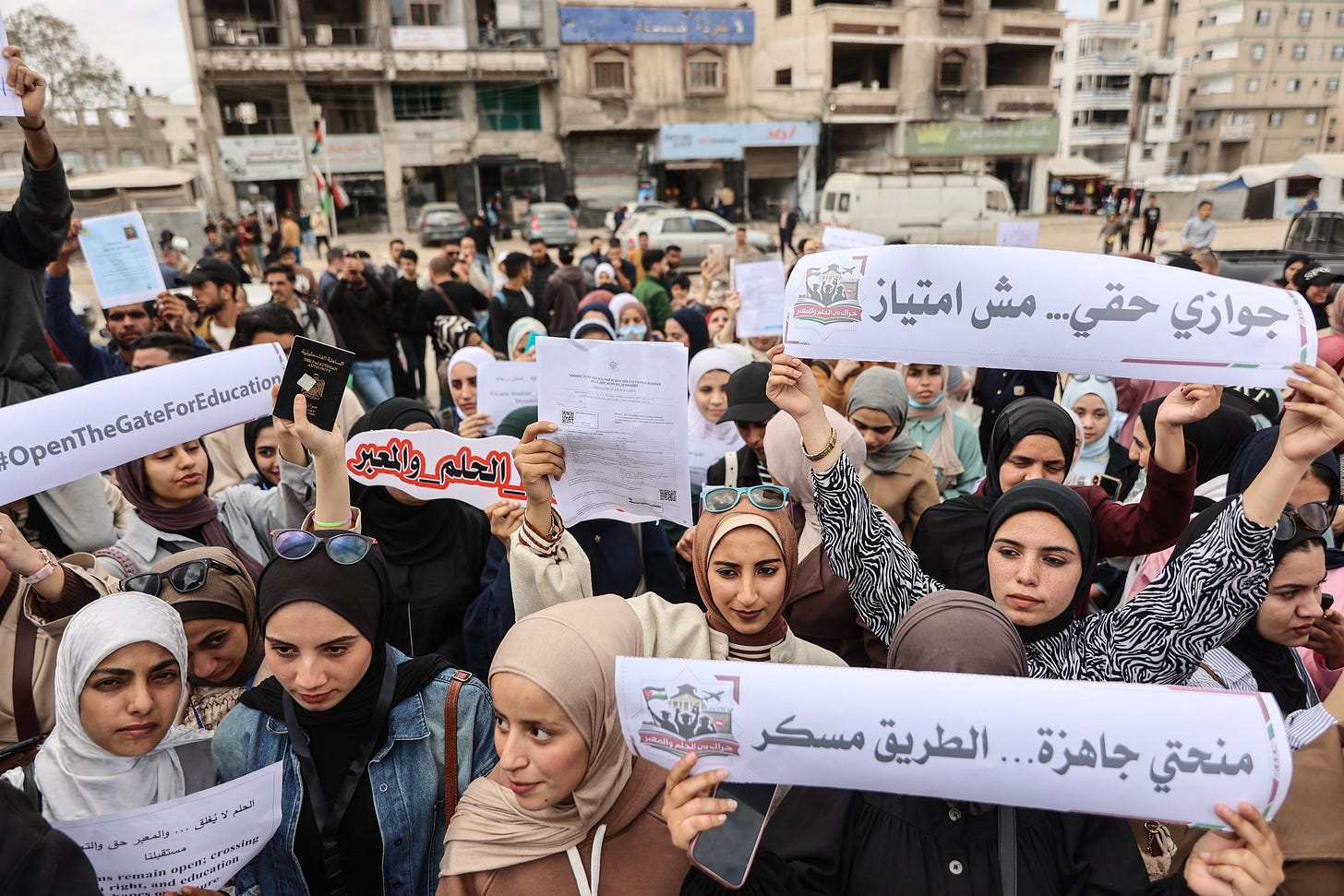
Even among students fleeing conflict worldwide, Palestinians in Gaza face a uniquely steep climb. From Syria to Ukraine, students could generally count on international relief efforts to help a population at war rescue its young, and on diplomatic channels to assist the new generation navigate a complex bureaucratic path to continue their education abroad.
Gaza is different. For these students, there is no path. No dedicated visas, no biometric enrollment offices, no unified international response. Students like Serriea are caught in a bureaucratic hell they are bent on leaving, if they’re allowed to leave at all. They navigate on word of mouth, dodge ever-present scams, and rely on wholly inadequate solutions – like Duolingo.
Because test centers that administer the top English-proficiency exams, IELTS and TOEFL, have physically left the Strip due to the war, students in Gaza use Duolingo’s online version of the English test to obtain the certification that foreign universities require. But for Palestinians living in crowded tents, with unstable connections, and the constant threat of bombs, it’s nearly impossible to adhere to Duolingo’s testing rules. The result is that the app keeps failing them for violations students say are automatically detected by a company that has recently replaced its contract workers with AI. The result is also that students like Serriea and Sultan purchase the same test again and again, with money they could have used for much-needed food or other supplies instead.
Escaping Israel’s Scholasticide in Gaza
Education has long been a source of national pride for Palestinians.
Their literacy is exceptionally high; children in the occupied West Bank and Gaza enroll in preschool at a higher rate than in the region; and the UN Palestinian refugee agency (UNRWA) reports that its students consistently achieve results above those of their peers in their host countries.
These achievements come despite the problems students face. In East Jerusalem, Palestinians struggle to find a spot in overcrowded classrooms. In the occupied West Bank, Israeli settlers have attacked children walking to class (or have blocked them from even getting to school with barbed wire), while the region’s schools have faced demolition orders. And in Gaza, even before October 2023, repeated conflicts and Israeli restrictions made it hard to get uniforms, school bags, and the construction materials necessary to rebuild schools that were bombed. Yet, material deprivation has contributed to making education such a valuable commodity for Palestinians.
“With the 1948 Nakba and what followed, Palestinians lost all their physical possessions,” says Mona Jebril, a Palestinian who lived in Gaza for over two decades and is now a researcher at the University of Cambridge. “My family always emphasizes that education is a resource you can take with you wherever you go.” Today, such emphasis on portable education has taken on new urgency. Students trying to escape what UN experts have described as a scholasticide are stuck in a catch-22 – a contradiction where the destruction of their lives and assault on their education is simultaneously what makes them want to leave and what prevents them from doing so.
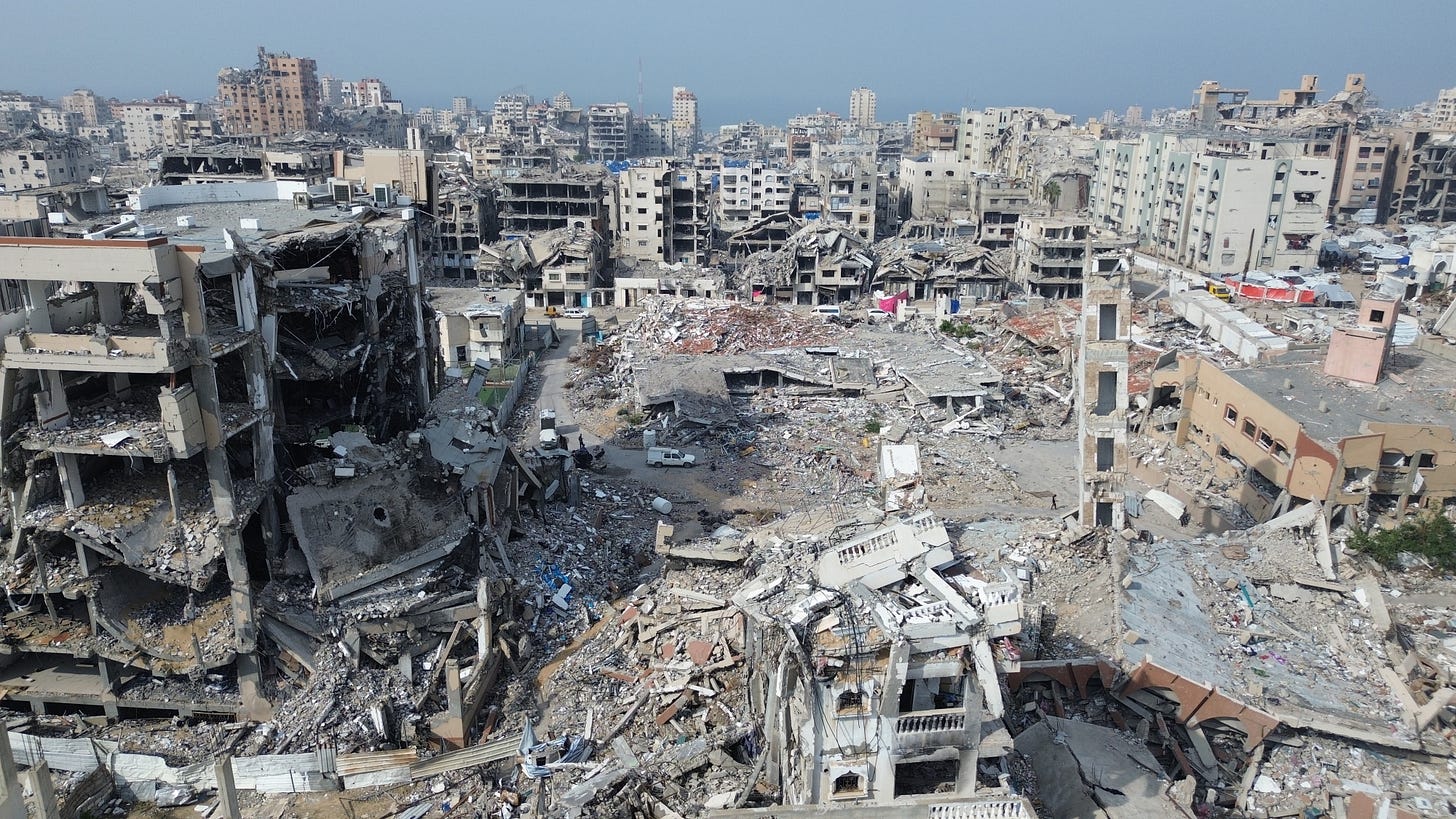
One may have lost their ID documents when their house was destroyed, or one might, as in Serriea’s case, have never had a passport. But getting one when 82% of government buildings have been destroyed is nearly impossible. One may need to reach out to their past professors asking for recommendation letters, as in Sultan’s case, but will they have a phone or a computer to send them? Will they still be alive? And then there’s the problem of obtaining an English certification, a step required by most universities, made harder by the fact that all test centers have physically left the Strip.
“Our last face-to-face IELTS session in Gaza took place on 1 October 2023,” said The British Council, which administers the test. ETS, the non-profit organization behind the TOEFL, has also left Gaza. Their home-based versions remain available, but almost no Palestinians in Gaza use them because both take two to three hours to complete – an eternity for students who rarely have access to a stable connection. The British Council confirmed that “since October 2023, around 70 candidates have taken the exam” across Palestine, including the occupied West Bank.
“What’s the point of trying to take a three-hour online test with this internet connection?” says Sultan, the 26-year-old student who applied to dozens of scholarships.
“When my university was destroyed in the war, my dream was shattered, and I began to feel that my abilities and passion for learning were being buried in a place filled with death and destruction,” says Aya El Nawajha, a 21-year-old student from Khan Younis. “I wanted to save myself and my deep desire to learn.” Before applying to a foreign university, El Nawajha spoke with trainers for the TOEFL and IELTS tests. “They told me that the tests weren’t available in Gaza because of the war. That’s why students tried to apply through Duolingo.”
“I want to make the whole world know about my story, and my people’s story, and my country’s stories,” says Tala Herzallah, a student from Gaza who was evacuated in August 2025 to Ireland with more than 45 other students. She says that most of the students evacuated with her had taken the Duolingo English Test.
Duolingo is the most popular option in Gaza, but it is far from ideal.
A Bomb Explodes, a Test Canceled
On Jan. 30, 2026, Serriea took the Duolingo English Test for the second time.
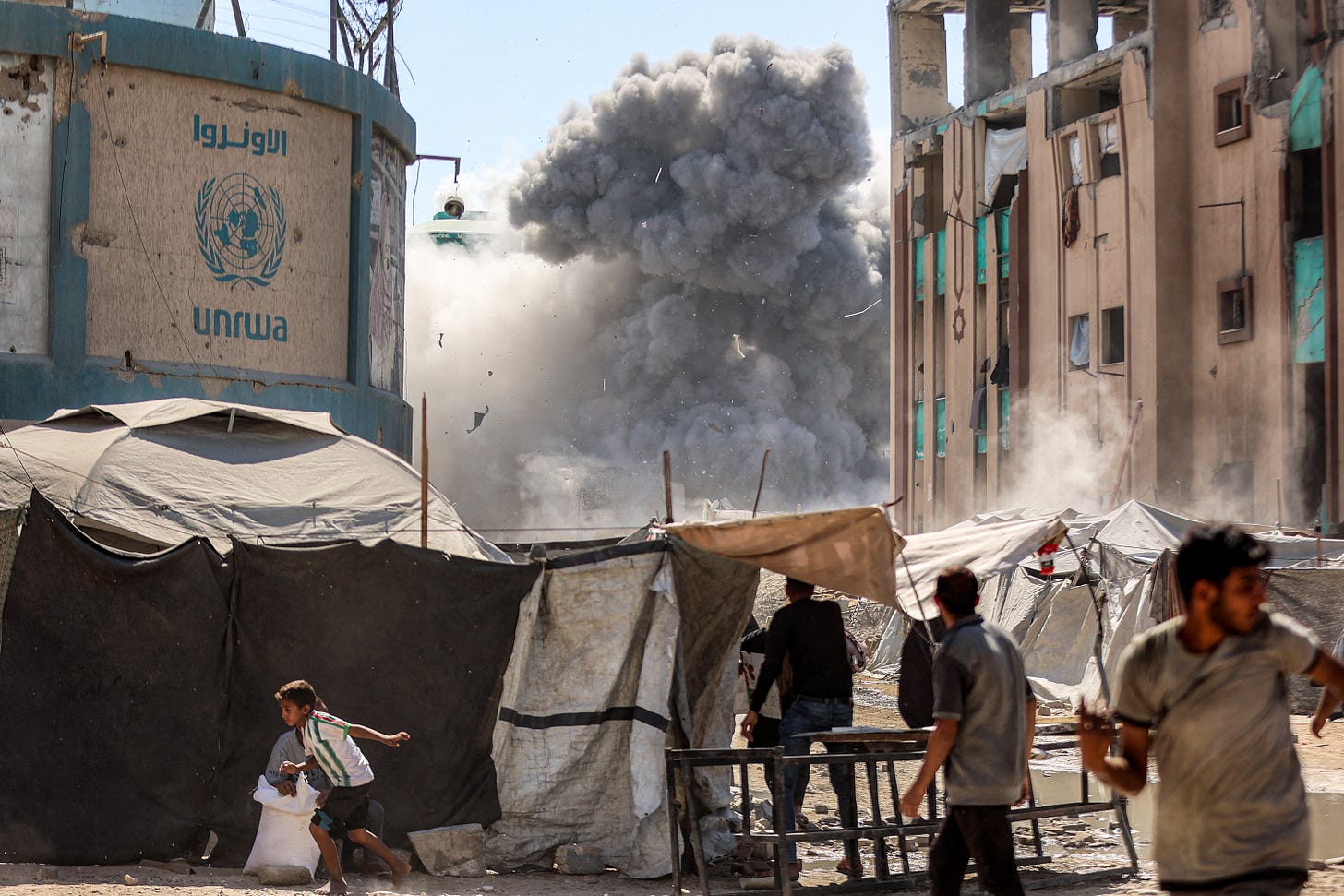
She walked with a friend to Dir al-Balah, in central Gaza, where she hoped to find a better connection. Already tired from the long trip, she clicked on the blue button that started her test once again. She only had a few questions left when a strike hit a court near her building. “We all scrambled out of the place in a panic, and I forgot my ID on the ground. I am still terrified from what happened and can barely speak about it,” she says.
Duolingo’s testing rules are strict. Test-takers are expected to sit alone in a bright, quiet room, with nothing and no one to interrupt their session. Their computer must remain connected to the internet at all times. Their face must stay fully visible and well-lit. Their eyes must stay fixed on the screen, looking down only when their fingers need the keyboard. They’re expected to prop their phone behind them, camera on and fully charged, serving as a silent witness to the entire session.
Students in Gaza find it almost impossible to meet these conditions.
“If the internet connection drops for more than five seconds, the test is canceled,” says Sultan.
“Headphones were not allowed, which was one of the most frustrating parts,” says Serriea. “There was constant noise – people talking, children crying, generators humming. Focusing in that chaos felt impossible.”
Their lights might go off because of a power outage. Wind might shake their damaged tents and move the phone that’s recording the test. Someone in their crowded camps might walk into the frame. The loud buzzing of a drone may force them to look away from the screen for too long. Any violation can lead to an aborted session and force them to restart the test from scratch. After three violations, the test is canceled, and students must re-purchase it to continue.
What’s worse is that these violations appear to be detected automatically.
Duolingo confirmed to me that the test uses AI monitoring technology, which it says lowers costs and increases accessibility. The company also said the conditions in Gaza could trigger false violations, but added that human agents review every test and that incorrect flags can be overturned.
Students interviewed for this story say they did not receive any such corrections. Not for Serriea: neither after her connection dropped, nor after she was interrupted by a strike. Both sessions were canceled. “It all went to waste,” she says, referring to the money her father had borrowed. And not for Sultan, who was even more unlucky. He paid for the Duolingo English Test three times using money he was saving for food. Each attempt ended in a similar way: a violation detection, a failed test. Sultan says he contacted the company but never heard back. Eventually, after I told Duolingo about his case, he was refunded.
Other people in Gaza I spoke with experienced the same problems. For these students, the apparently lower cost of the test came at a much higher price – a price they paid multiple times, and which one of the world’s most desperate populations can hardly afford.
In the past, Duolingo has supported refugees’ right to education. In 2018, it produced a documentary about Syrian refugees learning a new language through Duolingo. In 2022, the company announced that it would donate “all of the ad revenue from people studying Ukrainian on Duolingo to Ukraine relief.” It also provided “fee waivers to Ukrainian students taking English proficiency tests.” Some fee waivers are also available for Palestinians. Gazan Student Support Network, a Jordan-based non-profit that helps students in Gaza continue their education, said it offered Palestinians over 140 waivers. Sultan, Serriea, and El Nawajha say they contacted the non-profit to obtain one of these vouchers, but never heard back. The Gaza Student Support Network did not answer my questions about why the students didn’t get a response.
Their struggle against this monitoring technology comes in the context of a larger move to replace workers in Silicon Valley, of which Duolingo is also a part. In late 2023, the company laid off roughly 10% of its contract workforce, followed by another cut in October 2024. In April 2025, CEO Luis von Ahn sent a memo to staff saying the company would “gradually stop using contractors to do work that AI can handle,” even if it meant accepting what von Ahn called “occasional small hits on quality.”
“International universities need to acknowledge the fact that apps like Duolingo, for example, are limited when it comes to specific contexts,” says Jebril, the researcher at the University of Cambridge. “It’s an easy way of handling a problem without really dealing with it, like sweeping things under the carpet.”
Part of the problem goes back years. According to Jebril, Israel’s blockade “has limited a lot the ability of the universities to connect with other international universities” at least since Hamas took power in 2007. Contrary to students in other conflicts like Ukraine and Syria, Palestinians wishing to evacuate can rarely count on established connections. “If universities had these relations in place, it would have been much easier now to respond and adjust,” says Jebril.
The level of destruction in Gaza dwarfs that of most recent conflicts. According to a report by UNESCO, 95% of campuses in Gaza have been damaged or destroyed. And it’s not just universities. Visa application centers in Gaza are closed, and authorities in countries like Canada and the UK are often reluctant to waive these requirements, particularly for men. “There is a lot of suspicion that young men – and I’m talking as young as 12 and as old as probably in their 70s – are potentially fighters,” says Debbie Rachlis, a Canadian immigration and refugee lawyer who has worked on the case of Palestinian students evacuating to her country.
The crisis of students in Gaza calls for a long-term, sustainable plan, “but it also doesn’t mean waiting for the big response and not doing these little steps,” says Jebril. There is a great deal that universities can already do. They can also use their institutional weight to push governments toward comprehensive diplomatic solutions rather than a patchwork of regulations. They can replace digital tests with direct interviews. For students whose English is not yet at the required level, mandatory language courses on arrival can bridge the gap without barring the door entirely. And if they insist on an English certification, they can offer vouchers for students in need. That’s exactly what a university Serriea was applying to did.
‘Trying Not to Lose Hope’
In February 2026, Serriea took the Duolingo English Test for the third time.
She said she requested a fee waiver from a non-profit working with Duolingo to help students in Gaza, but received no response. A university in Turkey later agreed to pay for the test. This time, no violations were detected, and she obtained her certification. With it, she could get a scholarship from the UK, and is now hoping to be evacuated. But that at the moment feels like a distant hope, as Israel continues to severely restrict movement in and out of the Strip. Still, Serriea remains optimistic, and perhaps for good reason: This week, 72 students passed through the Israeli Kerem Shalom crossing to continue their studies in Italy and San Marino.
“I really want to achieve my dreams and reach my goals no matter how hard things get. Some days are harder than others,” Serriea says. “But I am trying not to lose hope.”
Chris Caurla is a journalist, motion designer, documentary-maker, film-lover. Italian-born, Berlin-bred, now living in New York, where I overthink stuff and write articles about it.
RELATED:
- 15K Gaza Students Have Been Killed. Survivors Are Denied Their Education.
- Israel’s assault on Palestinian universities is a threat to human rights and a tragedy for this generation of students
- A New Library in Gaza Rises From the Ashes of Destruction
- The US-Israeli War on Science is an Assault on our Future
- Stunning Victories and Rising Repression: a look back at the global student movement for Palestine in 2025
- After crushing dissent, U.S. universities are deepening ties with Israeli academia