By Malak Hijazi, Reposted from Electronic Intifada, May 5, 2026
Kafa Hannon, 76, struggles to access medication for her chronic illnesses.
Kafa lives with long-standing chronic conditions, including hypertension, diabetes, a thyroid disorder and joint pain. But with tight Israeli restrictions on medicine entering Gaza, she’s been forced to ration her own care.
“The last strip [of medicine] I got was two months ago, and it only had ten pills,” Kafa told The Electronic Intifada. “I was taking one pill a day instead of two, until it ran out. Since then, I haven’t taken a single dose of my blood pressure medication.”
She is far from alone.
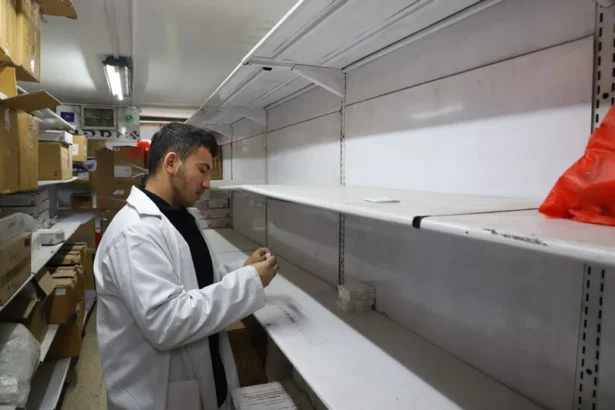
Just over half of Gaza’s medicines are out of stock, according to data from the General Directorate of Pharmacy at the Ministry of Health in Gaza, shared with The Electronic Intifada. Of 622 essential items, 312 were unavailable as of March 2026.
The shortage of medicines in Gaza is rooted in the blockade Israel imposed in Gaza in 2007, but the genocidal war that began in October 2023 pushed an already fragile system into operational collapse.
The ceasefire-that-is-not-a-ceasefire agreement that came into effect in October 2025 has brought no meaningful relief. Only 4,999 trucks entered Gaza out of 23,400 planned under the agreement, amounting to roughly 21 percent of the intended volume – and the empty shelves in pharmacies up and down Gaza bear this out.
In March, the World Health Organization’s regional director, Hanan Balkhy, warned that “stocks of essential medicines, trauma supplies and surgical consumables are critically low, and fuel shortages continue to limit hospital operations” in Gaza.
Meanwhile, Doctors without Borders reported that it has been unable to bring any supplies into Gaza since 1 January 2026. Israel has denied Medical Aid for Palestinians access for aid since March 2025, as well as UNRWA, the UN agency for Palestine refugees.
Nothing’s changed
The impact is most severe among patients with chronic conditions, with approximately 60 percent of primary care medicines unavailable, according to Ministry of Health pharmacy records, forcing widespread rationing and treatment interruption.
Patients like Kafa.
“The ceasefire changed nothing,” Kafa told The Electronic Intifada in April.
The insulin she needs to manage her blood sugar arrives only intermittently, keeping her health in a state of constant disruption.
Without regular medication for her chronic conditions, the consequences are tangible. Originally from Gaza City, Kafa was displaced south before the ceasefire came into effect last year, and there she collapsed more than once.
On one occasion, she lost consciousness and vomited and was rushed to hospital. She initially believed the episode was caused by a lack of insulin, but doctors later told her it was due to the sudden interruption of her thyroid medication.
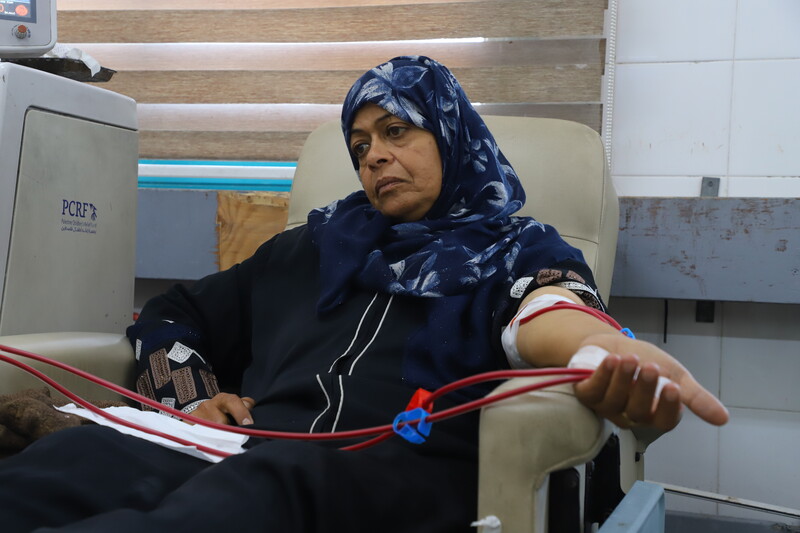
Kafa describes herself as “always sick and exhausted.” She suffers from constant headaches, and her vision, she told The Electronic Intifada, is “blurry.”
Recently, after significant effort, she obtained a single strip of thyroid medication brought from Khan Younis to Gaza City, where she lives with her daughter. She is rationing the medicine, taking one pill a day instead of two to prolong its use.
“I don’t know what I will do when it ends,” she told The Electronic Intifada.
The shortage of medicine is compounded by soaring prices.
“A strip of medication used to cost around 6 shekels,” or nearly $2, she said. Now it has quadrupled in price, she added, “if you can find it at all.”
Her family members help her look through bare pharmacies every few weeks. More often than not, they return empty-handed.
The wrong dose
For Ali al-Sayed, 19, a heart condition that once required careful medical supervision has become a constant struggle with dosages, availability and uncertainty.
The young engineering student has already undergone two open-heart surgeries, the first at the age of 9 and the second when he was at secondary school in 2023. Before October 2023, doctors had recommended specialist follow-up care outside Gaza.
That option disappeared with genocide.
“I was relying on a specific medication my whole life and used to get it easily from the pharmacy,” Ali told The Electronic Intifada. “Now I’m using a substitute at a different dose than what I actually need. My medication still hasn’t come in at all.”
He depends on a blood thinner that requires precise dosing and regular monitoring to prevent clotting or internal bleeding. The challenge is precision. Ali needs 3mg daily, but only 5mg tablets are available in Gaza. He will typically divide the tablets in half, as the closest possible approximation to his dose. Without proper measuring tools or consistent medical supervision, dosing errors can carry serious risks – too little and the blood clots; too much and it can cause internal bleeding.
Monitoring requires a standard international normalized ratio (INR) blood test to measure clotting levels and guide dosage. In Gaza, this is no longer reliably available.
“I can go to a hospital in Gaza City and another in Deir al-Balah in the same day,” Ali said, “and after hours of waiting they tell me the test material isn’t available and my whole day is wasted.”
On one occasion, he took three blood clot tests in different hospitals in a single day. The results varied significantly, making it difficult to determine a safe dose. He said such disruption has also affected his engineering studies.
His father, Jalal al-Sayed, a social worker, told The Electronic Intifada that one of the challenges they are facing is ensuring his son has access to appropriate food – in particular fresh fruit and vegetables.
Like medicine, deliveries of food aid into Gaza dropped dramatically after Israel and the US started their war on Iran, and what foods are available, like canned foods, are not suitable for his condition.
“There is no doctor we can reach regularly,” Jalal said. “Specialists have either left Gaza or been displaced to areas we cannot access.”
During the war, the family sometimes resorted to expired medication when no alternatives were available.
Jalal said the cumulative disruption has taken a psychological toll on his son, who is “angry and irritable all the time.”
A system dismantled
Zikri Abu Qamar, acting head of the pharmacy division at Gaza’s Ministry of Health, said that coordination for the entry of medicines for the private sector stopped entirely once Israel launched its genocidal war, leaving supply dependent almost exclusively on international organizations and without a functioning procurement system.
He said the impact varies by condition. Patients with hypertension can sometimes be switched to alternatives, but those with endocrine and other chronic conditions without substitutes face continuous deterioration.
The collapse of UNRWA in Gaza has deepened the shortage. Before the war, the UN agency’s health centers supplied medical services to more than 70 percent of Gaza’s population, who are mostly refugees. That responsibility has now largely shifted to Ministry of Health facilities.
Cold-chain requirements further complicate supply. Insulin and cancer drugs depend on refrigeration that cannot be reliably maintained at crossings, resulting in delays or rejected shipments.
“Medicine can remain for long periods at the crossing,” Abu Qamar told The Electronic Intifada. “If it degrades due to improper storage, it becomes ineffective.”
The biggest problem is a lack of supply. “What we manage to bring in does not exceed 30 to 40 percent of patients’ needs,” he said.
Yasmin al-Helou, a doctor and the director of Al-Sabra Clinic, a primary care facility in Gaza City, said the breakdown of the health system is evident daily.
“The worst feeling for a doctor,” she said, “is to stand helpless, hands tied, in the face of patients’ needs.”
Patients often discontinue treatment when medicines run out or become unaffordable, she said, leading to preventable complications including hospitalizations, intensive care admissions and avoidable deaths among people with chronic diseases.
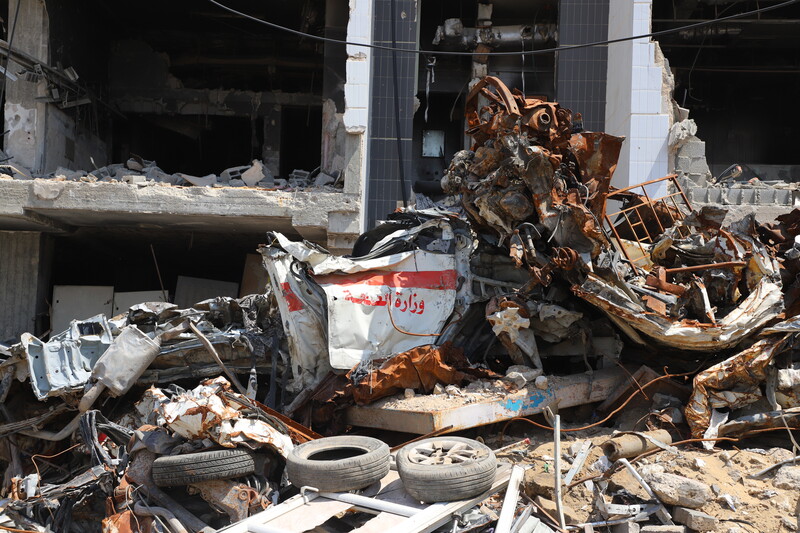
Her clinic operates without basic supplies such as gauze, IV fluids and diagnostic tests. Israel’s attacks have gutted much of Gaza’s health infrastructure, partially or completely destroying more than 1,800 health facilities and leaving the few remaining primary care centers overwhelmed with far more patients than they were built to serve.
The reconstruction bill for Gaza’s health system is an estimated $10 billion.
“We try our hardest to provide the best care,” she said, “but with so little available and so many more patients than before the war, it is an enormous burden on medical staff.”
Under such desperate circumstances, families are left to make difficult decisions about treatment on their own.
“We live in constant anxiety,” said Jalal. “We do not know whether the dose is protecting him or putting him at risk.”
Malak Hijazi is a Gaza-based writer for Electronic Intifada.
RELATED:
- ‘Nothing has changed’: Gaza health workers report almost no medical aid entering the strip
- Israel gives war profiteers sole control of life-saving Gaza aid: Report
- MSF: Israel’s deliberate restriction of food and aid led to alarming malnutrition levels in Gaza
- Six Months into Gaza Ceasefire, Setting the Record Straight About Aid
- Netanyahu’s plan to “end” US aid to Israel is to give even more money under a different name