By Nagham Zbeedat, Reposted from Haaretz, April 29, 2026
Shortly after 1 A.M. on October 8, 2023, Omar Hamad received a warning to evacuate his home in Beit Hanoun, near the Erez crossing in northern Gaza. His family wanted to leave immediately. He refused.
The 30-year-old poet and former pharmacist insisted on waiting until morning, delaying his evacuation for hours despite the risk. By daylight, he began packing – not only clothes or documents, but books from the collection he had been building since he was 15 years old.
“I knew our displacement would be permanent,” Hamad tells Haaretz. “I waited until morning and took what I could carry: 120 books.”
After surviving more than two years of bombardment, multiple displacements and a famine, Hamad’s 120 books – and the thousands more he collected during Israel’s war in Gaza – form the foundation of the collection at the newly opened Phoenix Library. The name was chosen because, like the mythical bird, it has been pulled together from the literal ashes of a scorched landscape.

Located in Gaza City, the Phoenix Library houses roughly 6,000 titles. Its collection is a patchwork of survival: books rescued from the rubble of the Edward Said Library in Beit Lahia, volumes salvaged from the Islamic University, and 2,000 donations from bereaved families who wanted their loved ones’ scholarly legacies to live on.
For two years, Hamad’s goal was to preserve as many of Gaza’s books as he could. The idea of turning what remained into a public library only came after a cease-fire was announced in October 2025. Two months later, Hamad and Ibrahim Massri, a 30-year-old author and teacher from Beit Hanoun, began working with a small group of friends to re-establish a library in Gaza City.
In besieged Gaza, “the cheapest thing is human life, and the most expensive thing is time,” says Hamad. Every shelf, every nail and every screw required a day-long search. Because the Israeli military prohibits the entry of construction materials like wood and stone, the founders had to scavenge and repurpose what remained.

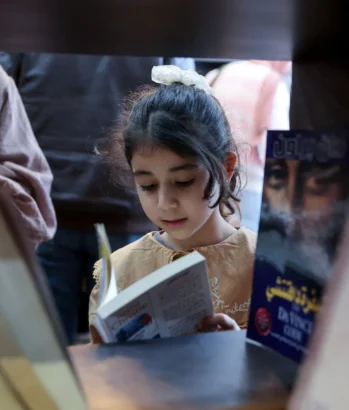
Phoenix Library opened its doors on April 21. It is the first library to open in Gaza since the war broke out two and a half years ago, and its founder describes it as a defiant response to what United Nations experts deemed a “scholasticide” in Gaza – the targeted, systemic destruction of schools, universities, libraries and cultural institutions. (In June 2025, an independent UN commission said that Israel’s attacks on educational, religious and cultural sites amounted to war crimes.)
“For me, the books are my identity, my very being, a part of me, and they were worth the weight I carried through displacement,” Hamad says. “I have books from after 1948 that were printed in Gaza – valuable, rare volumes, very old, a heritage that does not die.”
Six displacements, thousands of books saved
By the time the war broke out, Hamad’s personal book collection had grown to nearly 400 books – literature, history, older volumes printed in Gaza decades earlier. He says he began assembling it as a teenager after becoming aware of what he describes as Israeli monitoring of the Palestinian curriculum, and his sense that his education was being limited.
The books moved with him, and not in a single direction. From Beit Hanoun, Hamad and his family was first displaced to Gaza City. Hamad built a small shelving unit inside his tent, where he arranged the books he had managed to keep. Today, the same bookshelves are displayed in the Phoenix Library as a remnant of his journey.

As the war expanded, they moved south in stages – to Khan Yunis, where he sheltered for days inside al-Amal Hospital as it was besieged by the Israeli army; then to Rafah, then back north to Deir al-Balah. Each displacement meant deciding what could be carried and what had to be left behind, and the books were caught in that calculation.
At one point, while leaving Khan Yunis under fire, Hamad says he walked out between tanks. The books stayed behind.
Weeks later, after hearing that Israeli forces had withdrawn from the area around al-Amal Hospital, he went back. The books were still there. He gathered them again and carried them south. When fighting reached Rafah, he was displaced once more, again with the books.

During the temporary cease-fire between January and March 2025, Hamad returned north to Beit Hanoun. There was no house to enter; the entire area had been flattened. He searched through what remained, trying to locate where his room had been, where his bookshelves once stood. He pulled out what he could from rubble; he estimates that he saved 300 or so books. Others remain buried under debris to this day.
In Beit Lahia, he retrieved dozens of books from a destroyed private library belonging to Mosab Abu Toha, an award-winning Palestinian poet, writer and literary figure from Gaza who founded the Strip’s first English-language library – the Edward Said Library. “We asked for his permission, and I tried as much as possible to retrieve the books, managing to save around 50 of them.”
Hamad remembers the first book he saved from the wreckage of the Edward Said Library: “The Catastrophe of Palestine.” “It felt like a cruel irony, and I felt it as a burden on my shoulders – a task that went beyond passion and became a responsibility, a duty,” Hamad says.
His next rescue mission was at the Islamic University in Gaza City. “I was told about the large library at the Islamic University, that it had been burned, and that people were taking the books. I went there; on the first day I saved around 300 books, and on the second, another 400.”

Hamad says the university’s central library had around 700,000 books before the war. By the time he reached it, most were unsalvageable – burned, damaged or scattered. “I felt a deep sense of loss while rescuing the books, because so many valuable ones had been destroyed,” he admits. “Most people couldn’t find wood or firewood to light fires, so they turned to books as a substitute for cooking and starting fires.”
In a place where a bag of flour can cost more than a rare manuscript, Hamad’s obsession was often met with bewilderment. “People asked, ‘What will you do with books?’ They were probably right – bread was more valuable than ink,” he said. “But I had a belief that one day, I would stand in a library of 6,000 books. Today, that is where I am.”

In the weeks before a famine was declared, Hamad told Al Jazeera as he sheltered in Gaza City that he was willing to trade his library for a sack of flour.
As the humanitarian crisis intensified due to restrictions on the entry of food and medicine, Hamad offered the collection in exchange for food, and remained willing to give it up “for a loaf of bread to feed my siblings.”
“Every book here carries a part of me, of my childhood and my dreams, but hunger shows no mercy,” he said at the time, his voice breaking. “We have nothing left. I tried to hold on to my library until the very last moment, but hunger does not wait.”

‘Saving the minds of our children’
Working alongside Hamad and Massri at the library is Omar’s cousin, Hussam Hamad, a 42-year-old academic with a doctorate in human resources management. For Hussam, the library is a vital intervention against the “intentional ignorance” being forced upon a generation.
“The infrastructure is gone,” Dr. Hussam explains. “Schools, universities and institutions like the Rashad Shawa Cultural Center – which held over 100,000 books – have been leveled. When you destroy education, you create social fragmentation. We are trying to save the minds of our children from the vacuum of war.”
Hussam’s own story mirrors the loss of the Strip. Just three months before the war began, he returned to Gaza after living in Egypt for 12 years. He brought 15 suitcases filled with books to start his own research library. “Today, all those books are under the rubble of my house.”

To expand their catalog, the library has begun printing books locally. “Before the war, a book cost 7 shekels [$2.36] to print. Now it costs 45 [$15.20],” Hamad notes. “The paper is lower quality, but we print what we can.”
The library operates on a monthly subscription fee, roughly 190 shekels ($64.19), to cover the astronomical costs of solar-powered electricity, internet and paying rent. It currently hosts up to 50 visitors an hour, offering a sanctuary for researchers and students who have nowhere else to go.
“The vast majority of schools, universities, libraries and cultural centers have been destroyed,” Hussam says. “Students struggle to find places to learn. Access to knowledge has become extremely limited.”
Despite the immense challenges, the Phoenix Library stands open today as a testament to Gaza’s steadfast resilience.
“We love life. We condemn death,” Hussam says. “The establishment of this library is, in itself, an act of survival. If we don’t take the initiative for our children and the next generation, who will? We refuse to be a people who just live in tents and wait.”
Nagham Zbeedat covers Palestinian affairs and the Arab world.
RELATED:
- Israel sees terrorism in books – even coloring books, arrests Palestinian bookshop owners
- Israel carries out systematic erasure of Gaza’s historical landmarks and cultural heritage
- Israel’s Attacks on Seed Banks Destroy Millennia of Palestinian Cultural Heritage
- ‘Words like Slaughter:’ A comparative study of The New York Times reporting in Ukraine and Gaza
- Israeli Destruction of Gaza: The Facts