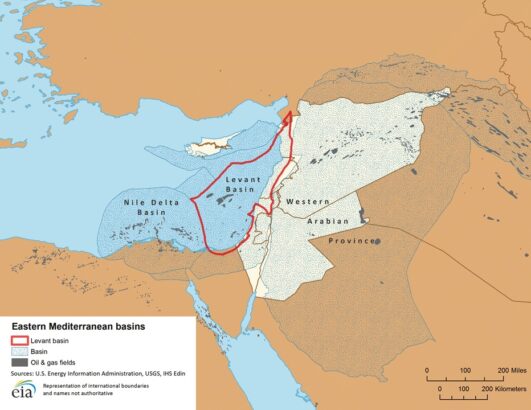
Sizeable reservoirs of oil and natural gas wealth are located in offshore Gaza and even in the occupied West Bank.
But the Israeli occupation prevents Palestinian efforts to develop the energy fields, while seeking to benefit from their assets. Hence, the need for whitewashing.
By Dan Steinbock, Reposted from AntiWar.com, October 31, 2025
The Quest for Gaza’s Energy, Part 2
Read part 1 here
In 2019, UNCTAD (the United Nations Conference on Trade and Development) reported that the occupied territories lie above sizeable reservoirs of oil and natural gas wealth in Area C of the occupied West Bank and off the Gaza Strip. However, as UNCTAD warned, the Israeli occupation has prevented Palestinians from developing their energy fields.
The missed opportunities added up.
Palestinians’ ransacked energy wealth
Based on the 2010 US Geological Survey, the discoveries of oil and natural gas in the Levant Basin amounted to 122 trillion cubic feet of natural gas and 1.7 billion barrels of recoverable oil. In 2023 US dollars, the value of these resources translated to $557 billion and $87 billion, respectively. On the eve of October 7, that was about $644 billion in total.
By 2018, 18 years had passed since the drilling of Marine 1 and Marine 2 offshore Gaza. As the Palestinian Authority had not been able to exploit these fields, the accumulated losses were already in billions of dollars. Even in the West, the Israeli stance was seen as needlessly harsh.
In February 2021, amid the COVID-19 fog of the pandemic years, talks on a gas pipeline that would deliver reliable energy to the impoverished Gaza seemed to move ahead. The plan would see natural gas from the deepwater Leviathan field operated by Chevron in the eastern Mediterranean flow through an existing pipeline into Israel, and from there into Gaza through a proposed new extension. The Israeli side of the planned pipeline would be funded by Qatar, and the section in Gaza would be paid for by the European Union.
After a painful seven-year pause, the pipeline project was expected to provide “a steady energy source to Gaza, ending rolling blackouts that have helped cripple the economy of the blockaded Palestinian enclave.” Control over these energy resources was a central element in Yasser Arafat’s state-building agenda. As Michael Barron, an energy consultant who has written on Gaza’s energy, concurs, “Israeli exploitation of Palestinian resources was and remains a central part of the conflict.”
But the Netanyahu cabinets’ intransigence is working against Israel’s long-term interest in peace and stability. In particular, the recognition of the Palestinian state, especially by countries like the UK and Italy with large energy firms registered in their jurisdiction (BG and ENI, respectively), could clarify the legal ambiguity. It could ensure the Palestinian Authority with a secure source of income that is no longer reliant on Israel.
But that has never been acceptable to the Netanyahu cabinets.
Illegal offshore tenders amid huge onshore destruction
In December 2022, the Israeli Ministry of Energy launched the Fourth Offshore Bid Round, offering new exploration licenses. A year later, it awarded licenses to several Israeli and international companies: Eni (Italy), Dana Petroleum (UK, a subsidiary of a South Korean company), and Ratio Petroleum (Israel). The problem is that these tenders violated international law, however.
Nonetheless, just a few months later, in June 2023, following years of stalled talks, Israel approved the development of the Gaza Marine field, while Egypt’s state-owned EGAS (Egyptian Natural Gas Holding Company) was to lead extraction efforts in cooperation with the Palestinian Authority. Nonetheless, Israel stipulated that Hamas must not benefit financially.
Ironically, PM Netanyahu had for years ensured, as part of his Gaza strategy, that Hamas could receive multi-million-dollar shipments, via intermediation. The double-faced ploy used by Hamas to disrupt the Palestinian Authority (PA), to keep Gaza weak, and ultimately to reap the gas benefits to Israel.
As a net effect, active gas exploration or production could not commence due to the ongoing tensions in and around the Strip, which undermined investment and infrastructure development. The resulting stalemate status quo harmed Egypt’s mediation and interest in fostering regional energy stability.
As Israel initiated its ground assault in Gaza a week after October 7, 2023, Energy Minister Israel Katz pledged on X that “all the civilian population in Aza [Gaza’s Hebraized name] is ordered to leave immediately. We will win. They will not receive a drop of water or a single battery until they leave the world.”
But Netanyahu’s veteran Likud ally had another, equally destructive role. It was Katz’s Ministry that awarded the exploration licenses to the companies on October 29, 2023, violating international law, just two days after the lethal fury of the full-scale invasion of Gaza by the Israeli military. If it wasn’t pre-planned, it was certainly most convenient.

Palestinian rights groups protest licenses
Due to his actions, Katz contributed deliberately and directly to the Palestinian genocide in Gaza and could be charged in the ICJ genocide case, together with Prime Minister Netanyahu and ex-Defense Minister Yoav Gallant. Katz was also directly responsible for the weaponized famines that facilitated the genocide.
By early 2024, almost in parallel with the South African genocide case against Israel, the Israeli Energy Ministry’s decision was protested by several Palestinian human rights groups.
Based in Haifa and Beersheba, Adalah demanded that Israel revoke the tenders that violated international law. In turn, Al Mezan, Al-Haq, and the Palestinian Center for Human Rights (PCHR) appealed to licensed companies to refrain from participating in acts of pillage of the sovereign natural resources of the Palestinian people.
A law firm representing these groups sent a warning letter to the Italian state-owned firm ENI that it should not exploit the gas fields in an area called Zone G. They said that roughly 62% of the zone lies in maritime areas claimed by Palestine. Consequently, “Israel cannot have validly awarded you any exploration rights and you cannot validly have acquired any such rights”.
For half a year, these appeals were effectively ignored by Israel and the United States, its primary military supplier and financier. Things changed in August 2025, when the PCHR released a report concluding that Israel has been committing genocide in Gaza.
Positioning for a gas exploration bonanza
As ceasefire talks intensified and property tycoons like Jared Kushner and Steve Witkoff began to dominate negotiations using Tony Blair as the public façade, the U.S. State Department sanctioned the three Palestinian human rights NGOs for having “directly engaged in efforts by the International Criminal Court (ICC) to investigate, arrest, detain, or prosecute Israeli nationals, without Israel’s consent.”
Secretary of State Marco Rubio added that “the United States will continue to respond with significant and tangible consequences to protect our troops, our sovereignty, and our allies from the ICC’s disregard for sovereignty, and to punish entities that are complicit in its overreach.”
Previously, the Trump administration had sanctioned the ICC in response to its investigation and arrest warrants for PM Netanyahu and his former Israeli Defense Minister Yoav Gallant for alleged war crimes committed in Gaza.
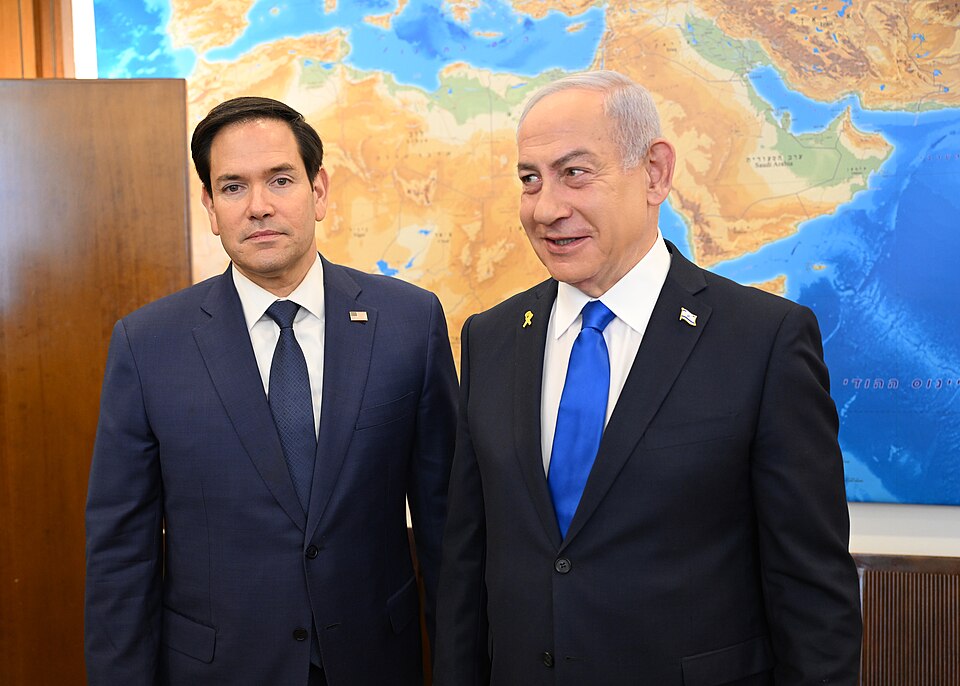
The opposition to Palestinian human rights is the common denominator between the Trump administration, which initiated its domestic suppression campaign against Palestinians in January, and the Netanyahu cabinet, which began its efforts to decimate leading Israeli human rights groups weeks later.
However, Rubio’s timing was in line with efforts to neutralize potential legal challenges in the aftermath of the ceasefire when offshore explorations would take off. Furthermore, the three Palestinian NGOs – Al Haq, Al Mezan, and the PCHR – just happened to be the ones that in February 2024 had confronted the Israeli gas exploration licenses offshore Gaza.
These were not just human rights groups that had long, highly-regarded track records and that had assisted ICC and other international organizations in their pursuit of human rights in the Middle East. They were likely to protest vocally and internationally if the Palestinians’ energy rights were to be shunned.
In brief, they were in the way.
RELATED:
- (2020) U.S. is in Middle East ‘to protect Israel’ not for oil, Trump says
- The Transparent Cabal: The Neoconservative Agenda, War in the Middle East, and the National Interest of Israel
- Tucker escalates war with neocons over Iran
- New neocon manifesto: Keep US troops in the Middle East forever
- WATCH: How Pro-Israel Neocons Pushed for War in Iraq (Alison Weir)