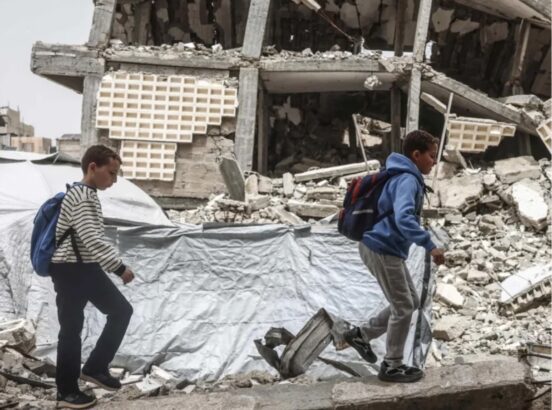
Less than one percent of debris has been removed from Gaza, and thousands of people still wait to bury loved ones who were killed in airstrikes and remain under the rubble. ‘I would dig with my own hands to bring out my son,’ says one father, who can’t reach his son’s body
More than six months after Hamas and Israel agreed to a U.S.-brokered cease-fire, the bodies of thousands of Palestinians remain decomposing under debris, as efforts to clear rubble from Gaza have largely stagnated.
More than 8,000 people remain buried under rubble as of April 26, according to Gaza’s Civil Defense. Rescue teams say they continue to receive calls from families who know exactly where their loved ones are buried under the rubble, but lack the equipment needed to reach them. In some areas, like Gaza City’s Shujaiyeh and Tuffah neighborhoods, recovery attempts have been halted entirely due to the scale of destruction or the risk of renewed strikes, Gaza’s Civil Defense says.
A joint assessment published on April 20 by the United Nations, the World Bank, and the European Union estimates that 68 million metric tons of debris are waiting to be cleared – a process complicated by the presence of human remains and unexploded ordnance. Total removal will cost more than $1.7 billion, according to the report.

In February, Alexander De Croo, the head of the UN Development Program, asserted that 0.5 percent of rubble had been removed from the Strip, and that at the current pace, it would take seven years to clear.
Ayham Shurab, 31, tells Haaretz from Cairo, where he moved in May 2024, that he still remembers the smell and the sight of decomposed bodies at his uncle’s house in Khan Yunis. The floors collapsed into each other during Israeli strikes in December 2023, and 12 people from the family disappeared between the rubble.
After Israeli forces withdrew from Khan Yunis in April 2024, Shurab’s father returned to the house to try to bury his brother and whoever they could reach. “I was there, but I didn’t do anything. I just stood,” Shurab says, explaining that he could not get closer. “The bodies were decomposed.”
العثور على جثامين ١٢ مواطنًا من عائلة شراب ارتقوا قبل أسابيع جراء قصف طائرات الاحتلال منزلهم على رؤوسهم في منطقة السكة وسط خان يونس. pic.twitter.com/OhpaFDcela
— ق.ض (@Qadeyah1) February 2, 2024
Only five of the 12 family members were able to be buried, although uncertainty remains around exactly who was buried. The only reason Shurab is certain it was his family, he says, is that no one else remained in the area.
“The entire neighborhood had already been emptied. No one was left but them. The rest of the houses were still standing. Only my uncle’s house and a neighboring empty house were targeted and erased.”
What remains unresolved is not only who was buried, but the knowledge that seven relatives will likely never receive a proper burial.
“There is grief, and there is also a sense of injustice,” he says. “The least a martyr deserves is a funeral, a proper farewell – like we grew up with, like a procession to their final resting place.
“People have the right for their names to be known, to be buried, to be mourned,” he adds. “But even this, the occupation took from them.”

Shurab says the main obstacle to retrieving the bodies is what he describes as a pattern of targeting rescue workers.
“When a house is hit, and people are inside, and civil defense teams come, they are targeted, too,” he says. “There is no freedom for them to work. Before hitting the house, they target civil defense sites, so there is no equipment, no ability to respond.
“The house is bombed, and it doesn’t stop there. They target it again and again. They target anyone who tries to rescue the wounded. They target ambulances, civil defense,” he continues. “So the bodies remain under the rubble, they decompose, and it becomes almost impossible to retrieve them.”
‘I would dig with my own hands to bring my son out’
Jehad Tayeh, 56, from Shujaiyeh in Gaza’s Old City, says he knows exactly where his son has been since Deiaa, 21, was killed last May. His body is beyond the Yellow Line. “Until now, we cannot get there.”

Deiaa, a university student studying information technology, is described by his father as a well-mannered, religious young man who scored high on the local matriculation exam. “In Gaza, this is what we care about. We raised all our children like this,” Tayeh says. “Without any political affiliation, with strong morals.” He says that morning, they had been cutting wood together. “He told me, ‘Father, my friend’s brother was killed. We are going to bury him.’ I told him: ‘Go help them.'”
The body they went to retrieve was partially buried under rubble. “He told me half of the martyr was visible, and the other half was under the debris,” Tayeh says.
Deiaa went with six of his friends to help. “Five of them were killed,” he says. The strike hit a school where they had gathered. “They targeted the school where he was. He was killed there.” At the time, he says, the area had not yet been declared a closed military zone, but shortly after it was classified as within the Yellow Line in an area now controlled by the Israeli army.
Since then, he has tried to reach his son’s body, but has not been able to. “I went to all institutions and organizations – the Red Cross, Doctors Without Borders, and the United Nations Office for the Coordination of Humanitarian Affairs,” he says. “I tried to coordinate with everyone. All of them told me the same thing: Coordination must be done through the Israeli side.”

If he were allowed, Tayeh says, he would go himself. “I would dig with my own hands to bring out my son,” he says. “I know exactly where he is. Maybe the landmarks have changed, maybe the area was bulldozed, but I know the place. I will search for him. I will recognize him, even from a shirt or a shoe. We will lift the rubble and find him. We have to.”
Speaking about his son’s death, Tayeh quotes the Quran: “No soul dies except by God’s will. He causes death and grants burial.” He says he has accepted the first part, but not the second, not yet, at least. “I am grieving my son,” he says. “I will cry for him all my life. Nothing equals losing my son.” He pauses, then adds: “May God have mercy on him. God chose him. This was his fate.”
‘I still dream that I am under the rubble.’
Amir al-Ajla was killed in an Israeli airstrike in December 2023, less than three weeks after his first birthday. His body has remained under the rubble ever since.

Amir’s mother – who requested anonymity out of fear for her safety – says she was displaced with her children from Shujaiyeh to her parents’ home in the Sahaba area in Gaza City. The six-story building housed her father and four of her uncles and their families.
“It was a miracle that I survived,” she says. “While I was under the rubble, I thought my children were killed. I said the shahada [the Islamic declaration of faith traditionally recited in one’s final moments]. I didn’t expect to come out alive.”
She says rescuers reached them with difficulty. She and her older son survived, but Amir did not. “Until now, they haven’t been able to retrieve him from under the rubble,” she says.
He was killed alongside multiple members of the family. “My mother, my brother, his wife and son, my uncles, their wives and children. It was a massacre.”

What she remembers most is the hour before the air strike. “I woke up early that day. I changed their clothes, combed their hair, and put perfume on them.” An hour later, the building was hit. “While I was under the rubble, I kept saying, ‘Oh God, was I preparing my children for death?'”
The grief has yet to ease, the mother explains. “There is a huge emptiness in my life,” she says. Her older son, now 5, still asks about him. “He tells me, ‘Mama, where is Amir? Why did he leave us? Mama, Amir is crying, bring him.’ He tells me, ‘I love him. I miss him.'”
At night, she says, her son dreams of his grandmother and brother.
“Until today, I still dream that I am under the rubble, searching for my children, calling out to them,” she says. She says she tells the bereaved brother that Amir is in heaven. “I tell him he is with his grandmother,” she says. “He tells me, ‘Okay, bring him back.'” She pauses, then adds quietly: “I am in pain, but I tell myself I accept God’s will.”

Families protest recovery efforts in Rafah
Even when bodies are eventually reached, not all families accept how they are recovered.
In a statement published last week and shared with Haaretz, the Rafah Families Association, a grassroots group representing bereaved families from the southern Gaza city, said they reject efforts by a local contracting company to retrieve bodies from under the rubble.
The statement accuses Masoud & Ali Contracting Co. of cooperating with Israeli authorities to remove debris and human remains from a 74-acre area in Rafah that has been under Israeli military occupation since the cease-fire was announced in October.
While Haaretz could not independently verify Israel’s relationship to MACC, Israeli officials were among the sources that confirmed MACC has been contracted to build an Emirati-funded compound for tens of thousands of displaced Palestinians at the site, Reuters reported in February. The Gaza-based contracting company has previously built water-pumping stations, solar energy fields, desalination plants, bridges, and other infrastructure in both the Strip and the West Bank, according to its website.
The families say they oppose the removal of rubble and bodies “in cooperation directly with the Israeli occupation,” and accuse the company of altering the geography of the city and handling the remains of their relatives without consent.
“We condemn what the company is doing, extracting the remains of our sons from under the rubble,” the families’ statement reads. “We hold them fully responsible for the destruction of people’s property and for working within the plans of the occupation.”
The IDF Spokesperson’s Unit responded to a request for comment after this article was published:
The IDF targets only verified military objectives used by the enemy and does not intentionally target rescue teams. It should be noted that every target is carefully reviewed.
The IDF takes numerous and varied precautionary measures to reduce the risk to the civilian population resulting from the fighting and from Hamas’s embedding and cynical use of civilian areas. Accordingly, during the war, the IDF has implemented precautionary measures in the form of temporary evacuations of the population for their protection. Evacuation efforts are carried out through SMS messages, leaflets, phone calls, media broadcasts, and announcements by the IDF Spokesperson in Arabic.
Alongside evacuation notices, civilians are allowed to move for their safety via designated routes. Contrary to the reporter’s claims, the IDF places the highest importance on protecting medical teams in general, and humanitarian aid workers in particular, and maintains ongoing coordination with all humanitarian aid organizations in the Gaza Strip.
Nagham Zbeedat is an Israeli reporter for Haaretz.
RELATED:
- ‘I searched for my father in the ruins’: The fate of thousands buried under Gaza’s rubble
- Rescue Teams Dig Up Over 50 Bodies Buried in Shallow Graves in Courtyard of Gaza City Clinic
- Israel now targets anyone trying to rescue children buried under rubble
- ‘Disappeared, buried, detained’: The horrors of Gaza’s missing children
- Thousands of Palestinians Return to Gaza City to Find a Wasteland of Rubble