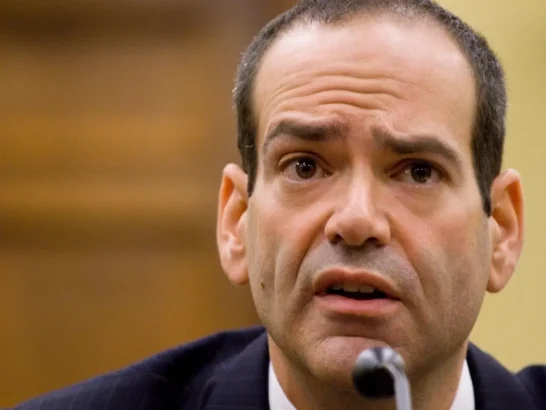
Tlaib calls for UAW federal monitor Neil Barofsky to resign after recording undercuts his claims about interactions with union President Shawn Fain
By Ryan Grim, reposted from Drop Site News, July 17, 2026
Detroit’s Democratic lawmaker Rashida Tlaib has called for the resignation of Neil Barofsky, the federal monitor tasked with overseeing the United Autoworkers, following reports of a call in which Barofsky hammered UAW President Shawn Fain in 2024 over the union’s call for a ceasefire in Gaza.
Drop Site obtained and authenticated a recording of the conversation, which undercuts previous claims by Barofsky about his interactions with Fain. During a board meeting around the same time, Barofsky claimed, according to previously leaked minutes, that he had never said that the UAW statement crossed a line into antisemitism, but in the call he repeatedly made that claim. Barofsky also claimed he didn’t share his own opinion with Fain on the call, but in fact Barofsky does so at length.
The recording also undercuts Barofsky’s claims about what Fain said during the call. Barofsky claimed that Fain told him he had intended to compare Israel to Nazi Germany, that Fain said he wasn’t interested in hearing other perspectives, and that he said it was “bullshit” that Jews were suffering as a result of rising antisemitism.
Fain’s only reference to “bullshit” on the call was to Israel’s actions in Gaza. “My problem with this is they’re killing tens of thousands of innocent fucking civilians in this process, and it’s complete bullshit,” Fain said. “They need to go after Hamas, target the fucking leaders, and take them out. And you know, if the U.S. supports that, I’m all for it. But this shit of just killing innocent fucking people is bullshit.”
Barofsky responded, “Okay, so that is what your intent was, to compare it to the Nazis.”
The call was first reported by the Detroit News on Thursday, and backs up 2024 reporting by Drop Site on the clash over Israel between Fain and Barofsky. (A Drop Site editor is married to a UAW official, but she did not work on this story or the previous one.) The call appears to have happened on December 12, 2023, as Barofsky urges Fain to read a Bret Stephens column on anti-Semitism he said was published that day.
Tlaib said that the call betrays a conflict of interest that makes Barofsky unfit to oversee the union. “Neil Barofsky’s personal support for genocide is irreparably interfering with his duties and he should resign from his position immediately,” Tlaib said on Twitter. “The UAW deserves an unbiased Monitor, not someone improperly acting on his personal politics.”
Samuel Bagenstos, law professor at the University of Michigan and former general counsel of the Department of Health and Human Services and the Office of Management and Budget, said he didn’t hear any “ill intent” from Barofsky in the recording.
“Barofsky states explicitly that he’s not calling in his capacity as a monitor, and he doesn’t make any threats,” Bagenstos said. “But the power the monitor has to make trouble for the union and its leadership would inevitably hang in the background of the call. Monitors of consent decrees should communicate with the parties about the matters addressed in those decrees and shouldn’t press the parties to change their actions on other issues—no matter how important they consider those issues to be in a personal or policy sense.”
In an additional irony, while Fain insisted repeatedly on the call that he was not comparing Israelis to Nazis, Barofsky himself said that calls for a ceasefire could be understood to be reminiscent of language in Germany used before the Holocaust. “I just wanted to share with you a different perspective, that sometimes the language of ceasefire can get conflated with comparisons to apartheid or to Nazis, which is very, very common right now, and that that language again is very, very similar to the dehumanizing language that was used in the run-up to the Holocaust,” Barofsky said. He said later that his children had seen protesters chanting “gas the Jews,” and there were UAW logos nearby, again linking the UAW to the Nazis.
Barofsky did not respond to a request for comment.
The federal monitor oversees the UAW as the result of an agreement reached between the union and the Department of Justice after a corruption investigation. That agreement led to the first election in which all rank-and-file members could elect a president, and Fain swept into office on a promise of rooting out the old guard and bringing a new combative approach to organized labor. As part of that agenda, he ousted some longtime union leaders, accusing them of being too cozy with management and slow-walking the more aggressive agenda he intended to carry out.
Ironically, the federal monitor, Barofsky, then took the side of the ousted union leaders, launching an investigation into Fain’s handling of their dismissal. He has since referred Fain to the Department of Justice for prosecution connected to those decisions, and a grand jury has been impaneled.
Barofsky launched his first probe just days after his disagreement with Fain on Israel and Gaza exploded. In his call with Fain, Barofsky took particular issue with Fain’s UAW statement, which described how the union had stood against fascism during World War II, stood against apartheid in South Africa, against the Contras in Central America, and was continuing to stand on the side of justice. The suggestion that the Israelis were comparable to fascists or to apartheid South Africa, Fain told him, “crossed a line that is an unfortunate one.”
The audio of the call picks up partway into the conversation, but it appears to be toward the beginning. Because the details of the conversations between Barofsky and Fain have become so contested, we’ve reproduced the full transcript below:
Federal Monitor Barofsky: In the statement, when you made comparisons to the UAW’s prior statements against fascism in World War II, against apartheid in South Africa, and the Contras, like it unintentionally—I believe unintentionally—drew a parallel between the actions of Israel after it was attacked by Hamas.
UAW President Fain: Well, I mean, no, my—let me be real clear about my stance on it. I mean, my stance was simply this: I look at Hamas like I look at al-Qaeda, and you know, we didn’t—you know, unfortunately, Bush was a fucking idiot, and we bombed the fuck out of Iraq, who had nothing to do with al-Qaeda, but that was you know finishing Daddy’s war.
But but at the end of the day, I mean, you know, Obama went after Bin Laden. He didn’t like go after a nation and bomb the fuck out of a nation. They they tracked the fucker down and killed him. My problem with this is they’re killing tens of thousands of innocent fucking civilians in this process, and it’s complete bullshit.
They need to go after Hamas, target the fucking leaders, and take them out. And you know, if the U.S. supports that, I’m all for it. But this shit of just killing innocent fucking people is bullshit.
Barofsky: Okay, so that is what your intent was, to compare it to the Nazis, and I would just—
Fain: No, it’s not.
Barofsky: I mean, but comparing it to condemning fascism of World War II is comparing Israel to the role of the Nazis, and look, I think I agree with you that the actions of any country have to be mindful and restrained, right? And as you would say, wholesale killing of tens of thousands of people—which I think that number is not not accurate—but a lot of innocent people have been killed for sure.
Much like you know, 100,000 people were killed in the bombing of Dresden during World War II by the Allies, and that’s not to excuse it, but it is an aspect of war, and it is—once again, everyone should have have the right to have their view on whether that’s wrong, right, necessary in war, unnecessary war.
And that’s why I say like, you know, views on a ceasefire, that’s one thing, but when you make the comparison to the fascists, right, the read on that is going to be that you’re comparing the actions of Israel to the actions of the Nazis, and that is a very unfortunate and very common characterization right now, right, is comparing Israel to the Nazis.
To say that they’re acting and engaging in acts of genocide, and as I said, I’m not an expert, but that does potentially cross the line into the area of anti-Semitism because whatever you want to say about Israel, if they wanted to commit genocide, it wouldn’t look like this. Genocide looks like what Hamas did, right? Which is a government, right, that went in and they killed babies and they raped women, and gang-raped women and then shot them, and kidnapped children and ripped babies out of their mother’s stomach and this is all stuff the Nazis did to the Jews, right?
I mean, killing of babies—the Nazis’ preferred method of killing a Jew baby would be to slam it against a tree, right? Because that way they could save the bullet, and again, I’m not excusing or justifying, or it’s not my job to say what Israel is doing is right, but they’re not doing that. But there’s a perception of that, that that’s what Israel is doing.
Fain: No, and that’s not the perception I have, and it’s—I’m not comparing Israelis to Nazi Germany, but I am—
Barofsky: Yeah, and that’s my point, I don’t think that that was your intention, right? But when you make that comparison in this environment, that’s what people are perceiving, and you know I would say, similar to apartheid in South Africa—
Fain: But I’ll say this also. I mean, [Former regional director] Dan Vicente gave a very impassioned speech about his wife being Palestinian. I didn’t know that, and talking about [how] his wife was kidnapped by Israelis some years back, and bad things happened. And I mean, no one’s innocent in this.
I’m not against Israel. I’m not against any of this. But at the end of the day, I’m sure as hell not against what’s going on. I think there should be a ceasefire, and I think there should be—it should be peace, and they should deal with the problem. They should target Hamas, find those people, and take them out.
Barofsky: And on this, we 100% agree. I’m just, you know, Shawn, I’m just saying that—I just wanted to share with you a different perspective, that sometimes the language of ceasefire can get conflated with comparisons to apartheid or to Nazis, which is very, very common right now, and that that language again is very, very similar to the dehumanizing language that was used in the run-up to the Holocaust, and has been used multiple times throughout history when it comes to persecuting and ultimately—
Fain: Well, the only the people I see getting villainized in this are Palestinians. I mean, I just sat there and met today with Rashida Tlaib. I mean, Rashida Tlaib has been censured in Congress for standing up for innocent people, so I don’t, I don’t. I mean, if anyone’s, in my opinion, being villainized in this, it’s the Palestinian people, the innocent Palestinian people, not Hamas.
Barofsky: So, Shawn, again, I think, again, more perspective might be helpful here. I mean, just to give you an example, my children were walking home from school, and Students for Justice in Palestine, which has been banned from most college campuses, were chanting by and saying, chanting “gas the Jews.”
And if you look at the photographs, they’re holding UAW signs while they’re chanting that. And like again, it’s like there’s a lot of mess here. But I’m just letting you know, when you use language like that, and are making those types of comparisons, you risk crossing a line. And you know, there is such, again—I don’t know what it’s like in Detroit, but I know what it’s like in New York. And the amount of threats, you know, anti-Semitic attacks are just through the roof.
The language, the dehumanizing language that is being used every day that my my kids are subject to, you know, like my kids came home the other day, like, “If someone asks us if we’re Jewish, what do we do?” Right? What do we do? Do we tell them the truth or not? You know, it’s a hard time. And again, there’s no reason to draw equivalency here.
I mean, there is anti, you know, Islamic hatred that’s going on that is completely unacceptable and is has no place in our country. But just because that exists, doesn’t, you know, doesn’t make it okay or any better for what’s happening in these types of historical comparisons, and again, I really, I have no intention to argue with you or anything, I just wanted to point—just because there was some need or some desire for additional perspective.
I really wanted to just offer you the opportunity to talk to [former executive director of the National Jewish Democratic Council] Ira Formanand if you want to, and if you don’t want to, that’s okay too. But you know, I, I mean, I I just think that some of these images, you know, of these protesters holding UAW signs, put together with the statement of the International Executive Board of weighing in on this issue.
You know, and using the language that it does, you know, it’s impactful and it matters, and it may impact your organizational drives as well. Maybe negative, maybe positive, but I just wanted to share with you that as a Jew who lives in New York and who has to contend with some of this stuff, it just felt like it might be crossing a line, and I just wanted to share that with you. And again, give you—make available to you a resource that I have if you do want to talk further and get that perspective.
Fain: Okay, yeah, let me let me think about it because I don’t—like I said, I mean, my statement was strictly, I said this during our discussion in the meeting, was that we’re talking about a ceasefire and calling for peace. I don’t know how that’s even—
Barofsky: Because you compared it to Nazi Germany and you compared it to apartheid and you compared it to the Contras.
Fain: I wasn’t comparing it to that. What I was saying was the UAW has always stood for peace when it came to fascism, we stood against that. You know, when it came to apartheid in South Africa, you know, we stood for peace. We stood for releasing [Nelson Mandela].
Barofsky: I understand that those are good—but in this context, in that statement, again, intentionally or unintentionally, and given that it is a very, very common refrain to compare Israel to the Nazis and to compare Israel to apartheid, most people reading that are going to perceive that the UAW is taking that position because that is such a popular position.
And as I said, it’s one thing calling for a ceasefire and peace, which would not have generated this phone call at all, but the comparisons in that statement, you know, I don’t think it was necessary, frankly, to make the point of peace and ceasefire, and you know, again, I think you may have unintentionally, you know, crossed a line that is an unfortunate one.
And when you look at the German labor union and the statements it made in the run-up to the Holocaust, you know, this type of dehumanization and false comparisons, you know, there’s thousands of years of history there. And I just again, I never thought you would do it on purpose. I just wanted to let you know that there is that perception out there, and you know, and that it is—
Fain: I’m gonna have to call a lot of my—I have a lot of friends who are Jewish, and I’ve not heard from one of them about my comment. So you’re the first one, but I definitely want to call. I’m gonna call around the people and ask them, like, what they’re experiencing.
Barofsky: I mean, look, I’ve got, I will tell you that because of my role, I got, I would say, maybe 40 or 50 emails about—from the statement that you made, and not just from Jews, but from other people. So, but again, this is not a monitorship thing. I just want to make that any more clear. I just, I know there was a desire expressed at the IEB meeting for other perspective, and so I just wanted to share that. And again, if you, if you want to take advantage of any of the resource, I’m happy to provide it.
Fain: Okay, that sounds good.
Barofsky: But yeah, you should definitely talk to your Jewish friends and see if because you know—the one thing about Jews is that we’re all over the place on every issue. And I would also recommend, Bret Stephens has a column in the New York Times today on the definition of anti-Semitism that you might find, you know, sort of a little bit of historical perspective. And I just certainly don’t agree with everything Bret Stephens has to say, or anyone has to say, but some of the historical aspects of it might be—you might find interesting if you want to take a look.
Fain: All right,
Barofsky: Well, thank you, Shawn. Thank you for taking my call. I appreciate it.
Fain: Oh, thank you.
Barofsky: Okay, take care. Bye-bye.
Fain: I’ll see you, Neil, thanks.
Ryan Grim reporter for Drop Site, Co-Host of Breaking Points, author of We’ve Got People, The Squad, and This Is Your Country On Drugs.
RELATED:
- Contrived charges of antisemitism are the new ‘Red Scare’
- Chicago Teachers Union accuses AIPAC of swaying elections with ‘dark money’
- Amazon Labor Union Leader and Flotilla Crew Member Chris Smalls Released From Israeli Prison
- While teachers care about schools & salaries, teachers union head Randi Weingarten positions the union to support Israel
- Anti-Union, Pro-Israel Billionaires Are Behind Tim Walberg and His Show Trials