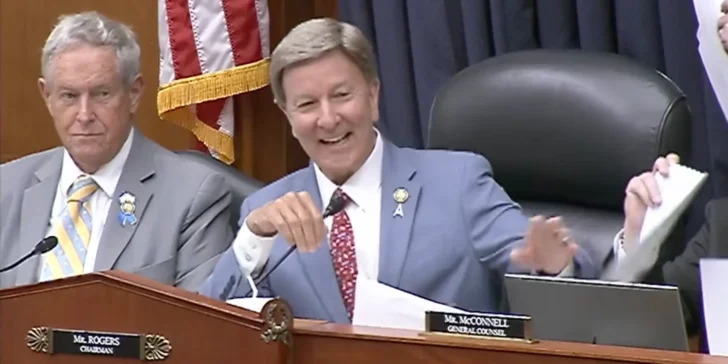
Rep. Khanna took the ‘America First’ approach against Section 224, but he was out-numbered by those who played down its dangers and implications
By Kelley Beaucar Vlahos, reposted from Responsible Statecraft, June 4, 2026
A House committee summarily struck down an amendment to strip a measure from the massive annual defense policy bill that would provide Israel “a higher level of military-industrial integration” with the U.S. than Washington has “with any other country in the world.”
Pro-Israel voices on the House Armed Services Committee argued that reports about Section 224 — that Congress was trying to integrate U.S. and Israeli military systems as a way to entrench aid without proper oversight — were disingenuous and wrong.
In fact, members claimed that these were “existing initiatives” and that Section 224 “actually improves oversight and accountability of these programs by designating a single official responsible for them,” according to Chairman Mike Rogers, (R-Ala.)
Not quite true, said the Quincy Institute’s Ben Freeman, who broke the initial story of Section 224 for RS last week. “Members of Congress supporting the proposal laid out caricatures of critiques against Section 224. And when they did actually talk about the provision itself they spread half-truths and outright inaccuracies about how far this provision will go to integrate the U.S. and Israeli defense sectors.”
According to Freeman, as reported in these pages, Section 224 would lay the groundwork for:
…bilateral research and development, co-production of weapons, joint ventures, licensing agreements, and seemingly every manner of U.S.-Israeli military-industrial complex cooperation. The U.S. and Israel already work together heavily on missile defense, but this provision would greatly expand coordination to seemingly every area of defense tech, including AI, quantum, autonomous systems, directed energy, cyber, biotech, and many more. It also proposes “network integration” and “data fusion.” In other words, the U.S. military’s data could soon be the Israeli military’s data.
Critically, it would shift the annual $3.8 billion the U.S. now gives Israel (a 10-year memorandum of understanding soon up for renewal) to these programs and partnerships, i.e. “co-production” and other “fusion” deep inside Pentagon procurement and acquisitions process, where sunlight is rare and often fleeting. A perfect solution — which is, by the way, endorsed by Prime Minister Benjamin Netanyahu — given the dwindling American support for Israel’s wars and U.S. military assistance for them.
In his remarks on Section 224, Khanna spoke vociferously against what he saw as a blank check at a time when a majority of Americans say they do not want to send more military aid to Israel.
“The American people are tired of the arrogance and insolence of Prime Minister Netanyahu telling America what we should do. The entire country of Israel has a GDP that is less than a single town in my district, yet somehow Netanyahu thinks he could tell the American people what we should do,” he charged.
“I am for Team America. I am for the interests of this country, and I believe that’s what Donald Trump ran on. That includes American interests against any foreign country,” Khanna said. “We should have American sovereignty and make it clear that we strike 224. If we want to give aid to Israel, if we want to sell them weapons, that should be a vote for the entire Congress.”
Unfortunately for Khanna, the majority on the committee did not agree. According to several members, not only is Israel the only friend we have in the region, it helped us create new technologies and capabilities, and we would only benefit from the deeper military ties.
“This is a win-win relationship. We have Silicon Valley, Israel has Tel Aviv, and it’s like Silicon Valley number two. We have gained so much technology advantages from our partnership with Israel, and vice versa,” declared Rep. Don Bacon (R-Neb). “They gain as well, and this is what we’re trying to do, is create that synergy. They support our foreign policy, they’ve been the most supportive of us in the U.N. They’re the only democracy in Middle East, and so I’ll oppose the amendment.”
Rep. Ronny Jackson (R-Texas) warned that American national security would be at risk if such synergy didn’t occur. After “the bad actors” of the world go after Israel they will then “exercise their free will against us,” he charged.
Rep. Adam Smith (D-Wash.) took the line that the reports about Section 224 were overblown. “It’s not a new framework at all. We have three existing programs right now where we do military cooperation with Israel to develop technologies. Those programs already exist,” he said.
“This amendment … suggests some other areas where maybe we should look at opportunities, and as the chairman noted, we had somebody now appointed to coordinate those programs.”
He said he, too, was “frustrated with Netanyahu’s leadership” and Israel’s support for a “war with Iran that has strengthened Iran and weakened our position,” but he disagrees that Section 224 “is Congress just bowing to what Netanyahu wants — this is to our benefit.” In fact, such sharing should occur with Ukraine, too, he added.
Rep. Sara Jacobs (D-Calif.) was the only other member who spoke out in favor of Khanna’s amendment, pointing out that current laws prohibit transfers of weapons to countries committing war crimes and violating international law, but Section 224 makes no such provisions, and takes oversight away, despite what some of her colleagues were arguing on Thursday.
She raised the issue of Israeli-owned Pegasus spyware, which was blacklisted for its use against Americans. “Two administrations from both parties left it on that list, and that same company is right now trying to buy its way into the American market, fusing our defense and technology sectors together permanently,” she said.
A proposal “with no conditions in the exact area where we have already been burned (Section 224) is reckless on its own terms, and it would do it through a must-pass bill with almost no oversight and with none of the human rights conditions that govern the rest of security assistance,” Jacobs added.
Next steps: Rep. Thomas Massie (R-Ky.) says he will work with Khanna to strip the language from the final House NDAA. If the parade of voices that insist Israel must have this relationship with the U.S. military is any indication, it will be a hard road ahead.
*Additionally*
House Dems Join GOP to Help Advance Deeper US-Israeli Military Integration
By Brett Wilkins, reposted from Common Dreams, June 4, 2026
A US congressional committee on Thursday rejected an amendment to strip a provision from next year’s Pentagon funding bill aimed at deepening integration of the US and Israeli militaries under the guise of reducing aid.
Rep. Ro Khanna (D-Calif.) introduced an amendment to strike Section 224—which would establish a formal “United States–Israel Defense Technology Cooperation Initiative”—from the 2027 National Defense Authorization Act. The proposed NDAA authorizes $1.15 trillion in baseline military spending, while the Trump administration’s full defense request seeks an unprecedented, debt-exploding $1.5 trillion in armed forces and related funding for the coming fiscal year.
Section 224 would require the US defense secretary to designate a Pentagon executive agent responsible for coordinating and expanding US-Israel defense technology cooperation.
In Thursday’s voice vote, members of the House Armed Services Committee (HASC) from both parties rejected the amendment to remove Section 2024 from the NDAA, with only Khanna and Rep. Sara Jacobs (D-Calif.) backing the measure.
The House voted today on a new measure to fuse elements of the Israeli and US militaries, particularly on the cyberweapons front. Section 224, as its known, is included in the National Defense Authorization Act. Rep. Ro Khanna, D-Calif., introduced an amendment to strip it from… https://t.co/xWAiZQ03BC pic.twitter.com/rLUViMeKLv
— Drop Site (@DropSiteNews) June 4, 2026
Israeli Prime Minister Benjamin Netanyahu—who is wanted by the International Criminal Court for alleged war crimes and crimes against humanity in Gaza—has called Section 224 “my plan.”
While proponents of Section 224 contend that the measure would reduce US taxpayer funding for Israel, Khanna argued that the provision amounts to a blank check for a country that most Americans oppose sending more aid to.
“The American people are tired of the arrogance and insolence of Prime Minister Netanyahu telling America what we should do,” the congressman said Thursday while promoting his amendment. “The entire country of Israel has a GDP that is less than a single town in my district, yet somehow Netanyahu thinks he could tell the American people what we should do.”
“I am for Team America,” Khanna added. “I am for the interests of this country, and I believe that’s what [President] Donald Trump ran on. That includes American interests against any foreign country. We should have American sovereignty and make it clear that we strike 224. If we want to give aid to Israel, if we want to sell them weapons, that should be a vote for the entire Congress.”
This is a simple question. Do we do more for Israel now or less? I introduced an amendment to strike 224 because I am for the American people calling the shots, not Netanyahu. I am for Team America. pic.twitter.com/FTWToXOl2T
— Rep. Ro Khanna (@RepRoKhanna) June 4, 2026
In a letter to Rep. Marlin Stutzman (R-Ind.)—who is not on the HASC—Netanyahu said he is “heartened” by Section 224’s plan to “develop a new Memorandum of Understanding with the United States government” that will reduce “US financial military assistance over the next decade” and replace it with “a new framework of joint defense cooperation, codevelopment, coproduction, and mutual investment.”
The US has provided more than $20 billion in armed aid to Israel during the Biden and Trump administrations since Netanyahu launched the genocidal war on Gaza in retaliation for the Hamas-led attack of October 7, 2023. The current 10-year Memorandum of Understanding between the US and Israel, signed in 2016 during former President Barack Obama’s tenure, provided Israel with $38 billion in US military aid and expires in 2028.
Rep. Thomas Massie (R-Ky.)—who has partnered with Khanna on introducing or supporting war powers resolutions aimed at curbing Trump’s ability to wage unconstitutional wars in countries including Yemen, Venezuela, and Iran—said last month that if Section 224 made it out of committee, he would work with Khanna to “offer an amendment to strip it from the bill on the floor.”
The American-Arab Anti-Discrimination Committee (ADC) is urging Americans to contact their members of Congress to tell them to reject Section 224.
🚨 Congress is quietly trying to lock the U.S. into a permanent military alliance with Israel – with no oversight, no caps, and no way out.
🔴Section 224 of the FY2027 NDAA would integrate U.S. and Israeli defense systems, hide weapons transfers from public view, and make it… pic.twitter.com/gFtrvC815H
— ADC National (@adc) June 4, 2026
“This is not ‘America First.’ It is Israel First,” ADC argues on its website. “The resolution language attached to this proposal gives it away: it expresses support for Prime Minister Benjamin Netanyahu’s initiative to transition the US–Israel relationship toward mutual defense cooperation and joint economic investment. This language turns Congress into a vehicle for advancing Netanyahu’s agenda and asks the American people to treat it as their own national security policy.”
“Section 224 would move US support for Israel away from the more transparent foreign aid framework and into a maze of Pentagon procurement, licensing, data-sharing, and backdoor deals that are harder for Congress, taxpayers, and future administrations to monitor, cap, condition, or unwind,” the group continued. “Concerns of undefined ‘network integration’ and ‘data fusion’ should alarm every American who cares about sovereignty, privacy, civil liberties, and democratic oversight.”
“At a time when Israel is committing genocide against Palestinians in Gaza, exporting surveillance technologies used against activists and journalists around the world, marketing military technology tested on Palestinians, and carrying out terrorist attacks as seen in the cell phone [bombings] in Lebanon, Congress should be cutting off military support—not integrating the US military and Israeli defense sector and making accountability harder than ever,” ADC added.
In an opinion piece published this week by Common Dreams, Ben Freeman, director of the Democratizing Foreign Policy Program at the Quincy Institute for Responsible Statecraft, wrote that “lawmakers should reject Section 224 from the NDAA to avoid deep integration with Israel’s military at a time when a growing number of Americans oppose Israel’s actions in the region.”
“This unprecedented level of US-Israeli military integration stands in stark contrast to the traditional aid model of defense cooperation, in which Israel already stood out as the top recipient of US military assistance,” Freeman said.
Kelley Beaucar Vlahos is the Editor-in-Chief of Responsible Statecraft.
Brett Wilkins is a staff writer for Common Dreams.
RELATED:
- US-Israel integration in NDAA is far from ‘America First’ – Joe Kent
- Congress Is Quietly Making Israel a Permanent Pillar of U.S. Military Modernization
- Congress quietly moves to integrate US and Israeli militaries
- Measure To Protect Israel From Global Arms Restrictions Tucked Into US Defense Budget
- The US is disappearing dissenters in broad daylight