
Is Washington Trying to Merge the US & Israeli Militaries?
By Brandon Weichert, Reposted from The Weichert Brief, May 31, 2026
Buried deep within the House Armed Services Committee’s draft of the Fiscal Year 2027 National Defense Authorization Act (NDAA) is a provision that deserves far more attention than it is receiving. On its face, Section 224—the United States–Israel Defense Technology Cooperation Initiative—appears to be a routine measure designed to improve military cooperation between two longstanding allies.
In reality, it may represent something much larger. Indeed, it is unprecedented.
If enacted into law, the provision would create a formal Pentagon mechanism dedicated to identifying Israeli defense technologies, accelerating their integration into American weapons programs, expanding joint industrial production, and deepening technological cooperation across nearly every major military domain.
This is not simply another aid package or a symbolic gesture of support. It is a blueprint for making Israel a more permanent component of America’s defense innovation ecosystem.
Essentially, the US and Israeli technological bases become fused.
And it’s aggravating everyone. Here’s outgoing Congressman Thomas Massie (R-KY) vowing to stop the passage of this bill, so long as Section 224 remains in place:
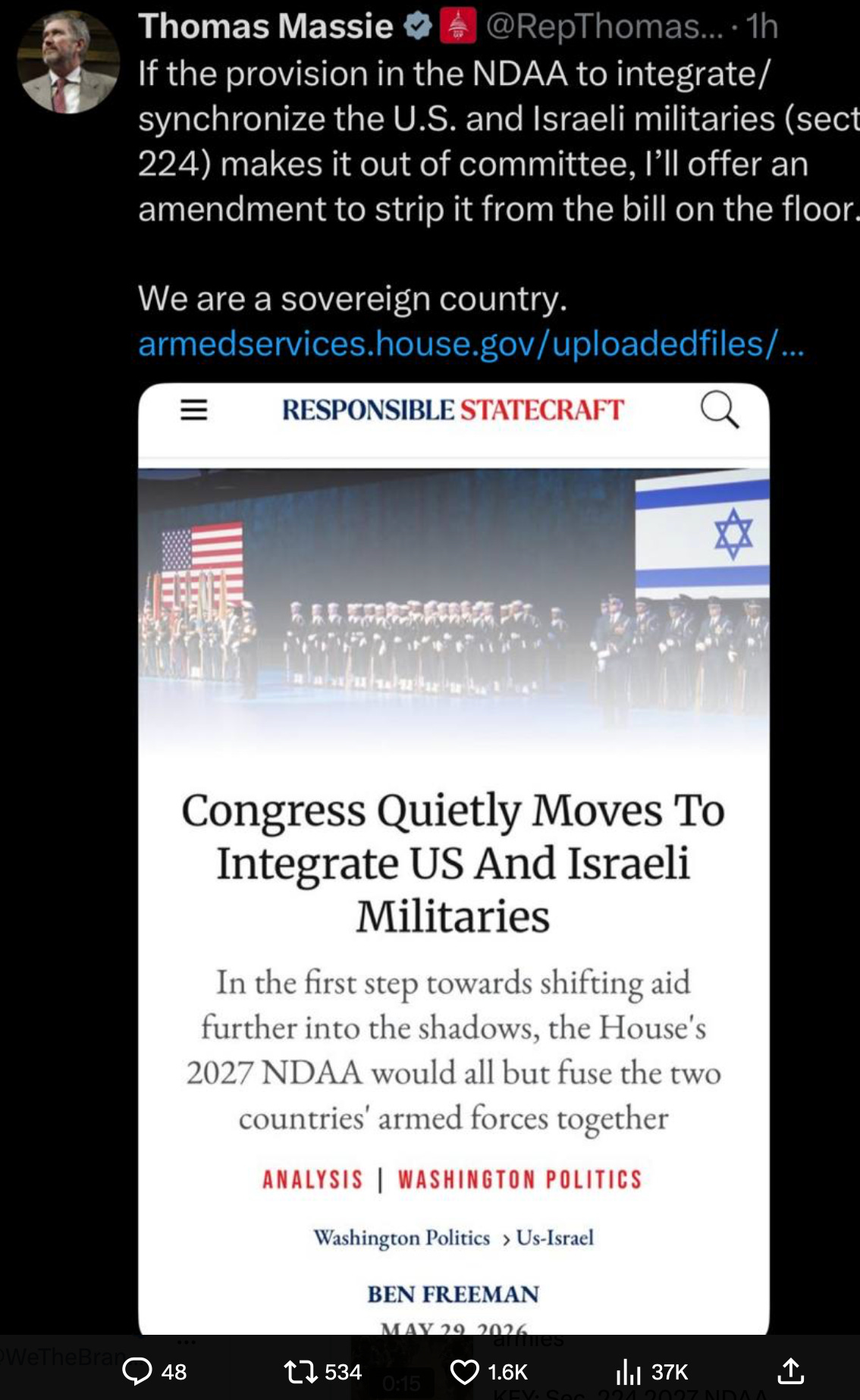
Section 224 also makes it impossible to separate US and Israeli technology.
That distinction matters.
For decades, the United States and Israel have cooperated on missile defense programs such as Iron Dome, David’s Sling, and Arrow. Intelligence sharing between the two countries is extensive. Joint military exercises are routine.
Yet Section 224 goes well beyond those traditional forms of cooperation.
The legislation directs the Secretary of Defense to appoint a dedicated executive agent to synchronize bilateral defense technology efforts. That official would be tasked with identifying Israeli-origin technologies that could be incorporated into U.S. programs of record, facilitating their transition from research projects into actual procurement pipelines, and promoting industrial partnerships and co-production arrangements between American and Israeli firms.
In other words, Congress is not merely encouraging cooperation. It is directing the Pentagon to actively search for Israeli technologies that could become part of the future U.S. military.
That is unusual.
The United States cooperates extensively with allies such as Britain, Australia, Japan, and South Korea.
Through AUKUS, Washington is sharing some of its most sensitive military technologies with Canberra and London.
The United Kingdom enjoys an exceptionally close defense relationship with the United States, including cooperation on nuclear weapons and advanced aircraft programs.
Yet Congress has rarely created a dedicated statutory framework to identify a specific ally’s technologies and integrate them into American acquisition programs.
Further, none of those extremely close relationships—not even the US-UK “Special Relationship”—comes close to the level of cooperation and integration being proposed for the US and Israel under the NDAA’s Section 224.
Section 224 effectively creates such a unique framework for Israel.
The list of technologies covered by the initiative is strikingly broad. Cooperation would encompass counter-drone systems, missile defense, artificial intelligence, quantum technologies, machine learning, autonomous systems, directed energy weapons, cyber warfare, electronic warfare, biotechnology, advanced sensing, logistics networks, and defense manufacturing.
Taken together, these are not niche capabilities. They represent many of the technologies that will define military competition over the coming decades.
Supporters of the initiative would argue that the logic is straightforward.
Israel has developed a reputation for rapidly adapting to battlefield realities and fielding innovative military technologies under combat conditions. Israeli firms have been at the forefront of drone warfare, missile defense, electronic warfare, intelligence fusion, and autonomous systems.
Congress may simply believe that the Pentagon should have a more systematic way of identifying useful innovations and integrating them into American programs.
There is merit to that argument.
After all, the U.S. defense acquisition system has become notorious for delays, cost overruns, and bureaucratic inefficiency.
Programs often take decades to move from concept to deployment. If Israeli technologies can help shorten that timeline or provide useful capabilities, policymakers naturally want to explore those opportunities.
But the broader strategic implications are difficult to ignore.
The legislation arrives amid growing concerns about America’s ability to maintain military superiority in an increasingly competitive world. China is rapidly modernizing its armed forces. Russia continues to adapt despite years of war in Ukraine. Iran has demonstrated the effectiveness of drones, missiles, and underground military infrastructure.
Future conflicts are expected to place a premium on precisely the technologies highlighted in Section 224.
Congress appears to be concluding that preserving America’s military edge will require a more integrated network of technological partnerships among trusted allies.
This move highlights the growing concern that, despite a $1.5 trillion budget, the US defense industrial base cannot keep pace with its rivals in technological innovation. Or, more specifically, when it comes to scaling those innovations. By involving allies, Washington thinks it can avoid the worst impacts of decades of deindustrialization.
Israel occupies a unique place in that vision.
Awkward Timing
But this comes at an awkward time in US-Israeli relations.
There is a definitive shift against Israel in most US public opinion polls. That’s especially true for younger Americans, in either political party. What’s more, there’s a new growing consensus that the US must distance itself from Israel, notably in reaction to the perceived brutality of the US-backed Israeli military in places like Gaza following the 10/7 terrorist attacks.

At the very least, most Americans are increasingly of the mind that Israel should not be receiving any foreign aid or military assistance from the US government.
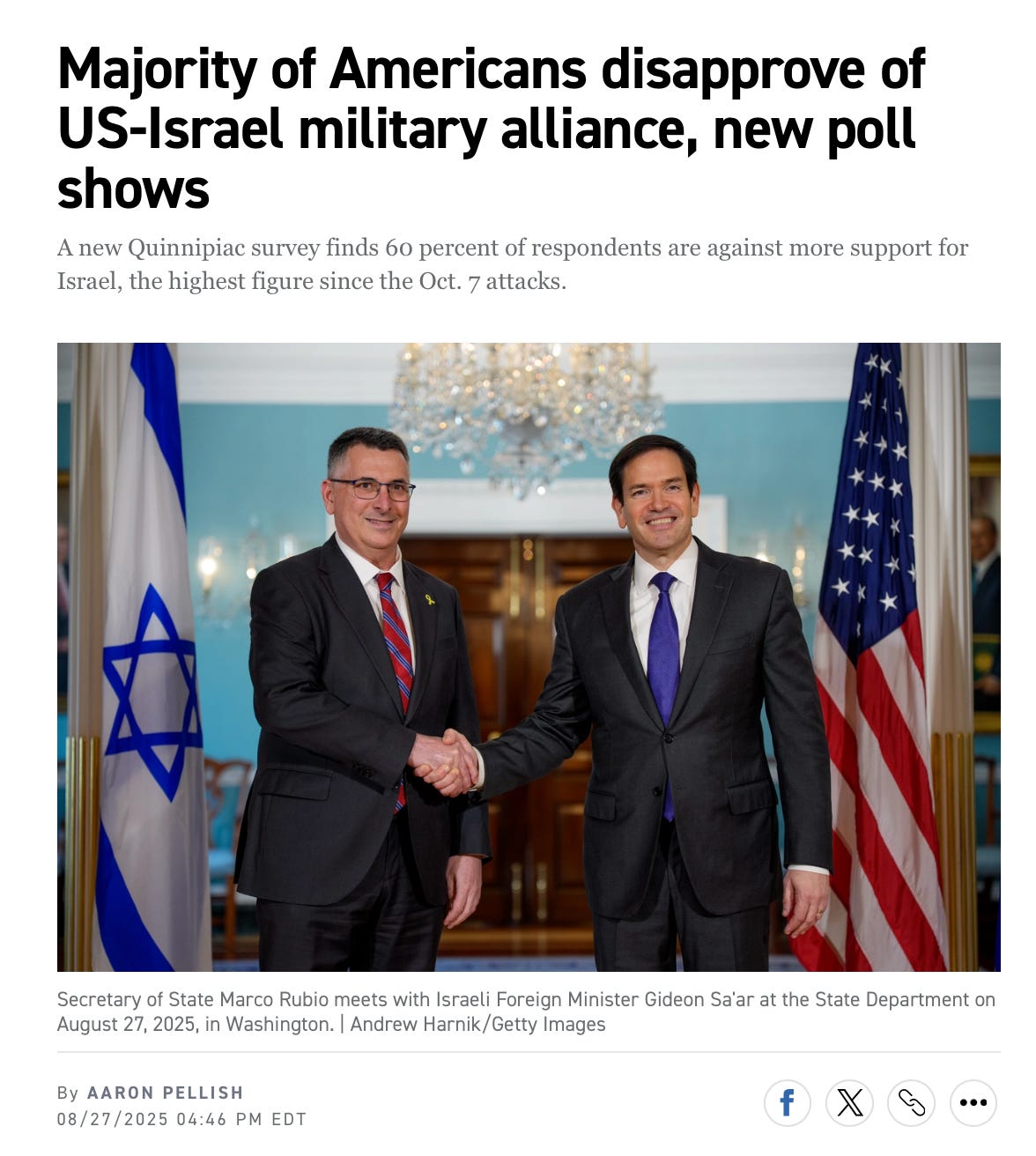
Incorporating the Israeli tech sector with the US military’s tech and industrial base could serve as a potential backdoor for ensuring more aid to Israel even if all forms of foreign aid to Israel are inevitably phased out.
The voters in America may think they’re ending foreign aid. In fact, they’re simply ending one publicly known program while another, amorphous, even larger program—Section 224—continues. And expands.
Will Israel Steal Our Tech & Transfer It to Enemy Nations?
Back in 2019, I met with two young computer scientists who were heavily involved in developing quantum computers. One of them spoke in great detail about how, despite the US and China dominating the headlines in the development of quantum computing, Israel was the “real stalking horse.”
Indeed, Israel does have some impressive high-technology research and development programs.
But as this computer scientist explained to me, much of Israel’s success in quantum computing was due to the relationship between the US and Israel. According to this individual, in 2019, Israeli firms engaged in quantum computing research worked with US firms and scientists on key breakthroughs, seeking to leverage them to get closer to China.
During the infamous case of American traitor Jonathan Pollard, something similar happened. Pollard, who handled America’s nuclear weapons secrets and worked for the Department of the Navy, betrayed his oath at the height of the Cold War. He took proprietary information on how NATO would defend Europe against a Soviet attack and sold it to the Soviets.
His price?
The release of some Soviet Jewish citizens that Moscow had been holding in their infamous prisons.
Pollard justified his treason by claiming he was Jewish before anything else—even before he was an American—and he was obligated to do whatever it took to free his co-religionists in the USSR.
And that’s not the only time that US and Israeli interests have diverged. It’s to be expected. After all, both the United States and Israel are separate countries. By fusing the tech sectors of these two countries, no matter how close their alliance may be, Washington is setting itself up for disaster.
What is to stop Israel from gaining access to our sensitive technologies and using that technology for its own strategic purposes—purposes that might not be in America’s best interests?
More to the point, what is to stop Israel from poison-pilling technologies the Americans get from their Israeli partners?
Is Israel Going to Poison Pill Sensitive US Technologies?
Israeli leaders are keenly aware that public sentiment in America has decisively shifted against them.
Clearly, Tel Aviv is not just going to walk away from its alliance with the United States, considering how essential that relationship is to its survival in a particularly nasty part of the world.
Who’s to say that, as a safety measure, the Israelis didn’t sabotage our advanced systems, using Section 224 as a way to gain access to these sensitive American systems they wanted to sabotage?
Section 224 is a weird move by Congress that does not, in fact, make the United States or the American people safer. It just exposes the country to a whole new manner of complications that no independent state should ever have to deal with.
What Are “Subterranean Threats”?
The same NDAA package also expands U.S.-Israeli cooperation on subterranean warfare, extending collaborative efforts against tunnels to include “subterranean threats of all types.”
That seemingly minor change broadens the focus from counterterrorism operations against tunnel networks to the much larger challenge of locating, mapping, and defeating underground military infrastructure.
Taken together, these provisions suggest a broader trend.
Israel Gets a Better Deal from the US Than the UK Does
If the National Defense Authorization Act is enacted with Section 224 in place, Congress will be sending a clear message: Israel is no longer viewed merely as an ally that receives American support.
Increasingly, Congress views Israel as being a key contributor to the technologies that may shape the future of American military power itself.
But what does that mean for American national security and operational security?
Nothing good, that’s for sure.
Many pundits and online personalities are claiming that the US and Israel are merging their militaries. No, they are not. It’s their industrial and technological bases that might be merged. In some respects, that’s scarier.
Brandon J. Weichert is a senior national security editor at The National Interest.
RELATED:
- Congress quietly moves to integrate US and Israeli militaries
- From Paul Findley to Thomas Massie: How the Israel Lobby Purges Republican Dissenters
- Measure To Protect Israel From Global Arms Restrictions Tucked Into US Defense Budget
- Israel’s Proposal to End US Military Funding Is Actually Designed to Further Enmesh the US in Its Oppression of Palestinians
- US to embed Palantir AI across entire military: Report