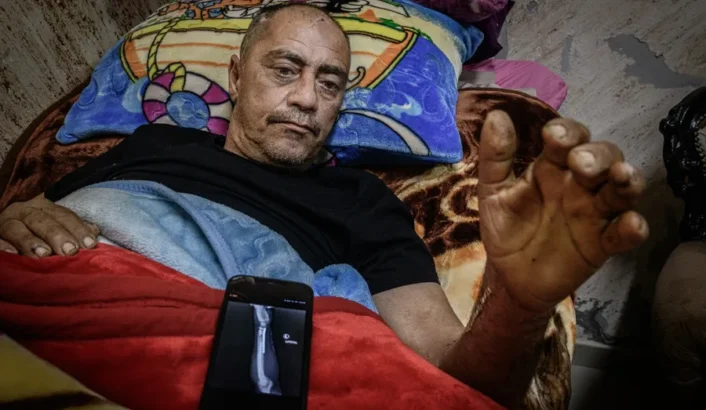
Hikmat Shteiwi, earlier this week. (Matan Golan, Haaretz)
‘Where is the Israeli Shin Bet? Where is the Israel Police?’: Attackers fractured Hikmat Shteiwi’s skull, and torched his car in his olive grove. West Bank.
by Matan Golan, reposted from Haaretz, December 7, 2025
‘Where is the Israeli Shin Bet? Where is the Israel Police?’: Attackers fractured Hikmat Shteiwi’s skull, caused dozens of other fractures and torched his car in his olive grove. The army is supposed to prevent such attacks, but is protecting the settlers, friends and family members of the victim tell Haaretz
The family of Hikmat Shteiwi, who was assaulted by settlers near his village west of Nablus last month, can’t believe that they are again able to talk to him. “He’s back from the dead – it’s a miracle,” they say about their 51-year-old loved one, who was in an induced coma and on a ventilator for about two weeks.
Shteiwi was diagnosed with a compound skull fracture and brain hemorrhage, and he had bruises across his body. He now lies in a hospital bed set up in the living room of his home in Kafr Qadum in the northern West Bank, surrounded by family and friends. “What I remember is something you can’t even imagine,” he told Haaretz.
“I was on my land and working the olives, when suddenly 11 masked settlers attacked us,” he says, recounting the incident. Three other people were working with him, and as they fled the scene, they split up. “When I saw them, I ran to my car to get away, but they smashed the car, grabbed me and pulled me out of it. They hit me with rocks and clubs on my hands, feet, in the head and in the ribs. I thought I was going to die. It was terrifying – with every blow I felt the world around me spinning.”
At some stage, Shteiwi says he blacked out, and when he woke up, he was alone. He noticed his car had caught fire and tried to put it out with what strength he had left, despite his severe head and limb injuries. “I felt that my hands were burning. From this point on, I don’t remember what happened,” he says.
His family found him later injured, suffering burns on his hands and unconscious inside his burned and vandalized vehicle. Shteiwi was taken to a hospital in a life-threatening condition. “When I awoke, the doctors said they were about to declare me dead,” he says.
The report prepared by the hospital shows that aside from the many fractures, Shteiwi suffered brain injury, nerve damage and a dangerous lack of oxygen in the body’s tissues. During his hospitalization, doctors reconstructed his skull using titanium and implanted metal in his hand to treat the fractures.
“The doctors found 36 fractures and cracks,” says a family member. “They explained that the multitude of fractures caused the bone to break down,” the family member added. He spent 12 days in an induced coma and on a ventilator in the intensive care unit, and was finally discharged to home care after 26 days in the hospital.
Palestinians praying at an olive grove near Kafr Qadum, last month. Credit: Itai Ron
Shteiwi had been earning his living by manual labor. Now his family of seven is left without an income.
“When God created man, he gave him a measure of compassion. There’s no human logic in what happened,” Shteiwi’s friend says. “This is a shame for humanity – these aren’t human beings.” They recount past attacks, including the kidnapping and murder of Mohammed Abu Khdeir, the killing of the Dawabsheh family in a fire, and last month’s torture and slaughter of lambs in Samu. “Can we call them human beings?”
Shteiwi, it appears, is the most severely injured Palestinian from settler attacks during this year’s olive harvest. Residents of his village say that before the attack in which he was assaulted, there had been six other attacks in Area B, a zone under Palestinian civil control and joint Israeli-Palestinian security authority.
Before each incident, settlers gather at a newly established frontline outpost, north of the Kedumim settlement, where a canopy was erected. Many of the attacks involve dozens of masked settlers, and have resulted in varying levels of injury to Palestinians and damaged property, including vehicles and buildings. Palestinians watch the settler outpost that the attackers came from, in the West Bank, last month. Credit: Itai Ron
A relative visiting Shteiwi said he was also a victim of the attack from that outpost last month. “We were digging in the fields when suddenly 15 masked men came,” he recalls. “When I saw them, I prayed – you know you’re going to die. We started running, and a large stone hit me in the back of the head. I fell face down and passed out.” He says he woke up in a hospital with additional injuries.
“It appears that they kept assaulting me after I lost consciousness. There was a much older man among us, sick and on dialysis, and they hit him with clubs, too,” the relative says. “We beg all the authorities to put an end to this. A criminal is a criminal. Those who commit a crime against others will eventually also commit crimes against his own.”
“Where is the Israeli Shin Bet? Where is the Israel Police?” Shteiwi asks. Someone else in the room adds, “If a Palestinian even thought about doing something like that, what would happen to him? On the one hand, we can’t take the law into our own hands; on the other, no one is protecting our rights.”
One of Shteiwi’s friends said that the attacks occur despite the army having cameras in the area. “Even if the army doesn’t know what’s happening at that moment, you can see on the cameras where the settlers came from and where they went,” he said. “It’s a question of will, not ability. I feel the army is two-faced, almost as if it suffers from a split personality.”
“The army is supposed to prevent what is happening, but at the same time it protects the settlers,” the friend adds. “It evacuated the outpost four or five times, then, when it was rebuilt, it’s done in the presence of the army and people in uniform.” In early November, a Haaretz team was present at one of the evacuations, during which Palestinians from the area protested against the outpost. Since then, it has been rebuilt at least once more.
Those visiting Shteiwi that day say that they are all afraid to tend their lands. “You have to tell a relative that you’re going there, so that they know to go and look for you if you don’t come back,” says one. “The whole family is anxious until you come back.”
Another recalls the olive orchards from his childhood.”I have so many memories of the groves – we would sit there, eat with the whole family and come back home late at night. When we grew up, we went with friends, and later with our own family and children. Today, it’s too dangerous to bring people you love to the land. In the coming weeks, we’re supposed to prune the trees for next year – we won’t be able to do any of that.”
Matan Golan is a freelance photojournalist based in Israel