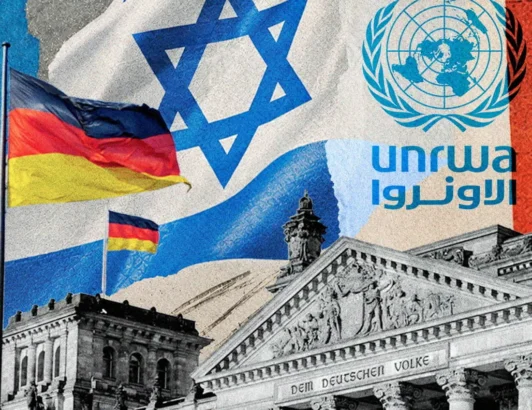
A new report maps a network of Israel advocacy groups that work to influence Berlin to discredit the UN agency for Palestinian refugees. ‘The debate over UNRWA was definitely not evidence-based.’
By David Issacharoff, reposted from Haaretz, July 7, 2026
Germany’s support for the UN Relief and Works Agency is a critical lifeline for the humanitarian group. It became the largest governmental donor after the United States halted its contributions in January 2024, following Israel’s claim that 12 of the agency’s 13,000 employees maintained links to Hamas.
The UN agency, which provides education, healthcare and humanitarian aid to 5.9 million Palestinians in Gaza, the West Bank and neighboring countries, received $116.8 million from Berlin in 2025 – 2.5 times more than the United Kingdom, the second-largest governmental donor. Last week, UN Secretary-General António Guterres warned that the agency was fighting for its life and that “any further cuts could push conditions past the breaking point.”
A new report – published Monday and commissioned by democratic-socialist, Die Linke-affiliated think tank Rosa Luxemburg Foundation – maps what it describes as an ecosystem of Israel-aligned advocacy organizations that work in tandem with the ultimate objective of ending German government donations to UNRWA.

While the study traces the coordinated effort back to 2014, efforts intensified after the October 7 attacks and the ensuing war in Gaza to disseminate narratives and craft policy in line with Prime Minister Benjamin Netanyahu’s far-right government.
The report, authored by Berlin-based analyst Alon Sahar – together with interviews with current and former members of Germany’s governing coalition conducted by Haaretz – illustrates a decade-long campaign aimed at discrediting UNRWA among German politicians, particularly in lawmakers in the Bundestag. Funding for NGOs and international organizations may be administered by the government, but the budgets are negotiated in parliament – making lawmakers a key target for right-wing pro-Israel groups.
The report identified the Geneva-based UN Watch, as well as the Israel-based groups NGO Monitor and Institute for Monitoring Peace and Cultural Tolerance in School Education (IMPACT-se), as producing research and policy arguments that lobbying groups rely on.
In an interview with Haaretz, Ilyas Saliba, a political scientist who worked as a Green Party foreign policy adviser until January 2023, describes the right-wing watchdogs as “a delegitimization machine” that target established NGOs.

The report details how lobbying groups – including the European Leadership Network, the German-Israeli Society and Nahost Friedensforum – cultivate relationships directly with lawmakers through parliamentary briefings, private meetings and conferences, as well as free trips to Israel.
“This lobby operates under the radar. No one in Germany wants to touch it,” one member of parliament from the governing Social Democratic Party told Haaretz on the condition of anonymity. “They are not scrutinized nearly as much as AIPAC. Political figures and journalists in Germany are scared to go against this very influential network, which also has deep ties to the media and business world.”
Another member added that there “is no doubt” that they are among “the most active and best-connected” actors shaping Germany’s debate on Israel and Palestine.

The report also details how media outlets such as Bild and Welt amplify those narratives, while publicly funded civil society organizations, including the Central Council for Jews in Germany and its newspaper, shape the boundaries of acceptable debate on Israel, antisemitism and Palestinian policy.
‘Not evidence based’
Luise Amtsberg was in the room when Germany’s humanitarian policy toward Gaza was being shaped in the immediate aftermath of Hamas’ October 7 attack and the war that followed. As the Federal Government Commissioner for Human Rights Policy and Humanitarian Assistance under then-Chancellor Olaf Scholz, the Green Party politician was among the officials responsible for Germany’s humanitarian engagement with the Palestinian territories.
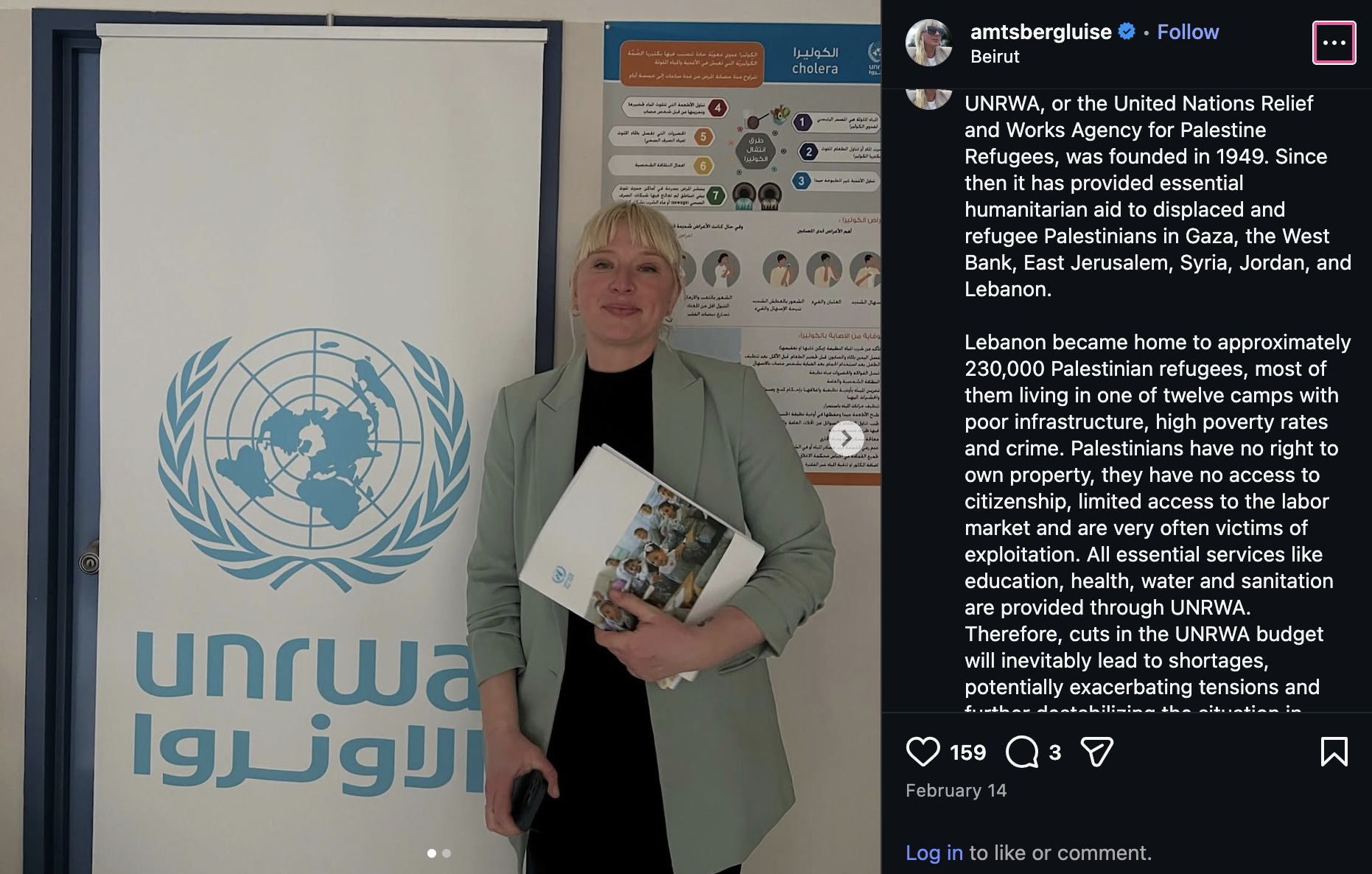
“The debate in Germany over UNRWA was most definitely not evidence-based, but driven by a lack of understanding of UNRWA’s difficult mandate and by unsubstantiated allegations,” Amtsberg, now a member of the Foreign Affairs Committee and the Green parliamentary group’s spokesperson on the Middle East, told Haaretz.
In January 2024, Israel accused 12 UNRWA employees of participating in the October 7 attack and circulated intelligence alleging that a significant number of the agency’s approximately 13,000 employees in Gaza had links to Hamas or other militant groups. UNRWA terminated the employment of seven staff members “who may have been involved” in the attack, plus two more employees after an internal probe. At the same time, Germany joined several major Western donor countries in suspending new funding.
Three months later, an independent review commissioned by the UN and led by former French Foreign Minister Catherine Colonna concluded that there was no evidence of systemic links between UNRWA and terrorist organizations. (The Colonna Report also noted “Israeli authorities provided no proof” for its claims and recommended dozens of reforms to strengthen the agency’s existing neutrality mechanisms.) Germany subsequently resumed cooperation with UNRWA, initially for operations outside Gaza.

Amtsberg said she repeatedly asked Israeli officials to substantiate its claims, to no avail.
“Many times I met with Israeli government officials and also UNRWA officials. The allegation that UNRWA had been infiltrated by terrorists was never substantiated in any of these discussions,” she said, adding that “the Israeli government and advocacy organizations aligned with it succeeded in creating a lot of hesitation around working with UNRWA.”
One SPD lawmaker who spoke to Haaretz on the condition of anonymity said that Israeli embassy officials regularly met members of parliament and presented screenshots of Facebook posts allegedly written or shared by UNRWA employees.
“They show them screenshots of Facebook comments by people who supposedly work for UNRWA and who liked or supported Hamas and anti-Israeli propaganda,” the parliamentarian said. “They bring that material to meetings to show them that UNRWA is full of terrorists and cannot be supported.”
A spokesperson for Israel’s Foreign Ministry told Haaretz that Israel presented countries with evidence from Gaza, including “official Hamas membership documents of UNRWA employees; military ID cards detailing operational ranks of UNRWA staff within Hamas’s military wing; payroll records proving active terrorists drew regular salaries from UNRWA.”
“In Germany, the Israeli Embassy in Berlin has presented ample proof of UNRWA’s involvement in terror, along with the names of those who either actively took part in the massacre or were on Hamas’s payroll. This evidence was conveyed directly to the relevant German ministries,” the Foreign Ministry said.

All expenses paid trips to Israel
Amtsberg recalls that back then, the European Leadership Network (ELNET) “was sending emails about UNRWA and hosted events about it in Berlin” for members of parliament.
Founded in 2007 and often described as “the European AIPAC,” according to the report, ELNET specializes in building relationships between Israeli political and security elites and European decision-makers. ELNET’s influence, according to the report, lies in repeatedly convening lawmakers, diplomats and senior officials with Israeli ministers, military figures and advocacy organizations, helping frame debates over UNRWA first around questions of neutrality and reform and, increasingly after October 7, around its replacement.
One example cited in the report was ELNET’s partnership with UN Watch, including a 2020 initiative promoting what it described as a more “balanced” approach to UN human rights institutions. By 2025, ELNET Israel was hosting UN Watch Executive Director Hillel Neuer at a breakfast briefing for European ambassadors while directing participants to UN Watch’s report, “The Unholy Alliance: UNRWA, Hamas and Islamic Jihad.”
ELNET-Israel hosted today its “Breakfast and Briefing with European Ambassadors” to discuss Israel’s new legislation on @UNRWA .@HillelNeuer , Executive Director of @UNWatch , provided documented evidence on the Hamas affiliation and on the active participation of senior UNRWA… pic.twitter.com/xDdaHnwUZL
— ELNET (@elnet_global) January 9, 2025
“They don’t only target foreign policy MPs, but all MPs,” Saliba, a former Greens parliamentary foreign policy adviser, says. Foreign policy spokespeople from parties like the Greens and the SPD “get pushback from other MPs who don’t know the region but went on one trip with ELNET.”
Several current and former parliamentarians interviewed by Haaretz said ELNET’s greatest strength, however, lay in its ability to gain access to lawmakers early in their parliamentary careers.
Isabel Cademartori, an SPD member of the Bundestag, described the organization in a conversation with Haaretz as “very influential” within parliament.
“They efficiently target new members of the Bundestag,” Cademartori said. “When I came into parliament in 2021, very early on we got invitations for an all-expenses-paid, week-long program. They do it for everyone across all parties.
“I’ve never participated – I was told it’s a propaganda trip by those who have. The topic is not the conflict, but ‘tech, smart city, startup nation.’ They use less contentious topics to invite parliamentarians, and then over the week, they introduce the more controversial ideas.”

Another former parliamentary adviser described the trips as one of the network’s most effective recruitment tools. “There is no lobby group that flies out parliamentarians and decision-makers like ELNET,” he said. “Parliamentarians have no say in the program. It is totally decided by ELNET.”
Another parliamentarian said ELNET was also active in promoting defense cooperation between Germany and Israel, including discussions with lawmakers on procurement, military budgets and security policy.
ELNET did not respond to Haaretz’s questions regarding its parliamentary delegations, programming or ties to organizations critical of the UN and NGOs.
‘It’s rather veiled’
The report also highlighted Nahost Friedensforum (NAFFO), a Berlin-based advocacy organization focused on parliament and government ministries that made opposition to UNRWA one of its central campaigns after October 7.
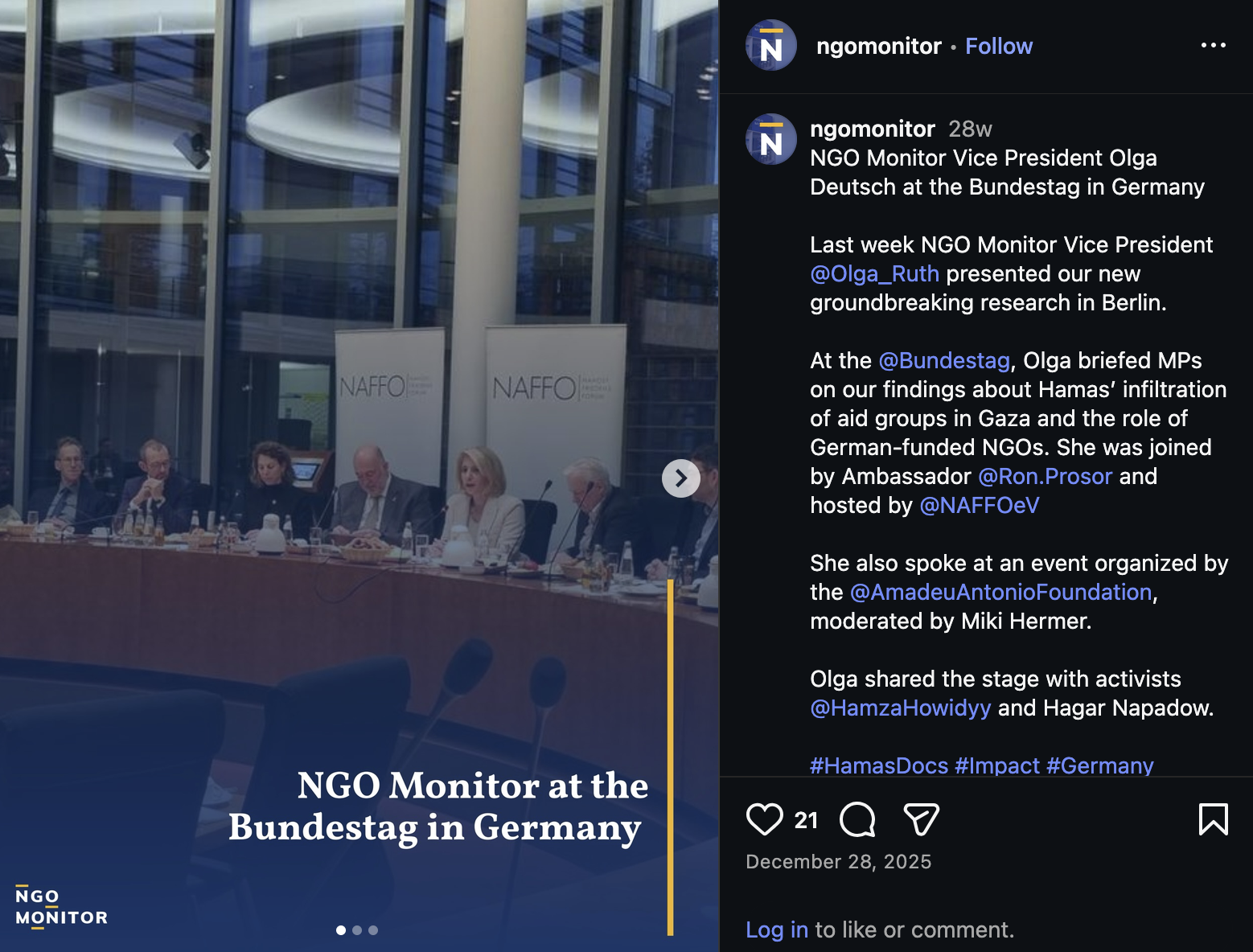
NAFFO organized parliamentary events such as “Alternatives to UNRWA – What’s Next for Gaza?” and published “Gaza: The Facts Behind the Headlines,” a report that portrays UNRWA as structurally subordinate to Hamas; it later circulated a position paper titled “Why UNRWA Is an Obstacle on the Road to Peace,” calling for an end to German funding and the agency’s eventual replacement.
Cademartori said NAFFO organizes parliamentary breakfasts and brings in experts to explain “why Israel is not breaking international law, campaigns against UNRWA and argues that the UN is antisemitic.”
“But it’s all rather veiled,” she said. “They talk about ‘human rights,’ so you don’t immediately necessarily see how one-sided it is.”
👉️ “Unraveling UNRWA” – die Doku der preisgekrönten Produzenten zeigt erneut: UNRWA schürt Hass und Gewalt und ist Teil des Problems!
🎥 Doku jetzt anschauen: https://t.co/dmmQfxf1BM pic.twitter.com/qRiJRfbZsJ
— Deutsch-Israelische Gesellschaft (@DIGeV_de) June 2, 2026
NAFFO did not respond to Haaretz’s questions regarding its parliamentary activities, its publications on UNRWA or its engagement with German lawmakers.
The report also highlights the German-Israeli Society (DIG), a nationwide association that maintains longstanding ties with federal ministries and parliamentary groups while receiving more than 540,000 euros ($617,390) annually from the German Foreign Office.
Following October 7, DIG intensified its campaign against UNRWA. Together with NGO Monitor and IMPACT-se, it published a 12-point policy paper calling for a fundamental overhaul of Germany’s humanitarian policy toward Palestinians, questioning UNRWA’s mandate and challenging the inherited Palestinian refugee status framework. Months later, it issued a statement declaring: “UNRWA cannot be reformed. Germany must stop funding these structures.”
DIG’s President Volker Beck is a former member of parliament from the Green Party. He dismissed the report as a “propaganda pamphlet” and told Haaretz that the DIG is “a cross-party and politically independent NGO,” which “actively participate[s] in the discussion on Israel and the Middle East.”
For generations, Hamas, @pflp islamic jihad and other Terrorist groups have counted on @UNRWA for support & essential services. https://t.co/6kiw54xWdy
— Volker Beck 🐋 🇺🇦🇮🇱🇪🇺🇩🇪 (@Volker_Beck) June 30, 2026
The group, he said, is “engaged in lively exchange” across German and Israeli civil society and has “for years… demanded transparency regarding the audit reports on UNRWA,” adding that the DIG is suing the German government after a request under the Freedom of Information Act was rejected by the Development Ministry.
Amplified by the media?
The report argues that the campaign against UNRWA was amplified in Germany’s mass media. It singles out Axel Springer-owned outlets WELT and Bild as playing what it describes as “an outsized role in amplifying Israel-aligned and UNRWA-critical narratives” that later filtered into parliamentary debate and policymaking.
According to the report, WELT relied heavily on material produced by organizations such as UN Watch and IMPACT-se in its coverage of UNRWA. In 2021, WELT political editor Frederik Schindler published an opinion column calling for Germany to freeze funding to UNRWA, drawing extensively on IMPACT-se’s findings. Following October 7, the report says, the newspaper increasingly amplified Israeli allegations that Hamas had infiltrated UNRWA and that some of its employees had participated in the attacks.
Bild, which boasts the largest circulation numbers in Europe, has long maintained a pro-Israel editorial line; its publisher, who also serves as Axel Springer’s CEO, was awarded the 2025 Presidential Award by Israel’s Isaac Herzog. The tabloid was also at the center of the ongoing Bibileaks affair, in which Netanyahu’s media team is accused of divulging classified intelligence to the German tabloid in an effort to suppress hostage family protests favoring a cease-fire in September 2024.

The report argues that Bild played a complementary role by translating similar narratives into sensational tabloid fodder. It repeatedly highlighted allegations that originate from Israeli intelligence, UN Watch and IMPACT-se, portraying UNRWA as irredeemably compromised while giving comparatively less attention to the agency’s denials or to independent investigations such as the Colonna Review. According to the report, this reinforced the perception that dismantling or replacing UNRWA, rather than reforming it, was the only credible policy response.
One episode involving Cademartori that she shared with Haaretz illustrates how pro-Israel advocacy groups and the media reinforce one another. After the SPD lawmaker described Netanyahu’s government as “far right” on X and called Germany’s refusal to support sanctions during the humanitarian catastrophe in Gaza a “historic failure,” Bild devoted an article to her remarks and to reactions from the heads of two of the organizations: DIG and ELNET.
In the article, DIG head Beck accused Cademartori’s party – and, indirectly, her – of being “consumed by hatred for the Jewish state,” arguing that “punishing the Jewish state is more important” to her than pursuing a political solution. In the same article, ELNET head Carsten Ovens argued that sanctions on Israel amounted to “shooting ourselves in the foot,” adding that “among friends and partners, you don’t criticize online, but engage in direct dialogue.”
Cademartori, who was recently elected leader of the SPD in her home state of Baden-Württemberg by an overwhelming majority, said: “When I called early on for a cease-fire, friends and colleagues told me, ‘You are crazy and risking your political career.’ When Volker Beck targeted me for the first time, I admit I didn’t sleep well at night.”
“But,” she added, “they only have the power you give them. It doesn’t have to be like that.”
Antisemitism accusations
Another SPD Bundestag member, who requested anonymity because of the sensitivity of the issue, said that many of her colleagues are mindful of the possibility of becoming “the target of highly publicized accusations of antisemitism” when advocating for continued support for UNRWA or emphasizing the importance of international humanitarian law.
She added that this fuels a climate in which “there is a reluctance to speak publicly on these issues,” while noting that some major media outlets contribute to the “hesitancy” to speak about these topics publicly.

Saliba, the former Green Party foreign policy adviser, warns that in Germany, even positing that an Israel-aligned lobby exists is prone to be branded as “antisemitic,” meaning even parliamentarians skeptical of these groups and their agenda “would never call it out. Maybe they just don’t participate, but they are afraid of being sidelined and targeted by them.”
“There is a difference compared to the U.K. and the U.S., where there are similar lobbying efforts,” he said. “If this were treated as a propaganda campaign, fewer parliamentarians would participate.”
Saliba argues that “The German government pays lip service in support of international institutions, but they do not want to appear uncritical of UNRWA because it has been delegitimized by propaganda campaigns.”
“They want to avoid appearing to support UNRWA unequivocally, but they know it is irreplaceable and that ending support would damage Germany’s standing. So they try to find a middle ground: continue funding, but look for loopholes.”

For Saliba, the implications extend well beyond UNRWA. Germany’s failed bid for a seat on the UN Security Council, he argues, reflects the costs of a widening gap between policy and public discourse that threatens Berlin’s international credibility. There is an “increasing distrust of the public vis-a-vis policymakers and to the decrement of Germany’s image and standing abroad,” he said.
Beyond parliament
The report also identifies groups operating outside parliament that seek to shape the German debate on Israel, Palestine and antisemitism.
Among them is the Central Council of Jews in Germany, which receives €22 million ($25 million) annually from the federal government and, after October 7, called for Germany to freeze funding to Palestinian organizations, including UNRWA. According to the report, its weekly newspaper, Jüdische Allgemeine, became a key platform for amplifying material produced by NGO Monitor, UN Watch and IMPACT-se.
The report also highlights WerteInitiative, a publicly funded Jewish civil society organization that receives roughly €750,000 annually from the Interior Ministry. The group has long advocated ending Germany’s support for UNRWA and last June said that, as with the Ku Klux Klan, “structures that are so deeply corrupt cannot be reformed.”
Sehr geehrte Frau Ministerin Alabali Radovan,
die Geschichte des palästinensischen Jungen, die Sie schildern, ist in der Tat erschütternd. Am 6. Oktober 2023 hatten Kinder wie er noch Hoffnung auf eine Zukunft. Die Hamas hat diese Hoffnung zerstört.
Doch Ihr humanitäres… pic.twitter.com/rR7YOyKzYU
— WerteInitiative. jüdisch-deutsche Positionen (@WerteInitiative) June 26, 2025
Elio Adler, chairman of WerteInitiative, told Haaretz that “as German taxpayers, all of us help fund what UNRWA does,” and that the agency promotes a narrative portraying Israel as “the principal aggressor in the conflict,” which is “taken up on a massive scale by actors engaged in Israel-related antisemitism.”
He said much of the report was “accurate – and none of it improper,” except for portraying him as “centrally dictating” the association’s activities.
A spokesperson for the German Federal Foreign Office told Haaretz that government funding for NGOs detailed in the article is subject to “strict legal and administrative frameworks,” and that it accepts the “inherent contradictions” of funding NGOs that are “not congruent” with government policy and that criticize it.
When it comes to policy on UNRWA, the spokesperson said the government reaches decisions “independently, relying on its own analyses of available sources and information,” and that “third-party information can contribute to this process, if the information can be independently verified.”
The spokesperson added that “Germany calls for the comprehensive implementation of the Colonna Report’s reform recommendations, followed by the continuous monitoring and evaluation of their impact.”
David Issacharoff is an editor and writer at Haaretz English edition. He studied political science and history at the Hebrew University of Jerusalem and Humboldt University in Berlin. In 2024, he is a visiting fellow at Der Spiegel through the International Journalists’ Program (IJP).
RELATED:
- The real reason Israel is banning UNRWA, and what it means for millions of Palestinian refugees
- UNRWA Heads Tell Ha’aretz: ‘We Don’t Radicalize Palestinians – Their Lived Existence Does’
- ‘People in Gaza are neither dead nor alive, they are walking corpses,’ says UNRWA
- MSF: Israel’s deliberate restriction of food and aid led to alarming malnutrition levels in Gaza
- Gaza officials warn of ‘silent famine’ as aid deliveries fall far below planned levels
- Official US gov’t reports contradict Mike Waltz’s rants against UNRWA