In the final month of the campaign, the two Dem candidates offered an instructive conversation on the power of AIPAC money
By Prem Thakker, Reposted from Zeteo , July 08, 2026
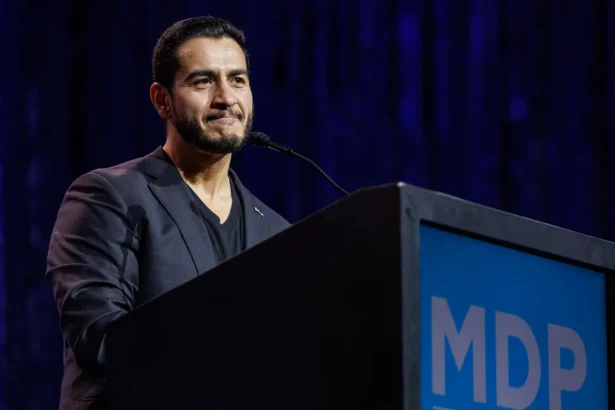
With Mallory McMorrow’s departure from the Michigan Democratic Senate primary, the race has become a showdown between Abdul El-Sayed and Rep. Haley Stevens. On Tuesday, the two debated. It was an instructive conversation, in the final month of the campaign. In particular, the debate showcased one very puzzling, even revealing strategy the Chuck Schumer- and AIPAC-backed Stevens is pursuing.
Onstage in Grand Rapids, the two candidates duked it out in a similar format: El-Sayed frequently argued any given issue could not be solved without being freed from corporate or outside interests. He then attacked Stevens for being the recipient of donations from such interests, such as Big Tech companies contributing to the AI data center boom. Stevens would retort with podium-pounding refrains, saying she had “the receipts,” or defaulting to a repeated suggestion that El-Sayed was only trying to “go viral” or “shouting into a bullhorn about problems.”
Early on, questions about the U.S. relationship with Israel dominated the conversation.
“The reason that we’ve seen this war [with Iran] fought is because of the impact of AIPAC in our politics. AIPAC has spent tens of millions of dollars on attack ads against me, or ads lying about the congresswoman’s record. They clearly want one individual, and it’s not me,” El-Sayed said, of the pro-Israel lobby group that backs Stevens. “They are spending against me because they’ve called me the most dangerous candidate for the U.S.-Israel relationship, because maybe I don’t want to waste our money fighting wars we don’t need.”
Thumping the podium, Stevens retorted: “Well, Abdul, I would say no one is afraid of you,” claiming Republicans are propping him up because he’d be easier to beat.
Pressed on the millions of dollars in pro-Israel cash propping her up, Stevens scoffed: “No one owns my vote, and no one owns my policies.” Stevens, who AIPAC has thanked over and over, has belted in the past: “Israel comes to me in my dreams.”
The back-and-forth on Israel previewed how much of the debate would go. Stevens focused on three lines of attack. The first was calling for El-Sayed to release his tax returns. “My opponent,” she said, “said that transparency is key, but yet, he hasn’t released his tax returns.”
“Abdul, you talk about getting money out of politics and putting money in people’s pockets, but who is putting money in yours? What are you hiding?”Stevens asked. The delivery was one of Stevens’s best.
There is no indication El-Sayed is hiding anything in his tax returns, but their publication has been a Stevens demand for months, of both her opponents.
Another Stevens attack concerned Fighting for Michigan, a super PAC supporting El-Sayed, spending millions. Groups including National Nurses United, Command Defense Action Fund, the Working Families Party and the pro-Palestine American Priorities are involved. Two people have spent six figures to fund the PAC: Illinois physician Mansoor Ahmed, and El-Sayed’s father-in-law, Jukaku Tayeb, a Michigan nephrologist. Stevens hit El-Sayed for having his father-in-law’s financial support, and suggested Republican donors were also spending to boost him.
“I’m sure everybody out there thinks that Republicans really want me to win this race. Sure,” El-Sayed responded.
Stevens also repeatedly suggested El-Sayed did nothing to help Kamala Harris in Michigan in 2024, and thus helped Donald Trump win the presidential election. In a conversation about AI, after El-Sayed suggested industry support would compromise Stevens’s ability to fully regulate it, Stevens pivoted away.
“And look, I worked really hard to make sure that Kamala Harris was going to get elected and that Donald Trump would be stopped, and my opponent did nothing,” she said.
El-Sayed replied: “I don’t know what Kamala Harris has to do with AI.”
Stevens soon said: “If you listen to Donald Trump – who my opponent just admitted he didn’t do anything to help stop him from getting elected – he wants to do everything for the billionaire class…”
El-Sayed responded: “I endorsed Vice President Harris. I campaigned for Vice President Harris. I really wanted Vice President Harris to win this race. Now ask yourself why we were where we were. Because for too long our policy has been wrong on a number of critical issues, and it’s been wrong because of the role of special interests in our politics… the same special interests who are funding my opponent.”
It was a puzzling attack because it was so wrong. El-Sayed was among the first Muslim-American leaders to endorse Harris. The origin of Stevens’s attack, if it is not just a simple lie, is perhaps that she is conflating El-Sayed with other Muslim politicians and activists from Michigan who did not endorse Harris right away, for example the Uncommitted movement including Michigan organizer Abbas Alwieh (who ended up backing Harris).
Ultimately, the debate showed where each campaign is planting their flag. Stevens pitched herself as a “workhorse,” pointing to legislative efforts. She also said the race was not about a broader debate within the party, but about getting stuff done. El-Sayed, Stevens said, is a podcaster, a viral video poster deploying “Republican tactics” but not a serious or realistic legislator.
“I have the receipts as the most effective lawmaker for Michigan, I’m not trying to go viral or get a good tweet out,” Stevens said. “If you check the facts, the claims that my opponent has made about eradicating medical debt are untrue. If that’s all you got to run on, Abdul, well then good for you.”
(Take a quick look at the record of Stevens’s “effective” lawmaking here.)
El-Sayed pitched himself as a direct challenge to the party status quo, and thus the apparatus surrounding Stevens.
“Chuck Schumer desperately wants one of us to be the next senator, and it’s not me. So, if you want your politics dictated to you by AIPAC or Chuck Schumer, then I’m not your guy,” El-Sayed said. “Forty million dollars of spending in this race, $40 million – I want you to think about what that means – that’s money that buys something on the back end, so if you elect the person who took that money, don’t be surprised when they betray you.”
Prem Thakker is a Zeteo Political Correspondent & Columnist.
RELATED:
- AIPAC: Defending the Indefensible
- How AIPAC channels millions through shell PACs ahead of US midterms
- U.S.: New Data Highlights AIPAC Ties to the U.S., Israeli Governments
- DNC Resolution to Reject AIPAC Funding Puts Democratic Leaders in the Hot Seat
- AIPAC, other pro-Israel groups enter midterms with $100 million to spend