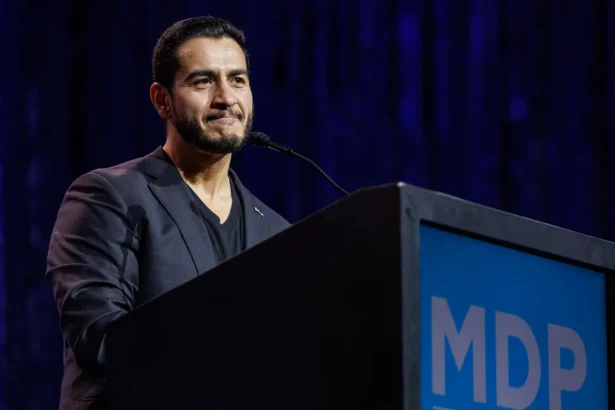
Abdul El-Sayed’s campaign focused at first on healthcare and cost of living, but then made opposition to the pro-Israel lobby the defining issue of Michigan’s Democratic primary
By Etan Nechin, reposted from Haaretz, July 28, 2026
As Democrats increasingly debate the political costs and benefits of confronting Israel and its allies, Michigan’s Senate primary has become the clearest test yet of whether opposition to AIPAC can be a winning electoral strategy.
With a week until the election, frontrunner Abdul El-Sayed has cast the pro-Israel lobbying group – not his Democratic opponent Rep. Haley Stevens – as his campaign’s principal adversary, betting that Democratic voters now see rejecting AIPAC as a political asset rather than a liability.
“Billionaires, Trump donors, and AIPAC are spending fifty million dollars disparaging Abdul,” Alexandra Ocasio-Cortez says in a fast-paced 30-second ad released by the campaign over the weekend. A series of Michiganders follows, addressing the camera directly: “They have millions. Abdul has Bernie, AOC… and us.”
They have Trump donors, AIPAC, and tens of millions.
We have Bernie, AOC, nurses, teachers, UAW, working people, and Democratic leaders across Michigan, and the people. pic.twitter.com/z6qnU6kAap
— Dr. Abdul El-Sayed (@AbdulElSayed) July 25, 2026
In the SMS campaign, the election is framed as a choice between “AIPAC or moral clarity.”
Bernie Sanders, who is in Michigan campaigning for El-Sayed, told a rally the race is about more than two contenders. The vote “will show the nation whether AIPAC and other billionaire-funded Super PACs can buy a U.S. Senate seat or whether the people of Michigan can prevail,” Sanders said.
El-Sayed’s message has won support from progressives, unions and young voters, as well as from Michigan’s significant Arab American community, whose “Uncommitted” campaign against the Gaza war many Democrats blame for helping Donald Trump carry the state in 2024. If elected, Sayed would be the first Muslim member of the Senate.
El-Sayed was also the beneficiary of the first-ever Senate endorsement by Jewish Voice for Peace. “This is a historic opportunity to send a leader to the Senate who will fight for our communities at home while reimagining U.S. foreign policy, to support freedom for all people, not apartheid and genocide,” Beth Miller, JVP’s political director, told Haaretz.
The son of Egyptian immigrants and a Rhodes Scholar with a PhD in public health, El-Sayed became the country’s youngest health officer at 30, leading Detroit’s health department. In 2018, spurred by the Flint water crisis, he ran in the Democratic Party’s gubernatorial primary, winning endorsements from Sanders and Ocasio-Cortez, but lost by 20 points to Gretchen Whitmer. Since 2019, he has hosted America Dissected, a successful podcast on public health. In 2023, he was appointed the public health director for Wayne County.
When El-Sayed announced his Senate bid in April 2025, AIPAC and Israel played only a minor role in his campaign, which centered on bread-and-butter issues like the cost of living and healthcare – playing to El-Sayed’s strengths as a progressive insider in the state’s public health system.
Over the past few months, his campaign increasingly fused his economic populism with attacks on AIPAC and the U.S.-Israel relationship
Abdul El-Sayed: “What does AIPAC want? We saw that last week. They want a vote that is gonna send your tax dollars, $3.3B of them, somewhere else to a genocidal foreign government rather than to invest that money here in your schools and your infrastructure” pic.twitter.com/UcMQnsECEG
— Marco Foster (@MarcoFoster_) July 25, 2026
Omid Memarian, an analyst from Michigan and the director of communications at Democracy for the Arab World Now, argues that the Iran war and rising gas prices have made foreign policy unusually salient for Michigan voters. “I’ve never seen one single issue external to candidates’ platform and campaign become so central,” he said.
The conflict, Memarian argues, made voters more receptive to El-Sayed’s claim that Washington was prioritizing Israeli interests over American ones.
Rather than hurting him, the tens of millions AIPAC spent supporting Stevens reinforced his outsider credentials. “Even voters unfamiliar with El-Sayed came to see rejecting AIPAC as proof he was ‘clean,'” Memarian said.
“What has been feeding Abdul’s campaign is Trump’s broken promise to Muslims that we are not going to start a war, that he’s going to solve the Gaza problem,” Memerian added.
El-Sayed’s rhetoric on Israel places him well to the left of the Democratic mainstream and sharply distinguishes him from Rep. Stevens, who has recently voted against discontinuing U.S. aid to Israel. He has called Israel a “rogue state” and said its government was “as evil” as Hamas. In March, after a terror attack on the Beth Israel synagogue, El-Sayed drew criticism after tying the attack to Israeli airstrikes in Lebanon, in which the attacker’s brother was killed. “Hurt people hurt people,” El-Sayed said.
Jewish leaders have accused El-Sayed of justifying the attack, and organizations like the Jewish Democratic Council of America have endorsed his rivals. Some have threatened to endorse the Republican Mike Rogers in November if El-Sayed wins the primary.
His appearance alongside popular streamer Hasan Piker also generated controversy. The Anti-Defamation League called it a “dangerous normalization of antisemitism.”
But so far, it seems Piker has helped El-Sayed gain a bump in the polls.
“They thought tying up Abdul with a leftist Twitch streamer would sink his primary campaign,” Piker told Haaretz. “It only bolstered his credibility as a fighter for humanitarian principles, especially on the issue of Israel’s genocide in Gaza and the U.S. government’s financial contributions and political cover to let it continue.”
For a campaign so focused on Israel, an El-Sayed win would signal a seismic shift in the Democratic Party. Piker sees it as simple political savvy.
“How can you expect a politician to fight against paywalled healthcare and the corporate power safeguarding that system, if you’re too afraid to demand an end to a genocide carried out with U.S. funds?”
Etan Nechin is an Israeli reporter for Haaretz.
RELATED:
- Abdul El-Sayed and Rep. Haley Stevens on the debate stage
- AIPAC, ‘Murky’ Donors Spend $50 Million to Help Stevens Beat El-Sayed in Michigan
- Pro-Israel GOP donors fueling Rep. Stevens’ Dem primary in Michigan
- Democrats Rejected U.S. Aid to Israel, and AIPAC Couldn’t Stop Them
- AIPAC: Defending the Indefensible