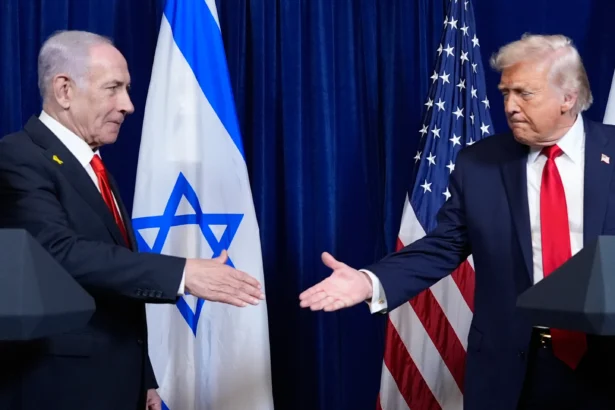
From Trump’s proposal to turn Gaza into the ‘Riviera of the Middle East’ to Netanyahu’s private promise that triggered a global crisis: What the two leaders pledged at their meetings in the U.S. over the past 18 months – and what actually happened
By Yotam Frost, reposted from Haaretz, July 28, 2026
Prime Minister Benjamin Netanyahu is visiting the U.S. on Tuesday (July 28) for the seventh time since President Donald Trump’s second inauguration. After departing Israel from an air force base and, breaking with custom, barring journalists from accompanying him on the trip, Netanyahu’s arrival in Washington was met by protests organized by pro-Palestinian and liberal Jewish groups.
Haaretz revisited the six previous meetings at the White House and at Mar-a-Lago in Florida, to see what the two leaders promised their publics and the world – and what actually came of it.
Feb. 4, 2025 Taking over Gaza, displacing Palestinians
Netanyahu’s first visit to the White House since Trump’s reelection took an unexpected turn when Trump announced that the United States intended to take over the Gaza Strip and proposed relocating its entire Palestinian population.
-
The promise: “The U.S. will take over the Gaza Strip and we’ll do a good job with it too,” Trump said. Describing Gaza as a potential “Riviera of the Middle East,'” Trump added that “we’re gonna take over that piece and develop it, create thousands and thousands of jobs. It will be something the entire Middle East can be very proud of.”
-
Reality: Trump brokered a cease-fire in September 2025, but the U.S. never took over Gaza – let alone turned it into a Middle East Riviera, rebuilt it, created thousands of jobs or made it a safe, thriving place.
-
The Promise: “Many countries will soon be joining this amazing peace and economic development transaction. I think we’re going to have a lot of people signing up very quickly,” Trump said of the Abraham Accords. Netanyahu added: “I think peace between Israel and Saudi Arabia is not only feasible, I think it’s going to happen.”
-
Reality: Since Trump’s second term, only Kazakhstan has joined the Abraham Accords – a country with which Israel has had diplomatic relations since 1992. Somaliland, which is formally recognized as a sovereign state only by Israel, pledged to join the following month. Saudi Arabia still refuses to join without clear progress toward a Palestinian state. Syria has said joining the accords is not currently on the table, though Syrian President Ahmed al-Sharaa recently said he is working to reach a security agreement with Israel.
-
The promise: “In Gaza, Israel has three goals: destroy Hamas’ military and governing capabilities, secure the release of all of our hostages, and ensure that Gaza never again poses a threat to Israel. We will not only win the war. Working together, we will win the peace…. Hamas is not going to be in Gaza, and we’re going to get everyone back,” Netanyahu said.
-
Reality: So far, Israel has completed only one of these goals – the return of the hostages. Israel’s other objectives have not been achieved: Hamas has not disarmed and retains significant influence across Gaza.
-
The Promise: Trump raised the idea of relocating Gaza’s population, saying he believed the move would be welcomed by the neighboring nations: “We’re going to give people a chance to live in a beautiful community that’s safe and secure. They should get a good, fresh, beautiful piece of land … I have a feeling that the king in Jordan and Egypt will open their hearts and will give us the kind of land that we need to get this done.”
-
Reality: No mass transfer of Gaza’s population has taken place, and Egypt and Jordan have publicly refused to participate.
April 7, 2025 Erasing the trade deficit – and Gaza relocation, again
At their next meeting at the White House, the discussion turned to trade, Iran and the recurring question of Gaza’s population. Trump surprised Netanyahu when he told the press that the U.S. is “having direct talks with Iran,” and that “doing a deal would be preferable to doing the obvious,” referring to military action. Two months later, the U.S. and Israel war with Iran began.
-
The Promise: “We will eliminate the trade deficit with the United States. We intend to do it very quickly. We think it’s the right thing to do. And we’re going to also eliminate trade barriers, a variety of trade barriers that have been put up unnecessarily,” Netanyahu said.
-
Reality: The deficit is reduced but nowhere near eliminated. The 2026 U.S. goods deficit currently stands at $2.36 billion, and non-tariff barriers remain. Israel canceled most remaining tariffs on U.S. imports, though nearly 98 percent of American goods were already duty-free. Additional agreements have been reached to phase out some of the remaining barriers over the next several years.
-
The Promise: Netanyahu again raised the idea of relocating Gaza’s population: “We’ve been talking about some countries that are saying, if Gazans want to leave, we want to take them in. Countries are responding to that vision. We’re working on it.”
-
Reality: Gaza’s population has not been relocated to other countries.
July 7, 2025 A victory lap after the Iran war
The July meeting was something of a victory lap following the first Israel-Iran war and U.S. strikes on three Iranian nuclear sites, even though the war ended without a detailed agreement. The two leaders addressed the future of U.S.-Iran diplomatic efforts. “They want to talk, they took a big drubbing when we hit the three sites. not just the one big one, it was deep and granite and obliterated,” Trump said.
-
The promise: “We’re working with the United States very closely about finding countries that will seek to realize what they always say – that they want to give the Palestinians a better future. We’re getting close to finding several countries, and this will give Palestinians the freedom to choose,” Netanyahu said.
-
Reality: No country has offered to take in hundreds of thousands of Gazans.
-
The promise: “Hezbollah has been brought to its knees. Iran is out of the picture. This presents opportunities for stability, for security, and eventually for peace,” Netanyahu said.
-
Reality: Hezbollah still retains military capabilities. It joined Iran by firing on Israel in March 2026, triggering a round of warfare that has resulted in more Israeli casualties than in the Iran war theater.
Sept. 29, 2025 Declaring ‘peace in the Middle East’
At a celebratory meeting at the White House, Trump announced a comprehensive plan to end the war and free the hostages, saying that, when both parties agree to the proposal, “the war will immediately end” and all Israeli hostages will be released within 72 hours.
-
The promise: “This is a big, big day, a beautiful day, potentially one of the greatest days ever in civilization … we’re talking about much beyond Gaza. The whole deal, everything getting solved. It’s called peace in the Middle East … And it means the immediate end to the war itself, not just Gaza. It’s the war itself,” Trump said.
-
Reality: Trump described the agreement as the dawn of peace across the Middle East and the end of the fighting. In practice, it was a pipe dream. A few months later, Trump and Netanyahu launched another war against Iran.
-
The promise: “Demilitarize Gaza, and that’s quickly. Decommission the military capabilities of Hamas and all other terror organizations. Do that immediately. And I’m hearing that Hamas wants to get this done, too. That’s a good thing,” Trump said. Netanyahu added: “Hamas will be disarmed. Gaza will be demilitarized. Israel will retain security responsibility, including a security perimeter for the foreseeable future. And lastly, Gaza will have a peaceful civilian administration that is run neither by Hamas nor by the Palestinian Authority.”
-
Reality: Ten months later, Hamas still retains influence over much of the Strip, talks on its disarmament have stalled and Israel is threatening a new round of fighting.
-
The promise: “All parties will agree on a timeline for Israeli forces to withdraw in phases. They’ll be withdrawing in phases. No more shooting, hopefully, as progress is made toward achieving these goals,” Trump said.
-
Reality: Israel committed to withdraw, but in practice the IDF has continued to expand the territory it controls in Gaza, pushing out Palestinian residents in the process. When the cease-fire was signed, Israel controlled 53 percent of the Strip. Israel now controls approximately 64 percent of Gaza, and Netanyahu ordered the IDF to expand that control to 70 percent.
-
The promise: “Hamas and other terrorist factions will play no role in the governance of Gaza at all, directly or indirectly,” Trump said.
-
Reality: Hamas’ ministries and employment system remains in place, and it continues overseeing security and policing in parts of Gaza under its control. The U.S.-backed technocratic administration has yet to assume full authority and the international stabilization force has yet to be deployed.
-
The promise: “We obliterated Iran’s nuclear enrichment capacity, making it impossible for them to have a nuclear weapon,” Trump said. Netanyahu added: “Just a few months ago, in Operation Rising Lion and Operation Midnight Hammer, we struck a decisive blow against Iran’s nuclear and ballistic missile program.”
-
Reality: In the months that followed, it became clear that this was not true. Iran maintained a substantial missile arsenal, and its nuclear program remained a central concern. The U.S. and Israel launched a new war against Iran in February 2026 precisely to eliminate these concerns. While its capabilities may have been degraded, they remain a concern.
Dec. 29, 2025 An ultimatum for Hamas, and a promised pardon
At a meeting at Mar-a-Lago in Florida, Trump and Netanyahu again discussed Hamas’s disarmament.
-
The promise: Trump said Hamas would be “given a very short period of time to disarm,” warning that if it didn’t, “it would be horrible for them. Other countries will wipe them out.”
-
Reality: Hamas still has not disarmed.
-
The promise: Trump renewed his call for President Isaac Herzog to pardon Netanyahu, saying: “I think he [Herzog] will. He tells me it’s on its way.”
-
Reality: No pardon has been granted.
-
The promise: “Abraham Accords will be expanded fairly quickly,” Trump said.
-
Reality: No additional countries have joined the Abraham Accords.
Feb. 11, 2026 Toppling the Iranian regime
Perhaps the most consequential promise was made behind closed doors during Netanyahu’s most recent White House visit: He assured Trump that Iran’s regime could be toppled.
Netanyahu arrived without the traditional honor guard and his motorcade entered the grounds through a side entrance typically used by staff, and out of view of the press. According to Maggie Haberman and Jonathan Swann’s book, “Regime Change: Inside the Imperial Presidency of Donald Trump,” Netanyahu presented Trump and his advisers with a briefing intended to convince them that regime change in Iran was achievable. Just over two weeks later, the war began.
Netanyahu and his team reportedly suggested that Kurdish fighters would invade Iran from Iraq, stretching Iran’s forces and accelerating the regime’s collapse. American officials reportedly viewed the plan as “detached from reality.”
In practice, Kurdish forces did not invade Iran and regime did not fall. Disruptions surrounding the Strait of Hormuz still plague the global economy, with no end in sight.
Yotam Frost is an Israeli journalist for Haaretz.
RELATED:
- Five decades of Israeli covert strategy to push US, Iran into confrontation
- US House passes $1.15 trillion military bill expanding Israel cooperation
- Israel’s War Kills More U.S. Troops
- Inside the Pentagon Plan to Stitch Israel Into American Defense
- Israel tries to speed up US-Israel MoU talks as clock runs down on current Congress