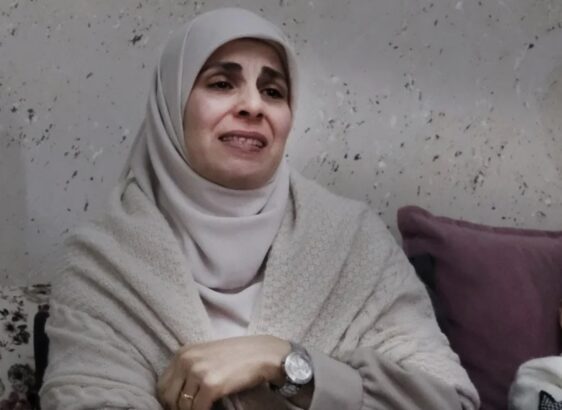
A decade passed between the killing of the first son and the second. Nur was killed at a West Bank checkpoint, and Rayan was shot in an ambush on his way home. IDF soldiers took Rayan’s body, and Israel now refuses to return it
How many children do you have? “I will never erase my two sons – so, six sons and a daughter.” Thus, dry-eyed but clearly in pain, Nayfeh Abu Alla, an impressive, nicely dressed woman, replies to a question we asked this week.
Her son Nur a-Din was in the 12th grade and his brother Rayan was in 11th grade – both about the same age, 17, when they were killed by soldiers, years apart. Their photographs hang on the door and walls of the elegant living room of the family’s home in the town of Qabatiya, in the northern West Bank: Nur a-Din, 27/12/2015; Rayan, 20/12/25.
One week shy of a full decade, from death to death. Nur was preparing for a mathematics test before he was killed, Rayan for a test in religious studies. Nur was killed at the Hawara checkpoint, south of Nablus; Rayan a few hundred meters from his home.
The Abu Allas named the baby born after their first son’s death for him; Nur a-Din is now 8. The couple is unlikely to have another child who will perpetuate Rayan’s name: Mohammed, the father, is 55; Nayfeh is 46.
הירי בריאן אבו עאלה, ב־20 בדצמבר בקבאטייה
שימוש לפי סעיף 27א לחוק זכויות יוצרים pic.twitter.com/MkGo5LXZ1U
— הארץ חדשות (@haaretznewsvid) February 19, 2026
Footage showing Rayan being shot.
Mohammed, who is mostly idle these days, worked as a renovations contractor for years in Israel. His last workday was on the day Israel Defense Forces soldiers killed Nur, the eldest Abu Allas child. After that, Mohammed was not permitted to reenter Israel – standard practice because, it’s claimed, he might have wanted to seek revenge.
Israel thus punishes the bereaved parents twice: once by taking a life and afterward by revoking the permit that allows them to make a living. Since then, Mohammed has done occasional renovation work in the West Bank.
Qabatiya is a tough place, a militant town that has lost no few of its sons. The Abu Alla family lives in the Old Quarter, which possesses a special beauty despite its neglected condition, in the Saba’neh neighborhood, which is also the name of the residents’ extended hamula (clan).
Rayan was killed on the lower part of the street, near Walid Saba’neh’s grocery store. When the troops shot him, the elderly Saba’neh, whom we met this week at the entrance to his small shop, hid inside, frightened and shaken.
Rayan had been on his way home when two soldiers, who were hiding around the corner, fired a volley at him from close range, killing him instantly. Footage from a security camera shows the killing in detail, second by second, in a manner that leaves no room for questions – other than: Why did soldiers killed an unarmed youth who was innocently walking on the street?

The street was quiet and totally deserted before the incident. Rayan wasn’t holding anything that could have posed a threat to the soldiers. He was thus apparently shot for no reason, in his own neighborhood. The soldiers then snatched his body and left.
Ten years ago, Israel returned the body of Rayan’s brother, Nur a-Din, after five days. Today, however, the authorities are refusing to return Rayan’s body, leaving the family with no funeral, no grave and even greater anguish.
Rayan, who was 6 when Nur was killed, could not grasp the horrible news until he saw his brother’s body – a scene captured on video, in which he can be seen hugging it. Rayan grew up in the shadow of the loss. Now his youngest sibling, Jadallah (Jad), also 6, doesn’t believe Rayan is gone forever.
In a dress, hijab and scarf, all beige, Nayfeh recounts the disaster. Mohammed listens and hardly joins in. The children come and go, every so often one of them gets up, no longer able to listen to an account of the family’s suffering. At one point, Nayfeh asked little Nur a-Din to leave the room to bring them some water, so he wouldn’t hear.
Their eldest child, Hudeifa, 24, unable to bear the hopelessness of life in Qabatiya, left in August 2024 for the Netherlands, where he hopes to be recognized as an asylum seeker; he is living in a camp outside Amsterdam with others requesting the same status. The last straw for him was an incident that occurred before he left, in which he was taken into custody at a checkpoint and humiliated and beaten by soldiers who also broke his cellular phone and confiscated his ID card – which was found a few months later by a passerby on the roadside.

When Rayan was killed in December, Hudeifa wanted to return for the funeral but his parents forbade it, fearing that Israel would not let him leave again. His brother Daffar, 20, a nursing student at the Arab American University in Jenin, is sitting with us and his parents.
Last December 20 was a regular day in the household. At midday, Nayfeh went with her youngest children, Nur and Jad, to the cemetery to visit the grave of Nur a-Din. She visits the grave every two months, she says, because otherwise Nur appears in her dreams and complains that she isn’t coming to see him. One year she went to Mecca on the hajj and was out of the country for a relatively lengthy period, and he indeed appeared in a dream, asking: Why don’t you come to visit me?
After spending about half an hour at the graveside, mother and children went home, stopping at the market on the way. Nayfeh bought vegetables and shawarma for the children, to cheer them up after their visit to the cemetery. When they got home, Rayan came out to help her with the baskets, as always. He was happy to get a shawarma, too, she recalls, and then went back to his room.
Mohammed got home at 5 P.M. and invited Rayan to sit with him as he ate his meal. Toward evening, Nayfeh prepared a dessert in the kitchen and Rayan was in his room – or so she thought.
Dark had fallen sometime later when she suddenly heard the wail of an ambulance that had stopped outside. She went to the window, photographed the vehicle with her phone and sent the image to her daughter, who then called to ask where Rayan was. Nayfeh was certain he was in his room, but discovered that the room was empty.

Immediately she called and texted Rayan, but then noticed that he had left his phone in the house. By now it was a few minutes after 7 P.M. Nayfeh decided to go outside to see what was going on. The paramedic in the ambulance told her that someone had been wounded but the army would not allow the vehicle to approach. The wounded person was apparently lying on the ground further up the street. Her son was missing from the house, Nayfeh told the paramedic, and she was afraid he was the casualty.
She tried to persuade the driver to move ahead very slowly and walked alongside the vehicle in the direction of the soldiers, but they trained their rifles on her and she had to stop. In the meantime, her husband and other children went out and begged her to come back inside, which she did. Around 30 to 40 minutes passed. Large army forces streamed into the street. After a about an hour, she saw out of the window that the jeeps were leaving the neighborhood. She never imagined, she says now, that one of them was carrying her son’s body.
Meanwhile, unbeknownst to her, a post on Telegram reported that Rayan had been wounded in the leg.
Rushing back into the street, Nayfeh hoped that the wounded person was still lying where he had ostensibly been shot in the leg. But the crowd of neighbors who had gathered at the scene wouldn’t let her approach or see the bloodstains on the ground. She asked who had been wounded and they said they didn’t know. Then she heard someone tell someone else on the phone that Rayan was dead. She collapsed.
Nayfeh was taken home; the house filled up with people. A representative of the Palestinian Authority called Mohammed and said they needed Rayan’s birth certificate. Nayfeh went into Rayan’s room – as she recalls that moment now she no longer holds back the tears – and found the cup of coffee he hadn’t finished drinking and his religious studies textbook, still open.

What actually happened that evening? Abdul Karim Sadi, a field researcher for B’Tselem, the Israeli Information Center for Human Rights in the Occupied Territories, shows us the revealing footage from the security camera that was mounted on an electricity pole across from the site of the incident. In the clip, two soldiers are seen hiding behind the wall of a building, at the corner of the street. All is quiet. Then a teenager is seen walking in the direction of the soldiers, though it’s clear that he doesn’t see them. Abruptly they emerge from their ambush and rain heavy fire down upon him from close range.
Sadi measured the distance between the soldiers and their victim – between 1.7 and 2 meters, from the end of the rifle to Rayan’s chest. A photograph taken by a neighbor shows the youth’s body lying in the street. It lay there for about half an hour before being taken away by the soldiers, Sadi says.
We asked the IDF Spokesperson’s Unit this week about the results of the investigation that was launched and why Rayan’s body was abducted. The response: “Following the shooting incident, an investigation has been opened by the Border Police whose findings will be passed on to the Military Adjutant General’s office. Naturally, details of an ongoing investigation cannot be made public.”
A decade ago, after Nur a-Din was killed, Nayfeh consulted with clerics and was told that if more than 15 years pass between his death and her death, she can be buried in one grave along with him. Now she wants to bury Rayan there instead, in his brother’s grave – but Israel is refusing to return the body. She is desperate, ready to talk to anyone who may be able to help, to do everything in her power to get it back.
“My life has stopped and it will be able to continue again only after we get Rayan back,” Nayfeh mumbles through tears.
Gideon Levy is an Israeli journalist and author. Levy writes opinion pieces and a weekly column for the newspaper Haaretz that often focus on the Israeli occupation of the Palestinian territories. Alex Levac is an Israeli photojournalist and street photographer. He was awarded the Israel Prize for photography in 2005.
RELATED:
- US groups demand release of American-Palestinian teen imprisoned by Israel
- Israeli Soldiers Kill Palestinian Teen, Injure Three, In Nablus
- Israeli Occupation Forces Kill Palestinian Teenager, Injure 2
- Israeli forces kill Palestinian teen, another Palestinian dies of wounds
- Israeli Soldiers Kill A Palestinian Teenager – 197th Palestinian this year