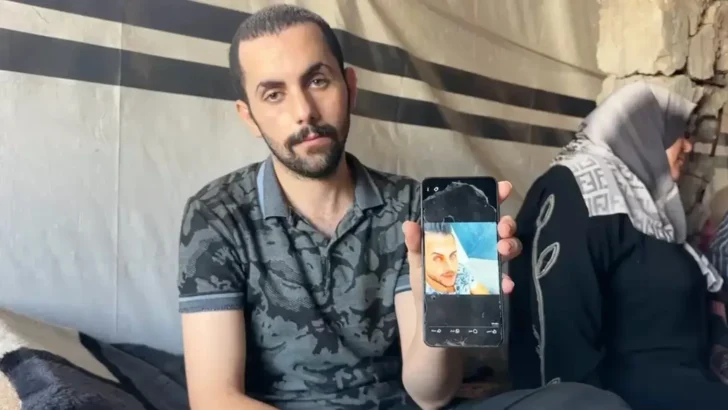
With over 9,500 missing in Gaza, Palestinians search for family members under the rubble, in the “numbered graves cemetery,” or in Israeli prisons.
By Abdel Qader Sabbah, reposted from Drop Site News, July 15, 2026
JABALIYA, Gaza Strip—Six months after Hamada Al-Banna disappeared while seeking food from an aid convoy in July 2025, his family heard he had been killed and gave up their search. They held a funeral for him at home in Jabaliya, without his body. Al-Banna was the third son his parents mourned. Al-Banna’s brother, Adham, had gone with him to the Zikim crossing area to get food for his children and was confirmed killed that same day. His other brother, Amjad, had been killed in an Israeli attack two months prior.
Last week, a full year after Al-Banna was last seen and six months after his funeral, Al-Banna’s father received a phone call. “He called and said, ‘Hello, Dad.’ I replied, ‘Who is this? Who are you calling Dad? Who are you?’ He said, ‘It’s me, Hamada.’ I didn’t believe him,” Yasser Al-Banna told Drop Site News, sobbing as he recounted the story. “He kept saying, ‘Dad, it’s me, Hamada.’ We had searched everywhere for him.”
Al-Banna was somehow alive. He had been badly wounded while trying to get food that July morning a year ago and was detained by Israeli soldiers. He spent 12 months in Israeli detention without charge in such appalling conditions that he tried to take his own life several times. His family had no idea what happened until he was suddenly released without explanation on July 6. Shortly after he called his father, he was home and in his arms, back from the dead.
“How did I feel? I fainted. It was as if I had died. I simply couldn’t believe it,” Yasser said.
The official death toll in Gaza since Israel launched its genocidal assault in 2023 now stands at more than 73,200 Palestinians, with over 1,100 of them killed since a so-called ceasefire went into effect in October 2025. The figures are widely acknowledged to be a vast undercount, with at least 9,500 Palestinians missing, the vast majority of them presumed dead and under the rubble. Trying to locate, retrieve, and identify the bodies is a daily ordeal in Gaza as thousands of families continue to search for their loved ones. But there are also an unknown number of the missing who have been abducted and vanished into Israel’s prison camps where they are held without charge or trial—or even any official notice of their detention.
Hamada Al-Banna was one of them. His account of what happened to him is a litany of horrors.
Like tens of thousands of other Palestinians suffering under Israel’s starvation campaign in the summer of 2025, Al-Banna would routinely risk his life in search of food for his family. His father’s left leg had been amputated and he was unable to make the arduous trek himself. In northern Gaza, many would head to an area near the Zikim crossing, where arriving aid convoys would distribute food in chaotic and desperate scenes. Israeli soldiers routinely opened fire on the crowds, killing and wounding starving Palestinians. On a July morning, Al-Banna headed there with his brother, Adham. Al-Banna managed to get hold of a bag of flour but lost sight of his brother in the melee as Israel again attacked the area. As he headed home, he received a call from an acquaintance telling him his brother had been killed.
“I was in shock. I went back to look for my brother. I searched among the bodies of martyrs lying on the ground. I kept moving closer, looking everywhere for him,” Al-Banna told Drop Site. “Without warning, I was thrown into the air by an explosion. At that moment, I thought I was dead. …My entire body was covered in injuries. My leg was badly wounded. The soldiers came toward me and saw that I was dying and reciting the shahada. I could feel my soul leaving my body. I lost all hope. I thought, ‘This is it. I’m going to die.’ I closed my eyes and I don’t know what happened after that.”
When Al-Banna woke up he found himself in Soroka hospital in southern Israel. He was told he had been in a coma for two full months. His body was still covered in injuries and his left leg badly mangled. He spent six months in the hospital before being taken away while still recovering and thrown into solitary confinement for four months.
“They took me out of the hospital and they threw me into solitary confinement. The cell was about the size of a bathroom—actually, even smaller. There was only a toilet in the middle, and that’s where you had to relieve yourself. I lost my mind in that room, incredibly small. I spent four months there and tried to take my own life several times,” Al-Banna said.
Hamada Al-Banna with his family in their damaged home in Jabaliya on July 7, 2026. Video by Abdel Qader Sabbah.
He told the story sitting beside his parents in their severely damaged family home in Jabaliya. Tarps hung where walls once stood. Broken and twisted support columns were barely upright. A massive pile of rubble from the neighboring building spilled into one room.
As Al-Banna recounted his ordeal, both his parents broke down in tears. When he never came home that day, they quickly began searching for him in hospitals and morgues. They hired a lawyer to try and find out if he had been detained. “I sold my gold jewelry to pay the legal fees,” said his fiancée, Reem Jadallah, their engagement having taken place just one month before he disappeared. They showed a photograph of Al-Banna to released prisoners to ask if they had seen him. Six months into his disappearance, a second lawyer the family hired said he had been killed.
“The lawyer called me and sent me a list of people who had been martyred, and Hamada’s name was on it,” Jadallah told Drop Site. “That was devastating—we had held on to hope, and then it was gone all at once.”
Al-Banna was thrown into solitary confinement at around the same time his family, believing he was dead, held a funeral for him. It would not be his last place of detention.
“After four months [in solitary], they took me for interrogation and tortured me extensively. After the interrogations and torture, they transferred me to Sde Teiman prison,” Al-Banna said, referring to the Israeli military prison camp in the Negev desert notorious for some of the worst abuses against Palestinian detainees. “Why did they take me? I’m not a Hamas member or anything like that. I had done nothing. Why did they do this to me? During the interrogation, I told the interrogator, ‘I just want to reassure my family. They don’t know anything about me.’ Instead, he tried to frighten me. He told me that members of my family had died, making my psychological state even worse.”
After a full year of being in custody, Israeli soldiers took Al-Banna out of his cell, beat him, shackled his hands and feet, blindfolded him, and placed him on a bus. After a short drive, they removed his restraints, struck him one final time, and released him.
“When I got home, it felt as though I had come back from the dead. I saw my mother from a distance, and we both ran toward each other. I hugged her in the middle of the street, but I couldn’t bear the moment and collapsed to the ground,” Al-Banna said.
Surrounded by family members in their dilapidated home, Al-Banna hugged relatives and sat close to his fiancée. He lifted his shirt to reveal his chest and abdomen which were covered in wounds and scars. A wide, angry gash ran down the nearly entire length of his left shin. He spoke in a soft, matter-of-fact voice as he relayed his year of torment in Israeli custody.
“Prison broke me. I truly lost my mind there. I reached a point where I behaved irrationally, like someone who had gone insane. Thank God, He brought me back from death.”
The Cemetery of the Missing
In Gaza, Al-Banna was one of the lucky ones. The many thousands of other missing Palestinians have been killed and remain buried under the rubble—or in some cases their bodies have been retrieved but they remain unidentified. The number of unidentified dead has grown so large that a special cemetery was established in Deir Al-Balah last October, after the “ceasefire” went into effect, to bury them.
Known in Gaza as the “cemetery of the missing” or the “numbered graves cemetery,” it now contains over 650 unidentified bodies, according to Ziad Obeid, director of the cemeteries department at the Ministry of Religious Endowments and a member of the Body Management Committee (BMC), part of the Ministry of Health.
As part of the “ceasefire” agreement, Israel began transferring the bodies of dead Palestinians back to Gaza in batches. Many of them bore marks of torture and summary execution, others were nothing more than loose body parts handed over in bags. At the same time, Palestinians across Gaza started digging through the rubble to recover bodies trapped underneath or hastily buried in shallow mass graves during the acute phase of the genocide. In each case, a rigorous process was put in place to try and identify the dead, with those who remained unidentified taken by authorities to be interred at the “numbered graves cemetery” in Deir al-Balah.
The “numbered graves cemetery” in Deir Al-Balah was established in October 2025 to bury unidentified bodies. July 7, 2026. Video by Mohamed Ahmed.
Last week, five unidentified bodies were brought to the cemetery, where hundreds of half-buried cement cinder blocks jut out of the sand to mark the graves as headstones. Standing at the site as the fresh graves were dug and the five bodies in white plastic body bags were buried, Obeid and three other government forensic specialists explained the processes put in place to confront the scale of the unidentified.
The bodies are brought to Shifa hospital in Gaza City or Nasser Hospital in Khan Younis, where they are received by forensic medicine and criminal investigations teams. Each body is thoroughly photographed, including any identifiers such as teeth, clothing, or body marks. The teams also collect samples of each body and store them in a designated facility at Shifa Hospital for possible DNA testing at a later time, though Israel has so far prevented the entry of DNA testing kits into Gaza.
The bodies are then displayed for several days in designated hospital rooms, with families forced to sift through graphic photographs of decomposed bodies and body parts, in hope of finding their loved ones. The images are also uploaded to an online platform run by the Health Ministry. If the body is not identified after a legal waiting period of several days, the Ministry of Endowments and the BMC assign it a unique code and transport the body to the Deir al-Balah cemetery where it is buried and assigned a grave number.
“Some families have identified their relatives buried in this cemetery,” Obeid told Drop Site. “Families took one of two approaches: Some chose to exhume the bodies and rebury them near their homes, while others opted to place a headstone marking the grave of their identified relative in here. This cemetery is primarily intended for unidentified bodies. However, if a family decides to leave the body here after it has been identified, we have no objection, provided the grave is marked to indicate that it belongs to their relative.”
Jihan Mohammed Ammar has been coming to Shifa hospital every few days to try and find her son Abdulsalam Abu Taqiya, who went missing on November 29, 2024, in Beit Lahia as invading Israeli troops besieged the area. He was 15 years old when he disappeared.
“Every few days I come here. They tell me I’m probably the person who comes here the most,” Ammar told Drop Site as she stood in the halls of Shifa hospital. “I’ve been shown all the photographs that have come in. I’ve looked through every one of them. I come every time photos are displayed to search through them.”
Ammar’s husband was detained by Israeli troops in Al-Qarm roundabout, east of Jabaliya, and also remains missing. Her search for her son has consumed her. “My greatest fear is that my son has been buried in a mass grave. There isn’t the equipment here to determine whose body belongs to which family. There isn’t the equipment to identify a son for his parents or a husband for his wife,” she said.
“That boy is my whole life, my entire life. He was my support—he was everything to me,” she continued. “They took him, or he was martyred—I don’t know where he is. I just want to know where he is, where he ended up. I want to hold him in my arms like any other mother. He was my soul, my heart, my whole life.”
Abdel Qader Sabbah is a journalist and videographer in northern Gaza.
RELATED:
- The Gaza Ethnic Cleansing Agenda Continues To Roll Forward
- Prominent Palestinian Surgeon Reported ‘Near Death’ in Israeli Prison Camp: 2 Articles
- Why Gaza is the world’s most dangerous place for children
- Israel Continues to Shoot Children in the Head During the Gaza Ceasefire
- Drones and decomposing babies: What’s in UN report on Israel’s genocide of Palestinian children