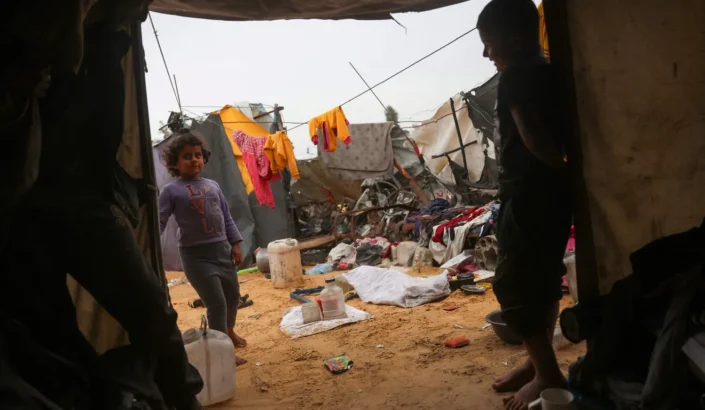
Alongside a surge in diseases caused by insects, rodents and contaminated water, health officials and aid groups report that Israel’s restrictions have resulted in dire shortages of medicine and medical supplies. An estimated 1.2 million Gazans live in crowded tent camps
By Nagham Zbeedat, Reposted from Haaretz, April 14, 2026
Health officials and humanitarian groups warn that the “catastrophic” public health crisis in Gaza is worsening, due to Israeli restrictions on aid, severe shortages of critical medicine and supplies, decimated hospitals and clinics, and the dire living conditions imposed on the 1.2 million Palestinians residing in more than 1,600 displacement camps across the Gaza Strip.
Restrictions on humanitarian supplies – particularly items Israel classifies as “dual-use” and claims could be used by Hamas for “weaponry or infrastructure development” – continue to prevent the entry of critical medical equipment into Gaza, including operating tables, scalpels and parts needed to repair ultrasound machines, ventilators and incubators.

“The health crisis in Gaza has transcended traditional definitions of emergency, reaching a catastrophic level where the most basic human rights are violated,” the Palestinian Ministry of Health said in a statement last week.
More than half of essential medicines in Gaza are at zero stock, meaning they are fully unavailable anywhere in the Strip, according to data published by the ministry, while 71 percent of lab testing materials and 57 percent of medical disposables are also out of stock. These include basic supplies such as gauze, needles, compresses and sterile medical equipment, like gloves, gowns and disinfectant for surfaces.
After the U.S.-Israeli war on Iran began on February 28, Israeli authorities shuttered crossings into Gaza, leading to an 80-percent decrease in the number of trucks entering the Strip in the first three weeks of the war with Iran. U.S. pressure led Israel to reopen Kerem Shalom on March 4, followed by the Rafah crossing with Egypt on March 19. Aid delivery resumed via the Zikim crossing on April 12 – two days after the U.S. declared a two-week cease-fire with Iran – yet Palestinians in Gaza say they have yet to feel any relief.
Sharqiya, a 25-year-old woman from Gaza City, says that despite the openings, her father, who has diabetes, still can’t access insulin with any regularity.

“Even when trucks enter, it’s not enough,” she tells Haaretz. “Chronic illness medicines, if they come in, they come in small quantities and are not enough for everyone. Since the war with Iran started, the shortages have only gotten worse.”
An anesthesiologist at Gaza City’s Al-Shifa Hospital, who spoke to Haaretz on the condition of anonymity out of fear for his safety, is currently displaced and living in a tent. He describes Gaza’s health system as “completely exhausted.”
“Since I began practicing medicine six years ago, Gaza has always been under blockade, but the health situation was relatively stable. Now, it is catastrophic,” he says. “There is a major shortage of anesthesia drugs. We have been forced to perform surgeries using alternative medications, basic tools, and sometimes without full anesthesia.
“In one case, we were unable to use full anesthesia during an amputation,” the doctor added. “We used only ketamine because it was the only option available.”

Some operations, like open-heart surgeries and cardiac catheterizations, have “ceased entirely” due to lack of resources, according to the Health Ministry statement.
“Brain and neurosurgery procedures cannot be performed due to the lack of equipment. The same applies to prosthetics and many orthopedic surgeries,” the anesthesiologist adds.
Patients requiring these operations are among the more than 18,500 Gaza residents whose are registered to be evacuated to receive lifesaving medical care abroad. “Many patients die while waiting for their turn because we do not have the capacity to treat them here,” the doctor says.

Marah Shamali, a dentist who volunteers at a public clinic in Gaza City’s al-Sabra neighborhood, says there “is a severe shortage of essential resources due to policies that prevent the entry of dental materials into Gaza.”
“We are forced to turn away emergency cases suffering from severe pain because we don’t have the materials needed for root canal treatment,” she says. “We mainly provide emergency pain relief, extractions and basic fillings. In some cases, we personally contribute money to buy materials for a limited number of patients. But this is not sustainable.”
Shamali says the Strip is witnessing a “frightening deterioration in children’s oral health,” especially as parents are forced to choose between feeding their families or paying more than a month’s income on dental procedures.
“Children arrive with advanced infections that can extend to the neck and become life-threatening. We are forced to resort to extraction as the only final solution for permanent teeth, because families cannot afford restorative treatment,” she explains. “A root canal used to cost 150 shekels. Now it can reach 400 to 500. With no income, families prioritize food over treatment.”

Diseases spread rapidly in tent camps
Health officials and aid groups report a serious surge in waterborne, foodborne and insect-borne diseases in recent weeks, especially in the more than 1,600 displacement camps where an estimated 1.2 million Palestinians live in tents and makeshift camps.
“Cold and rainy weather, severe overcrowding, deteriorating shelters and poor water and sanitation conditions have created a high disease-transmission environment across Gaza,” says a recent World Health Organization report.
More than 1.9 million people were diagnosed with acute respiratory infections in the first two months of 2026, making it the most common communicable disease in Gaza, followed by acute watery diarrhea and skin diseases (including lice and scabies), according to data released by the Ministry of Health.
Nearly 23,000 suspected cases of insect-borne diseases, such as scabies and lice, were recorded in February, according to Gaza’s Health Ministry. The UN’s Office for the Coordination of Humanitarian Affairs says the ability to treat these infections has been limited as access to hygiene kits, insecticides and scabies treatment remain critically low.

An OCHA assessment in March found that 80 percent of Gaza’s displaced persons camps have “frequent and visible rodent and pest presence, while skin diseases are widespread in 48 percent of the sites.”
“Garbage is everywhere in the streets. There are pools of wastewater because the sewage system is destroyed,” says Sharqiya, the 25-year-old from Gaza City. “The rubble hides everything. You don’t know what’s underneath: martyrs, animals, decay. It becomes a place for rodents and insects. And we are living among them.”
Faraj, 32, says illness has become part of daily life in the refugee camp in Jabalya where he now lives in northern Gaza.
“We try to reduce contact with people because diseases are everywhere, and many of them spread fast,” he says. “But there are no real precautions we can take. Living in a tent forces you to face it. The tents are very close to each other. Even the smallest camp has around 4,000 people. There is no infrastructure, sewage is always there, and bathrooms are shared.”
Faraj says he does not expect the situation to improve any time soon. “As long as the crossings are closed, our situation will only get worse.”

Bureaucratic constraints
The Kissufim and Erez crossings remain completely shut, while the Kerem Shalom, Zikim and Rafah crossings are technically open and operational as of publication. Yet humanitarian organizations say barriers beyond the checkpoints constrain their ability to deliver aid.
Between March 31 and April 5, only 70 percent of trucks were offloaded at Kerem Shalom Crossing, with the remaining 30 percent being returned to Egypt – a 23-percent decrease from the previous week, according to a report by the UN’s Office for the Coordination of Humanitarian Affairs. The agency attributes the decrease to closures during the Jewish holiday of Passover at the Kerem Shalom crossing.
Doctors Without Borders reports that “prolonged and unpredictable administrative procedures” imposed by Israeli authorities delay deliveries by up to a month. If a single item is rejected at a border crossing, the truck and all of the supplies onboard are returned to Egypt.

In a separate report, the UN’s OCHA cited bureaucratic challenges including “Israeli requirements related to customs clearance, which is often delayed; insufficient scanning capacity, which makes it difficult to secure approval for many critical items; and blanket bans on specific UN agencies and NGO partners that are central to the joint humanitarian response.”
Doctors Without Borders is among the 37 international aid groups facing the “blanket ban” on operating in Israel, the West Bank and Gaza by Israeli authorities. Since January 1, these groups have been blocked from bringing medical or humanitarian supplies into Gaza, and international healthcare workers – including doctors, surgeons and nurses – affiliated with these groups were forced to leave the Strip at the end of February.
The 37 groups provide a large share of medical treatments in the Strip, in addition to running displaced persons’ camps and providing water and waste/sewage removal, plus educational and psychological services to Gaza’s residents.
Israel’s Coordinator of Government Activities in the Territories (COGAT) did not reply to a request for comment.
Nagham Zbeedat is a Palestinian reporter that writes about Palestinians in Gaza, the West Bank, Israel, and across the Arab world.
RELATED:
- Gazans face a triple crisis: severe shortages of water and bread, healthcare in tatters
- Healthcare access: Israel has Palestinian women giving birth by the side of the road
- Humanitarian Scorecard: Six Months In, Gaza Ceasefire is Failing
- Israel’s restriction of aid into Gaza leads to critical shortages in bread, baby formula, and water
- Iranian leaders’ Open Letters to the American People