Lone soldier programs recruit American teens to provide reinforcements to the Israeli military during its ongoing genocide in Gaza. “It keeps American Jewish communities very, very close to the Israel question. It doesn’t allow them to think critically because it’s so close, because you know people who have been killed, or people who have served.”
by Georgia Gee and Akela Lacy, reposted from The Intercept, July 19, 2025
American volunteers for the Israeli army have partied with Ben Shapiro in Boca Raton, met with House Republicans Brian Mast and Mike Lawler in Washington, and joined New York City Mayor Eric Adams at Gracie Mansion. On a Manhattan rooftop late last year, they sipped cocktails and reconnected with people they’d met before — supporting Israel in its campaign of bombing, displacement, and starvation in Gaza.
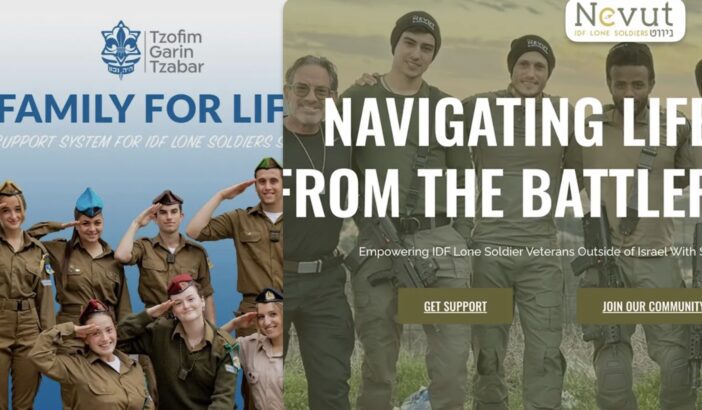
These efforts were organized by Nevut, a New York-based charity supporting American “lone soldiers” who sign up for the Israeli military. Among its upcoming events is a wellness retreat to Panama for lone soldier veterans who served in the Israeli military during its ongoing genocide in Gaza, which has killed more than 58,000 people — nearly half of them children — according to Gaza’s health ministry. Other estimates put the death toll at 80,000 or higher.
Nevut, which operates across 22 states, is one of at least 20 U.S.-based charities directly funding lone soldier programs. Since 2020, according to The Intercept’s analysis of their tax forms, these organizations have spent over $26 million to recruit and support lone soldiers from initial drafting to reintegration. The groups provide subsidized apartments, therapy, wellness retreats, and equipment to Israeli military units.
The Intercept reviewed five years of tax documents that show 2023 was the most lucrative year on record for lone soldier programs. After Israel began calling up hundreds of thousands of reservists in the wake of Hamas’s October 7 attack, U.S. donors poured funding into the organizations. Each year from 2002 to 2020, between 3,000 and 4,000 lone soldiers served in the Israeli military, about a third of them from North America. Since October 7, 2023, it is estimated that 7,000 lone soldiers from the U.S. alone have either signed up or returned to Israel to serve.
The programs have helped to prop up an Israeli military now facing its biggest recruitment crisis in decades. As Prime Minister Benjamin Netanyahu drags the assault on Gaza through its second year, civilians have protested his government and soldiers have refused to show up for reserve duty. With an estimated 100,000 Israeli soldiers refusing service, volunteers from the U.S. and other countries provide reinforcements. Last year, the Israeli military estimated that at least 23,000 American citizens were currently serving, a combination of lone soldiers and Americans who immigrated to Israel with their families.
On social media, Nevut and other organizations post pictures, videos, and testimonies from lone soldiers serving in Gaza. Earlier this month, Nevut promoted a video advertising a day at a shooting range as “a little dose of enjoyable fire.” A man wearing military tactical gear says: “All the guys here serve in the IDF; a majority serve in the war in Gaza.”
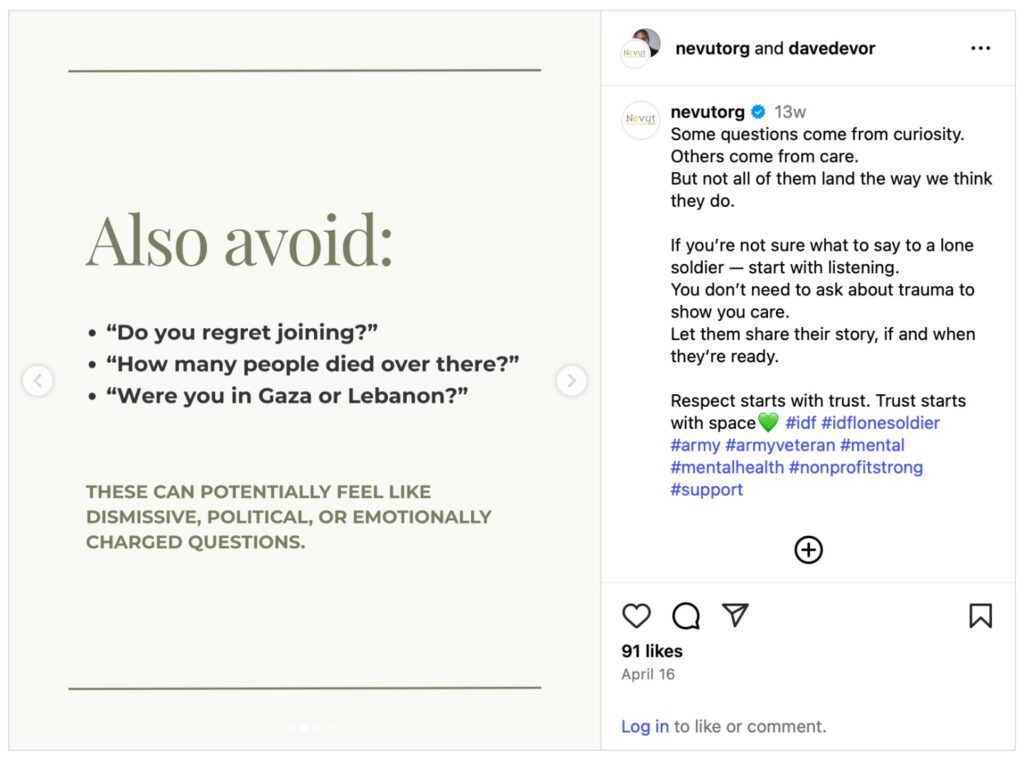
Another Instagram video encourages lone soldier veterans to reach out if they’re thinking of going back into combat. One Nevut post advises viewers on “What not to ask a lone soldier,” including: “Did you kill anyone?” “How many people died over there?” and “Were you in Gaza or Lebanon?”
“These can potentially feel like dismissive, political, or emotionally charged questions,” the post warns.
While the United States’ steady supply of weapons shipments to Israel has come under scrutiny from elected officials to the United Nations, thousands of U.S. civilians who travel to Israel to join the army have received markedly less attention. Back at home, American lone soldiers do speaking tours to cleanse the reputation of the Israeli military.
“I almost died for Palestinian children,” said lone soldier Eli Wininger at an event in an Alabama church put on by the Massachusetts-based lone soldier organization Growing Wings. A Los Angeles native, Wininger has touched many sides of the lone soldier ecosystem: He was recruited after taking part in the youth scouts program Garin Tzabar, served with the Israeli military in Gaza, returned to the United States, and recently started a volunteer position as a youth leader with the U.S. nonprofit Friends of the IDF. Speaking at the Growing Wings event earlier this year, he said he was instructed “not to kill Palestinian children. There is not a single soldier in there that is doing that.”
According to the U.N., over 50,000 children have been killed or injured in Gaza since October 7, 2023 — though this is likely an undercount.
Wininger did not respond to The Intercept’s request for comment.
In response to questions on lone soldiers and the army’s affiliation with U.S. nonprofit groups, the IDF told The Intercept it had “no comment.” Neither Nevut nor Growing Wings responded to The Intercept’s requests for comment.
Federal law prohibits recruiting for foreign armies within U.S. borders, but it allows donations and promotion of foreign volunteering. Where, if at all, efforts to help American teens join the Israeli military run afoul of U.S. policy on foreign fighting is hard to determine, experts say.
“The State Department basically says on the website that we don’t want Americans serving abroad,” said David Malet, an associate professor of justice, law, and criminology at American University who researches foreign fighters. “But realistically, we know it’s kind of hard to enforce that.”
A State Department spokesperson said U.S. citizens serving in the Israeli military are not required to register their service with the U.S. government. Dual citizens must comply with the laws of both countries of which they are a citizen, including any mandatory military service. The department said U.S. citizens are encouraged to consult current travel advisories for Israel, the West Bank, and Gaza. (It recommends that people reconsider their travel to Israel and the West Bank, and not travel to Gaza.)
“Our embassies overseas maintain rough estimates of U.S. citizens in their countries for contingency planning purposes, but these estimates are imperfect, can vary, and are constantly changing, which is why we do not generally disclose them publicly,” a State Department spokesperson said in a statement. “U.S. citizens are not required to register their travel to a foreign country with us, so we cannot track with certainty how many U.S. citizens are in any particular country.”
The State Department referred questions about legal implications of serving in a foreign military to the Department of Justice. DOJ referred questions to the Department of Defense, which referred questions to U.S. Citizenship and Immigration Services. USCIS referred questions back to the State Department.
Across the Jewish diaspora and in Israel, lone soldiers are receiving more recognition than ever.
“I’m definitely aware of increased numbers of volunteers which are welcomed in Israel right now,” Malet said. “You can see a lot more recognition and efforts to honor fallen lone soldiers than you would have seen before October 7.”
The pipeline
Becca Strober was hailed as a hero when she returned to the U.S. while serving as a lone soldier in Israel. As she walked around her father’s synagogue in Philadelphia in 2009, the congregants stood up to shake her hand and thank her.
“I had just finished guarding a West Bank settlement,” said Strober, now an anti-occupation activist. “Even then, I was like, this is such a weird experience.”
Strober was first introduced to the possibility of joining the Israeli military when she was 17, during a high school semester she spent in Israel. She said alumni of the semester in Israel program wearing miliary uniforms spoke to her group. “There were a lot of informal ways of talking about enlisting in the army,” Strober told The Intercept.
She later joined after participating in the Garin Tzabar program, which runs two major drafting sessions each year. The program is funded by Tzofim, the biggest Zionist youth movement in Israel and the U.S. Also known as the Friends of Israel Scouts, the group has a U.S. nonprofit in New York.
Tzofim “begins educating kids at five years old,” said one former Zionist youth leader in Australia, who requested anonymity for fear of professional retaliation. He took part in groups affiliated with Tzofim as a teen. “There is a direct funnel from educating toddlers to, as soon as they turn 18 — they’re of military age and they’re indoctrinated and groomed and brainwashed, and they’re ready to fight the battle.”
Garin Tzabar continues to recruit lone soldiers from the U.S., who often end up serving in combat in Gaza and “protecting civilians” in the West Bank — where Israeli settlers and forces have killed 1,000 Palestinians since October 7, 2023.