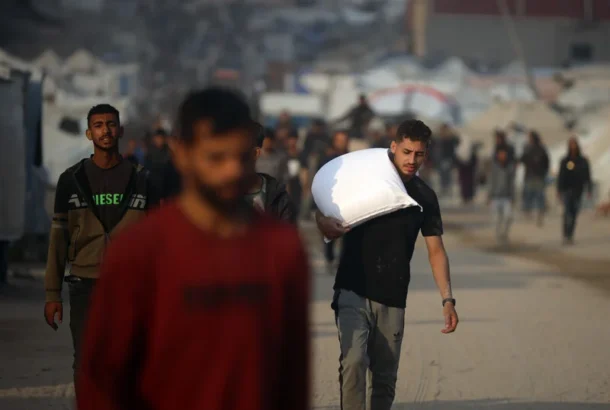
“I couldn’t move fast, so the truck had run over my foot,” one Palestinian said. “I could barely breathe, as people were stepping on my head.”
By Khaled Al-Qershali, Reposted from Electronic Intifada, April 20, 2026
The al-Nabulsi roundabout southwest of Gaza City was once known as a hub for gatherings and a spot to grab a piece of knafeh Nabulsia, a crispy and chewy pastry with cheese and nuts.
The roundabout itself, once called al-Shamalakh, was even renamed al-Nabulsi in 2013 after a popular sweet shop in the area. The shop was established by two Palestinians, originally from Nablus and Hebron, who had been freed in the 2011 Gilad Shalit prisoner exchange.
Yet, after 29 February 2024, the al-Nabulsi roundabout is now known for being the site of a massacre in which Israeli forces killed at least 118 Palestinians and injured 750 more. That day, just 400 meters south of the roundabout, as thousands gathered to await aid trucks in the pre-dawn hours, Israeli forces opened fire on the crowds of starving people.
Despite the Israeli military’s statement that their soldiers had merely targeted “suspects” and that the remainder of the killings were due to a stampede, a subsequent investigation confirmed the “full involvement” of Israel in perpetrating what came to be known as the Flour Massacre.
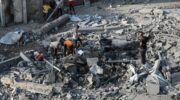
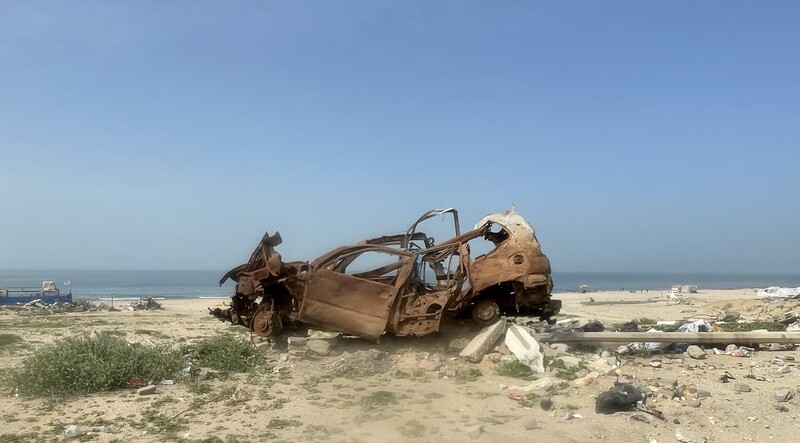
On a visit to the site by The Electronic Intifada this year, the seaside roundabout was quiet but scarred. The al-Nabulsi sweet shop was long gone, replaced by cracked pavement, twisted metal and the wreckage of burned-out cars that survivors of the massacre hid behind to escape bullets.
Amid the destruction, residents of the area have started to return, pitching their tents beside the rubble of their homes and trying to rebuild their lives. Yet the area will now be remembered as the site of the Flour Massacre, when bread became equated with blood.
Here are the testimonies of survivors from that day.
Khalil al-Shorbassi
Khalil al-Shorbassi, 29, was a pharmacist before the genocide. He lived with his 10-member family in the al-Tuffah neighborhood of Gaza City, though Israel destroyed the family’s home on 12 October 2023.
“I remained in northern Gaza because I did not have any place in the south,” al-Shorbassi said. “When I lost my home, I went to my sister’s home in Gaza City.”
In mid-October 2023, Israel issued an evacuation order for the 1.1 million Palestinians living in northern Gaza – an impossible task.
“When I wanted to evacuate south, the road was dangerous,” al-Shorbassi said, “and many individuals were killed in the Israeli checkpoint between the north and the south.”
Al-Shorbassi stayed in the north, where conditions deteriorated beyond what many could have imagined.
In early 2024, Israel intentionally starved northern Gaza through its near-total blockade on aid.
“It was not like the famine we experienced [later] in 2025, in which flour was available but at unimaginably high prices. In the 2024 famine, flour was completely nonexistent in the whole of northern Gaza,” al-Shorbassi said.
“People searched for animal feed to bake and eat.”
Al-Shorbassi explained that, at the time, when an aid truck arrived, it was the only way to obtain food.
“I was forced to risk my life and went to the aid trucks to bring food for the children. I could understand famine and bear fasting, but what could I say to the children if they wanted a piece of bread?”
On 28 February 2024, al-Shorbassi heard from friends that aid trucks would be entering the north. That afternoon, he went with them to wait for the trucks, which would not be arriving until the next day.
He said that thousands of people had gathered near the roundabout. He waited for hours, uncertain if the trucks would arrive or not.
“When it became dark in that freezing weather, people searched for wood to set up fires and gathered to warm themselves,” he said.
“I gathered with some people near the fire for a few minutes to warm myself and then moved forward.”
On 29 February, around 4 am, al-Shorbassi decided to leave, as no trucks had appeared on the horizon, but then he heard people shouting that the trucks had arrived.
“Knowing that the trucks had finally arrived after all the suffering I had been through, I decided to move forward more and more,” he said. “As it was my first time [getting aid from a truck], I asked some people around me about what would happen, and they told me that the occupation forces would shoot at the sky, as a sign for us to go back so the trucks could move forward.”
When the aid trucks moved forward, the shooting began, yet al-Shorbassi stayed put, as he assumed that the shooting was not directed at people but at the sky.
Yet when he saw bullets striking people and heard them screaming, he ran and took cover. Others were lying on the ground next to him, and one man was shot.
“I decided to jump and run to the seashore, hoping it would be safe there.”
Al-Shorbassi headed toward the sea, but he discovered that nowhere was safe; several more men alongside him were shot by Israeli forces. He again changed direction, hiding behind piles of rubble along the street, only to see an Israeli tank about 100 meters away.
“I ran along with the people around me, around 15 individuals,” he said. He even ran through a fire on the ground, burning his hands and feet.
“I did not feel anything because of the adrenaline.”
During the massacre, al-Shorbassi had forgotten about the aid. He only wanted to survive. Then, he saw a truck and approached it.
Someone in the back threw him a bag of flour.
“While I was grabbing the flour bag, I looked around to find a way to return [home], but the shooting resumed.”
Al-Shorbassi fell to the ground and the truck began to move. As he crawled away from the truck, to avoid being run over, he lost the bag of flour.
“I couldn’t move fast, so the truck had run over my foot,” he said. “I could barely breathe, as people were stepping on my head.”
He escaped the crowd and realized he could barely walk. He returned to his family with nothing, and they took him to one hospital after the next, but they were all entirely full with people who had been shot or maimed in the massacre.
Finally, at Al-Sahaba Medical Complex, he learned his foot was broken.
He reflected that if it had been hard pavement instead of sand under his foot when the truck ran him over, it could’ve crushed his foot to a point beyond healing.
Al-Shorbassi now lives with his family in al-Tuffah and has vowed never to return to any aid truck.
Abdullah Naim Abu Aser
Abdullah Naim Abu Aser, 22, worked as a chef before the genocide. In February 2024, he was living in the al-Rimal neighborhood of Gaza City. He refused to evacuate to southern Gaza.
“I didn’t have any place or relatives in the south, and I couldn’t afford the skyrocketing transportation costs,” he said, mentioning that it could cost up to $1,500 to transport one’s family and belongings south.
Abu Aser was not married, but he was part of a large nine-member family.
“Rent prices for houses were exorbitant if any were available, and tents were scarce throughout the Gaza Strip,” he said.
His dominant memory of the time was hunger, both his and his family’s. He said that any time he heard of aid – minimal as it was – entering the Strip, he would seek it out for his family. He estimated that he went out to aid trucks at least 15 times but had only succeeded twice in obtaining food.
He said that he had seen shootings and killings at aid sites, but that what he saw at al-Nabulsi was “unforgettable.”
Around 9 pm on 28 February, Abu Aser and some friends headed on foot to the roundabout, where he had heard that aid trucks would pass to enter northern Gaza.
Abu Aser said that the road from Al-Shifa Hospital, where he was taking shelter at the time, to the roundabout, was dangerous because of the relentless bombardments.
Realizing that they were headed toward the area where Israeli control was centralized was “terrifying beyond words,” Abu Aser said.
It was after midnight when Abu Aser arrived at the roundabout, where hundreds if not thousands of people had gathered.
He said that when the aid trucks arrived, he heard shooting.
“The shooting was not in the air,” he continued. “I saw more than 10 individuals shot, torn apart [from bullets] and covered in blood right in front of me.”
Despite what he had seen, Abu Aser continued to approach the truck and managed to get a 25-kilogram bag of flour.
He walked back to Al-Shifa and arrived around 6 am, but he did not find his friends there.
“I returned but my friends had not,” Abu Aser said. “Whenever I remember my dear friends, I feel guilty for surviving.”
Abu Aser could not bring himself to speak further about the friends who were killed that day.
“I can never see flour as something ordinary, as it was mixed with my people’s blood. The occupation used it as a weapon against us. Flour had never been more expensive; the occupier had never been more contemptible.”
Muhammad Ayman Shallah
Muhammad Ayman Shallah, 17, was in high school in October 2023. Like hundreds of thousands of other children and teenagers in Gaza, he was unable to continue his education, as Israel destroyed or damaged an estimated 97 percent of schools.
In the early months of the genocide, Shallah had tried to evacuate south from the Shujaiya neighborhood of Gaza City, but he was not willing to risk his life at the checkpoint.
“I heard that the Israeli occupation forces were stopping people who were evacuating south and sometimes killing them, so we remained in northern Gaza,” Shallah said.
“Whenever I called my relatives, they advised me not to evacuate, as the situation in southern Gaza was dire, with people living in tents.”
Shallah had gone out to obtain aid for his six-member family several times, but he described the famine of February 2024 as being one of the hardest moments.
Two days before the massacre at the al-Nabulsi roundabout, Shallah had traveled to the roundabout with his father, uncle and cousin to try and obtain aid. They had waited all night for the trucks and sat by a fire for warmth, but they returned home empty-handed around midnight.
“When we arrived home, we heard from our relatives that the trucks arrived and people got aid, so we went again the next day.”
On 28 February, around 11 pm, Shallah again went to al-Nabulsi hoping to obtain flour.
“The bombardments were heavier and the weather was colder that day, and I had not eaten for days,” he said.
He remembered that as he walked to the roundabout, Israeli drones and quadcopters were a constant presence.
“I arrived near the al-Nabulsi area at around 12:30 am, but there were hundreds of people there.” He said he tried to move around the crowds to have a better chance of getting flour.
Shallah said that he saw a quadcopter firing at people around 3 am.
“The shooting was from everywhere,” he said, “so when I found a burned car or a sand dune, I hid.”
He saw several individuals dead on the ground. He was afraid to help anyone, as he would certainly be shot himself.
“Because of severe starvation, there were people who went near the Israeli tank to increase their chances [of getting aid],” he said.
“I saw a man screaming as a bullet had – his hand, it had turned it to pieces. But no one helped him.”
Shallah’s father sent him and his cousin home while he remained, along with Shallah’s uncle.
They walked home, but when the sun rose around 5 am, they headed back to the aid site.
“When I arrived, the ground was covered in blood and the shooting had not stopped,” Shallah said. “I searched for my father and uncle but couldn’t find them.”
Only his uncle returned home around 8 am, and he reported that he had been separated from Shallah’s father in the chaos.
“After waiting, I went to Al-Shifa Hospital, looking for my father between the martyrs and the injured,” he said.
“When I could not find my father, I was shocked and thought of the people who were killed near the Israeli tank, and how no one could rescue them.”
Shallah’s father returned home later that morning.
“The moment I saw my father, I told him that I would rather starve to death than go to the aid trucks.”
Shallah said that he understands the true value of flour now.
“I haven’t thrown out any piece of bread since the beginning of the genocide,” he added.
Shallah remembers the massacre as if it happened yesterday.
“I would still be afraid of [a repeat of the massacre] these days, as the situation has not changed. The Israeli occupation would violate the ceasefire agreement anytime.”
Khaled Al-Qershali is an English graduate working as a journalist in Gaza.
RELATED:
- Israeli Soldiers Killed Gaza Aid Workers at Point Blank Range in 2025 Massacre: Report
- Compliant aid: Who are the Israel-approved NGOs scaling up in Gaza?
- Eyewitness says American subcontractors at Gaza aid sites fired at Palestinians
- 100+ NGOs’ joint statement: Israel must end weaponization of aid to Gaza
- The New York Times Repeated Israeli Claims of Hamas Stealing Aid Without Evidence