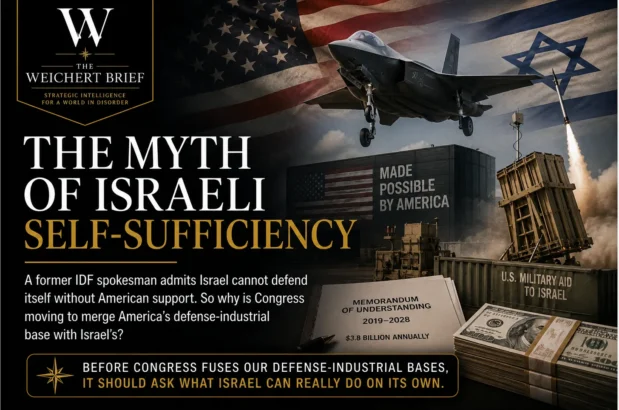
Israel’s most celebrated military technologies depend heavily on American funding, research, and industrial support. What, precisely, does America actually get in return?
By Brandon Weichert, reposted from Brandon Weichert’s Substack, June 24, 2026
Jonathan Conricus is the former spokesman for the Israeli Defense Force (IDF). Recently, he spoke at the Jerusalem News Service (JNS) 2026 International Policy Summit, which went from June 21-23.
At that summit, he stunned audiences with this claim:
“I am wary of Israeli politicians campaigning, saying, ‘We are going to be independent of the US.’ I humbly think that is a reckless thing to say because, Israel, I don’t think that Israel can defend itself using Israel-made platforms. We don’t make F-35s. We don’t make any of the “Effs.”
And for over 30 years, we have been limited from having a totally independent military industry. And if we are honest, the Israeli economy and our ability to produce heavy goods, like the ones you would need in military affairs, just aren’t there. It may be there in the future, but to speak about it now as if that is something achievable before we sign the next [Memorandum of Understanding] with the US, that is not realistic.”
Conricus’ remarks ran counter to a popular narrative in Washington.
For many years, Americans have been told that Israel is a largely self-sufficient technological powerhouse whose innovations provide extraordinary benefits to the United States. Yet one of Israel’s most prominent former military spokespeople is openly acknowledging that Israel remains dependent on American platforms, American industry, and American support.
If that is true, then Congress should carefully examine the assumptions underlying proposals to integrate the American and Israeli defense-industrial bases further.
For too long, those in favor of unfettered Israeli aid have not been entirely honest in their claims that Israel does not really benefit from its extremely close alliance with the United States. Per these voices, US aid to Israel accounts for only one percent of Israel’s total Gross Domestic Product (GDP). Israeli Prime Minister Benjamin Netanyahu has even highlighted the vulnerabilities that relying too much on the US for aid has made Israel vulnerable to.
Yet, the numbers don’t pan out.
According to the Council on Foreign Relations, Israel is the largest cumulative recipient of US foreign aid since the Second World War, having received over $300 billion in total economic and military assistance (adjusted for inflation). The US and Israel currently operate under a ten-year Memorandum of Understanding (MoU) covering 2019-2028, which guarantees Israel $3.8 billion annually.
That includes, by the way, $3.3 billion per year in Foreign Military Financing (FMF), as well as $500 million annually specifically for missile defense systems.
There is also the increased emergency US military aid that the United States Congress has passed multiple times, providing billions of dollars in additional funding for air defense and weapons procurement. In fact, since the 10/7 Hamas terror attacks against Israel, the United States Congress has delivered or approved massive arms shipments to Israel worth an estimated $17.9 billion.
Writing on the CATO Institute website, Jon Hoffman assessed that “A special relationship with Israel does virtually nothing for the United States while actively undermining the U.S. strategic interests and often doing violence to the values that Washington claims to stand for.”
The US-Israeli Technology Relationship
Circling back to Conricus’ comments at the recent JNS conference, Israel’s close alliance with the US military confers upon it what Israeli military planners refer to as “Qualitative Military Edge” (QME) over its regional adversaries, allowing it to deter threats from hostile threats and non-state actors.
Meanwhile, Washington provides serious political cover, especially at the United Nations Security Council, where it often uses its veto power to block resolutions condemning Israel.
At that same JNS conference, one of the other speakers regaled the audience with how Tel Aviv got the Trump administration to sanction the UN Special Representative who publicly criticized Israel. In fact, the Trump administration even went after her husband by getting him fired from his job at the World Bank.
The US does not really do that to any UN officials, even those who have besmirched the United States.
But Conricus’ statement at the JNS conference made something plain: whatever braggadocio Netanyahu and the Israeli political establishment want to engage in about how well Israel can stand on its own militarily and economically, the fact remains that this country cannot stand on its own. It depends on access to the US defense industrial base (such as it is), the US intelligence network, American know-how, and trade with the US, not to mention foreign aid.
Remove that support, irrespective of what official sources say, and the nation-state of Israel cannot survive. It can’t make a comparable plane to the F-35. But the Turks can. It can’t create a high-technology industry without major buy-in from the US financial sector as well as support from American universities and tech firms in Silicon Valley. Everything it does is an augmentation of technologies innovated or conceived of here in the United States at some point in the last 30-40 years.
The technology issue is the biggest factor to consider here. That’s because Congress is desperately fighting to pass Section 224 of the National Defense Authorization Act (NDAA), which would effectively fuse the US high-tech and defense industrial bases with those of Israel.
Let’s consider the most well-known Israeli technology. The Iron Dome and related air defense systems. We are told that the Israelis created this technology and shared it with the United States. In fact, it was the other way around.
Brandon Weichert is a former congressional staffer and geopolitical analyst who occasionally serves as an expert for various organizations.
RELATED:
- US-Israel integration in NDAA is far from ‘America First’ – Joe Kent
- U.S. Whole-of-Government Takeover by Israel
- Senate wants to force US to share sensitive intel with Israel
- What would happen if US actually cut off military aid to Israel?
- The Disappearing Aid Check: The Future of US–Israel Defense Support