ISRAELI MEDIA: The Jewish Ku Klux Klan Has a Calculated Plan for the Palestinians
By Amira Hass, reposted from Haaretz, June 15, 2026
Be aware that for every news report that you read about an act of settler terror, the Jewish Ku Klux Klan is carrying out dozens more acts of assault, harassment and bullying, while the army attacks and abuses Palestinians in dozens of neighborhoods and checkpoints to protect the KKK and its missions.
Be aware as well that these so-called rampages are part of a calculated, multi-pronged plan. Their ultimate goal is a land “cleansed” of Palestinians (in German, that already sounds clichéd). There is a direct line between the events of today and the violent takeover of Palestinian lands and springs by settlers in the 1990s and early 2000s.
Similarly, there is a connection between the apathy back then and the fatalism of today, as if the rioters are a biblical swarm of locusts and we are helpless against them. Perhaps the fatalism at least testifies to the fact that some are shocked, rather than delighted, by our hardy pioneers, who remind us of the great-grandfather from an Anita Shapira biography.
Remember that behind every man with a mask, weapon and tzitzit stands a normative society, warm and loving. It comprises of local settlement councils, rabbis, social workers and synagogues. Its warm embrace comes in the form of donations, the provision of herds, and water and support with logistics that enable hundreds of so called rotten apples to take pleasure in abusing the elderly, the young, and children, and then to squat on their land and infest the homes of the owners they’ve evicted.

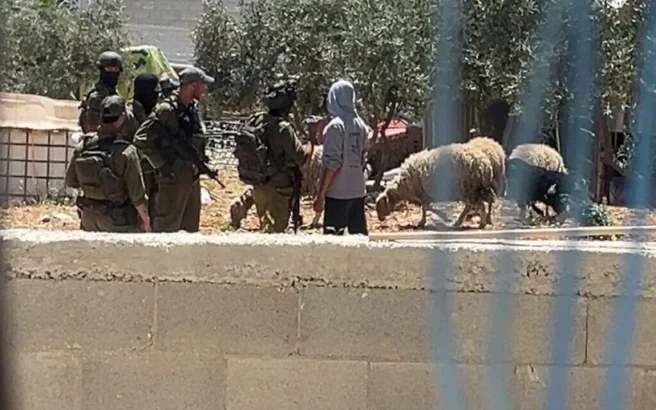
Do not forget that behind every attack, act of destruction and theft of sheep, there are police officers who do not bother to answer calls for help, and soldiers who rush to the scene to arrest those under attack and join in the beatings, if not killing. And behind everything, there is a glorious legal system – prosecutors and judges – who never knew, saw or heard what was happening around them, while legalizing the abomination called settlements. They sit at home and mourn (or not) for Israeli democracy, and are content with its Jewish part, with their grandchildren, the promotions and pensions.

Please refresh your memory: Every shepherd community that these dark, ultra-kosher forces managed to expel had struggled for decades with the “legal” prohibition against living with dignity that Israeli governments put in place. Civil Administration officials prepared the demolition orders for every new tent or renovated cave dwelling, every connection to water and electricity or installation of solar panels.
They signed off on fines for the offense of transporting drinking water in a tanker, using a tractor and grazing their herds. These former officials sit in their homes and mourn (or not) for Israeli democracy, but are proud of their children who go on to “meaningful and value-based” army service which means the killing of many Palestinians and Lebanese.
And regarding the WhatsApp groups of hilltop jugend shouting “gevalt” over the few among them who have been arrested by the police, or over a fraction of an outpost that was destroyed for the eighth time and will be rebuilt tomorrow: behind every person known to have been arrested are dozens of bone-crushing bandits who fall into the category of “no suspects found.”

When you drink beer, or work on research that examines the impact of global warming on the color of butterfly wings, or plan your trip to Rome, choose which watermelon to buy, fill up your bus pass or get quietly angry at your boss at work – what you don’t want to know is indeed happening.
Moment by moment, even if our media refrain from reporting it, and the world is preoccupied with other matters, Israel continues its war of annihilation in Gaza. Or rather, in about a third of the 365-square kilometers of the Strip that the state representing the victims of the Holocaust and its survivors allows two million living-dead to stay in, at a density that only the devil could create.
The living-dead walk kilometers between growing piles of trash and stinking puddles of sewage to bring home water. They walk on crutches and one leg waiting for a coupon from the World Food Program that will keep their families alive, and take their daughters to a makeshift clinic, perhaps there they will know what to do about the fleas, the ticks and the rat bites. As they play music, write poetry, or plant mint and beans among the tents, dozens of their dead loved ones cry out from the ground. And in between, the living are slaughtered by more Israeli bombs.

Pretend you are surprised: The Jewish KKK is hoping for a Palestinian reaction to their violence to advance its goal – a campaign of mass killing of Palestinians in the West Bank, and then a campaign of deportation of the living to Jordan, Syria or Lebanon. The Blue-and-White KKK knows full well that the Palestinians are afraid, shocked and angry.
Their hands are tied, and they are alone. Both of their unelected leaderships are concerned with their own survival. No country has issued the appropriate ultimatum to Israel: Stop the pogroms and arrest the perpetrators, now, or we will ban Israelis from our countries and halt all trade and scientific collaboration.
The KKK is waiting for some Palestinians who have personally been assaulted, or have seen their loved ones assaulted, or for young people unable to bear the helplessness in the face of so much evil to get weapons, money and advice from Iran to organize and take revenge on the Israelis. The weeds (as they are termed by other settlers) are waiting for a stone to cause a bus full of children to roll over.
And then the majority of the people of Israel will be united with the heroes of the KKK and the army, which will carry out most of the killing and deportation, because after all, we were attacked. We are the victims.
*Additionally*
ISRAELI MEDIA: Israeli Settlers Turn Seized Palestinian Land to Tourist Attraction Using Stolen Water
By Matan Golan and Nir Hasson, reposted from Haaretz, June 15, 2026
Despite military officials’ objections, Israeli settlers diverted water used by Palestinian farmers, seized an archaeological site in the West Bank’s Jordan Valley and filled an ancient pool to turn it into a tourist attraction, backed by members of the Israeli government.
Around two weeks ago, young settlers from the Jordan Valley area began arriving at an ancient pool near the settlement of Petza’el. They carried out cleaning and informal renovation work at the site and diverted water, likely from infrastructure serving the nearby Palestinian village of Fasayil, to refill the pool.
Once filled, the site was turned into an informal tourist attraction, with hundreds of visitors arriving over the weekend. In settlers’ WhatsApp groups, volunteers were urged to come, work at the site and remain there overnight. Mass prayers began to be held near the pool.
All activity at the pool was carried out without authorization from the staff officer for Archaeology in Israel’s Civil Administration – Israel’s governing body in the West Bank – who is responsible for archaeological sites in the West Bank. Organizers later thanked Heritage Minister Amichay Eliyahu for his assistance.
Despite this, the effort continued to expand and was framed by organizers as a grassroots environmental and recreational initiative. Organizers portrayed the takeover as a campaign to “restore” the site and maintain water flow, calling for a sustained presence to prevent what they described as “theft of water from nature.”
In one message circulated in a settlers’ group, organizers wrote: “Understand that we have a golden opportunity, by being present all hours of the day, especially from early morning, to keep the water in this amazing pool and bring about the rehabilitation of the entire area.”
“We have a gem here in the heart of the Jordan Valley that almost all parties, especially council head David Elhayani and Heritage Minister Amichai Eliyahu, want to rehabilitate and develop, as well as the entire area. Everyone who can should come to hike, visit, and especially camp near the pool starting tomorrow morning,” it wrote.
Petza’el is a moshav and Israeli settlement in the West Bank, located in the center of the Jordan Valley,
The settlers refer to the site as “Herod’s Pool.” The Petza’el area does contain a water system dating back to the Herodian period, and it is mentioned in the writings of the first-century historian Josephus Flavius. However, according to archaeologist Alon Arad of the organization Emek Shaveh, it is more likely that the pool now being used is not Herodian but rather a later-period water storage installation.
Because the site has never been fully excavated, its precise dating remains uncertain. It is, however, a declared archaeological site where any work requires a permit from the staff officer for archaeology. Experts also warned that flooding the structure could damage potential archaeological findings.
Arad said the fact that organizers publicly thanked the Heritage Minister reflected a serious institutional failure.
“It is inconceivable that a minister who has been echoing for four years the settlers’ false campaign about the institutionalized destruction of heritage sites by Palestinians – a campaign used as the basis for attempts to establish a new heritage authority in the territories – is now leading the institutionalized destruction of a site that has never been investigated, to create an attraction for his settler friends, since it is clear that these attractions have no audience in Israel except among settlers,” he added.

The Jordan Valley Regional Council said in response that the council “is not involved in filling the pool in Fasayil. These are all private initiatives. Petza’el Pool is not within the jurisdiction of the Jordan Valley Regional Council.”
The Coordinator of Government Activities in the Territories (COGAT) issued a statement in response to Haaretz’s request for comment, saying that according to the existing arrangements in the area, the waters of the Fasael Pool were diverted for agricultural use in the surrounding areas.
“Recently, a report was received about damage to the regulated water infrastructure in the area and its connection to Herod’s Pool, without authorization or coordination with the area’s authorities,” it added. “Following this, professional bodies are working to assess the situation and regulate the water flow in accordance with the law and the binding agreements.”
The Palestinian landowner told Haaretz in an interview that settlers arrived on his agricultural land about a year ago and cut irrigation pipes.
“We have springs on land we have owned for many years, and we use them for agricultural irrigation,” he said, adding that he holds formal ownership and title deeds. “There is also an ancient Roman pool on our land.”

He said that about two weeks ago, settlers destroyed a water pipeline and diverted the flow to fill the pool. “Now we have no water,” he said. “They diverted the water, they are swimming in the pool, they put up Israeli flags and opened a tourist site for settlers, and they do not allow anyone to approach the area or repair anything.”
He added that the Civil Administration recognizes his ownership of the land, and that the Coordination and Liaison Office confirmed this as recently as last week. “They said we could go fix the pipe tomorrow morning, but I know that if I fix it tomorrow, they will cut it the day after tomorrow, so we are suffering from this situation now. These settlers are dangerous.”
*Additionally*
As Israeli settler violence against Palestinians intensifies, settlers are increasingly and brazenly attacking and stealing livestock that many families and villages rely on.
By Aseel Mafarjeh, reposted from Zeteo, June 15, 2026
(The Israeli daily Ha’aretz has covered many incidents of settlers attacking Palestinians’ animals. Some of the stories referenced here can be found in the paper.)
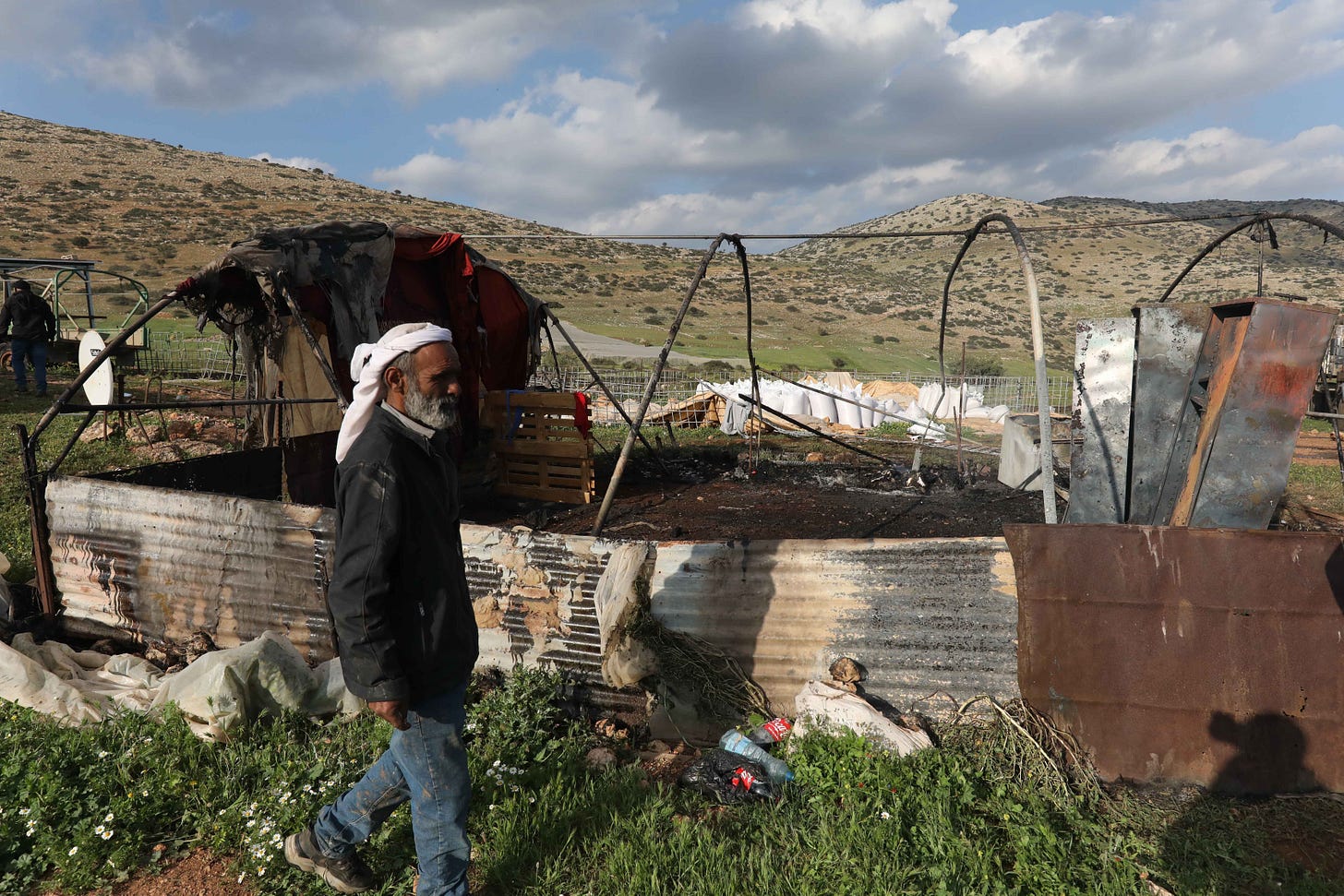
RAMALLAH, occupied West Bank – The morning Khalil Abu Ghanam ran toward his pen in al-Samu, south of Hebron, he already knew what had happened from the color of the smoke – Israeli settlers had set a fire to the enclosure. By the time he arrived, 75 goats and sheep were dead, charred inside the structure he had built as he expanded his herd, animal by animal, over the years. Security camera footage captured the attack, residents say.
Abu Ghanam did not just lose livestock. He lost the income that kept his family on their land. Today, he lives a hollowed-out version of his previous life, with nothing left to do but to start over – and slowly build his herd again.
It’s a position more and more Palestinians are finding themselves in. Across the West Bank, attacks on Palestinians’ animals – sheep, goats, horses, guard dogs – have become a documented feature of Israeli settler violence. Two videos last month – one of a settler beating a dog named Lucy and another of a settler running over sheep with his ATV and beating a shepherd – went viral. But such cases often receive less international attention than attacks on people. Still, they serve the same purpose: making Palestinian life on Palestinian land unsustainable.
The timing of many attacks is not accidental.
In Masafer Yatta, south of Hebron, Mohammad Abu Ali walked out to his pen on the morning of Eid al-Adha to find the locks cut and between 45 and 50 sheep gone, along with the guard dogs that protected them. Eid al-Adha, the Festival of Sacrifice, is the single most important occasion in the year for families who raise livestock. The animals stolen were the ones his family had raised to sell for the holiday.
He sat outside the empty pen. The loss was not only financial, though years of work had disappeared in a single night. For families in these communities, the ability to perform the Eid sacrifice is bound up with dignity, continuity, and the ability to live as a family on ancestral land.
Al-Baydar, an organization that monitors settler attacks on Bedouin and rural Palestinian communities, documented the theft of more than 12,000 heads of livestock across the West Bank in 2025, and approximately 1,500 more in the first months of 2026.
At an estimated market value of $400-$850 per animal, the losses from 2025 alone amount to $4-10 million. For many of the affected families, the animals were their only source of income.
Two Videos, 48 Hours Apart
In mid-May, two incidents were filmed and shared online within 48 hours of each other. Together, they reached audiences far beyond the occupied West Bank.
On May 15, a masked settler entered the village of Atara, north of Ramallah, where an illegal outpost had been established on the village’s land the previous year. In the yard of a Palestinian resident, he found Lucy, a guard dog tied to a post, and beat her repeatedly with a club.
The owner, who requested anonymity for fear of reprisal, told Haaretz: “She wasn’t loose, she didn’t attack him or bite him. He attacked a tied-up dog.” Lucy survived and is being treated by Palestinian veterinarians. Israeli police opened an investigation, and a settler was subsequently arrested, though no indictment has been confirmed. The arrest itself was unusual. Charges for settler violence against Palestinians are very rare.
Two days later, on May 17, a settler driving an ATV with a bull skull mounted on its front ran his vehicle into a flock of sheep in Khirbet al-Tawil, east of Aqraba near Nablus, trapping two animals beneath the wheels. He then stepped off the vehicle and beat the Palestinian shepherd who had been filming. The footage was published by Al Jazeera. Police say they are investigating. No arrests have been reported.
Residents of Khirbet al-Tawil said the incident was not a surprise. The area has long been under pressure from surrounding settler-pastoral outposts. Salah Bani Jaber, mayor of Aqraba, said livestock are being targeted directly to force residents to leave. “When you destroy a source of income,” he told me, “departure becomes a logical outcome, not a free choice.”
A Pattern
Human rights organizations, including Al-Haq, Yesh Din, B’Tselem, and the UN Office for the Coordination of Humanitarian Affairs, have documented livestock theft and attacks on shepherds as part of a broader strategy to pressure Palestinian communities off their land.
Amir Daoud, documentation director at the Anti-Wall and Settlement Commission, told me that “pastoral Palestinian communities have become a primary target because they represent guardians of Palestinian land. Targeting their animals and their shepherds is part of an effort to erode the capacity to remain.”
In Sinjil, north of Ramallah, settlers attempted to drive off a flock at the edge of town. Residents mobilized immediately. Dozens of people moved toward the surrounding hills where settlers were trying to move the animals away. Mayor Moataz Tawafsheh said the community understood the theft was not only the owner’s problem. “The attackers are not stealing animals,” he told me. “They are targeting the sources of livelihood that people depend on to stay on their land.” Some of the sheep were recovered.
In Ein Yabrud, northeast of Ramallah, Mohammad Hajeer lost three horses to theft over several months. When he tried to recover one of them, approximately 14 settlers beat him while taking the animal. He could not get help; the village entrances were blocked. He said he has no intention of leaving. “Staying has become another form of resistance,” he said.
According to the UN humanitarian office, OCHA, more than 760 settler attacks were documented in the West Bank in 2026 as of early May, an average of six per day, killing at least 13 Palestinians and displacing nearly 2,000 people, including 900 children.
The videos of Lucy and the sheep in Khirbet al-Tawil are unusual not because the violence they show is new, but because they produced visible documentation that traveled internationally. Israeli police opened investigations into both. The gap between documentation and accountability is what human rights organizations say enables the pattern to continue.
Yesh Din’s data covering 2005 to 2025 shows that almost 94% of investigation files related to settler violence against Palestinians were closed without conviction or effective legal accountability. The rate of indictments remains negligible relative to the number of complaints filed.
Last month, Israeli Finance Minister Bezalel Smotrich watched as 3,000 Palestinian-planted trees were uprooted to expand settlements, and said: “We are building the Land of Israel and destroying the idea of a Palestinian state.”
For the families in al-Samu, Masafer Yatta, Atara, Khirbet al-Tawil, Sinjil, and Ein Yabrud, that statement describes what they have been forced to witness and contend with every day.
Amira Hass is the Haaretz correspondent for the Occupied Territories. Born in Jerusalem in 1956, Hass joined Haaretz in 1989, and has been in her current position since 1993. As the correspondent for the territories, she spent three years living in Gaza, which served of the basis for her widely acclaimed book, “Drinking the Sea at Gaza.” She has lived in the West Bank city of Ramallah since 1997.
Matan Golan (b. 1988) is an Israeli freelance photojournalist and reporter. She graduated M.A studies in IPSD (International Planning & Sustainable Development) in Urban Resilience (DRR) and environmental policies pathway from the University of Westminster in London with distinction.
Nir Hasson is Haaretz’s Jerusalem correspondent, while also covering archeology and the climate crisis. Among other things, Nir is covering the humanitarian crisis in the Gaza Strip during the war that began on October 7, 2023, while also following the Nir Oz community.
Aseel Mafarjeh is a field journalist interested in human interest stories.
RELATED:
- UN experts alarmed by escalating settler terror and displacement in West Bank
- The Gaza family torn apart by IDF snipers from Chicago and Munich
- Israel’s former defense minister compares settler ideology to Nazism
- ‘Help Me, the Settlers Are Coming’: Armed With Clubs, They Beat a Palestinian Father and His Boy
- Oxfam: More Palestinians killed by Israel across West Bank in last 3 years than previous 17 years combined