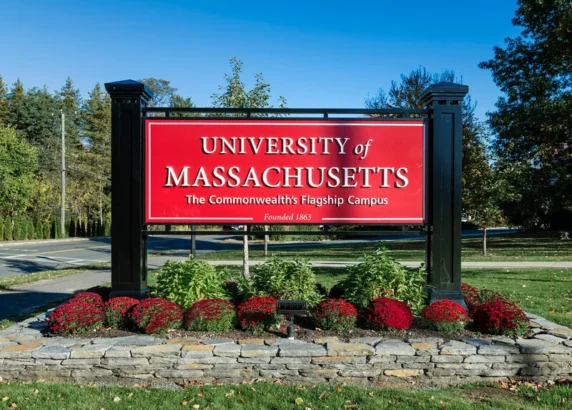
Two years after a brutal crackdown on encampment protests against Israeli genocide, the University of Massachusetts has cut the only Modern Standard Arabic course. The university has also effectively fired an Iranian lecturer and Palestine activist, which he believes was politically motivated.
By Chris Brady, reposted from Electronic Intifada, July 24, 2026
Times are tough for the academy.
The message from Washington has been clear: the college campus is a new political battleground. Comply or lose federal funding.
Student activists, the Gaza encampments, sympathetic faculty – anyone at the university who is perceived as advocating for Palestinian rights has put themselves at significant risk. University of Massachusetts Amherst (UMass) has remade itself in anticipatory compliance with anti-war repression.
Two years after a brutal encampment crackdown, the university has cut the only Modern Standard Arabic course. The university has also effectively fired an Iranian lecturer and Palestine activist, which he believes was politically motivated.
Now, that lecturer Mohammad Ataie – who works in the UMass history department – is suing. His case could set a precedent for Palestine in universities nationwide.
UMass Amherst cut the four-skilled (speaking, listening, reading and writing) Arabic program prior to the spring 2026 semester, citing low enrollment.
Immediately, students and faculty questioned the move.
Arabic is being singled out. Courses in languages such as Catalan and Polish remain unscathed.
Students were left reeling.
Shaheed Abraham was in his third-year of taking Arabic at UMass, and is interested in learning the language to pursue a career in social work for Arab communities in his hometown. “The cancellation of the program is heartbreaking and infuriating at the same time … I personally feel like my university is indirectly pushing anti-Islamic and Arab rhetoric. I am feeling like UMass is less and less of a place for me and other Muslim and Arab students.”
Rüya Hazeyen is a UMass Arabic alumna who doubts the university’s fiscal justification for cutting the language. “Arabic is one of the world’s most spoken languages, but lesser-spoken European language courses remain on the books. The decision to eliminate teaching such a globally significant language is difficult to defend or justify as a necessary educational choice rather than a political one.”
The university maintains that students can still take Arabic courses, including a Quranic Arabic course through the Judaic and Near Eastern Studies department and a course at nearby Smith College, which has an agreement with UMass to allow for mutual course enrollment. A bus ride between UMass and Smith College takes about 40 minutes, one-way.
However, Quranic Arabic is fundamentally different from the modern, spoken Arabic language course that the university cancelled. A student seeking to communicate with Arabic-speaking populations has no path to fluency at the state’s flagship public university.
“When you have an Arabic instructor who teaches about Arabic literature, brings in Arab voices into the classroom, for the university to cut that class and allow other classes with similarly low enrollments to keep going,” said Kevin Young, a professor of history at UMass. “That should raise concerns.”
“Cruel and absurd”
Students argue that the Smith College option is no real replacement. Eric Ross, a history PhD candidate, described it as “a cruel and absurd response to a situation the university itself has created.”
“For students without a car, the university’s solution is to tell them that, despite already demanding schedules, they should spend hours each day commuting by bus to take a course that has long been offered at UMass and should continue to be.”
The university defended the measure, arguing that budget cuts forced its hand. Faculty and staff unions have countered that UMass Amherst had run an approximately $100 million budget surplus for three years in a row.
But the cancellation did not happen in a vacuum. The same administration that eliminated the only program capable of producing fluent Arabic speakers also moved to block the hire of a qualified modern Middle East historian.
As Kevin Young, the history professor, put it, budget uncertainty has become “a catch-all excuse for any spending decision” the administration wants to make, and it has made no shortage of them.
Lecturer Mohammad Ataie is one of the latest casualties of proactive hypercompliance under the guise of fiscal discipline at UMass Amherst. A historian of the modern Middle East, Ataie taught general education courses, a class on the 1979 Iranian Revolution and “the history of Palestine and Israel.”
An immigrant from Iran, formerly a documentarian and correspondent at the United Nations, his classes were well-rated.
In November 2024, the UMass history department posted a tenure-track faculty position for history of the modern Middle East.
Ataie is employed as a non-tenure-track lecturer at the department. After encouragement from colleagues he applied for the position in the last few months of 2024.
The process for hiring tenure-track faculty is rigorous. After a full year of references and interviews, involving hundreds of hours of labor from the hiring committee of faculty in the department and a nationwide search, the committee invited four finalists to campus.
Ataie ranked second.
According to a history department faculty member and a close observer of the search committee, “The first finalist that was offered the job declined it, and then the standard practice would have been to offer it to finalist number two, which was Mohammad.”
That offer never came. During 2025, the university’s provost froze searches for a number of posts, including the one Ataie had sought, citing budgetary uncertainty. The federal government withheld a substantial amount of funding from UMass following Palestine solidarity protests on campus.
The freeze landed around the time Ataie would have received his offer.
The faculty union, and Ataie, were left in the dark. Eventually, a dean at the university replied that the search had been “failed” for unstated reasons.
A new search was reauthorized, and the process would have to start all over again.
Ataie’s complaint, filed with the Hampshire Superior Court, notes that “on or about October 3, 2025, the chair [of the history department] denied that the search had ever been ‘paused’ or ‘postponed,’ and stated that it had actually been ‘cancelled’ and had to restart from the beginning.”
“Subsequently, on or about November 19, 2025, the dean wrote that the search was not paused or postponed or cancelled, but actually had been ‘failed’ for unstated reasons such that it ‘cannot be unpaused’ and must be restarted from scratch,” the complaint adds.
This was a significant discrepancy of facts.
The word “failed” also carries a specific meaning in academic hiring: a search fails when no suitable candidates are found. That was not the case.
The provost had preapproved offers to all finalists. The department was unified behind its candidates.
As one search committee observer put it, “We had done the search. It was successful. We had candidates that we wanted to hire, and then they told us we need to redo the search altogether, which is a completely nonsensical decision, unless there’s some kind of ulterior motive at play here.”
“What is your religion?”
The timing of what happened next is difficult to ignore.
In May 2025, amid the original hiring process, Ataie taught a “history of Palestine and Israel” course.
One student filed a complaint with the university, arguing that Ataie had discriminated against her and that his course contained anti-Semitic content.
When investigators finally interviewed him in September 2025, the questions they asked were remarkable.
According to Ataie’s complaint, these questions included, “What is your religion? Are you devout? Where were you born? What did you do in the Middle East? Have you ever criticized the Israeli government in class? In your teaching, did you intend to demonize Jews?”
He was also asked to prove that Israeli sources appeared on his syllabus, which they did.
The complaint noted that the interviewer informed Ataie that the complaint typically would not have required a formal investigation in the past, but was a consequence of the federal government’s hyperfixation on Israel on college campuses.
The investigation dragged on for six months before concluding in December 2025 with a finding of no misconduct. By then, the damage to Ataie’s standing, and to the chilling effect on faculty who observed the process, had already been done.
With the added context of the four City University of New York professors fired in 2025 for Palestine solidarity activism, faculty attest that UMass Amherst contributed to a political culture of fear.
The history department organized and pushed back hard. In a department-wide vote, 94 percent of history faculty, staff and graduate students voted to offer the position to the candidate next in line from the original search, meaning Ataie.
Over two-thirds of faculty and graduate students wrote a letter to the dean requesting that the original search be reinstated. Faculty attempted to pursue alternative hiring methods to offer Ataie the position.
The dean and provost ignored each effort.
A new search committee was convened, mostly with new members.
The new members were largely critical of Ataie’s political views, and they were in the minority of faculty who voted in favor of starting the new search committee. Ataie reapplied anyway.
The new search committee declined to interview him.
The academic community took notice. The Committee on Academic Freedom of the Middle East Studies Association sent a letter to the provost and dean raising concerns that the university’s actions “may have violated proper university procedure and principles of faculty governance” and that “political considerations may have been involved.”
Daniel Chard, a history professor at Western Washington University and a UMass history graduate, wrote directly to the department: “I find the decisions of the UMass administration and the history department chair on this matter to be profoundly distressing not only because it occurs in the context of a national attack on bedrock principles of American higher education, but more personally, because of the serious, lasting reputational damage it may inflict upon the UMass history department.”
Chard’s letter quoted Ellen Schrecker, a fellow historian, who had argued that repression of Palestine activism on campuses had become “worse than McCarthyism” – witch hunts against Americans accused of being under communist or Soviet influence in the 1940s and 1950s.
But the university administration wasn’t done yet. Ataie was informed that all the courses he was supposed to teach in the spring were denied.
The courses canceled included an introductory history class (known as History 131) on the modern Middle East, which according to one history department faculty member, “has been taught virtually every year for probably the last 40 years uncontroversially. It’s a standard offering as part of the curriculum.”
After sustained student pressure, the university acquiesced to allow Ataie to teach History 131 and a graduate seminar.
One history department faculty member speculated that the blowback made administrators realize that the cancellation was a budding liability risk.
“There was a recognition within the administration that the dean had overstepped by canceling History 131 because it should have just been approved as a matter of routine. I think there was fear that her decision could become grounds for a legal complaint against the university so they acted to reverse that decision.”
Courses on “Palestine and Israel” and the Iranian Revolution remained canceled, as they have been at universities across the country.
According to Radhika Sainath, the litigation director at Palestine Legal – a legal aid firm for the Palestine solidarity movement – UMass Amherst’s anti-Palestinian repression isn’t unusual.
“It’s not surprising. There is a real McCarthyite environment in the United States right now,” she said.
Sainath has experience with UMass.
In 2024, she led a complaint under Title VI of the 1964 Civil Rights Act, alleging anti-Palestinian racism at the university.
Despite the credibility of the investigation, the Trump administration scrapped the division inside the Department of Education responsible for much of its civil rights work.
But Sainath argued that universities “are terrified” of losing funding due to Donald Trump’s pro-Israel ideological push in higher education. Sainath noted that the push follows a pattern set before 2024 – when Joe Biden was still president.
Sainath said that compliance with these mandates sidelines the intended missions of the modern university.
“Universities are obligated to follow the law,” she said. “They cannot fire professors on the basis of their viewpoints in support of Palestinian rights. They need to ask themselves: what do you want your legacy to be?”
Mohammad Ataie is teaching one summer course at UMass, but is effectively terminated.
The position he was next in line to receive has been filled by someone else. The university proceeded with that hire after a judge recently ruled against Ataie’s application for an injunction to keep the position open for the duration of the lawsuit.
The case will go before a jury in a later hearing.
The outcome of this lawsuit will have far-reaching consequences beyond Massachusetts, for academic freedom and Palestine in a university setting.
Chris Brady is an editor of Working Mass and an alumnus of UMass Amherst.
RELATED:
- Cornell Submits to Trump’s pro-Israel ‘Extortion’ Over Student Protests
- University of Michigan using undercover investigators to surveil student Gaza protesters
- Students around the US on hunger strikes to protest Israel’s killing & starvation of Gazans
- After crushing dissent, U.S. universities are deepening ties with Israeli academia
- How Hillel International uses antisemitism training and ‘campus climate’ concerns to attack Palestine solidarity
- How Universities Used Counterterror Intelligence-Sharing Hubs to Surveil Pro-Palestine Students