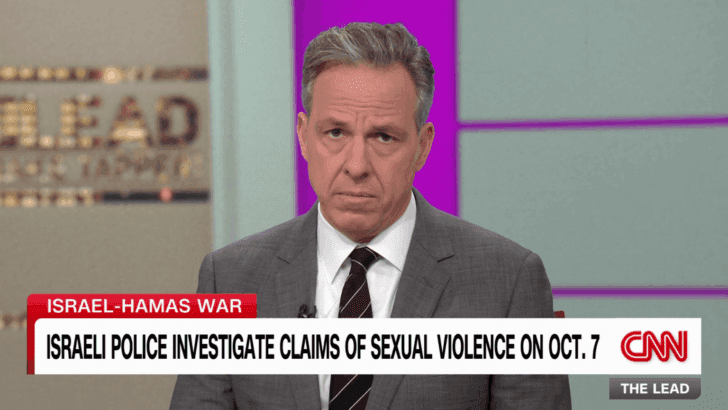
Jake Tapper and other mainstream U.S. media figures will wax poetic about free speech, but they ignore when advocates for Palestine are targeted, or even jailed, for speaking out.
By James North, Reposted from Mondoweiss, October 04, 2025
The other evening, the prominent U.S. cable newsreader Jake Tapper said something on a late-night talk show that was circulated widely and approvingly in the mainstream media. Tapper, commenting on the Trump administration’s (eventually unsuccessful) effort to remove comedian Jimmy Kimmel’s show from the airwaves, said the move was “the most direct infringement on free speech that I’ve seen in my lifetime.”
Tapper’s viral comment and its widespread approval in mainstream circles are terribly misleading. Since October 7, 2023, people who spoke out for Palestinian human rights and against Israel’s genocidal campaign in Gaza have been jailed and, in some cases, threatened with deportation for their words alone. But even earlier, the government repressed people in America solely for what they said. Here’s just one major example; there are legal penalties in a majority of American states to even advocate for the nonviolent movement for Boycott Divestment and Sanctions (BDS).
What’s encouraging, though, is that a Reagan-appointed federal judge has just issued a blistering opinion that rejects the Trump administration’s efforts to deny First Amendment rights to non-citizens. Judge William G. Young, on September 30, ruled against “the administration’s efforts to systematically silence noncitizens in academia who protested in support of Palestinians.”
Over the past few years, mainstream media figures like Jake Tapper have insufficiently reported on these serious government “direct infringements on free speech.” And yet there can be no doubt that Trump’s assault on the First Amendment has frightened ordinary people, and surely stifled free debate.
Let’s recall just one example of government repression, of a 30-year-old student at Tufts University named Rümeysa Öztürk. On March 26, six plainclothes officers rousted her on the street, arrested her, and jailed her for the next 7 weeks. Why? She (and 3 others) had written an article in the Tufts student newspaper calling for the university to divest from companies that had ties to Israel, and to recognize “Palestinian genocide.” Ms. Öztürk has not planned or advocated violence, and has written nothing that could even be distorted into a charge of “antisemitism.” She is not an American citizen, but under Judge Young’s ruling, she is still supposed to be protected by the First Amendment.
But since then, how many foreign students and other U.S. noncitizens have kept quiet because of fear?
What’s more, not all threats to free speech about Palestine have come directly from the Trump administration. Kori Davis, who works at PEN America, an organization supposedly devoted to protecting free speech, posted at this site last March that his superiors first interrogated him about views he put on the organization’s listserv channel, and then fired him! Davis’s posting on a private listserv channel is hardly the equivalent of comedian Jimmy Kimmel’s national TV audience, but his views were still stifled.
But it is arguably the longstanding successful campaign to squelch discussion of BDS that has had one of the most sinister impacts on freedom of speech. Pro-Palestinian voices have been smeared for decades as dangerously pro-violence, and BDS’s strong nonviolent approach is surely part of the reason Israel’s defenders here in the U.S. have fought so hard to suppress any discussion of the proposal.
So far, 38 states have passed anti-BDS legislation. Its advocates say the laws don’t inhibit freedom of speech. But the highly respected American Civil Liberties Union disagrees. The ACLU says that anti-BDS laws are designed to discriminate against disfavored political expression, “which is why two federal courts and several prominent First Amendment scholars have agreed that these laws violate the First Amendment.”
James North is a reporter for Mondoweiss.
RELATED:
- Western media’s pre-existing condition? Gaza atrocity denialism
- How Western media helped turn Israel’s genocide into ‘fake news’
- 22 Months of Complicity: Why The Media Suddenly Changed Its Mind On Gaza
- ‘Israel Doesn’t Want Journalists on the Ground’: CNN’s Jeremy Diamond on the Fight to Enter Gaza
- TikTok investor: ‘Embed the love and respect for Israel’ in the US