Genocide does not require mass graves; it also includes efforts to destroy a people’s capacity to bring the next generation into being.
Israel’s systematic use of torture and sexual violence against Palestinians meets that definition.
It is difficult to fully describe all the ways genocide reverberates through Palestine over the decades, in a way that does justice to the land and martyrs whose deaths were the price paid for the world’s indifference and dehumanization of Palestinians. But what is clear is the simple fact that Palestinians are nothing more than objects of torture to Israelis in every way torture could be prescribed.
For just one example, Israel built the only military prison in the world designed for children, children who are held arbitrarily and in contradiction to the tenets of “law,” children who are beaten, tortured, and starved on a regular basis. I think of the Palestinian toddlers whom Israeli soldiers torture and burn to elicit confessions from their fathers. I think of Walid Ahmad, a seventeen-year-old who starved to death in Megiddo Prison, returned to his family with almost no muscle or fat remaining.
But even beyond Israel’s systematic assault on Palestinian children, the ways Israel intimately uses sexual violence and rape against men, women, and children in their attempts to break them as people, to break the Palestinian people as a whole, might be the clearest example of their genocidal intent.
There is a long history of sexual violence against Palestinians, one that runs from before the state of Israel was established. As Nadera Shalhoub-Kevorkian, Sarah Ihmoud, and Suhad Dahir-Nashif show, “Rape and other forms of sexual violence against Palestinian women have always been an element of the settler colonial state’s attempts to destroy and eliminate indigenous Palestinians.” To Israel, Palestinian bodies have always been vulnerable.
Israeli historians, including Benny Morris, have documented proof of rape by Israeli soldiers and officers in at least twelve Palestinian cities and villages during the 1948 war. In some cases, soldiers raped Palestinian women upon occupying a village and then murdered them. Ben-Gurion wrote in his diary during 1948 about the rape and sexual torture of Palestinian women. But the full extent of those crimes has never been publicly revealed and may never be revealed since Israel destroyed much of the evidence of the early days of its settler colonial project.
The Israeli military later developed a formal practice, named in Arabic isqat siyassy, of using sexual threat and the exposure of sexual identity to recruit Palestinian collaborators and break organized resistance, and, on many levels, to the enjoyment of a perpetrator because psychopaths take pleasure in inflicting cruelty.
The UN Commission of Inquiry concluded in March and September of 2025 that sexual and gender-based violence has been used by Israel as a method of war, carried out under explicit orders or with the implicit encouragement of Israel’s top civilian and military leadership. Francesca Albanese, the UN Special Rapporteur, issued a report to the Human Rights Council this month, finding that Israel has imposed a continuous regime of psychological terror across the entirety of occupied Palestinian territory, one “designed to break bodies, deprive a people of their dignity, and force them from their land.” She found that torture, including sexual violence, constitutes evidence from which genocidal intent can be directly inferred.
The violation of Palestinian bodies and the seizure of Palestinian land have never been separate projects. The same permission that opens the land to theft opens the body to harm. Settlement and rape are not different acts but the same violence, unfolding across flesh and earth.
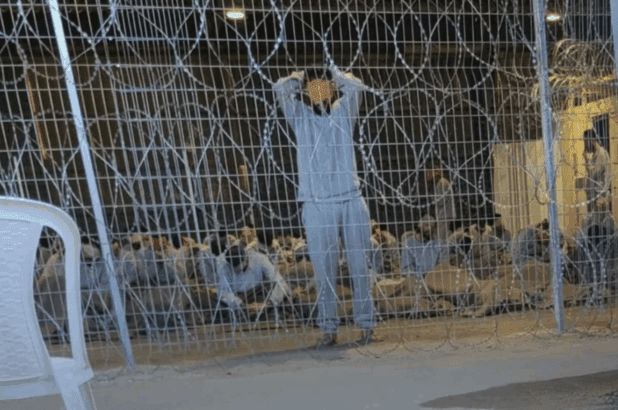
B’Tselem published testimonies from survivors of Israeli detention under their reports “Living in Hell” and “Welcome to Hell.” Tamer Qarmut, held at Sde Teiman, described being raped with a wooden stick, the guard pulling it out and forcing it back in, then pushing it into his mouth. Sami al-Sa’i, a journalist from Tulkarm held sixteen months without charge, was brought to a room at Megiddo Prison where guards held him down, blindfolded, and penetrated him with an object while they laughed and smoked cigarettes afterward. Other prisoners told him the guards called it the “reception party,” inflicted on arrival.
S.S., held at Sde Teiman, described soldiers beating him on the penis and tying it with a plastic cord until it bled. One detainee in the same facility lost a testicle. A detainee identified as J.M. described female soldiers grabbing his genitals during a forced strip search, squeezing until he screamed, and saying, “I’m going to rape you.” These are but a few of the harrowing stories of the over 10,000 Palestinians who have been taken into Israeli military detention since 2023.
In July 2024, five soldiers at Sde Teiman gang-raped a handcuffed, blindfolded Palestinian detainee with a sharp object. It ruptured his rectum, broke his ribs, and punctured his lung. The assault was filmed. In March 2026, all charges were dropped. Netanyahu welcomed the decision. A Knesset member declared anal penetration with a stick is completely legitimate.
Violence like this is meant to do more than break the body. It is meant to seek total domination over the body, and through it, the self; to make a person feel that there is nothing left of them that cannot be taken or destroyed. This is how genocide sustains itself over time. Not only through killing, but through the steady unmaking of a people’s sense of themselves.
And yet, Palestinians continue to live beyond what has been done to them. They share their stories, and their resolve for liberation becomes more steadfast. Palestinians, like all victims of oppression and manifestations of violence, are more than the cruel actions of the monsters who violate them.
The international legal community has already told us that sexual violence can constitute genocide. In 1998, the International Criminal Tribunal for Rwanda, in Prosecutor v. Akayesu, held for the first time that rape is an act of genocide when committed with the intent to destroy a protected group. The Trial Chamber recognized that sexual violence not only destroys an individual’s body. It destroys a group’s capacity for continuity. The psychological torment it inflicts is designed to make survivors not want to continue, not want to bring children into a world where this is what awaits them, not want to reconstitute the community that was targeted through their bodies.
The court found that this destruction of generational will, when it is deliberate and directed at a group as such, meets the definition of genocide under Article II of the Convention. The ICTY, in prosecuting criminals involved in the Bosnian genocide, confirmed the same standard in Doe v. Karadžić.
Genocide does not require only mass graves. Genocide requires only the deliberate destruction of a people’s capacity to continue through their bodies, their dignity, and their will to bring the next generation into being. What Israel has done to Palestinian bodies in its prisons and detention centers, systematically, under orders, on film, and without consequence, meets that definition.
This is what genocide looks like when it does not end in a single moment, but is carried through the body, again and again. Bombs and bullets announce themselves, but this violence is quieter, more intimate, and no less annihilating. It fractures a people from the inside, and that is precisely the point.
Ahmad Ibsais is a reporter for Mondoweiss.
RELATED:
- ‘We returned from hell’: Palestinian journalists recount torture in Israeli prisons
- Palestinian journalist recounts rape and torture in Israeli prison
- Israel Is the Global Rape, Torture Capital
- Electrocution, Waterboarding, Hallucinogens: UN-Expresses ‘Grave Concern’ Over Israeli Torture of Palestinians
- Israeli Human Rights Groups Tell UN That Israel Increased Use of Torture During Gaza War