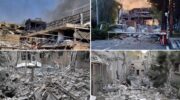
The Intentional destruction of cultural heritage sites is another arm of Israel’s genocide
Gaza City is home to landmarks such as the Church of Saint Porphyrius, the Great Mosque and Gaza’s al-Zawiya and gold markets.
These landmarks testify to Gaza’s archaeological history, religious significance and commercial heritage.
But throughout its genocide in the Gaza Strip, Israel has wreaked havoc on these places.
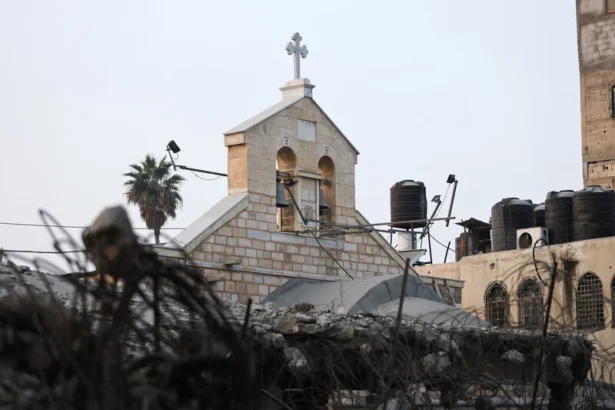
The Orthodox Church of Saint Porphyrius is located in Gaza City’s al-Zaytoon neighborhood, with roughly 20 Christian homes standing around it.
The church is believed to be the third-oldest in the world.
But its heritage and status as a place of worship didn’t deter Israel from bombing the church on 19 October 2023, targeting the church’s annex building and killing 17 Palestinian Christians who were sheltering there.
“It was the greatest catastrophe of our lives,” Fuad Ayyad, a Christian working at the church, told The Electronic Intifada.
“I can still see the faces and bodies of the martyrs I collected with my own hands, the children I buried myself,” Ayyad, 44, said. “It was the first time in our history that a church – a house of worship – was directly targeted.”
The Christian community sought refuge in Gaza’s churches during the genocide.
More than 400 sought refuge in Saint Porphyrius, while a few hundred meters away, the Latin convent, which comprises the Catholic Holy Family Church, sheltered around 500 others.
On 16 December 2023, an Israeli sniper fatally shot two Christian women while they were sheltering at the Holy Family Church.
On 18 July 2025, an Israeli artillery shell struck the Holy Family Church, killing three Christians.
Churches weren’t safe havens only for Christians.
The Saint Porphyrius Church, Ayyad said, was also housing Palestinian Muslims.
But “the Israeli army makes no distinction between a Christian or a Muslim,” Ayyad said.
The 19 October 2023 bombing, he said, killed another Muslim man who was sheltering at the church.
“The church lost its majesty, but it still carries the memory of coexistence and love,” Ayyad said, referring to the 2014 Gaza war when the church sheltered Palestinian Muslims during Ramadan, Muslims’ holy month, where they broke their fasts and worshiped god.
The Jewel of Gaza
Just meters away from the Orthodox Church, Israel destroyed the Great Mosque of Gaza.
On 19 November 2023, the Israeli army targeted the mosque, partially destroying its minaret. But on 8 December, the army rendered the mosque into a partial ruinous state after bombarding it again.
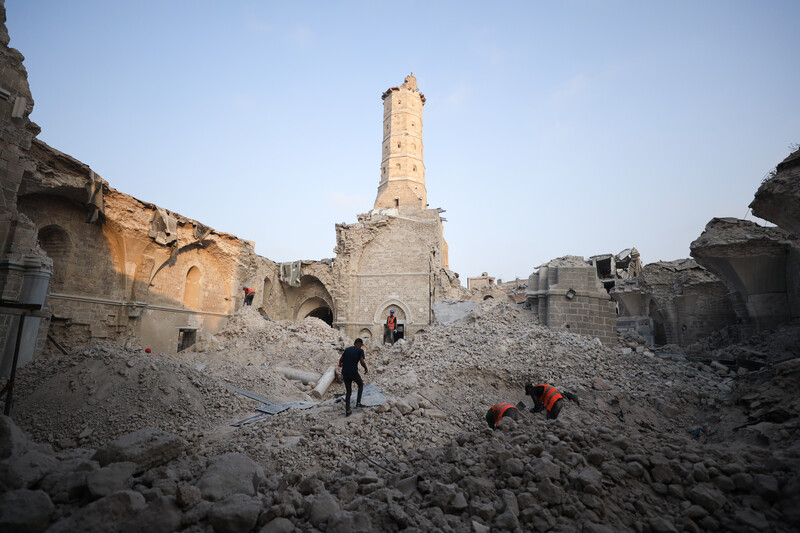
The Great Mosque – also known as al-Omari Mosque – is 1,400 years old and is named after the second caliph of Islam, Umar bin al-Khattab.
“They bombed it again … a hundred years after the British bombed it,” Tariq Haniyeh, a tour guide at the mosque, said, referring to when British artillery inflicted significant damage to the mosque in 1917 during the First World War.
Through 1926-27, the mosque was restored by Said al-Shawwa, Gaza’s first mayor.
The Great Mosque, Haniyeh said, was considered the jewel of Gaza for its religious significance, surpassed only by the holy Al-Aqsa Mosque in Jerusalem.
“We were deprived of Al-Aqsa, and amid this genocide, from the Hajj,” Haniyeh, wiping his tears, said of the annual pilgrimage to Mecca. “But nothing hurt more than seeing al-Omari Mosque fall.”
Despite the devastation, he and others have begun clearing the rubble and reopened the courtyard of the mosque for prayer.
“Even in ruins, it’s sacred ground,” he said of the mosque, of which only its minaret has been left intact, albeit with damage to the upper section.
The corner market
“The mosque is our soul,” Ahmad Haboub, 58, said.
“I know every inch of it – I’ve prayed there my entire life. As a boy, I climbed its roof and recited the [call for prayer] adhan from its minaret over 20 times.”
Ahmad works as a tailor in his shop at al-Zawiya market, which is adjacent to the Great Mosque.
“The market without the mosque is incomplete,” Ahmad said, whose family shop has survived three generations for 60 years.
“My father and grandfather ran this same shop, and my son and I are running it now.”
Growing up in al-Zawiya market since he was five, Haboub described it as “his life.”
“My shop, my home, my prayers – all were in this market,” he said. “Without it, I have no life.”
Since October 2023, the Israeli army has targeted al-Zawiya market multiple times by airstrikes and artillery bombardment, causing extensive destruction to several buildings and shops.
During the first weeks of the genocide, Ahmad fled south, but as soon as the roads reopened during the so-called “ceasefire” announced in January, he returned to Gaza.
Ahmad went back to al-Zawiya market and reopened his shop, which was intact.
But “people came to buy only what’s necessary – food, water,” Ahmad said.
The market was no longer lively as it used to be after being mostly destroyed.
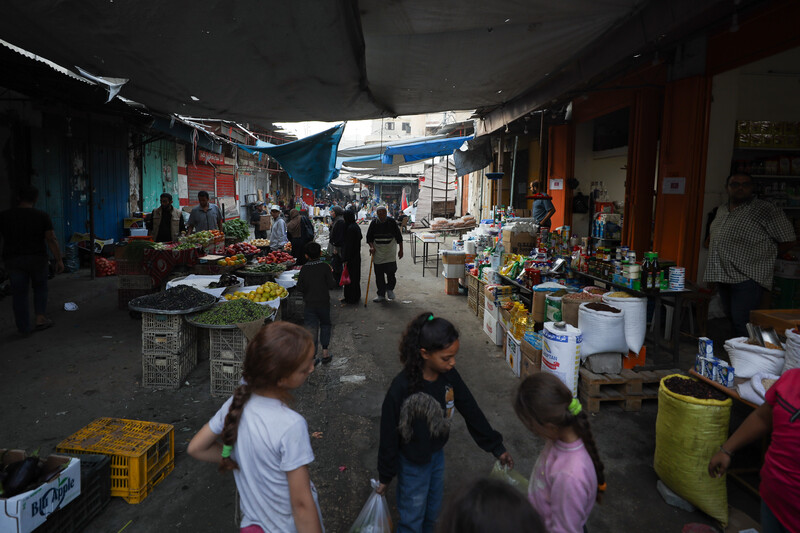
Abu Haitham Bulbul, a spice vendor in al-Zawiya market, pointed to the row of 15 shops on the eastern side of the market that were flattened.
“Seventy-five percent of it is gone,” he said.
Bulbul, 52, described al-Zawiya as a complete market that – before Israel’s genocide – included everything, being a cluster of submarkets: grain markets, spice markets and apothecary markets.
Al-Zawiya market, Bulbul said, is the “soul of the city” and the “meaning of civilization,” where losing it is to lose an “architectural and historical treasure.”
For 35 years, he said, he has been selling spices from his shop that wafted the narrowest corners of the market.
An architectural masterpiece
Al-Zawiya market comprises more than 1,150 submarkets spread across the corners of its alleys, from which it is believed the name zawiya – meaning corner – was obtained.
In one of the corners of al-Zawiya market, the gold market of Gaza City is located.
Also known as Qaysariyya – referring to the architectural form of industrial and commercial establishments in the Roman era – the gold market is believed to have been built in 1476.
Muhammad Haboub, 68 – the head of the goldsmiths guild – said that the market was deserted after the Nakba, the 1948 expulsion of the Palestinian people from most of Palestine by Zionist militias and later the Israeli state.
It was later turned into a shoemakers’ market, Muhammad said, and remained so until 1968, when Gaza’s economy began to recover, and the gold trade slowly emerged.
With Palestinians in Gaza allowed to work in occupied Palestine back in 1970, he said, the income in Gaza grew.
As there were no banks or stable currency, people began saving their money in gold, which transformed the gold market.
By the early 1980s, Muhammad said, it became Gaza’s central hub for jewelry.
“When I started in 1981,” Muhammad said, “there were only about 15 goldsmiths. The whole city relied on us and there was no other gold market in Gaza, not in the north, center or south.”
The trade flourished as gold was cheap, he said, where a gram of gold would cost only 5 Jordanian dinars back then.
More gold craftsmen joined through the years and renovations were made, and the market gleamed again by the 2000s.
“In 2023, it was more beautiful than any Arab market; it was such an architectural masterpiece – marble floors, soft lights, unified signs and golden reflections that illuminated the old city,” Muhammad said of the market that comprised over 120 jewelry shops.
When the genocide began, the gold market suffered considerable damage throughout, but most particularly on 4 July 2024, when the Israeli army bombed it, inflicting significant destruction and even damaging the nearby Great Mosque of Gaza.
Muhammad said that now “30 jewelry shops are completely destroyed or burned” while the traders are trying to repair their shops with their own hands.
“We have no support – only faith,” he said.

By February, Israel already either damaged or completely destroyed 95 percent of the historical heritage in Gaza, committing a cultural genocide.
According to a November satellite imagery analysis by the UN cultural organization UNESCO, Israel has damaged 145 cultural sites across Gaza since 7 October 2023.
For the people of Gaza, these cultural sites weren’t just landmarks or of mere archaeological value – they were a collective memory, a livelihood and a heritage passed from one generation to another.
Huda Skaik is a student of English and a journalist based in Gaza.
RELATED:
- How Israel Weaponizes Archeology
- Israel preparing largest ever act of ‘archeological cleansing’ in West Bank
- Digging for annexation: How Israel uses archaeology to erase Palestine
- ‘Tunnel vision’: how Israel is using archaeology to win US support for goals
- Israel’s attacks on Gaza bookshops are an attack on Palestinian culture