Subordinating scientific value to colonial expansion, Israeli archeologists are putting up no resistance as the state moves to expropriate swaths of Sebastia.
While residents of Sebastia, a Palestinian village north of Nablus in the occupied West Bank, huddled for an emergency meeting to discuss a new Israeli plan to seize significant parts of their village under the pretext of “developing” its archaeological site, Israeli archaeologists gathered in Boston for the 125th annual conference of the American Society of Overseas Research (ASOR).
Formerly the American School of Oriental Research, ASOR replaced the meaning of the letter “O” in its name in 2021 to ostensibly signal a shift away from archaeology’s colonial legacy and toward research based in equal partnership with local populations. For Israeli archaeologists, however, that shift appears largely cosmetic: As they attended the prestigious conference — their main arena for cultivating ties with the global academic community — their government was busy using archaeology as a tool for continued colonial control over Palestinians.
On Nov. 19, Israel’s Civil Administration announced plans to expropriate 550 of Sebastia’s private plots — approximately 1,800 dunams (450 acres) of land that have been central to the village’s livelihood, cultural heritage, and identity for centuries. Residents say the project will devastate local agriculture, including destroying some 3,000 olive trees, some of which are hundreds of years old.
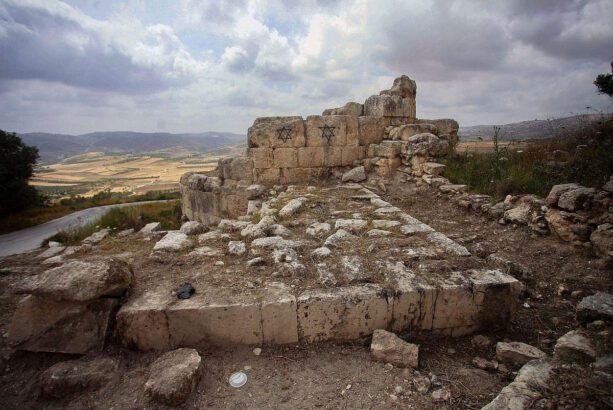
Sebastia is, undeniably, a multi-layered archaeological site of extraordinary value. Once the Iron Age city of Samaria, capital of the Kingdom of Israel, it contains remnants of King Ahab’s palace that were unearthed in the 1930s. In the first century BCE, King Herod of the Kingdom of Judea rebuilt the city, leaving behind a temple honoring his friend, Roman Emperor Augustus, near the older ruins. A well-preserved Roman theater, Byzantine church, and other antiquities have also been uncovered in the area.
But Sebastia’s archeological significance only sharpens the political contradiction at hand: While the site merits careful study, the gulf between the ethical commitments claimed by Israeli archaeologists and the state violence carried out in archaeology’s name to justify steps toward annexing the West Bank has never been more stark.

Israel’s takeover of Sebastia began in May 2023, when the government allocated NIS 32 million for the site’s “restoration and development.” The campaign escalated in July 2024, when the military seized the summit of Tel Sebastia (the village’s highest point, home to its most significant archaeological remains) citing vague “security concerns.” Soon after, the government signaled plans to take over even more of the village.
Palestinian residents — together with Emek Shaveh, the organization I direct — filed a formal objection with the Civil Administration, arguing that international law prohibits the use of cultural property for military purposes. The challenge was ultimately rejected.
Heritage Minister Amichai Eliyahu celebrated the expropriation online. “We will no longer hand over our inheritance to murderers,” he wrote on X last month. Eliyahu, a prominent advocate of West Bank annexation and Jewish resettlement in Gaza, added: “This is our historic homeland; we will never leave this place.”
Though the area currently targeted for excavation lies technically within Area C (under full Israeli control) and most of Sebastia’s built-up village falls within Area B (under Palestinian civil administration and Israeli security control), in practice the two zones form a single, continuous landscape. The village’s own antiquities are historically and culturally inseparable from those situated in Area C.
The new expropriation plan threatens to rupture that connection entirely. It envisions diverting Israeli visitors along a road settlers intend to build that bypasses the Palestinian village altogether, and includes constructing a visitor center, fencing off the archaeological zone, and charging entrance fees. If carried out, these measures would effectively cut Sebastia’s residents off from their land and heritage.
Archaeology in service of annexation
Israel’s use of archaeology to facilitate the takeover of Palestinian land — a practice that can aptly be described as “archaeological cleansing” — long predates Sebastia. For decades, the state has deployed this strategy both within the 1948 borders and across the West Bank: in East Jerusalem’s City of David park, in the village of Susya in the South Hebron Hills, in the Nabi Samwil national park, in Shiloh, and in numerous other sites.

Large segments of Israel’s archaeological community have abandoned core professional principles and ethical standards meant to uphold international law and protect cultural heritage. Many have collaborated openly with settlement leaders and Israeli enforcement authorities, providing both ideological cover and physical infrastructure for settlement expansion. As recently as last year, several local archaeologists attended a Jerusalem conference hosted by Heritage Minister Eliyahu, with some even accepting government-funded hotel accommodations.
The Israeli archaeological community has persistently refused to engage in any meaningful internal reckoning over the ethical implications of its work. For years, its scholars have ignored fundamental debates about where excavations can be legitimately conducted and under what conditions, despite repeated warnings, policy reports, and resolutions from major international bodies — including UNESCO, the UN Independent Commission of Inquiry, and the International Court of Justice — urging Israel to halt archaeological activity in occupied territories.
Against this backdrop, archaeology in East Jerusalem and the West Bank has long since forfeited its objective scientific value. The discipline’s commitment to studying the past to deepen human understanding has been subordinated to a political project of Jewish supremacy, in which archaeology is wielded as a tool of territorial control. Rather than defending the integrity of their field, many Israeli archaeologists have effectively become an extension of the state’s political apparatus.
In the lead-up to the ASOR conference, some international participants urged restricting the involvement of Israeli archaeologists in light of these practices. Similar debates have emerged in Europe, including within the European Association of Archaeologists (EAA), where some members proposed allowing Israeli scholars to participate only if they shed their institutional affiliations.
Rather than engaging with these substantive critiques, many Israeli archaeologists default to invoking antisemitism and framing themselves as perpetual victims. This attitude shuts out any meaningful discussion of the core ethical issues: the permissibility of excavating in occupied territory against the will of local communities and in violation of international law; the collaboration with settlement organizations; and the conditions under which ethical research in Israel might still be possible.

The dissonance between Israeli archaeologists presenting their work in Boston while participating in the appropriation of Sebastia illustrates why international colleagues are increasingly unwilling to collaborate with them. By disregarding international norms and aligning with those who weaponize archaeology for displacement and dispossession, they undermine their own scientific credibility.
The West Bank contains more than 6,000 known archaeological sites. Anywhere else, such wealth would be considered a cultural treasure. But for Palestinians, it has become a curse: Each site — the majority of which have no connection to Jewish history in the region — is treated as a potential tool for asserting territorial dominance. Sites that hold centuries of Palestinian history are destroyed either through systematic neglect or appropriation, then leveraged into an ideological project that threatens future Palestinian existence.
Archaeology has become yet another mechanism of oppression, alongside settler and military violence, movement restrictions, and daily dispossession. And while Palestinian communities resist with the few means available to them, Israeli archaeologists continue to legitimize and advance these forces.
If Israeli archaeologists wish to maintain their academic legitimacy — and, more importantly, cease participating in an unethical project of colonial domination — they must heed the warnings of their international peers and reject the state’s cynical exploitation of their profession.
Alon Arad is an archaeologist and the executive director of Emek Shaveh, an Israeli NGO working to defend cultural heritage rights and to protect ancient sites as public assets that belong to members of all communities, faiths and peoples.
RELATED:
- Digging for annexation: How Israel uses archaeology to erase Palestine
- ‘Tunnel vision’: how Israel is using archaeology to win US support for goals
- Israel used widely banned cluster munitions in Lebanon, photos of remnants suggest
- Israel destroys Gaza’s historical palace, with over 20,000 artifacts looted