Israel’s nuclear weapons program was secretly developed with financial and diplomatic support from the West. Its nuclear arsenal, estimated at over 90 warheads, remains a leading driver of conflict across the region.
By Anna Illing, Reposted from Mondoweiss, April 5, 2026
The current U.S.-Israeli war is the second war in less than a year declared by Israel and the USA, allegedly on the grounds of dismantling Iran’s nuclear capabilities.
While there is no documented evidence that Iran has a nuclear weapon or is close to developing one, there is another state in the Middle East whose nuclear arsenal exists as an open secret. That state is, of course, Israel, and its nuclear arsenal, although not officially recognized or confirmed, stands as one of the leading drivers of unrest throughout the region.
Israel’s history with nuclear weapons unfolded between secrecy, public tacit knowledge, and support, both materially and diplomatically, from the West, creating a playbook of strategic ambiguity around it still in place today.
At some point in the 1950s – it is impossible to pinpoint an exact date – David Ben Gurion, Israel’s first prime minister, launched the country’s nuclear project.
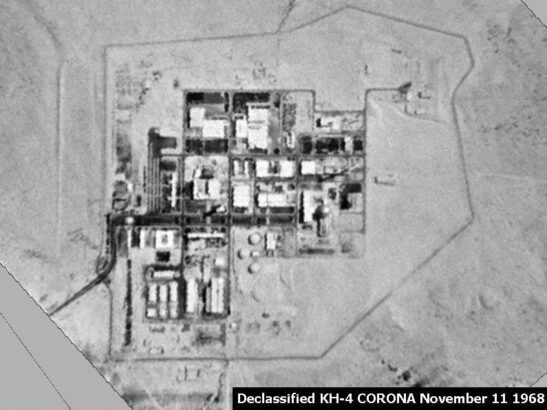
In the Negev desert, 152 kilometers from Tel Aviv and 90 kilometers from Jerusalem, out of indiscreet sight, the Shimon Peres Negev Nuclear Research Center, commonly referred to simply as “Dimona” complex, was built. Seventy years later, the facility is considered the most important pillar of Israel’s nuclear program, while officially it is a 26-megawatt thermal reactor.
To Israel’s aid in this mission came France who, according to historians, was seeking an alliance against Gamal Abdel Nasser, Egypt’s then-president.
Except for the French partner, everyone was kept in the dark about Dimona, including the USA. In December 1960 Ben Gurion reported to the Israeli Knesset that the Dimona reactor was “a research reactor” which would serve “industry, agriculture, health and science”.
Washington did repeatedly question the nature of Israel’s actions in Dimona, and US officials even inspected the site on eight occasions between 1961 and 1969.
What they found was Israel’s articulated and well-designed propaganda stage: some sections of the nuclear plant were concealed, others were carefully disguised, hiding their real purpose.
But in the meantime, it is believed – impossible to claim certainty – that Israel finished building its underground separation plant by 1965, that it was producing weapons-grade plutonium by 1966 and assembling a nuclear weapon before the 1967 six-days war. It is also believed that in September 1979 Israel and apartheid era-South Africa conducted a joint nuclear test, known as the “Vela incident” from the US VELA 6911 satellite that detected a common sign of nuclear blast: an unexplained double flash of light.
Beliefs turned into facts in 1986. Mordechai Vanunu, a former Israeli nuclear technician, had been an employee at Dimona for eight years when he disclosed to the Sunday Times details and photographs of the nuclear research center. From this evidence, it was discovered that Israel ranked as the world’s sixth nuclear power and possessed as many as 200 atomic warheads. For his act of whistle-blowing, Mordechai Vanunu was imprisoned for 18 years, 11 of which he spent in solitary confinement. He was released in 2004, but he is still banned from travelling or speaking to foreign journalists.
There was, however, someone who was not caught by surprise: the U.S. and UK governments, and, of course, France. In 1969, the then U.S. president, Richard Nixon, and Israeli prime minister, Golda Meir, reached a “nuclear understanding“: questions would not be asked if Israel maintained silence and vagueness around its capabilities and avoided testing its nuclear weapons. Explained in Henry Kissinger’s, then national security adviser, own words: “While we might ideally like to halt actual Israeli possession, what we really want at a minimum may be just to keep Israeli possession from becoming an established international fact.”
It took an extra twenty years for the rest of the world to know the extent of Israel’s nuclear programs, and another extra twenty, until 2006, for the documents exposing the agreement between Nixon and Meir to be declassified. Still, in 2009, when asked whether any countries in the Middle East possessed nuclear weapons, Barack Obama, who was serving his first term as president of the USA, said he would not speculate.
Similarly, in 2005, a BBC investigation revealed that Britain had secretly supplied 20 tons of heavy water to Israel almost half a century before. Heavy water is so called because it goes through a laborious electrolysis process, which results in the water containing extra neutrons. At the time of the sale, this type of water was fundamental to the nuclear reactor Israel was building with French help.
One of the world’s “worst-kept secrets”, as it has been called by some scholars, that for Israel results in the ability to maintain its military standing in the Middle East and simultaneously avoid scrutiny. On the other side, for the West, silence on the matter is harder to explain. Gary Samore, President Obama’s top advisor on nuclear nonproliferation from 2009 to 2013, presented one reason behind the secrecy: “For the Israelis to acknowledge and declare it, that would be seen as provocative. It could spur some of the Arab states and Iran to produce weapons. So we like calculated ambiguity.”
There has been an attempt by the UN General Assembly to call on Israel to allow international oversight of its nuclear facilities in December 2014. The resolution was adopted, 161 to 5, on the premise that Israel is the only Middle Eastern country and one of the three countries in the world that have never signed the Treaty on the Non-Proliferation of Nuclear Weapons, together with India and Pakistan. Most importantly, of the world’s nine nuclear powers – U.S., Russia, China, France, the UK, Pakistan, and North Korea – Israel is the only one that does not officially admit having nuclear weapons. UN resolutions are non-binding, so it kept being business as usual for Israel.
To this day, there are estimates of Israel’s nuclear capacity: 90 warheads; 750–1110 kg plutonium stockpile, approximately – potentially enough for 187-277 nuclear weapons; 6 Dolphin-I and Dolphin II-class submarines believed capable of launching nuclear-armed cruise missiles; and Jericho III intermediate-range ballistic missiles with a potential range of 4,800 – 6,500 km.
Globally, these numbers would make Israel the second-smallest nuclear power after North Korea, but just as seventy years ago when Israel began building nuclear weapons, it remains impossible to know anything for a fact.
As events unfolded through the decades, the Israeli government maintained its stance of neither confirming nor denying its nuclear efforts, with some key rhetorical strategies that stayed the same. In the ’60s, Israel pledged “not to be the first country to introduce nuclear weapons into the Middle East”, an often-repeated line, also by Israeli Prime Minister Benjamin Netanyahu in 2011. Again in the ‘60 the expression “the Samson Option” was coined, a principle by which Israel would resort to nuclear retaliation in defence from an existential threat. In fact, although they never admitted the existence of a nuclear program, Israeli leaders have affirmed that nuclear weapons could be used if necessary.
That was the case of the 1973 war, when Egypt and Syria mounted a surprise attack. Anver Cohen, Israeli-American historian, professors and author, among others, of Israel and the Bomb, and other researchers have claimed that on that occasion Israel considered the nuclear option. More recently and less covertly, in 2016, Netanyahu claimed: “our submarine fleet acts as a deterrent to our enemies. They need to know that Israel can attack, with great might, anyone who tries to harm it”. And in November 2023, Haaretz reported that Israeli Heritage Minister Amichai Eliyahu said in a radio interview that dropping a nuclear bomb on the Gaza Strip was “an option”.
This long history and well-established narrative of secrecy and the avoidance of international inspection have succeeded to the extent that they remain in place today. Nonetheless, it is precisely because of Israel’s ambiguity that the Center for Arms Control and Non-Proliferation reads on its website that “the lack of clarity surrounding an Israeli nuclear weapons program is a key obstacle to establishing a weapons of mass destruction free zone in the Middle East”.
One of the many, often contradicting, motivations given by Trump to justify its joint attack with Israel on Iran was the danger represented by Iran’s weapons of mass destruction, for the sake of the region’s and the world’s safety. In his first statement on the war on February 28 he warned: “Just imagine how emboldened this regime would be if they ever had, and actually were armed with nuclear weapons as a means to deliver their message”. No imagination is needed. We have seen through the 70 years of Israel’s nuclear program what this threat looks like. And if the goal is to secure a nuclear-free region, then it is long overdue that we start talking about Israel’s nuclear arsenal.
Additionally, here is an excerpt from the Federation of American Scientists’ report on the subject:
Nuclear Weapons
Israel has not confirmed that it has nuclear weapons and officially maintains that it will not be the first country to introduce nuclear weapons into the Middle East. Yet the existence of Israeli nuclear weapons is a “public secret” by now due to the declassification of large numbers of formerly highly classified US government documents which show that the United States by 1975 was convinced that Israel had nuclear weapons.
History
Israel began actively investigating the nuclear option from its earliest days. In 1949, HEMED GIMMEL a special unit of the IDF’s Science Corps, began a two-year geological survey of the Negev desert with an eye toward the discovery of uranium reserves. Although no significant sources of uranium were found, recoverable amounts were located in phosphate deposits.
The program took another step forward with the creation of the Israel Atomic Energy Commission (IAEC) in 1952. Its chairman, Ernst David Bergmann, had long advocated an Israeli bomb as the best way to ensure “that we shall never again be led as lambs to the slaughter.” Bergmann was also head of the Ministry of Defense’s Research and Infrastructure Division (known by its Hebrew acronym, EMET), which had taken over the HEMED research centers (HEMED GIMMEL among them, now renamed Machon 4) as part of a reorganization. Under Bergmann, the line between the IAEC and EMET blurred to the point that Machon 4 functioned essentially as the chief laboratory for the IAEC. By 1953, Machon 4 had not only perfected a process for extracting the uranium found in the Negev, but had also developed a new method of producing heavy water, providing Israel with an indigenous capability to produce some of the most important nuclear materials.
For reactor design and construction, Israel sought the assistance of France. Nuclear cooperation between the two nations dates back as far as early 1950’s, when construction began on France’s 40MWt heavy water reactor and a chemical reprocessing plant at Marcoule. France was a natural partner for Israel and both governments saw an independent nuclear option as a means by which they could maintain a degree of autonomy in the bipolar environment of the cold war.
In the fall of 1956, France agreed to provide Israel with an 18 MWt research reactor. However, the onset of the Suez Crisis a few weeks later changed the situation dramatically. Following Egypt’s closure of the Suez Canal in July, France and Britain had agreed with Israel that the latter should provoke a war with Egypt to provide the European nations with the pretext to send in their troops as peacekeepers to occupy and reopen the canal zone. In the wake of the Suez Crisis, the Soviet Union made a thinly veiled threat against the three nations. This episode not only enhanced the Israeli view that an independent nuclear capability was needed to prevent reliance on potentially unreliable allies, but also led to a sense of debt among French leaders that they had failed to fulfill commitments made to a partner. French premier Guy Mollet is even quoted as saying privately that France “owed” the bomb to Israel.
Continue reading here.
Anna Illing is an Italian journalism master’s student. She has covered local politics for Voci di Cortina, national and international politics for La Svolta, and published analyses of Middle Eastern geopolitical relations for the Geopolitics Network Group. You can follow her work here.
RELATED:
- US Arms Control Official Refuses To Comment When Asked If Israel Has Nuclear Weapons
- EXPLAINER – Dimona: What to know about Israel’s nuclear site
- Flashback: Israel offered to sell South Africa nuclear warheads
- Secret gag order hides Israel’s espionage & theft of US nuclear technology
- Secretive Israeli nuclear facility undergoes major project