Israel’s attacks on humanitarian sea missions aiming to reach Gaza go back nearly 2 decades, with at least 10 previous flotillas intercepted or attacked
By Efe Özkan, Reposted from Anadolu Ajansi, April 30, 2026
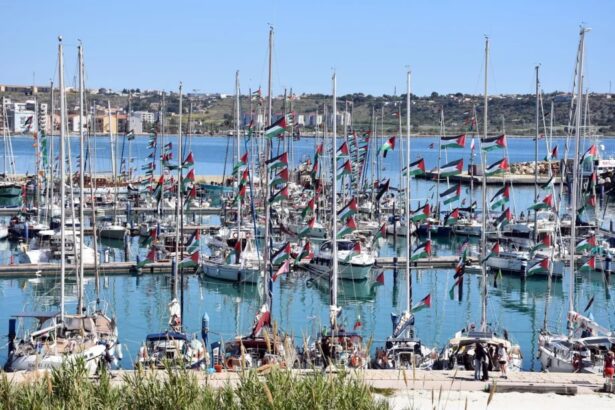
Israeli naval forces intercepted ships of the Global Sumud Flotilla late Wednesday carrying humanitarian aid to the besieged Gaza Strip more than 500 nautical miles away or 926 km, making this interception the furthest away in a long history of maritime assaults aimed at breaking Israel’s illegal blockade.
The Israeli navy intercepted the vessels in international waters near the Greek island of Crete by surrounding the convoy, jamming communications. As of April 30, 22 vessels have been seized in the 58-strong flotilla, with several of them managing to escape and enter Greek waters following the incident.
[Editor’s note: The voyages to Gaza began in 2008 by the Free Gaza Movement, which landed boats in Gaza five times: On August 23, 2008, October 28th, 2008, November 2008, December 8th 2008, December 19. These set a precedent that boats had every right to sail into Gaza’s port and break Israel’s illegal siege on Gaza. Details on each are below]
August 2008: Free Gaza and Liberty – tracked by Israel, landed in Gaza
On August 23, 2008, 44 ordinary people from 17 different countries sailed from Cyprus to Gaza on two small wooden boats, the FREE GAZA and the LIBERTY. We did what our governments would not do – we broke the Siege of Gaza. The boats encountered rough seas and many of the passengers suffered from severe seasickness. At sea, we were tracked by Israeli naval vessels for over half of the journey, and the boats’ navigation systems were jammed and interfered with. When our two boats arrived safely in Gaza on 23rd August after over 30 hours at sea, they were welcomed by tens of thousands of Palestinians lining the shore.
We stayed in Gaza for 6 days, visited hospitals and schools, and delivered donated hearing aids and medicines. During our stay the Free Gaza boat and several passengers accompanied Palestinian fishermen at sea. This accompaniment helped the fisherman fish in their own territorial waters without being assaulted by the Israeli navy for the first time in several years.
The boats left on 29th August, returning to Cyprus with 7 Palestinians. These included 5 family members who were reunited with the rest of this family in Cyprus, whom they had not seen for several years. Also on board was 15-year-old Saed and his father who were leaving to obtain medical treatment for Saed, who lost his leg and was severely injured in an Israeli attack. They became the first Palestinians in modern history to freely leave their own country. For the first time in over 40 years, international ships docked at Gaza Port. For the first time in over 60 years, Palestinians freely entered and exited their own country.
Ten passengers remained behind in Gaza, six of them on a long term basis, undertaking human rights work and forming the first international presence of the International Solidarity Movement since 2003.
In the words of Palestinian voyager, Musheir El-Farra, a human rights activist originally born and raised in Khan Younis in Gaza but currently living in Sheffield, UK: “For the first time in my life, I went to Gaza without being humiliated, without having to ask Israel for permission. We did it. We finally did it. And now others must join us and do it as well.”
Since 2009, Israel has illegally intercepted and attacked all humanitarian aid flotillas attempting to break its 19-year siege on Gaza. Even though a ceasefire has been in place since October 2025, Israel has continued to restrict food and medicine deliveries, pushing the enclave into famine and starvation.
Israel’s attacks on humanitarian sea missions aiming to reach Gaza go back more than a decade, with at least 10 previous flotillas intercepted or attacked.
October 2008: Dignity – followed by Israeli warships, landed in Gaza
On October 28th, 2008, we made our second voyage to Gaza, this time aboard the DIGNITY, a new ship, better able to make the journey in the rough winter weather. Although Israeli warships trailed our small ship when we approached Gaza, they did not attempt to use force against us, and we were able to once again break through their blockade.
Aboard the Dignity were 27 doctors, lawyers, journalists, and human rights workers, representing 12 different countries. The passengers included Palestinian legislator Mustapha Barghouti, Nobel Laureate Mairead Maguire, and Italian opera singer Joe Fallisi – who delivered Gaza’s first ever opera concert. The passengers also included Caoimhe Butterly, a renowned human rights worker who stayed on as the first Free Gaza co-ordinator, working alongside the Palestinian NGO Network and the Popular Committee Against the Siege, our partner organisations inside Gaza.
After watching the Dignity’s arrival Fida Qishta, the local coordinator for the International Solidarity Movement (ISM) in the Gaza Strip, said “If Gaza is free then it’s our right to invite whomsoever we wish to visit us. It’s our land and it’s our sea. Now more groups must come, not only by sea but also the crossings at Erez and Rafah must be opened as well. This second breaking of the siege means a lot, actually. It’s the second time in two months that people have come to Gaza without Israel’s permission, and that tells us that Gaza will be free.”
November 2008: “Parliamentary Delegation” – landed in Gaza
In November 2008, the DIGNITY made its second successful voyage to Gaza, carrying 24 Passengers. On this voyage, the Free Gaza Movement joined with the European Campaign to end the Siege to bring over a ton of medical supplies to Gaza, accompanied by 11 past and current European parliamentarians from England, Ireland, Scotland, Wales, Italy and Switzerland, including the Baroness Jenny Tonge, Lord Nazir Ahmad and Clare Short, the former British Secretary for International Development.
They were part of a much larger group of 53 European parliamentarians who had been denied entry to the Gaza Strip earlier in November. Journalists from Al Jazeera, Haaretz and the Independent (UK newspaper) were also on board for a three day fact finding tour of the Gaza Strip. The passengers also included Eva Bartlett, a Canadian activist who remained in Gaza to increase the number of international human rights workers there.
In addition to delivering medicines, the parliamentarians toured hospitals, schools, agricultural centers, and Gaza’s power plant, as well as meeting with their counterparts in the Palestinian Legislature.
The Dignity left Gaza on 10th November carrying an additional eight Palestinians for the return journey, including the secretary for the Independent Union for the Labour Leagues in Gaza. He came aboard the DIGNITY to speak to syndicates and university students in Spain, and encourage them to participate in breaking the siege on Gaza. Also on board were an elderly Palestinian couple. After suffering from a stroke in 2007, the husband was not allowed out for treatment through either Rafah or Erez. The couple had not seen their children since the siege began in 2006.
“We’re thankful that we were able to deliver these badly needed medical supplies,” said Dr. Arafat Shoukri, Chair of the European Campaign to End the Siege. “However, the unfortunate truth is that these supplies are only symbolic. Until the siege ends once and for all, innocent people will continue to unnecessarily suffer and even die.”
December 2008: “Students’ Delegation” – landed in Gaza
On December 8th 2008, the Free Gaza Movement sent in a “students” delegation, headed by professors Mike Cushman and Jonathon Rosenhead of the London School of Economics and BRICUP – the British Committee for Universities for Palestine. The delegation toured schools and universities in Gaza to assess the impact of the siege on education, and successfully brought out 11 Palestinian students who had been accepted to universities abroad, but were unable to exit Gaza due to the Israeli siege.
They are just a handful of the over 700 Palestinian students who have visas to study at universities in Europe, but who have been forbidden to leave by Israel and Egypt, another example of the collective punishment on the civilian population of Gaza.
According to Rosenhead and Cushman, “As academics we are particularly pleased to be traveling on the Dignity on this mission to enable at least some of the hundreds of students trapped in Gaza by the Israeli siege to get out and take up their places at universities round the world. This siege is an affront to any idea of academic freedom or human rights. How can anyone justify preventing young people from fulfilling their potential and learning how to serve their community more fully?”
Also on board the DIGNITY on this voyage was a British surgeon, Dr. Sonia Robbins, travelling to Gaza to volunteer in local hospitals. Dr. Robbins had worked in Gaza previously but had been prevented from returning by the siege. The boat also carried a Palestinian who had been denied the right to see his family in Gaza for several years, international human rights workers, and journalists.
The Dignity carried a ton of medical supplies and high protein baby milk formula. Two human rights workers remained in Gaza to join the teams working there, including Ewa Jasiewicz, who joined Caoimhe Butterly as our co-coordinator on the ground in Gaza.
December 2008: “Qatari Delegation” – landed in Gaza
On December 19, the Free Gaza Movement returned to Gaza once again, this time with two envoys from the Qatari Eid charity, in partnership with the people of Qatar. With this historic journey, Qatar became the first Arab nation to ever break the siege of Gaza. Envoys from Qatar assessed hospitals, schools, and civilian centers, and established the foundations for future, lasting partnerships between Qatar and Gaza.
The boat passengers included three human rights workers, all of whom remained in Gaza. They included Italian Vittorio Arrigoni, who had been on board the first Free Gaza mission, had remained in Gaza to do human rights work including the accompaniment of fishermen, and had been kidnapped at sea by the Israeli Navy and subsequently deported from Israel.
Also on board was Natalie Abou Shakra, from Lebanon, who became the first Lebanese activist to work long-term in Palestine – therefore breaking another aspect of the siege which denies anyone from Lebanon the right to enter Palestine. Among the other passengers were two Israelis, including Neta Golan, one of the founders of the International Solidarity movement.
Lubna Masarwa, a Palestinian human rights activist stated that: “…We are unarmed civilians carrying desperately needed supplies to other unarmed civilians … [but] Gaza doesn’t need charity. What Gaza needs is sustained political action aimed at overcoming this vicious siege.”
Declared Alze Al-Qahtani, one of the Qatari envoys: “This is just the beginning…”
December 2008: “Ramming of the Dignity” – rammed by Israeli warships, mission aborted
In response to the Israeli massacres in Gaza at the end of December 2008, the Free Gaza Movement sent the Dignity on an emergency mission of mercy to besieged Gaza. Aboard the ship were over 3 tons of medical supplies, 3 surgeons intending to volunteer in hospitals and clinics in Gaza, Dr. Elena Theoharous, a member of the Cypriot Parliament, and Cynthia McKinney, former U.S. congresswoman and Green party presidential candidate.
On December 30, the Dignity was attacked by the Israeli Navy at approximately 6am (UST) in international waters, roughly 90 miles off the coast of Gaza. Several Israeli warships surrounded the small, human rights boat, intentionally ramming it three times. According to ship’s captain Denis Healy, the Israeli attack came, “without any warning, or any provocation.”
Thanks to the heroic efforts of its captain and crew, the ship was able to stay afloat, and made its way to safe harbor in Lebanon without the loss of life.
Also on board was Caoimhe Butterly, our Gaza co-coordinator, who stated that, “The gunboats gave us no warning. They came up out of the darkness firing flares and flashing huge flood lights into our faces. We were so shocked that at first we didn’t react. We knew we were well within international waters and supposedly safe from attack. They rammed us three times, hitting the side of the boat hard. We began taking on water and, for a few minutes, we all feared for our lives. After they rammed us, they started screaming at us as we were frantically getting the life boats ready and putting on our life jackets. They kept yelling that if we didn’t turn back they would shoot us.”
January 2009: forced to turn back by the Israeli navy
Read the testimonies from Israeli Jail.
Immediately following the ramming of the Dignity, the Free Gaza Movement secured a new boat, the SPIRIT OF HUMANITY, and attempted another emergency mission to besieged Gaza. Aboard the ship were 36 passengers and crew, representing 17 different nations. They included doctors, journalists, human rights workers, and five European parliamentarians representing Belgium, Greece, Italy, and Spain. The mercy ship also carried tons of desperately needed medical supplies meant for hospitals in the Gaza Strip. The ship was forced to turn back by the Israeli navy, which threatened to fire upon the unarmed civilians on board if they continued toward Gaza.
Fouad Ahidar, a member of the Belgian Parliament who sailed aboard the SPIRIT OF HUMANITY, stated that, “I have five children that [were] very worried about me, but I told them: ‘you can sit on your couch and watch these atrocities on the television, or you can choose to take action to make them stop.'”
During the massacre, the United Nations failed to protect the Palestinian civilian population from Israel’s massive violations of international humanitarian law. Israel has closed off Gaza from the international community and demanded that all foreigners leave.
But Huwaida Arraf, an organizer with the Free Gaza Movement, stated that, “We cannot just sit by and wait for Israel to decide to stop the killing and open the borders for relief workers to pick up the pieces. We are coming in. There is an urgent need for this mission as Palestinian civilians in Gaza are being terrorized and slaughtered by Israel, and access to humanitarian relief denied to them. When states and the international bodies responsible for taking action to stop such atrocities chose to be impotent, then we–the citizens of the world–must act. Our common humanity demands nothing less.”
June 2009: Spirit of Humanity – Israeli navy commandeered vessel, detained crew
On June 29, 2009, the Israeli navy intercepted the Spirit of Humanity, a vessel operated by the Free Gaza Movement, some 20 nautical miles off the Gaza coast.
The boat, which departed from Larnaca in the Greek Cypriot Administration, was carrying humanitarian aid and medical supplies, with 21 passengers onboard.
Surrounded by Israeli gunboats, which threatened to open fire, it was seized and escorted to Ashdod, where all the passengers were detained.
May 2010: Freedom Flotilla – Israeli forces stormed Mavi Marmara, killing 10
One of the most high-profile Israeli attacks on humanitarian attempts to break the blockade came on May 31, 2010, when Israeli forces stormed Turkish ship the Mavi Marmara as it was sailing in international waters toward Gaza.
The raid resulted in the deaths of 10 activists and injuries to more than 50 people. The vessel was part of a larger flotilla of eight ships carrying about 750 people from 37 countries and 10,000 tons of aid.
Severely straining Türkiye-Israeli relations, the attack prompted Ankara to demand an official apology, compensation, and an end to the blockade.
November 2011: Freedom Flotilla II – intercepted by Israeli navy, crew detained
This flotilla involved more than 300 participants from around the world and was set to sail on 10 vessels. However, intense diplomatic pressure from Israel, coupled with reported sabotage of ships and restrictions by host countries, prevented most boats from departing.
Only the Dignite-Al Karama came close to reaching Gaza. The 17-passenger French vessel initially declared an Egyptian port as its destination upon leaving Greek waters, but activists later announced they were heading for Gaza. Israeli naval commandos intercepted the boat and towed it to Ashdod in Israel. The activists were detained for questioning and later deported.
June 2015: Freedom Flotilla III – Israeli forces intercepted the Marianne, crew detained
In June 2015, the Swedish vessel Marianne was intercepted by Israeli forces around 100 nautical miles from Gaza.
The vessel was part of the Freedom Flotilla III, which carried 48 rights activists and journalists.
Most of the participants were detained in Israel’s Givon Prison before being released.
The Marianne was taken to the Port of Ashdod, while the other three ships in the group were turned back.
Summer 2018: Gaza Freedom Flotilla – Al-Awda and Freedom intercepted, crews beaten
In summer 2018, two boats, the Al-Awda and the Freedom, tried to protest the blockade.
On July 29 and Aug. 3, they were intercepted and seized during another Freedom Flotilla mission.
The ships were stopped in international waters, and activists on board reported being beaten during the seizure.
May 2025: Break the Siege – Conscience attacked en route
On May 2, 2025, Freedom Flotilla Coalition boat the Conscience was struck by drones in international waters off Malta while en route to Gaza.
The coalition, which operated the vessel, accused Israel of carrying out the attack. In a statement, the group said: “Israeli ambassadors must be summoned and answer to violations of international law, including the ongoing blockade and the bombing of our civilian vessel in international waters.”
The Maltese government said 16 people — 12 crew members and four civilians — were on board.
June 2025: Madleen – intercepted, crew detained
The Madleen, an 18-meter vessel part of a mission organized by the Freedom Flotilla Coalition, was intercepted by Israeli naval forces in international waters on June 9, 2025.
Less than 100 nautical miles from Gaza, all 12 people on board – including 11 international activists and a journalist – were detained, and the boat was towed to Israel’s Port of Ashdod.
The Madleen was carrying several hundred kilograms of flour, rice, baby formula, and medical and sanitary essentials for the Palestinians in the blockaded Gaza Strip.
October 2025: Global Sumud Flotilla – dozens intercepted, hundreds detained
On Oct. 1, 2025, Israeli forces attacked the vessels of the Global Sumud aid flotilla, made up of about 50 ships with over 500 activists. Israel initially detained at least 317 activists who were on board, gradually taking in all of them by Oct. 3.
The detained activists were taken to Israel’s Ashdod Port, from where they were deported over the next 10 days.
The flotilla had set sail in August carrying baby food, medical supplies, and other humanitarian aid for Palestinians in the Gaza Strip.
October 2025: Freedom Flotilla Coalition of a ‘Thousand Madleens to Gaza’: 150 detained
A flotilla of nine ships, organized by the Freedom Flotilla Coalition and Thousand Madleens to Gaza, set sail shortly after the Global Sumud Flotilla and was intercepted on Oct. 8, about 120 nautical miles from Gaza.
There were around 150 activists on board who were detained and deported by Oct. 12.
One of the ships was the Conscience, which had been struck by Malta earlier in the year.
July 2026: Handala – intercepted, crew detained
On July 26, 2025, Israeli naval forces intercepted the Handala aid ship as it neared Gaza’s shores.
It detained all 21 activists onboard, and escorted it to Ashdod.
The vessel had reached about 70 nautical miles from Gaza, surpassing the distance covered by the Madleen, which made it 110 miles before it was stopped.
Efe Özkan is a Journalist at Anadolu Agency, based in Istanbul, Türkiye.
RELATED:
- The Global Sumud Flotilla to Gaza — A cry at sea to the world’s dormant conscience
- History of flotilla campaigns to end Israel’s siege of Gaza
- Six Months into Gaza Ceasefire, Setting the Record Straight About Aid
- Israel’s restriction of aid into Gaza leads to critical shortages in bread, baby formula, and water
- ‘Nothing has changed’: Gaza health workers report almost no medical aid entering the strip