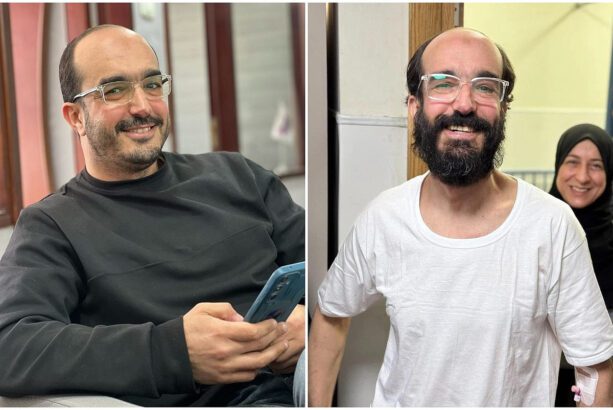
Held without charge in Israeli jails, West Bank reporters describe beatings, starvation, isolation, and threats meant to force them into silence.
By Basel Adra, reposted from +972 Magazine, June 1, 2026
Ali Al-Samoudi has spent four decades documenting the daily realities of life under occupation in the northern West Bank. A 60-year-old veteran Palestinian journalist from Jenin, he has worked as a correspondent for Al-Quds newspaper and as a cameraman for Al Jazeera and other international media outlets.
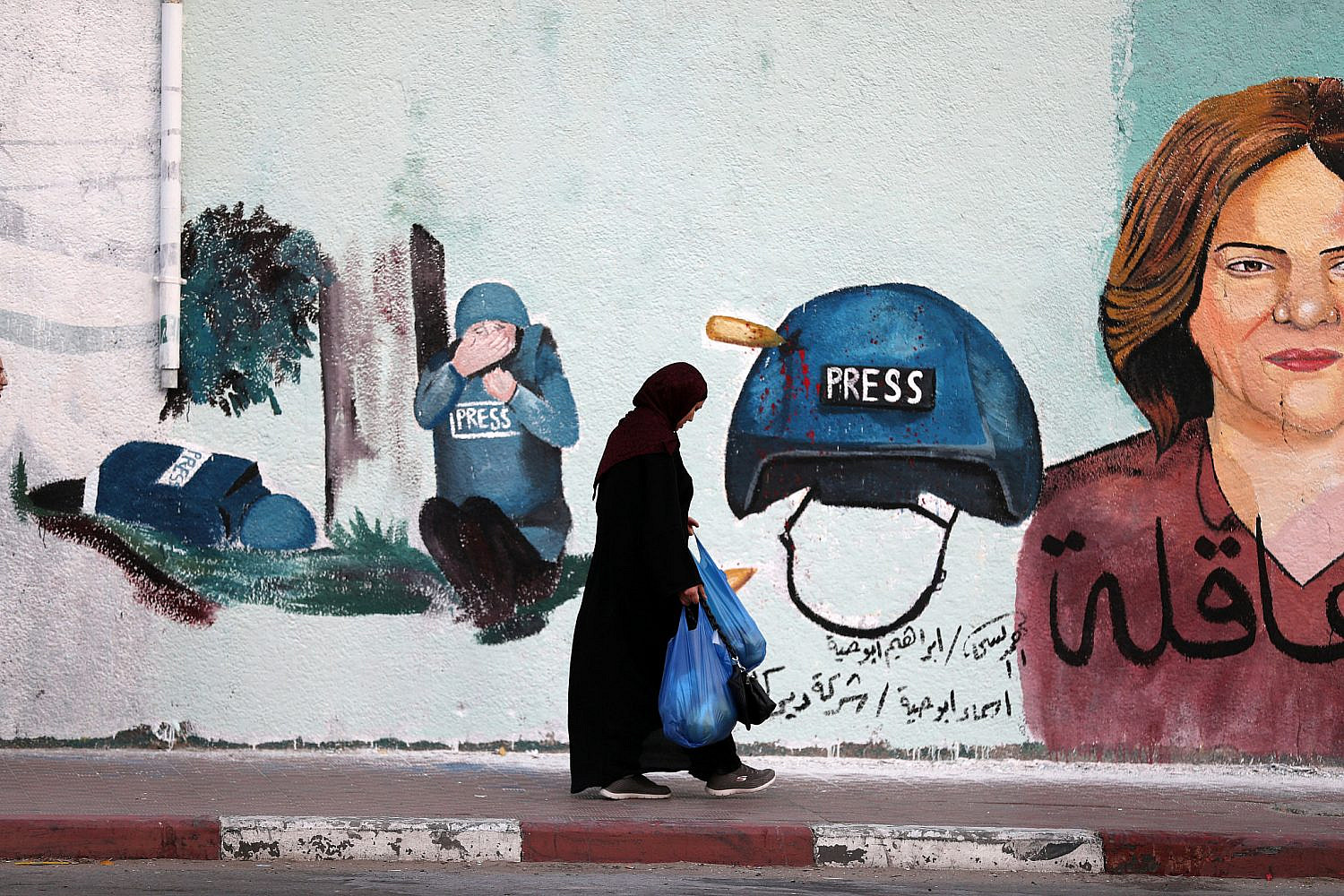
But he is perhaps best known as the colleague of Shireen Abu Akleh, whom Israeli forces shot and killed during a raid on Jenin refugee camp in May 2022. Standing beside Abu Akleh, Al-Samoudi was also shot that day in the back; the bullet exited cleanly through his shoulder.
On April 29, 2025, Israeli forces raided Al-Samoudi’s home in Jenin at dawn and arrested him. He was held without charge or trial, before being released almost a year to-the-day later, on April 30, 2026.
During his time in administrative detention, Al-Samoudi says he was starved, beaten, and denied medication. He was also transferred between multiple facilities, including Megiddo Prison and the notorious Ofer Prison. He now faces a long recovery journey, suffering from severe vitamin deficiencies and hearing problems, and remains under continuous medical supervision.
Al-Samoudi believes his arrest was directly connected to his journalistic work — particularly his coverage of Israel’s ongoing assault on Jenin refugee camp, where the army has destroyed homes, forced tens of thousands of residents to flee, and barred almost all from returning. In the months before his arrest, he had been working on written and filmed reports on displaced families trying to reenter the camp.

+972 Magazine spoke to Al-Samoudi shortly after his release about his arrest, the conditions of his detention, and Israel’s campaign to silence Palestinian journalists.
Can you describe your arrest?
They came to my home in the early morning hours. When they entered, my daughter and daughter-in-law were crying. The Israeli military officer instructed me, “Tell them I only want you for a three or four-hour trip and then you’ll return home.” I had no idea that trip would last a year.
The soldiers took me to the refugee camp, where they kept me blindfolded and handcuffed for 80 hours. They threw me in front of military barracks, which were actually Palestinian homes inside the camp. Whenever soldiers entered or left, they would beat me all over my body.
I was not allowed any food or water during that entire period. Throughout the nights, I suffered severe pain from the cold. I told them I needed my medication because I have diabetes and high blood pressure, but they ignored me and did not bring any of my medicine.
During interrogation, they told me there were three suspicions against me — not even charges. The first two appeared to be related to my journalistic work and field coverage. They considered covering events on the ground as serving what they called “subversive organizations.” Another suspicion was based on their allegation that a Palestinian detainee said that I had photographed him while he was firing at an Israeli settlement.
During my detention, I received direct threats over the phone from a Shin Bet officer. The officer told me: “You’ve exhausted us. I want to send you to prison for two or three years. I’m going to crush you.”
In the aftermath of October 7, many photos and videos started circulating on social media and news channels showing the condition of Palestinian prisoners after their release from Israeli jails. Many included before-and-after images showing drastic weight loss due to starvation. Can you describe the conditions inside the prisons?
As a journalist, I worked extensively on stories about Palestinians inside Israeli prisons, but I never imagined the conditions were this catastrophic.
We were held in cemeteries for the living, stripped of all rights. We had no paper, no pens, no books, no television, no radio. We didn’t even have a comb, a mirror, or hygiene supplies. They gave us only a tiny amount of shampoo — just one spoonful per week for bathing. I grew this beard because no shaving tools were available. Only when they wanted us to shave would they bring the equipment and force us to shave our heads and beards.

Food was given only so we could remain standing during the daily counts and so they could continue their abusive practices against us. In the morning, we were given one spoon of labneh and one spoon of jam. At noon, four spoons of rice, two tiny pieces of cucumber, two slices of tomato, and one spoon of beans. In the evening, two spoons of hummus, one spoon of tahini, one boiled egg, and ten small pieces of bread, each half the size of a hand.
I entered prison weighing 120 kilograms and left weighing 60 kilograms.
Each prison room contained 10 prisoners and measured seven by three meters. There were only six beds for 10 prisoners, meaning six slept on the beds while four slept on the floor.
The mattresses smelled rotten and disgusting, and we were not allowed to wash or clean them. We were given only 10 minutes for showering, with 20 prisoners at a time. There were no doors for the shower stalls, so we had to stand naked in front of one another, which was a severe violation of privacy and deeply humiliating for prisoners.
I informed the prison authorities that I needed medication for diabetes, blood pressure, and stomach problems. They provided me with only one blood pressure pill and a diabetes regulator. They refused to transfer me to the clinic until my health deteriorated severely.
I fainted several times, my health complications worsened, and I developed problems with my eyesight and hearing. My lawyer filed an objection before they finally transferred me to the clinic, but even then, I did not receive the treatment I needed.
There are prisoners suffering from cancer, heart disease, and other serious illnesses who are denied medication in the prison clinic. On one occasion, while transferring me to court, they were transporting a prisoner who could not walk on his own. They threatened to beat him if he did not walk, then lifted him into the prison transport vehicle while striking him.
Most prisoners were released directly to hospitals because of illnesses, including skin diseases caused by insects, filthy blankets, unclean mattresses, and the lack of sanitation in prison cells. The scenes were heartbreaking beyond words.
According to a recent report by the Committee to Protect Journalists, nearly 100 Palestinian journalists and media workers have been arrested since October 2023, and dozens remain in detention. Over half reported being subjected to torture, abuse, or other forms of violence. In your view, why does Israel target journalists like this?
This is all part of Israel’s ongoing war to silence voices, suppress free expression, and prevent Palestinian journalists from carrying out their fieldwork.
After they killed Shireen and wounded me, I said that shooting at us was a message of intimidation to every Palestinian journalist and media worker. They do not want documentation or witnesses to what they are doing in the West Bank. My arrest confirmed this.
Terrorizing journalists and their families
At the beginning of April 2026, according to the Palestinian prisoners’ rights NGO Addameer, Israeli prisons held more than 9,600 Palestinians, including 84 women and 350 children. Of these, 3,532 were administrative detainees, held without trial on the basis of secret evidence that they and their lawyers cannot access or challenge.
Among them was Samer Amin Khuwaira, a 45-year-old journalist from Nablus, who spent nine months in administrative detention after being arrested during a nighttime raid on his home in April 2025. His detention was renewed three times, without formal charges or trial. Speaking to +972, Khuwaira recalled a Shin Bet officer openly telling him that he was being held for “political reasons.”
Like other released detainees, Khuwaira described harsh prison conditions, including severe overcrowding, high humidity, limited access to showers, and a lack of clean clothing. During his detention, he developed scabies and painful skin infections, and lost more than 20 kilograms.
“I asked for treatment in September, but they only brought medicine in December, after the disease had spread across my whole body,” he said.
Khuwaira said prison authorities ignored his medical condition for months, while the lack of hygiene inside the prison made it worse. Prisoners, he said, were allowed to shower only once every six days. After his release, Kweira remained under medical treatment for two months, and isolated himself from his three children out of fear of infecting them.
Khuwaira and Al-Samoudi’s experiences are not uncommon: Many detainees are denied necessary treatment, examinations, and medication, in some cases turning illness into a slow death sentence. At least 98 Palestinian prisoners have died as a result of torture and systematic medical neglect since the start of the war in Gaza, according to data from the Israeli army and Israel Prison Service (IPS).

Since October 7, Israeli authorities have also barred the families of Palestinian prisoners from visiting their relatives in prison. Phone calls are also prohibited, as are visits by the International Committee of the Red Cross to monitor the condition of detainees. As a result, families are largely kept in the dark about the condition of their loved ones in Israeli jails — reliant on lawyers or the testimonies of other released prisoners for scraps of information.
+972 Magazine spoke to Abdul Majeed Al-Amarneh from Dheisheh refugee camp in Bethlehem, whose son, Ausayd, a 41-year-old journalist and media lecturer at Hebron and Bethlehem universities, has been held in administrative detention since July 2025.
“Since the night they took him, the whole house has changed,” Al-Amarneh said. “[Ausayd’s four] children ask about him every day, and the hardest part is not being able to answer them.”
About a month ago, Al-Amarneh met a former prisoner who had recently been released from the same facility where Ausayd was held, and who informed him about his son’s condition inside the jail.
“He told me the food was very bad and that the prisoners are suffering every day from hunger, mistreatment, and humiliation,” Al-Amarneh said, who added that Ausayd was nevertheless in good spirits and kept busy studying the Quran. “Hearing news about my son from another released prisoner instead of hearing directly from him breaks my heart.”
Communication with Ausayd remains extremely limited, available only through lawyers. But they can relay only basic information and often limited to legal updates, such as whether his detention has been extended and which prison he is being held in. According to the family, his most recent detention renewal hearing was held without his lawyer present. They are unable to hear his voice, or reassure themselves about his condition.
But the family’s suffering did not end with Ausayd’s detention. His sister, 31-year-old Islam, a freelance journalist and mother of a five-year-old daughter, was also arrested less than a month ago after Israeli forces raided the family home in the camp.
She is now being interrogated in connection with her journalistic work, on charges of working for a banned media website. Meanwhile, her husband has already spent the last three years in prison.
“My daughter has a little girl, and today that child is separated from both her mother and father,” Al-Amarneh said. “We don’t know how to explain this to a five-year-old child.”
The Israel Prison Service did not respond to +972’s request for comment.
Basel Adra is an activist, journalist, and photographer from the village of At-Tuwani in the South Hebron Hills.
RELATED:
- ‘We returned from hell’: Palestinian journalists recount torture in Israeli prisons
- ‘Deliberate Assassination’: 3 Journalists Among 11 Killed by Israeli Forces in Gaza
- Why Journalists Won’t Tell You the Truth About the Gazan Genocide
- Israel’s diabolical killing machine and how it targets journalists.
- Lobby group taking journalists on propaganda tours of Israel