Accused of attending a protest, Shadi has never confessed to any wrongdoing and endured 41 court sessions spanning three years of legal persecution, epitomizing a system that instrumentalizes law as a tool of political repression.
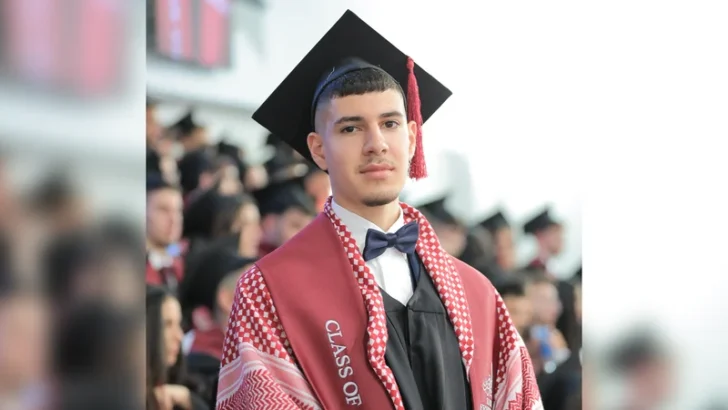
My son Shadi Khoury – a skilled football goalkeeper, a shy but hardworking student with quiet self-confidence – is more than a statistic in Israel’s system of injustice.
Shadi was seized from our family’s home in Jerusalem in October 2022 at the young age of 16. He is also, therefore, a witness to Israel’s colonial machinery that relentlessly works to transform Palestinian childhood into a site of trauma.
The armed Israeli forces which stormed our home, shouting that they had an order for my son’s arrest, beat Shadi and dragged him out while handcuffed, blindfolded, barefoot and wearing only his pajamas – shorts and a T-shirt from the Palestine Marathon in Bethlehem.
Shadi later told us that his interrogators beat him because of his T-shirt.
During interrogation, he was subjected to repeated beatings, lost consciousness three times, suffered a broken nose and was threatened in ways no child should ever endure.
After 41 days in detention, Shadi was placed under strict house arrest for an entire year. He was denied unrestricted access to school, forbidden from playing outside and subjected to constant surveillance.
Accused of attending a protest, Shadi has never confessed to any wrongdoing and endured 41 court sessions spanning three years of legal persecution, epitomizing a system that instrumentalizes law as a tool of political repression.
Israel’s case against my son lacks any credible evidence and relies on the coerced testimonies of children who later testified in court that they had been beaten and abused, and that they did not even know Shadi.
The interrogators admitted during court proceedings that they lacked specialized training for questioning children and failed to uphold basic legal safeguards while relying on physical and psychological pressure.
Despite the blatant injustice, Shadi is facing a multi-year prison sentence for a supposed wrongdoing that he has consistently said he didn’t do.
In a system with any semblance of justice, the charges would have been dropped. But my son is being dragged through the system of a racist, colonial state and so a judge is due to hand down my Shadi’s fate on 15 February.
Radical transformation
A mother whose child is imprisoned undergoes a radical transformation in her relationship to time.
Her calendar no longer revolves around the seasons, holidays or celebrations, but around the date of her child’s arrest, court hearings, prison visits, phone calls and the counting of days until the next encounter.
Every moment of waiting becomes an extension of pain; every letter from prison becomes a temporary infusion of life that allows time to move forward again.
For the imprisoned child, time is even more violently distorted. Captivity – including house arrest – does not merely restrict physical movement. It arrests psychological and social development at the moment of detention.
Childhood becomes a deferred memory, and time collapses into a closed loop of repetition: arrest, interrogation, court, food, sleep and fleeting visits.
This experience constitutes what scholars describe as “unchilding,” the systematic stripping of a child’s innocence, safety and future.
Shadi is hardly alone in this reality. Each year, Israel detains between 500 and 700 Palestinian children under so-called “security” pretexts.
Instead of security, however, these early arrests are designed to strike the future before the present, reshaping society through fear and enforced compliance.
Shadi’s story is part of a systematic regime designed to suppress an entire people by targeting the most fundamental rights of children: the right to childhood, education and safety.
Defending children’s futures
Despite this, and with the support of Friends School in Ramallah, my son completed his International Baccalaureate exams and later enrolled at Birzeit University, where he is currently in his second year studying digital marketing.
Despite the fear that weighs heavily on our hearts, each day we discover anew in Shadi a strength that astonishes us, a strength revealed in his steadfastness during arrest, interrogation and house confinement.
My family will continue to fight for Shadi’s rights. Up against a system where the interrogator, the prosecutor and the judge function as instruments of colonial occupation, we will persist in our struggle for justice, for freedom and for the dismantling of this machinery that seeks to destroy Palestinian childhood.
Defending children’s rights, their childhood and their future is not only a humanitarian issue, but a core political principle that demands direct confrontation with structures of oppression.
Standing with Shadi and with all detained Palestinian children is a human obligation.
Rania Elias is an independent administrative consultant in the fields of arts and cultural development. A Jerusalemite pursuing a graduate degree in Israeli Studies at Birzeit University, she was the director of Yabous Cultural Centre from 1998-2022.
RELATED:
- Bloodstains & Destruction: Israeli soldiers’ beating of Shadi Khoury
- Update on the arrest of Shadi Khoury, grandson of Samia Khoury
- Over 9,000 Palestinians remain in Israeli captivity following exchange deal
- The Free Press Called Out “Incomplete” Reporting on Gaza’s Starving Children. Here’s the Complete Story.
- They were forced to hand one son over to the Israeli army in return for another. Eight months later he was dead in prison