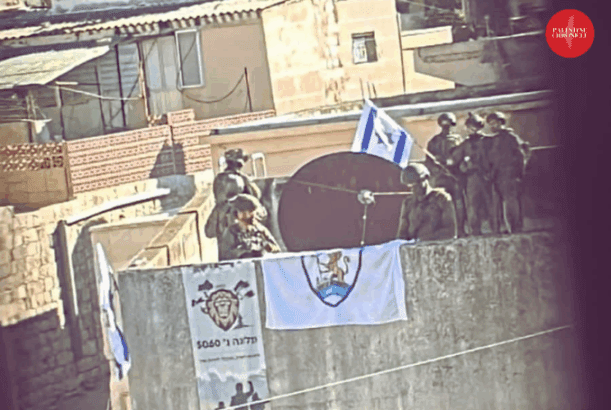
Dawabsheh described what happened to his family. Around midnight last Tuesday (March 10), Israeli soldiers surrounded their home and ordered the family to evacuate immediately.
By Fayha Shalash, reposted from Palestine Chronicle , March 13, 2026
Iyad Dawabsheh was taken by surprise when Israeli soldiers carried out a large-scale raid on his home on Tuesday. Without offering any explanation, they informed him that they intended to occupy the house for two full days.
The house, located in the town of Duma, south of Nablus, is home to a family of nine. Yet this did not stop the soldiers from ordering the family to leave their warm home so it could be turned into a military barracks.
In recent weeks, Israel has intensified the illegal seizure of Palestinian homes in the West Bank, converting them into temporary military barracks and, in some cases, field interrogation centers for detainees.
Israel claims such actions are necessary for security during the current escalation with Iran. In reality, Palestinian families are forced from their homes into the bitter cold and darkness of night, often without shelter or any indication of when they will be allowed to return.
There are no precise statistics on the number of homes occupied in this manner. The practice occurs almost daily, and the occupations are typically temporary, lasting anywhere from a few hours to several days.
A similar pattern was documented during the previous escalation with Iran in June 2025.
Between June 13 and June 23, the United Nations Office for the Coordination of Humanitarian Affairs (OCHA) recorded at least 32 incidents in which Israeli soldiers seized approximately 243 Palestinian homes—whether inhabited or not—as well as the roof of a school. These seizures lasted from several hours to several days.
According to the report, some families were allowed to remain in their homes, but many others were forcibly evicted and permitted to return only after the soldiers withdrew. At least 1,300 people were affected, many of whom came back to find their homes damaged or destroyed.
‘I Liked the House, So I Occupied It’
Dawabsheh described what happened to his family. Around midnight last Tuesday, Israeli soldiers surrounded their home and ordered the family to evacuate immediately.
Iyad tried to persuade them to allow his family to remain in the house, but the soldiers refused. Instead, they instructed the family to collect their personal belongings and leave, saying the occupation of the house would continue until the following morning.
“I told them that I have a sick son and a family of nine. Where are we supposed to go?” Dawabsheh told the Palestine Chronicle. “They replied: ‘Figure it out yourself.’ So we went down to the first floor, where my married son lives, and spent the night there.”
The family soon discovered that at least 50 Israeli soldiers had taken over the house, turning it into a military barracks and a field interrogation center for Palestinians who had been arrested during raids in the town that night.
Shortly before dawn, Dawabsheh prepared suhoor meals and attempted to bring food to the detainees being held inside his home. The soldiers refused and ordered him to return downstairs.
The following morning, he approached the commanding officer to ask when the soldiers planned to leave. The officer replied that there had been a “security update” and that they would remain until 5 p.m.
“I asked him why he chose my house specifically,” Dawabsheh said. “He told me he liked the way it looked, so he decided to occupy it.”
Later that evening, the soldiers withdrew and released the detainees, but they left the house in a deplorable condition. The family found furniture smashed, garbage scattered everywhere, and the bathrooms left filthy. According to Dawabsheh, the Israeli soldiers had also deliberately vandalized the bedrooms.
A military vehicle crashed into the external staircase of the house, breaking part of it, and also damaged several trees planted in the garden.
“We cleaned the house from the moment they withdrew until the following morning, and it still feels filthy,” Dawabsheh told the Palestine Chronicle. “Our lives were turned upside down after just two days of occupation. They deliberately humiliate us even in our own homes.”
Fear and Deterrence
In a report, Human Rights Watch noted that Article 49 of the Fourth Geneva Convention prohibits an occupying power from forcibly displacing the civilian population it is obligated to protect, except in exceptional and temporary circumstances.
Such evacuations are only permitted when they are required for imperative military reasons or for the safety of the civilian population.
Even in those cases, international humanitarian law strictly regulates how evacuations should be conducted. The occupying power must ensure the safe transfer of civilians, provide them with adequate food, water, and shelter, and allow them to return once hostilities in the area have ceased.
“Displacements that don’t meet these conditions constitute a violation of international law and, if committed with criminal intent, may constitute a war crime,” the report stated.
“When forced displacement is carried out as part of a widespread or systematic attack against civilians, reflecting a state or organizational policy, it may also amount to a crime against humanity.”
However, the policy of occupying Palestinian homes is not limited to periods of war or heightened military escalation. Israel has long implemented similar illegal practices in the West Bank.
Researcher and political analyst Suleiman Bisharat said the policy primarily aims to create a sense of constant fear and deterrence among Palestinians.
“The main objective is to impose a form of security deterrence and maintain a permanent state of fear within Palestinian communities,” Bisharat told the Palestine Chronicle.
According to Bisharat, the practice reflects the broader logic of the settler-colonial system and the structure of the occupation.
“This behavior is consistent with the nature of the occupation,” he said, noting that Palestinians face similar treatment regardless of whether tensions are escalating or not.
He added that the policy also allows Israel to redeploy its forces.
“This approach also helps empty some military bases of soldiers, especially given the large mobilization of Israeli combat units,” Bisharat explained. “By deploying them inside Palestinian neighborhoods, the Israeli army effectively uses Palestinian homes as protected locations for Israeli occupation forces.”
A third objective, he said, relates to training.
“The Israeli military establishment often turns Palestinian cities, villages and towns into real training grounds for soldiers,” Bisharat said. “This allows reserve combat units called up during emergencies to gain direct operational training on the ground.”
Fayha’ Shalash is a Ramallah-based Palestinian journalist.
RELATED:
- 58 years since the Naksa, Israel’s destructive West Bank military operation fuels mass forced displacement of Palestinians
- The Forced Displacement of Palestinians Never Truly Ended: A Revealing Family Story
- Israeli displacement orders in Gaza are psychological warfare
- Fear, hunger and displacement follows Israel’s worsening abuse of Palestinians in Hebron
- Palestinians in Gaza’s displacement camps face rampant disease due to destroyed infrastructure