Legitimizing state violence that breaks international law will be a lasting scar on the world left by Israel, and for Trump in Venezuela, a page taken out of their playbook.
When Venezuelan Vice President Delcy Rodríguez condemned the 3 January abduction of her president as bearing a “Zionist tint,” Western commentary dismissed the phrase as rhetorical overreach. That reflex evades the substance. The question is not who flew the helicopters. It is who legitimized the act—and what that legitimization does to an already fragile international order.
[Editor’s note: US Secretary of State Marco Rubio said the mission is also about ending Iranian and Hezbollah activity inside Venezuela.]
Israel’s response was immediate and unmistakable. Prime Minister Benjamin Netanyahu praised Washington’s “bold and historic leadership,” celebrating the operation as a moral achievement. Israel’s foreign minister, Gideon Sa’ar, framed the kidnapping as the conduct of the “leader of the free world,” aligning Israel with a spectacle that bypassed multilateral consent and due process. This was not careful alliance maintenance. It was a public endorsement of barbaric force.
Endorsement matters. In international politics, norms are not upheld by statutes alone; they are sustained by habits and expectations. When powerful states applaud breaches, those breaches become templates.
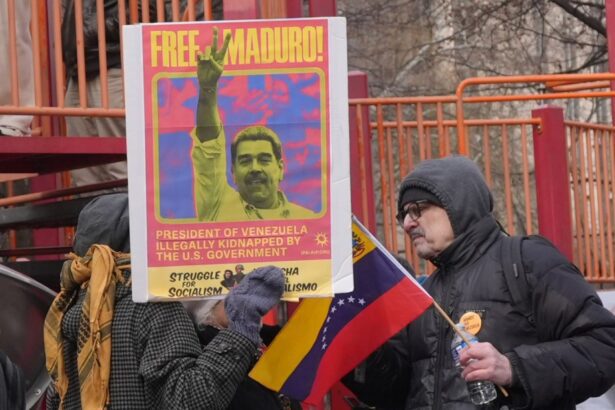
Maduro may be at fault. His rule was marked by economic shortcomings, curtailment of free speech, and elections seen as neither free nor fair. Yet even deeply flawed leaders are shielded—at least in principle—by a core norm of the post-1945 international order. The abduction ordered by Donald Trump crossed that line. A sitting head of state, Nicolás Maduro, was seized without a United Nations mandate, without an international arrest warrant, and without any judicial process recognized beyond American indictments. However objectionable Maduro’s governance, the precedent is unmistakable: sovereignty was treated not as a right, but as a revocable condition—withdrawn by a single power acting alone.
It is here that Venezuela’s internal politics intersect uncomfortably with global optics. The country’s most prominent opposition figure, María Corina Machado, welcomed Maduro’s removal as a moment of liberation. Machado has long aligned herself with Washington’s pressure campaign and has openly signaled her intention to restore diplomatic ties with Israel, severed by Hugo Chávez in 2009. She has also framed Venezuela’s crisis within a broader struggle against what she describes as an authoritarian axis linking Caracas to Iran, echoing Israeli and U.S. narratives that cast Tehran as a destabilizing force not only in the Middle East but across the Global South.
Yet her relationship with Washington’s architect of the raid has been more complicated. Machado praised the intervention enthusiastically—only to be coolly side-lined by Trump, who publicly questioned her domestic standing and, according to aides, appeared less impressed once the Nobel medal was no longer hypothetically available for sharing. In global politics, admiration is rarely reciprocal, and gratitude even less so.
For decades, Israeli security doctrine has insisted that necessity suspends restraint. Extrajudicial abductions, targeted killings, and cross-border strikes—often outside declared wars—have been defended as unfortunate but indispensable tools. This logic has been most visibly applied in Israel’s long confrontation with Iran and its regional allies, where pre-emption is treated not as exception but as strategy. Accountability is rare; explanation is optional. Over time, that worldview has seeped into the strategic imagination of allies. What begins as exceptional becomes, through repetition and tolerance, acceptable.
This is how doctrines travel. Not through secret coordination, but through public validation. When Israel’s leaders celebrated the Maduro abduction, they converted illegality into virtue. They told the world that borders are suggestions, that law yields to power, and that force—properly framed—earns applause.
The resonance of Caracas’s language should be understood in that light. Venezuela severed diplomatic ties with Israel in 2009 after the Gaza war and has cultivated close relations with Iran as part of its resistance to U.S. pressure. Anti-Zionism, in this context, became not merely ideological but geopolitical. Israel came to symbolize Western military assertiveness and selective adherence to law. One may reject the rhetoric while acknowledging why it lands: Israel’s own words after the raid animated it.
The wider reaction underscores the point. Across Latin America, Asia, Africa, and much of the Muslim world, governments condemned the seizure as a violation of sovereignty and a dangerous precedent. They warned that a rules-based order cannot survive selective enforcement. Smaller states heard a clear message: the protections of law thin out as power rises.
Defenders will insist that praise is not planning. True—and beside the point. Norms are forged by what the influential endorse. Law survives on habit. When breaches are cheered, erosion accelerates. The damage is cumulative, and it is not confined to the immediate victim.
Consider the lesson absorbed elsewhere. If a close ally can publicly celebrate the abduction of a foreign president—especially one aligned with Iran—why should others hesitate? Why should restraint survive when its violation is framed as leadership? The logic does not stop in Caracas. It travels to regions where grievances simmer and power seeks shortcuts.
This is why the “Zionist tint” cannot be waved away as mere polemic. It is not a claim of secret control; it is an indictment of a visible logic. Israel did not need to author the operation to own the principle it praised. By choosing applause over restraint, it aligned itself with a precedent that weakens the very legal order democracies claim to defend.
There is also a moral cost. Democracies derive legitimacy from limits—from the willingness to bind themselves even when it is inconvenient. Celebrating the circumvention of those limits corrodes that legitimacy. It tells the world that rights are contingent, that legality is selective, and that might—if wrapped in the language of freedom—becomes right.
The issue, then, is not conspiracy but consistency. If international law is to mean anything, it must restrain the strong as much as it disciplines the weak. If sovereignty is to be respected, it cannot be revoked by applause. That choice clarifies the moment. The “Zionist tint” is real not as a hidden hand, but as a public signal. It is the normalization of a worldview that treats borders as permeable, leaders as collectible, and law as optional. In a world already drifting toward raw power, such signals matter.
History will not judge this episode by who clapped the loudest, but by whether the rules survived the clapping. On that measure, the applause did real harm—and it will echo far beyond Venezuela.
Wan Naim Wan Mansor is Research Fellow and Managing Editor at the International Institute of Advanced Islamic Studies (IAIS) Malaysia, focusing on global Muslim affairs and systems-based policy making.
RELATED:
- Israel’s role in Trump’s attacks on Venezuela
- Why Israel is Pushing for Regime Change in Venezuela through Washington – 2 articles
- Israel Is Behind Trump’s Escalation on Venezuela – Col. Wilkerson
- Americans’ Support for Israel Dramatically Declines, Times/Siena Poll Finds
- New polls show growing support for Palestine, and for calling Israel’s actions “genocide”