If Christian liberation theology is recognized as an ethical and theological response to empire, then Islamic Liberation Theology, grounded in Quranic condemnations of oppression and the divine obligation to stand with the downtrodden, must be afforded the same legitimacy
By Feroze Mithiborwala, Reposted from Counter Currents, April 4, 2026
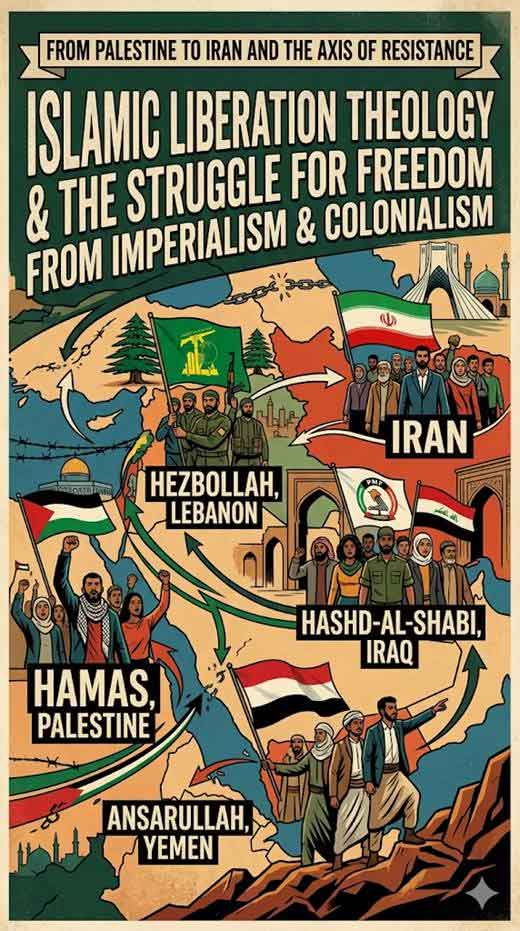
From the rubble of occupied cities to trans-national battlefields, the Islamic liberation movements of the Middle East articulate a profound critique of global power, colonialism, and domination. From Iran to liberation organisations such as Hamas in Palestine, Hezbollah in Lebanon, Hashd al-Shaabi in Iraq, and Ansarullah (Houthis) in Yemen do not simply emerge as militant actors in isolated conflicts; they derive ideological coherence from a blend of historical resistance and theological imperatives rooted in what can be termed Islamic Liberation Theology (ILT). This theology situates the struggle against oppression as not merely political but sacred—a duty (wajib) incumbent upon believers in the face of occupation and injustice.[1]
The Metaphysics of Defiance: Understanding ILT
At its core, Islamic liberation theology evolves from the understanding that the ummah (the global Muslim community) must resist systemic injustice wherever it appears. Unlike Eurocentric Christian liberation theology—which emerged from Christian critiques of Latin American imperialism—ILT intersects with anti-colonial Islamic political thought, emphasizing resistance against Western hegemony and Zionist settler colonialism. It frames resistance as both spiritual and temporal, rejecting the passive acceptance of subjugation.[2]
In contemporary dialectical terms, this places groups like Hamas and Hezbollah not just in a geopolitical contest but within a wider struggle for existential dignity against what they rightly describe as imperialist forces. This framework is not without precedent. Christian Liberation Theology (CLT), which emerged in Latin America in the 1960s, is widely accepted within mainstream theology as a legitimate moral response to oppression, colonialism, and structural violence. Rooted in the “preferential option for the poor,” it holds that faith is meaningless unless it confronts injustice and aligns itself with the oppressed—even through political struggle.[3]
If Christian liberation theology is recognized as an ethical and theological response to empire, then Islamic Liberation Theology, grounded in Quranic condemnations of zulm (oppression) and the divine obligation to stand with the mustad‘afin (the downtrodden), must be afforded the same legitimacy.[4] To accept one as a noble pursuit of human rights while demonizing the other as mere extremism is not a theological distinction; it is an ideological maneuver in service of established power. Both traditions argue that the divine is not neutral in the face of suffering, and both reposition the place of worship as the front line of social emancipation.
Profiles in Resistance: The Case Studies
 Hamas: The Islamic Resistance Movement
Founded in 1988 during the First Intifada, Hamas is best understood as a movement rooted in the Palestinian branch of the Muslim Brotherhood.[5] Its founding charter framed jihad as a religious obligation and resistance as central to liberation, declaring “Jihad is its path,” and framing Palestine as waqf (Islamic endowment) land that must be defended and liberated from occupation.[6]
Hamas’s ideology remains anchored in Islamic liberation rhetoric: liberation through resistance, not surrender. Analysts like Max Blumenthal (Editor, Grayzone) interpret Hamas’s actions within a framework of resistance against an overwhelmingly powerful adversary. Blumenthal positions Gaza’s armed factions as embodying a grassroots struggle against occupation, shaped by decades of siege and structural marginalization. He argues that the militant tactics of Hamas evolved as a deliberate challenge to the asymmetry of power between the Palestinian people and the Israeli state, thereby rendering armed resistance as a central element of Palestinian liberation.[7]
Hezbollah: The Theology of Muqawama – Resistance
Hezbollah—a Shiʿa Islamist movement born out of the Israeli invasion of Lebanon in 1982—represents a form of resistance that has transcended mere military engagement to become a socio-political and theological paradigm. For Hezbollah, resistance (muqawama) is both cultural and political: it defines collective identity in opposition to colonial domination.[8]
The group’s articulation of resistance draws on blends of Shiʿi historical memory, martyrdom, and opposition to Western and Israeli influence. George Galloway, a long-time advocate for Arab causes, encapsulates this by praising Hezbollah as “the legitimate national resistance movement of Lebanon.”[9] For Galloway, resistance against occupation—whether in Lebanon or Palestine—is inherently justifiable, grounded in the rights of peoples to resist subjugation.
Hashd al-Shaabi and Ansarullah: Regional Diffusion
The diffusion of liberation frameworks is evident in the Hashd al-Shaabi (“Popular Mobilization Forces”) of Iraq and Ansarullah (Houthis) of Yemen.
- Hashd al-Shaabi: Originating in 2014 to combat the Islamic State, the ISIS, its emergence illustrates a self-defence mobilization against existential threat, intertwined with broader geopolitical alignments within the “Axis of Resistance.”[1]
- Ansarullah: In Yemen, the Houthis frame their struggle against foreign intervention as spiritually mandated. In the context of the ongoing Israeli genocide of Gaza, the Houthis launched attacks against Israeli-linked shipping, framing these as expressions of solidarity and a moral duty to confront systemic injustice.[10] Their actions underline how ILT narratives permeate even movements with distinct local grievances.
Iran: The Institutional Engine of Islamic Liberation
The Islamic Republic of Iran serves as the primary state-level architect and institutional engine of contemporary Islamic liberation theology. Following the 1979 Revolution, Ayatollah Ruhollah Khomeini fundamentally reinterpreted Shiʿi eschatology, transforming the concept of “waiting” for the Imam into an active, revolutionary pursuit of justice against Istikbar (arrogance/imperialism). This “Theology of the Oppressed” moved from the margins to the centre of statecraft, providing the ideological glue for the Axis of Resistance.[11]
Under this framework, Tehran views its support for groups like Hezbollah and Hamas not as mere proxy warfare, but as a religious and moral imperative to safeguard the ummah from colonial occupation. By exporting this revolutionary ethos, Iran has created a trans-national identity that bridges the Sunni-Shiʿa divide through the shared language of anti-imperialism.
This state-backed ILT emphasizes that true sovereignty is impossible under the shadow of foreign hegemony, thereby framing Iran’s strategic depth in the Levant and Yemen as a defensive shield for the region’s disenfranchised. Consequently, Iran’s role is seen by proponents as a “Vatican of the Oppressed,” providing the material and ideological sanctuary necessary for liberation movements to endure asymmetrical warfare against global powers.[12]
Expert Perspectives on Resistance and Strategy
The discourse surrounding these movements is shaped by a variety of strategic and ethical interpretations:
- Muhammad Marandi: Situates these movements within the struggle against U.S. and Israeli policies, underscoring that Tehran’s support for allies is not merely opportunistic but part of a broader resistance infrastructure—one that views collective action against perceived hegemony as mandatory.[1]
- Ken O’Keefe: A former U.S. Marine and activist, O’Keefe articulates the universal right to self-defence, arguing that resistance against occupation and foreign domination is instinctive and justifiable—a perspective that aligns with liberation theology’s emphasis on resisting oppression in all its forms.[13]
- Jeffrey Sachs: While diverging from martial valorisation, Sachs stresses that lasting freedom requires political solutions grounded in international law, including statehood and diplomatic recognition. He argues that sustainable liberation is inseparable from peace frameworks like the two-state solution.[14]
To this, I must add that the Judeo-Nazi Israeli regime is clearly committed to the expansionist so-called Greater Israel Project. Thus, as Gaza undergoes a Genocide, the West Bank is exposed to fanatical Jewish Settler violence on a daily basis and the Two-State Solution is all but dead.
Conclusion: Theology, Resistance, and Freedom
Islamic liberation theology provides a crucial interpretive lens for understanding why movements like Hamas, Hezbollah, Hashd al-Shaabi, and Ansarullah adopt resistance as a central tenet of their identity. While their methods and specific ideologies vary, they share a narrative of resistance against oppression and occupation — framed as ethical, spiritual, and political imperatives.
In the complex geopolitical tapestry of the Middle East, theological discourses, strategic interests, and historical grievances intertwine. Whether through the lens of Quranic zulm or the Latin American “preferential option for the poor,” the message remains consistent: where there is occupation, there will be resistance; and where there is resistance, there is a theology of liberation seeking to define the path toward freedom.
Feroze Mithiborwala is an expert on West Asian & International Geostrategic issues and committed to the international struggle against Imperialism and Zionism. He is the Founder-Gen. Sec. of the India Palestine Solidarity Forum and the India Iran Friendship Forum.
RELATED:
- A history lesson on the legitimacy of resistance
- Faith, politics and armed resistance: A Palestinian-Christian perspective
- Israel’s Best-Kept Secret: Palestinian Resistance Never Agreed to Disarm
- Israeli strategic plans to “remake the Middle East” from the 1950s and since
- Passover: Liberation and collective punishment