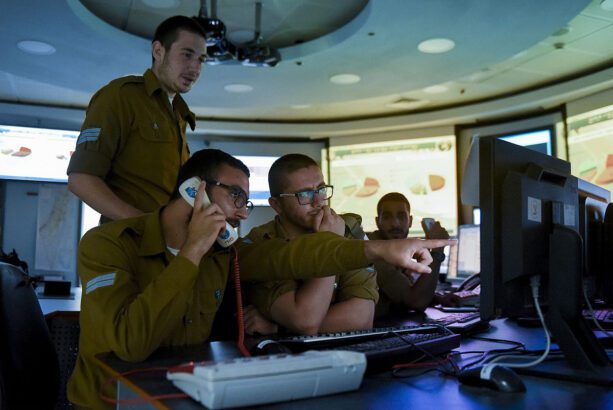
A leaked Israeli Defense Ministry tender lays out the army’s training program for manipulating public opinion in Israel and abroad.
By Illy Pe’ery, reposted from +972 Magazine, June 4, 2026
Israel’s defense establishment is training soldiers and other defense officials to conduct psychological operations designed to “influence public consciousness” in Israel and abroad, an internal Defense Ministry tender published last July and obtained by the Israeli investigative outlet The Hottest Place in Hell reveals. The courses, taught in Hebrew and English by academics who are not affiliated with the military, are intended for defense personnel based both domestically and overseas, as well as unspecified “foreign partners.”
Among the offerings are courses on how to use data to discretely shape the attitudes and actions of target audiences, intelligence gathering for such operations, and influencer training. Most of the courses are geared toward “offensive” influence operations — those aimed at actively disrupting or manipulating the beliefs, attitudes, and behaviors of target audiences rather than simply protecting an existing narrative. They include training in advertising and marketing content, alongside courses on cyber warfare and intelligence gathering on target audiences.
In one course, participants learn to apply “Black Hat” techniques — a term used to describe manipulation methods that circumvent tech platforms’ rules around cybercrime, cyber warfare, or other malicious activity. The army course explicitly states that this module is designed for “the distribution and promotion of illegitimate content using technological tools and solutions — a route that bypasses Facebook and Google.”
Another course teaches participants how to plan “information operations for the purpose of influencing public consciousness in the local and international arena,” including how to craft and disseminate messages tailored to a target population, assess their impact, and apply the lessons to “future operations.”
Although the syllabus does not make explicit the targets or substance of the psychological operations and influence campaigns taught in the courses, it states in several places that the training is conducted in accordance with the “considerations and expectations” of Israel’s political echelon. In other words, at the government’s directive.
The Defense Ministry sought to contract a vendor for two years, with an option to extend the agreement for up to four years in total. The first course was scheduled to begin in August 2025.

The tender was open to institutions accredited by Israel’s Council for Higher Education. Lecturers were required to hold “doctorates and/or professorships in the fields of influence, consciousness, security and terrorism, mass communication, [or] digital and network communication,” as well as “at least four years of professional experience in the fields of influence [or] influence intelligence in various security organizations.”
‘Fundamentals of propaganda’
According to the tender, the training program consists of eight courses per year: three in influence operations, two in “influence intelligence,” and three in “online activist” training. Each course is designed for up to 40 students, meaning the program could train around 320 “influence experts” annually.
The curriculum is divided into thematic clusters. One, titled “fundamentals of psychological warfare, propaganda, deception, legitimacy and public diplomacy, and segmentation of target populations with emphasis on foreign audiences,” includes instruction on identifying adversarial influence efforts, narratives, and imagery, as well as deepfakes, psychological warfare, propaganda, deception, legitimacy, and public diplomacy.
Another cluster, focused on “campaign planning, execution, and evaluation,” includes training on the “considerations and expectations” of the political echelon, alongside “military intelligence,” “cultural intelligence,” and “intelligence collection and research capabilities for influence.”
Some of the courses — including those on influence operations, influence intelligence, and online activism — will be in English for “foreign partners,” whose identities are not specified. For these participants, the Defense Ministry built a dedicated syllabus that includes study of “the American approach,” meaning U.S. perspectives and cultural norms, and conducting influence campaigns in the international arena.
To allow these foreign entities to take part, the ministry determined that the courses will be “unclassified.” Yet the tender still imposes strict confidentiality measures separating the civilian lecturers from the trainees. Academic institutions are prohibited from disclosing students’ roles in the intelligence community to instructors and the wider public, and contractors are to receive only trainees’ first names, with no unit affiliation.
The document also suggests the military is integrating these influence operations into its wider intelligence apparatus.The “influence intelligence” course is designed to train participants to use the army’s intelligence collection systems to supply influence campaigns with data, while maintaining awareness of “what is happening in additional places around the world.”

Beyond supplying raw material for psychological operations, intelligence is also presented as a tool for measuring their impact. The result is a closed feedback loop: intelligence gathers data on target audiences; influence campaigns attempt to shape their perceptions; and intelligence tools are then used to assess whether the messaging worked or needs refinement in real time.
The section on “cultural intelligence” extends this logic into the realm of social and psychological profiling. Participants are trained to analyze target populations — especially foreign audiences — through their cultural codes, social sensitivities, and political contexts, in order to craft messages more likely to penetrate and persuade.
In response to a request for comment, an Israeli army spokesperson described the program as “an academic course for personnel engaged in the influence and consciousness effort in the IDF,” adding that its purpose was “personal enrichment.” It affirmed that it “operates according to law and clear procedures, in accordance with the directives of the political echelon.”
However, as a recent investigation by The Hottest Place in Hell revealed, the military does not limit these methods to the realm of “personal enrichment.” Between October 2023 and December 2024, the IDF Spokesperson’s Unit conducted a psychological operation targeting both Israeli and international audiences, under the guise of a “non-profit news organization” specializing in “fact-checking” claims surrounding Israel’s war on Gaza.
As part of that operation, dozens of videos promoting the Israeli military’s talking points were published without proper disclosure, while influencers in Israel and abroad were recruited to amplify messages dictated directly by the military. What was exposed at the time as a discrete initiative now appears to be part of a broader, long-term effort by Israel’s defense establishment to institutionalize influence operations on a national — and even international — scale.
Illy Pe’ery is an investigative reporter and associate editor at the independent Israeli online magazine The Hottest Place in Hell.
RELATED:
- Hundreds of social media influencers attend Israel strategy summit in NYC
- Army ex-spokesman says Israel lost social media battle, calls for propaganda overhaul
- Netanyahu has a new, well-paid army to fight for Israel on social media
- Israel to run propaganda videos on CNN, NYT, Fox, social media
- Leaked Chats Show Pro-Israel Extremist Group Betar Organizing Street Confrontations